HTBAA Week 3: Cell-Free Reaction Composition
Part 3A: Formulation Analysis
Potassium vs. Magnesium Glutamate Dynamics Potassium glutamate supplies bulk ionic strength to maintain general protein solubility, requiring high physiological concentrations (e.g., 130–273 mM) with a wide tolerance window (Smith et al., 2026). Conversely, magnesium is a highly sensitive catalytic cofactor essential for stabilizing mRNA-tRNA-ribosome complexes; optimal concentrations are drastically lower (8–20 mM), and slight deviations rapidly induce ribosomal aggregation (Smith et al., 2026). Glutamate is preferred over acetate or chloride as it optimizes protein-nucleic acid interactions under osmotic stress.
PEP+NTP vs. Ribose+NMP Architectures Traditional PEP+NTP systems fuel rapid synthesis but suffer from prohibitive reagent costs and premature reaction termination due to the accumulation of inhibitory inorganic phosphate and acidic pH shifts. Ribose+NMP formulations slash reagent costs by replacing expensive nucleotide triphosphates with cheaper monophosphates, leveraging the extract’s latent central metabolism to drive in situ oxidative phosphorylation (Smith et al., 2026).
Literature Comparison: PANOx-SP vs. AI-Optimized (Smith et al., 2026) The PANOx-SP formulation relies on heavy loads of high-energy PEP (33 mM) and expensive cofactors, without an active pH buffer (Jewett & Swartz, 2004). In contrast, modern AI-optimized formulations crash the specific cost to $422/g (Smith et al., 2026). These systems omit PEP entirely, utilizing Ribose (40–77 mM) and NMPs, while strictly enforcing homeostasis via heavy HEPES-KOH (pH 7.5) buffering and potassium phosphate to prevent yield collapse (Smith et al., 2026).
Part 3B: Reaction Compositions (JSON Parameters)
Coopetition Portal Submissions
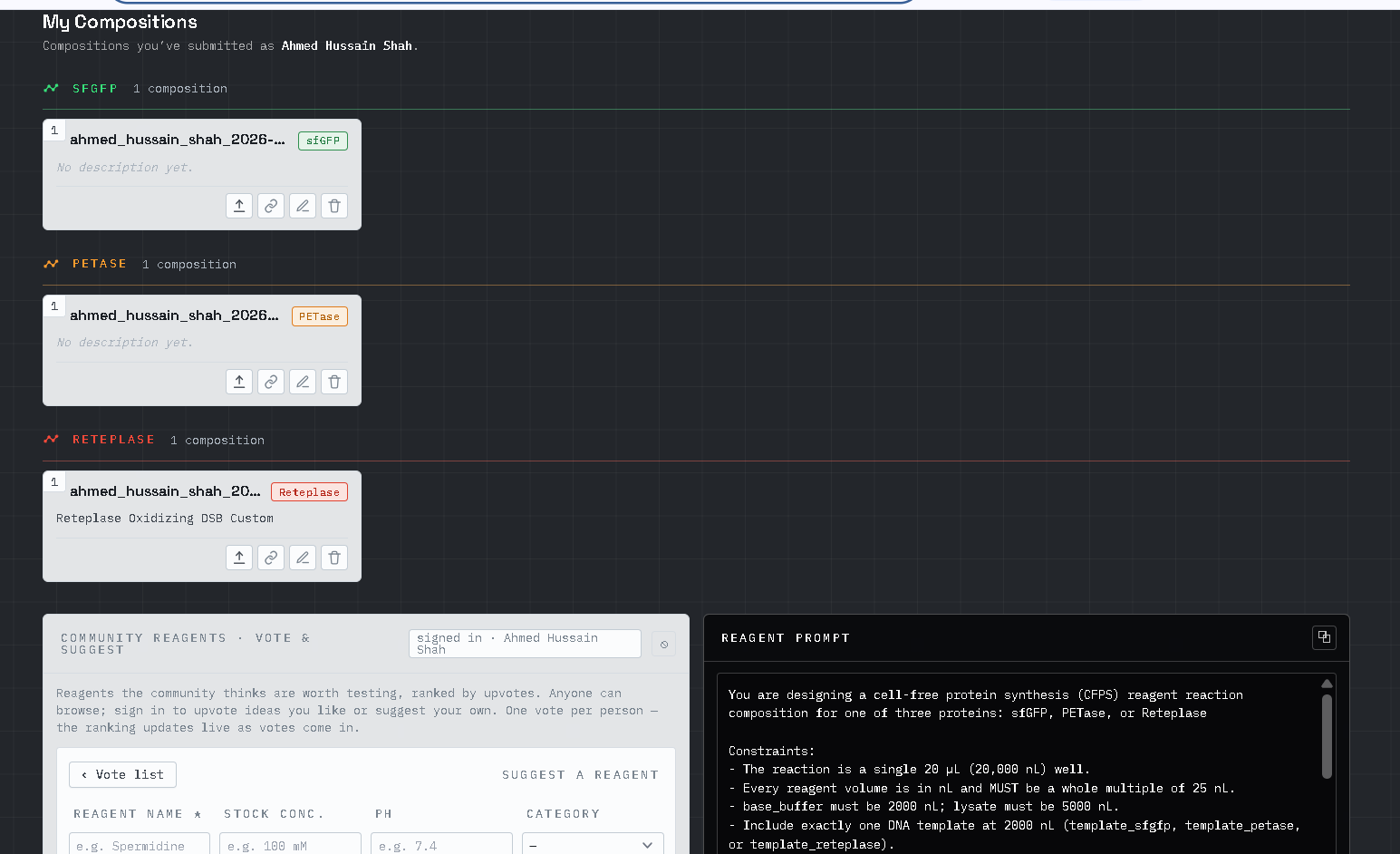
All three reaction compositions (sfGFP, PETase, and Reteplase) and the Trehalose community reagent were successfully submitted to the Coopetition portal:
Part 3C: Asimov Kernel Assembly
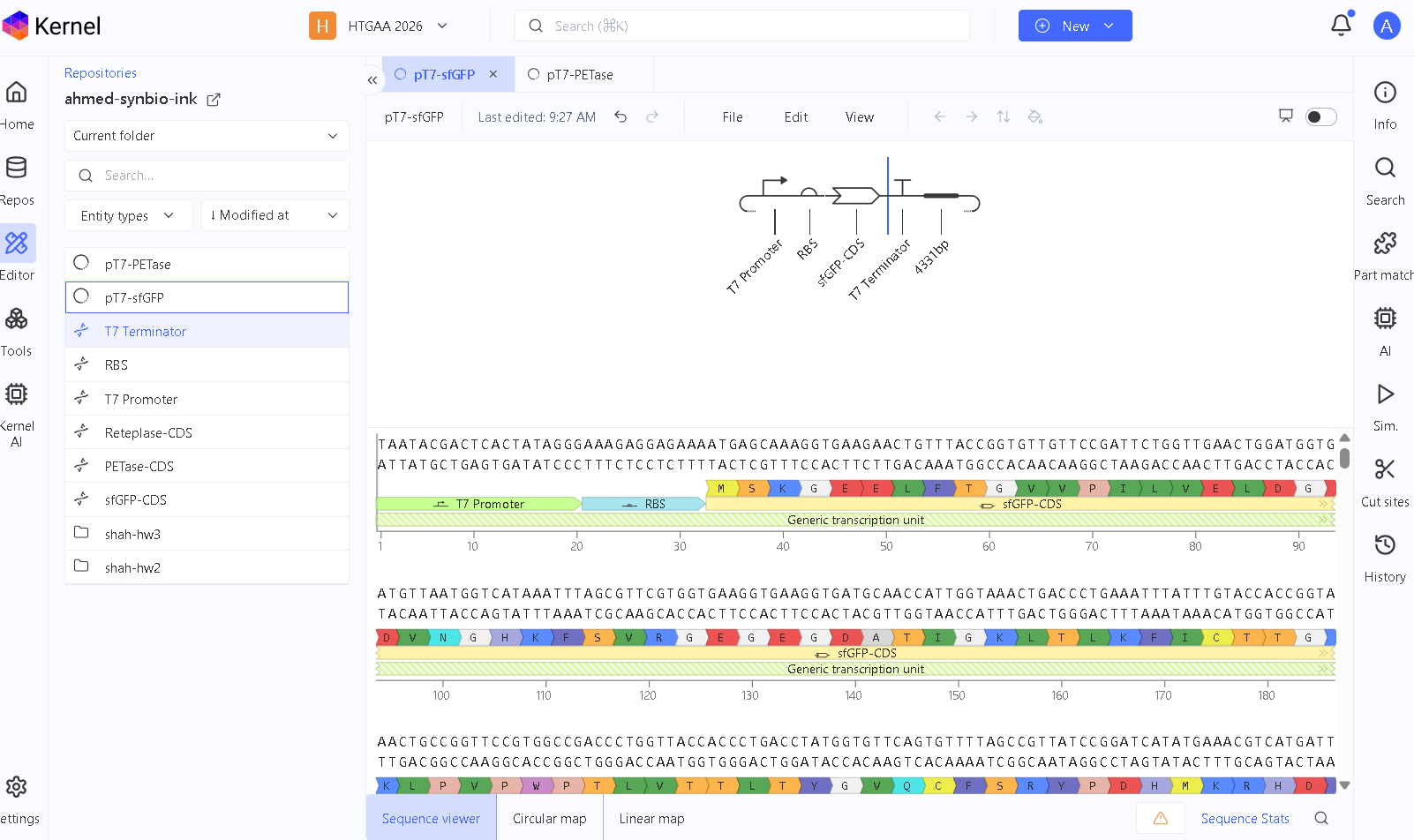
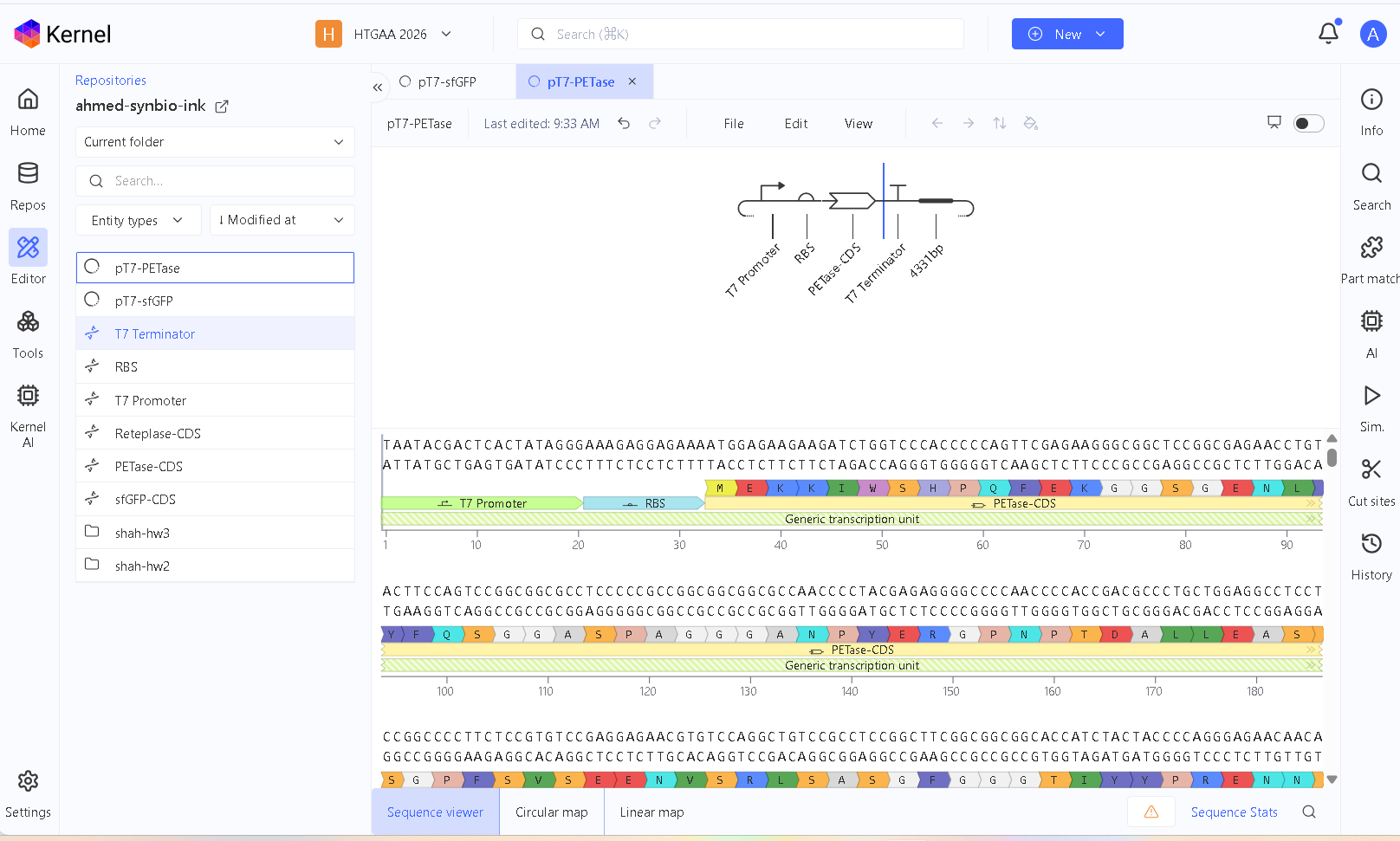
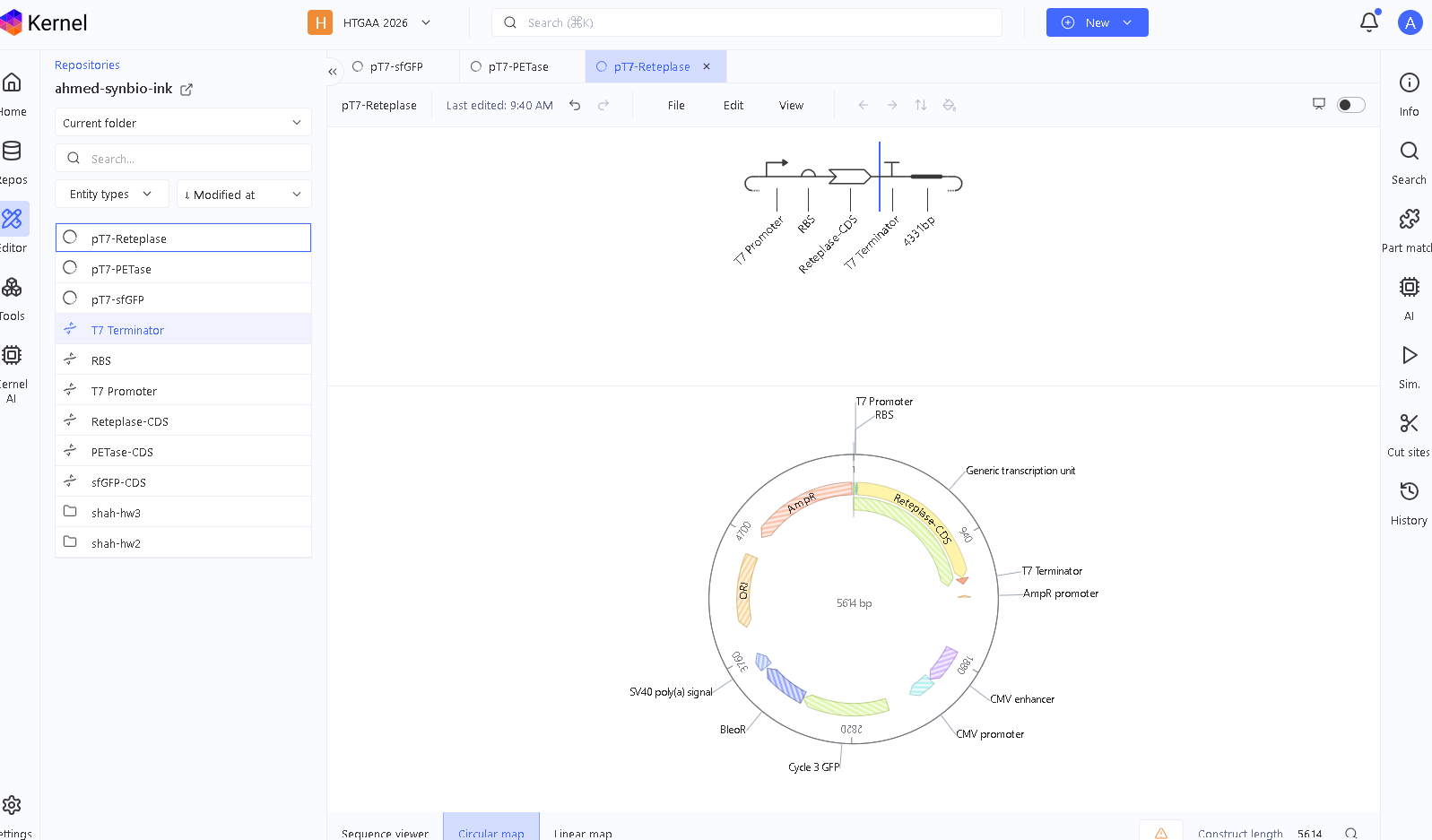
I designed T7-compatible expression plasmids for all three target proteins using the Kernel platform.
Regulatory architecture: All constructs use the same T7 expression cassette:
T7 Promoter → RBS (B0034) → [Protein CDS] → T7 Terminator
sfGFP Construct:
PETase Construct:
Reteplase Construct:
Bonus: DsbC Helper Plasmid To improve functional Reteplase yield, I designed a T7 helper plasmid expressing DsbC (disulfide-bond isomerase, UniProt P0AEG6). Co-expressing DsbC within the oxidizing CFPS reaction rescues mispaired disulfide intermediates without requiring expensive purified chaperone supplementation.
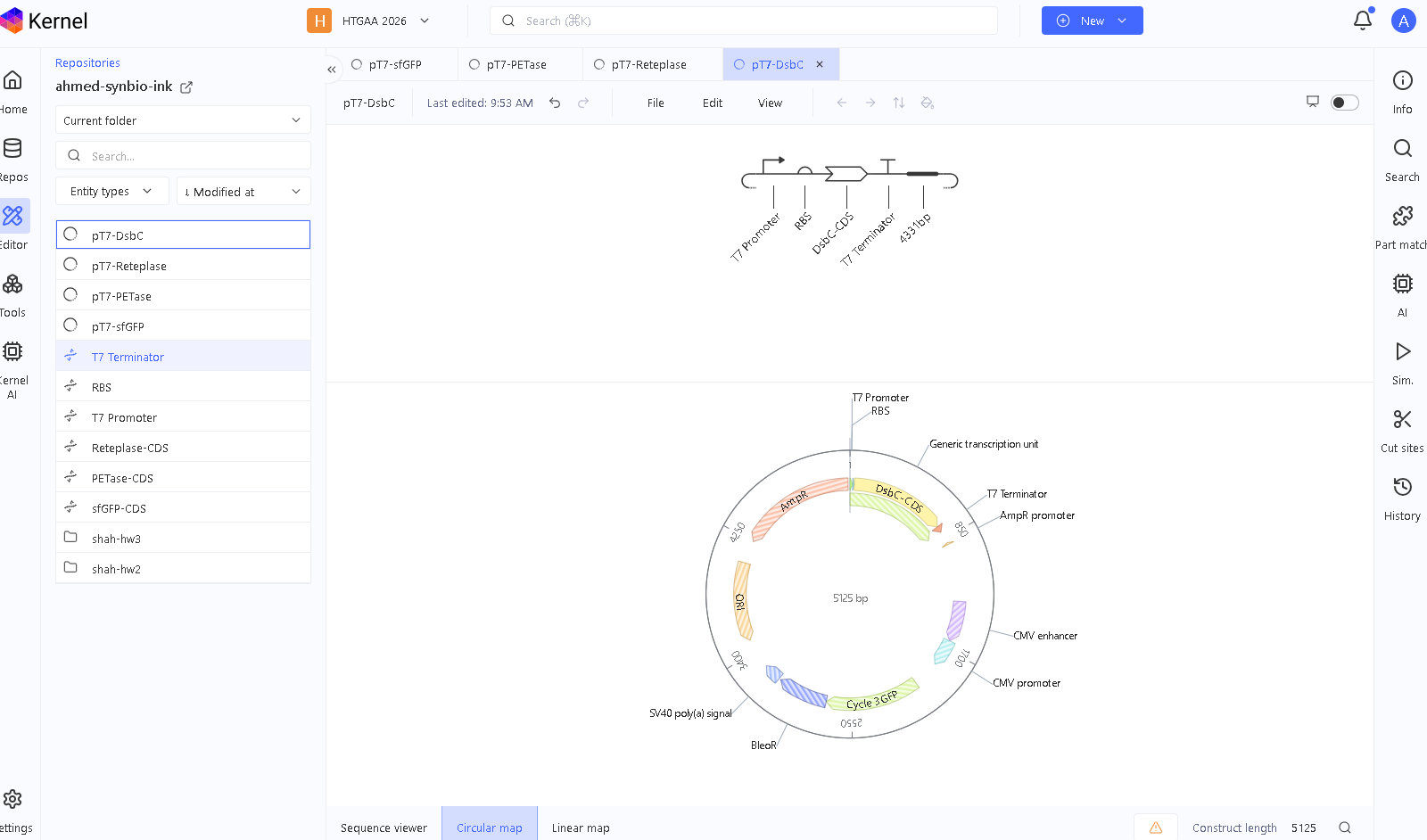
The following 20 µL compositions are designed to drive down the cost-per-microliter for scaled biomanufacturing while adapting to specific folding challenges.
1. sfGFP Baseline Reducing Environment Based on the highly balanced 1793122_35 architecture (Smith et al., 2026).
- Lysate & DNA: 5,000 nL BL21 Star (DE3); 2,000 nL sfGFP DNA; 2,000 nL 10X Base Buffer.
- Salts & pH: 67.5 mM HEPES-KOH (pH 7.5), 273.2 mM Potassium Glutamate, 8.8 mM Magnesium Glutamate (Smith et al., 2026).
- Energy & NMPs: 40.0 mM Ribose, 8.3 mM Glucose, 0.5 mM AMP, 1.0 mM each of CMP/GMP/UMP (Smith et al., 2026).
- Additives: 7.5 mM Potassium Phosphate mix, 1.2 mM Spermidine, 4.0 mM Nicotinamide (Smith et al., 2026).
2. PETase Ultra-Lean Reducing Environment Engineered for maximum cost efficiency based on the 1777863_77 architecture (Smith et al., 2026).
- Lysate & DNA: 5,000 nL BL21 Star (DE3); 2,000 nL PETase DNA; 2,000 nL 10X Base Buffer.
- Salts & Energy: 45.0 mM HEPES-KOH (pH 7.5), 312.6 mM Potassium Glutamate, 77.4 mM Ribose (Smith et al., 2026).
- Additives: 3.1 mM Nicotinamide, 5.6 mM Potassium Phosphate, with Spermidine omitted (Smith et al., 2026).
3. Reteplase (Complex Oxidizing Environment)
- Lysate: 5,000 nL BL21 Star (DE3) Δgor (treated with IAM and Cysteine quench).
- DNA & Base: 2,000 nL Reteplase DNA; 2,000 nL 10X Base Buffer.
- Redox & Folding: 4:1 ratio of GSSG to GSH; addition of DsbC isomerase to resolve the 9 requisite disulfide bonds.
- Backbone: Matches the sfGFP Ribose/NMP energy and salt profile for cost control.
Community Reagent Proposal: Trehalose Synthesizing heavy, multi-domain fusion complexes heavily taxes the CFPS folding machinery. Adding purified protein chaperones (like GroEL/ES) destroys low-cost production economics. We propose adding the simple disaccharide Trehalose (10–50 mM). In living E. coli, trehalose is natively accumulated under extreme osmotic stress to protect cytoplasmic proteins from aggregation (Jewett & Swartz, 2004). As a bulk sugar, it serves as a highly cost-effective chemical chaperone to stabilize complex fusions in vitro.
Part 3C: Asimov Kernel Assembly
To translate the provided amino acid sequences into T7-compatible expression plasmids within the Asimov Kernel:
- Regulatory Framework: Import standard modular parts: T7 Promoter → strong Ribosome Binding Site (e.g., B0034) → [Insert CDS] → T7 Terminator.
- Reverse Translation: Input the provided sfGFP, PETase, and Reteplase amino acid sequences into the Kernel’s codon-optimization engine tuned for E. coli translation profiles.
- Bonus Helper Plasmid (DsbC): To maximize Reteplase yields, assemble a secondary helper plasmid containing: T7 Promoter → RBS → DsbC (Disulfide bond isomerase) → T7 Terminator. Co-expressing DsbC directly within the oxidizing CFPS reaction rescues mispaired disulfide intermediates without requiring expensive purified chaperone supplementation.
AI & Literature Citations
- AI Tool: Gemini (Custom SynBio-Ink Agent Context). Prompts focused on cross-referencing autonomous laboratory CFPS formulations against linear network control failures.
- Literature: Jewett & Swartz (2004); Jiang & Lai (2019); Smith et al. (2026).