Week 4 HW: CFPS Batch Designs
Part A: Batch Designs for CFPS Optimization
Batch 1: sfGFP — Magnesium Glutamate Sweep
Hypothesis: Varying magnesium glutamate concentration will identify the optimal level for sfGFP yield, as Mg²⁺ is critical for ribosome function and T7 RNA polymerase activity.
| Sample ID | Mg-Glutamate (nL) | Nuclease-Free Water (nL) | Lysate (nL) | DNA (nL) | Base Buffer (nL) | Total (nL) |
|---|---|---|---|---|---|---|
| mg_200 | 200 | 10,800 | 5,000 | 2,000 | 2,000 | 20,000 |
| mg_300 | 300 | 10,700 | 5,000 | 2,000 | 2,000 | 20,000 |
| mg_400 | 400 | 10,600 | 5,000 | 2,000 | 2,000 | 20,000 |
| mg_500 | 500 | 10,500 | 5,000 | 2,000 | 2,000 | 20,000 |
Rationale: Literature formulations vary widely in Mg²⁺. This sweep tests a 4-point range while keeping all other components constant.
Batch 2: PETase — DsbC Chaperone Sweep
Hypothesis: PETase (TfCut2) contains one disulfide bond; adding DsbC disulfide-bond isomerase will improve functional folding and activity.
| Sample ID | DsbC (nL) | Nuclease-Free Water (nL) | Lysate (nL) | DNA (nL) | Base Buffer (nL) | Total (nL) |
|---|---|---|---|---|---|---|
| dsbc_0 | 0 | 11,000 | 5,000 | 2,000 | 2,000 | 20,000 |
| dsbc_100 | 100 | 10,900 | 5,000 | 2,000 | 2,000 | 20,000 |
| dsbc_200 | 200 | 10,800 | 5,000 | 2,000 | 2,000 | 20,000 |
| dsbc_400 | 400 | 10,600 | 5,000 | 2,000 | 2,000 | 20,000 |
Rationale: DsbC rearranges incorrect disulfide pairings. Even one disulfide bond can mispair; DsbC may rescue folding.
Batch 3: Reteplase — GSSG/GSH Redox Ratio Sweep
Hypothesis: Reteplase has nine disulfide bonds requiring an oxidizing environment; the GSSG/GSH ratio will strongly affect functional yield.
| Sample ID | GSSG (nL) | GSH (nL) | Nuclease-Free Water (nL) | Lysate (nL) | DNA (nL) | Base Buffer (nL) | Total (nL) |
|---|---|---|---|---|---|---|---|
| redox_1_1 | 400 | 400 | 10,200 | 5,000 | 2,000 | 2,000 | 20,000 |
| redox_2_1 | 400 | 200 | 10,400 | 5,000 | 2,000 | 2,000 | 20,000 |
| redox_4_1 | 400 | 100 | 10,500 | 5,000 | 2,000 | 2,000 | 20,000 |
| redox_8_1 | 400 | 50 | 10,550 | 5,000 | 2,000 | 2,000 | 20,000 |
Rationale: The GSSG/GSH ratio sets the redox potential. A 4:1 ratio is commonly used, but higher ratios may better support nine disulfide bonds.
Part B: Data Analysis & Metascience
Data Analysis: 384-well vs 96-well Deep-well Performance
The sfGFP_control_20260722-39-L_96w_report.pdf compares identical 20 µL sfGFP reactions in 384-well vs 96-well deep-well plates. Key differences likely arise from:
- Oxygen access: 384-well plates have a higher surface-area-to-volume ratio, allowing better oxygen diffusion. sfGFP folding requires oxygen for chromophore maturation, so reduced oxygen in deep-well plates could lower fluorescence.
- Evaporation: Smaller wells evaporate faster, concentrating reagents and altering kinetics. Deep-well plates may also have different humidity profiles.
- Plate geometry: Mixing and heat transfer differ between plate types, affecting reaction homogeneity.
These factors mean that plate format is a critical variable for reproducibility and scale-up.
Metascience: Rubric Criterion Proposal
Criterion: Expected Information Gain (EIG)
Why it matters: With hundreds of proposed reactions and limited wells, we should prioritize experiments that maximally reduce uncertainty about the design space. EIG scores how much a proposed batch would teach us about the underlying biology (e.g., whether a reagent’s effect is linear, saturating, or toxic). This is more principled than novelty alone, which may favor untested but low-value conditions.
Current Status of CFPS Optimization Ideas
My Week 3 submission established baseline compositions for sfGFP (Smith et al. 2026 formulation), PETase (ultra-lean formulation), and Reteplase (oxidizing DSB formulation). For Week 4, I am systematically sweeping:
- sfGFP: Mg²⁺ concentration (ribosome and T7 polymerase cofactor)
- PETase: DsbC chaperone level (disulfide isomerase)
- Reteplase: GSSG/GSH ratio (redox potential for nine disulfides)
These sweeps will identify the most impactful single-variable adjustments before testing combinatorial designs in later rounds.
Coopetition Portal Submissions
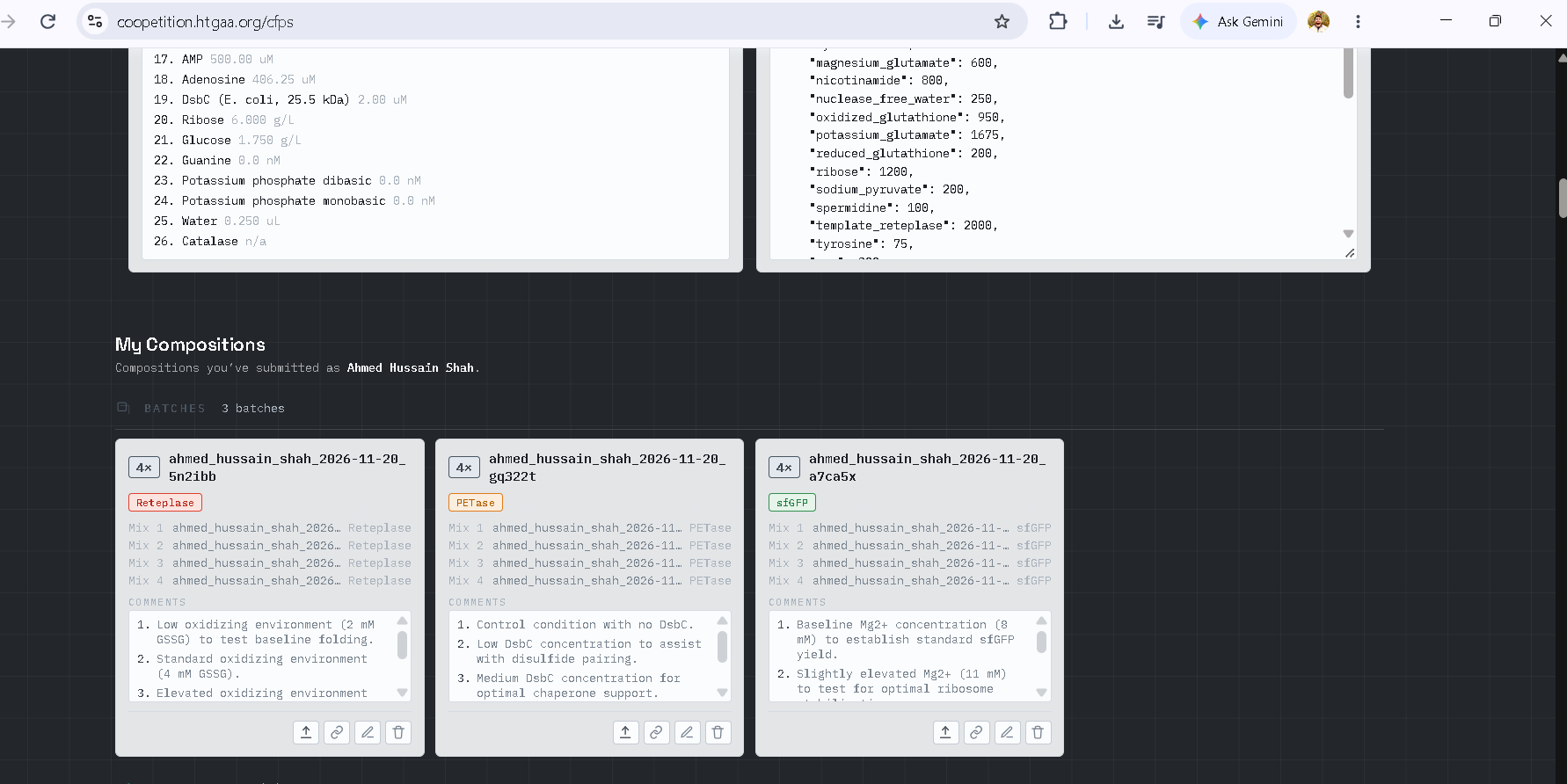
All three batch designs (sfGFP Mg2+ sweep, PETase DsbC sweep, and Reteplase GSSG sweep) were successfully submitted to the portal:
Use of AI
AI Tool: DeepSeek Prompts used: Used AI to formulate the parameter sweeps for the batches (sfGFP Mg2+ sweep, PETase DsbC sweep, and Reteplase GSSG/GSH redox sweep), to analyze the 384-well vs 96-well plate differences, and to structure the Expected Information Gain (EIG) rubric criterion for the metascience question.