DNA and manufacturing plan
Aimer Koshmambetov, Designer Cells at Yonsei University. HTBAA. November 13, 2026.
This page develops the DNA and manufacturing route for my resilin final project. The proposed product is intracellular, soluble His6-rec1-resilin, followed by purification, external crosslinking and coating. The 6139-bp circular design contains a 933-bp CDS including TAG, encoding 310 amino acids. This is a computational design; physical assembly, expression and material tests have not been performed. Kernel import is not confirmed.
Full explanation in Russian. Download the complete DNA and manufacturing package.
DNA files and sequence evidence
Annotated circular GenBank, whole-plasmid FASTA, CDS FASTA, expected protein FASTA, parts table, validation record, and sequence provenance.
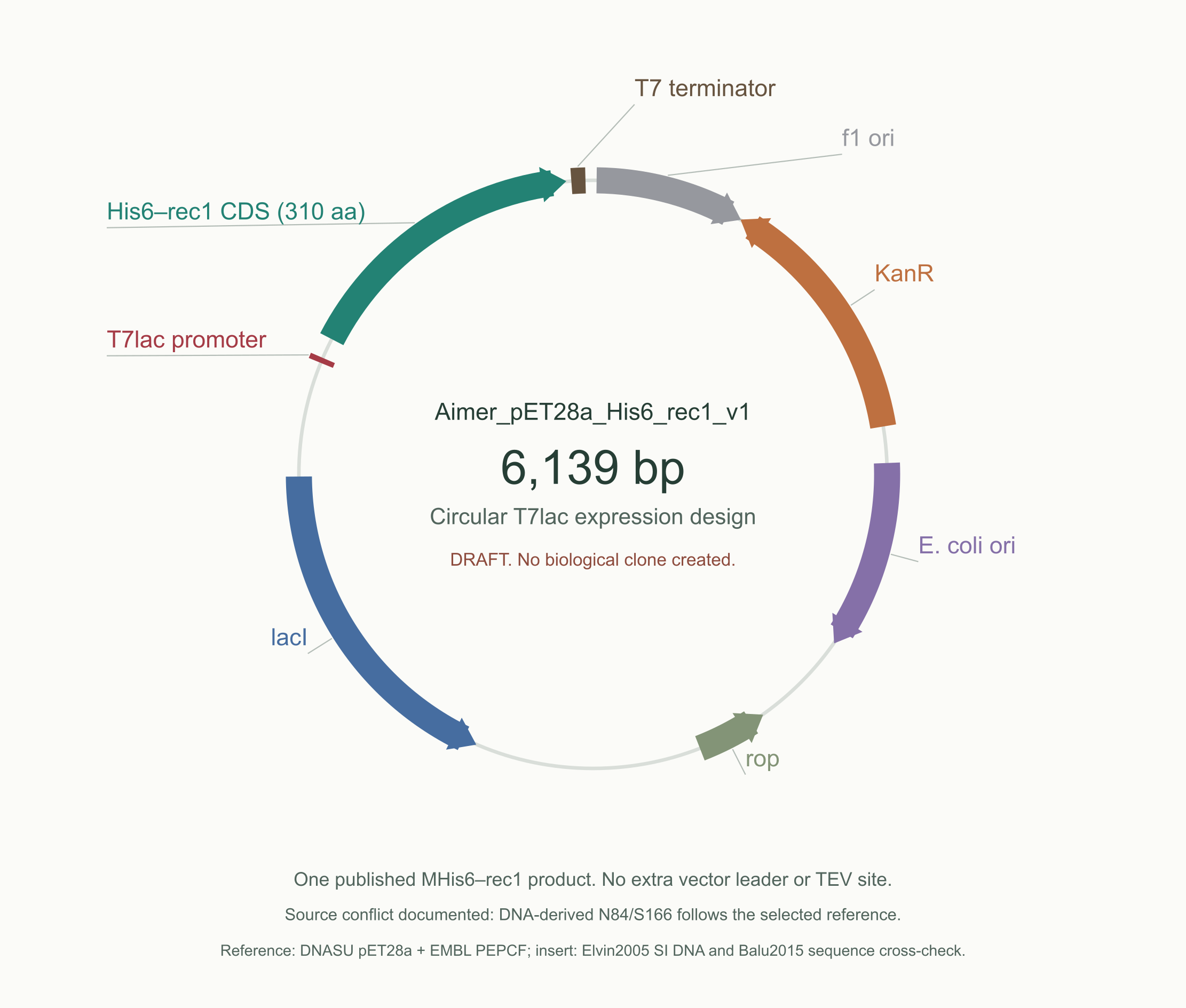
The insert uses the 909 native coding bases printed in Elvin et al. (2005), SI §1.2, with the MHis6 coding addition and TAG stop reconstructed from the published primers. It retains those native codons and one N-terminal MHHHHHH tag. It has no TEV site, secretion signal or extra vector-derived translation leader. The original material came from a majority-exon-1 fragment of Drosophila melanogaster Oregon-R CG15920, rather than the full-length insect protein. (Elvin SI, §§1.1–1.6)
The source is internally inconsistent: its printed DNA translates N84/S166, whereas its separate protein text lists D84/G166. The selected DNA-derived protein matches the later Balu SI Figure 1 across all 310 residues and calculates to approximately 28,491.7 Da, consistent with Elvin’s rounded 28,492-Da value. The native DNA uses GCC at Ala308, while the corresponding reverse-primer segment uses synonymous GCT; this design retains the native payload. No original clone trace or author-issued correction was recovered. It is a documented design reference, not a demonstrated exact historical clone. (Elvin SI, Balu SI, Fig. 1)
The pET28a reference is 5369 bp. Its DNASU sequence matches the reverse complement of the independent EMBL full sequence at all 5369 bases. The design replaces reference bases 5071–5233 with the full rec1 CDS: 5369 − 163 + 933 = 6139 bp. This removes the original translation leader, cloning cassette and optional C-terminal tag while retaining the regulatory and replication backbone. It avoids adding a second His tag, thrombin segment or T7 peptide to the product. (DNASU vector 319, EMBL pET28a)
| Component | New coordinates, 1-based inclusive | Role |
|---|---|---|
| KanR | complement(560..1375) | Kanamycin selection |
| Bacterial ori | 1497..2085 | Plasmid maintenance |
| lacI | complement(3515..4597) | Lac repressor |
| T7 promoter | 4984..5002 | T7 RNA polymerase promoter |
| lac operator | 5003..5027 | Regulatory sequence |
| RBS | 5058..5063 | Translation initiation |
| His6-rec1 CDS | 5071..6003 | 310-aa product and TAG |
| His6 after initial methionine | 5074..5091 | Single affinity tag |
| T7 terminator | 6067..6114 | Transcription termination context |
For Kernel, import the full GenBank as a DNA construct and confirm circular topology, 6139 bp, these annotations and the 310-aa CDS translation beginning MHHHHHH. The standalone CDS FASTA is a linear insert. The internal NdeI site prevents assuming a simple complete NdeI digestion; overlap-based cassette replacement is the design logic. The original NcoI site is lost because the desired MH start differs from its MG context. These new-plasmid properties are computational results recorded in the design validation file. Full insert and junction sequencing remain necessary after physical assembly. The original authors also noted an internal NdeI site. (Elvin SI, §1.1)
Microbes produce the protein before coating
The proposed host must supply T7 RNA polymerase, for example an appropriate DE3 strain. Induction relieves lac repression, T7 polymerase transcribes the insert and ribosomes translate the mRNA. Without an added secretion signal, the protein is expected inside the cells. The 2005 process used BL21Star(DE3)/pLysS with the different pETMCSI/Res5 vector. Its historical induction was 1 mM IPTG for four hours at 37 °C; this is a reference, not a demonstrated optimum for the new design. The new backbone needs its kanamycin selection, rather than the original vector’s ampicillin selection. If used, pLysS is a separate helper maintained according to the host requirements. (Elvin SI, §1.5)
After cell harvest and disruption, the soluble fraction is separated from insoluble material. The original purification used Q-Sepharose flow-through followed by Ni-NTA. The first step separates components by charge under the source buffers. Histidines then coordinate immobilized nickel; imidazole competes for binding and elutes the target. Buffer exchange and concentration establish the casting formulation. The His6 tag remains on this protein. I would compare total, soluble and insoluble samples and record concentration, recovered volume and losses. (Elvin SI, §1.6)
Identity, purity and amount need separate checks. A280 requires a sequence-specific extinction coefficient, correct path length and buffer blank; another concentration assay also needs suitable calibration for this composition and matrix. SDS-PAGE checks fractions, while intact mass or informative peptide evidence supports identity. The original rec1 migrated at approximately 47 kDa on SDS-PAGE despite its calculated 28.5-kDa mass. A soluble aliquot should be retained before fabrication. The original purified yield was about 15 mg/L. A later report of up to 300 mg/L concerns expression in another process and does not promise purified material from this plasmid. Published heat/salt purification is a distinct alternative workflow. (Elvin SI, §1.6, Kim et al., 2007, Lyons et al., 2007)
Crosslinking forms the material, then surface layers are applied
Ru(II)/persulfate photochemistry enables tyrosines to form covalent links, including dityrosine links between chains. Flexible segments between links form a hydrated network. Water affects chain mobility, so drying changes the material’s behaviour. The detailed reaction scheme is not an exclusive established pathway for every bond. (Elvin SI, Fancy and Kodadek, 1999, corrected scheme, Truong et al., 2011)
| Historical solid-specimen condition | Elvin SI §3 |
|---|---|
| Protein | 200 mg/mL rec1 |
| Buffer | 50 mM Tris/HCl pH 8.0, 50 mM NaCl |
| Photochemical reagents | 2 mM [Ru(bpy)3]Cl2, 10 mM ammonium persulfate |
| Illumination | 600-W lamp, 15-cm distance, 20 seconds |
These are source conditions tied to its lamp and geometry, not a validated exposure for an arbitrary LED or local specimen. The separate dilute test used approximately 4 µM Ru at 1 mg/mL protein; those numbers should not be combined with the concentrated casting mixture. Local formulation and illumination need a small reproducibility pilot. (Elvin SI, §§1.8 and 3)
The same DNA serves every coating group. The minimum study remains uncoated specimens in air, oil-coated specimens in air and a hydrated reference. The full particle–oil–particle shell is an optional fourth group; a particle-plus-oil process control can be added if resources allow. Oil and particles are external materials. Simple oil coverage needs inspection because bare hydrogel can resist oil spreading. (Kim et al., 2026)
In the MLM architecture, hydrocarbon-silane-treated HSAM glass particles help oil wet and spread over the hydrated surface. Outer fluorocarbon-treated FSAM particles stabilize the oil/air interface and reduce leakage. The paper tested other hydrogel chemistries, so compatibility and retained cyclic function with rec1 remain experimental questions. A later comparison could vary castor, silicone or paraffin oil, which Kim tested in MLM on other gels. First fix oil identity, architecture and coating mass/thickness, then change one factor. Surface coverage, leakage and immediate changes in stiffness or grip friction must be checked. (Kim et al., 2026, Fig. 1–2 and Methods)
Measurements and a feasible pilot
The input protein needs identity, concentration and yield records. Network formation needs its own material and, where available, dityrosine check. Function requires cyclic force–displacement measurements. With positive work magnitudes, R = W_unloading / W_loading. For force in N and displacement in mm, an integrated area of N·mm equals mJ. Record R, stiffness, permanent deformation, cracks, leakage and slipping. My proposed endpoint is R(t)/R(0) < 0.80, while requiring useful initial absolute recovery. This is a project criterion, not a published standard. If it is not crossed, report that the endpoint exceeds the observation window. (Elvin SI, §§1.9–1.10 and 3–4)
Composite mass includes oil and particles. Estimating water requires dry-core and coating information plus coating blanks. The dry core includes protein and retained nonvolatile salts or reagent residues, so subtracting protein alone overestimates water. Oil loss can also confound the correction. Temperature, humidity, exposure and loading history must accompany mass records. The hydrated reference helps separate fatigue from drying. Three independently cast specimens per minimum group are a proposed pilot, not a powered study or independent expression batches. (Kim et al., 2026)
| Record for each specimen | Fields to retain |
|---|---|
| Identity | Construct, host, expression/purification batch, specimen ID |
| Protein and casting | Calibrated concentration, recovered volume, geometry, formulation and light conditions |
| Coating | Oil, architecture, mass/thickness, coverage and immediate effects |
| Exposure | Time, temperature, humidity and loading history |
| Mass | Raw composite mass, dry-core/coating estimates and blank data |
| Mechanics | Raw F(x), rate/range/cycles, loading and unloading work, R, R/R0, stiffness and permanent set |
| Integrity | Cracks, slipping, leakage and documented exclusion reasons |
The budget is M (mg) = N × V (µL) × C (mg/mL) / 1000. At the historical 200 mg/mL, a hypothetical 10-µL specimen uses 2 mg; nine use 18 mg before losses. A 50% preparation allowance would give 27 mg. Neither this geometry nor the local yield is confirmed. A liquid handler could dispense matched aliquots after checking accuracy with the concentrated formulation, and a mechanical instrument could automate cycles. The first useful outcome is reproducible uncoated material followed by an interpretable coating comparison, including a coating that fails.
I used ChatGPT/Codex to compare primary sources, prepare design files and explain the manufacturing and measurement mechanisms. No physical production, coating experiment or Kernel import is claimed.