Final Project: Resilin
Aimer Koshmambetov · Designer Cells at Yonsei University · HTBAA Fall 2026
First drafted October 19, 2026 · Updated November 20, 2026
Can an oil coating preserve resilin elasticity in air?
I want to make a small elastic element from recombinant resilin. A future application is a passive hinge that bends and springs back. The first study asks whether a thin oil coating helps a hydrated rec1-resilin specimen keep recovering mechanical energy as it sits in air.
Current progress: I designed a circular expression plasmid and checked its coding sequence computationally. Protein production, specimen fabrication and mechanical testing are pending.
| Project at a glance | |
|---|---|
| Product | A crosslinked rec1-resilin test specimen |
| Biological system | Recombinant protein production in E. coli |
| First comparison | Uncoated in air, oil-coated in air and a hydrated reference |
| Primary readout | Time until cyclic energy recovery falls below 80% of its starting value |
| Automation | Dispense consistent aliquots and record specimen measurements over time |
Why this question?
Published work shows that rec1-resilin can be produced in E. coli and crosslinked into an elastic network [1]. Its mechanical behaviour depends strongly on hydration [2]. Oil and particle layers have also been used to protect other hydrogels [3]. These studies motivate testing whether a simple oil layer preserves cyclic performance in rec1-resilin.
My hypothesis is that the coating delays the loss of energy recovery by slowing drying. To support it, the coated specimens need to retain useful initial performance and maintain recovery longer than the uncoated specimens. I will check mass and coating integrity alongside mechanical performance to see whether the observations are consistent with that explanation.
What is the scope?
| Stage | Question | Output |
|---|---|---|
| Course pilot | Does a simple oil layer help matched specimens keep recovering energy in air? | A controlled comparison, per-specimen data and a decision about the next test |
| Follow-up | Can a particle–oil–particle coating improve coverage or durability if the simple layer fails? | A repeatable coating method with a clear reason to test it |
| Application | Does the material still work in a hinge under its intended loading and exposure? | A hinge demonstration after the specimen tests support it |
The pilot target is three independently cast specimens per group, or nine in total, subject to protein and equipment access. A single protein batch keeps inputs comparable across the three groups. A second independently produced batch would test manufacturing repeatability.
How would I make the specimens?
Workflow: DNA design → protein production and purification → cast and crosslink matched specimens → apply oil to the treatment group → measure mass and cyclic energy recovery.
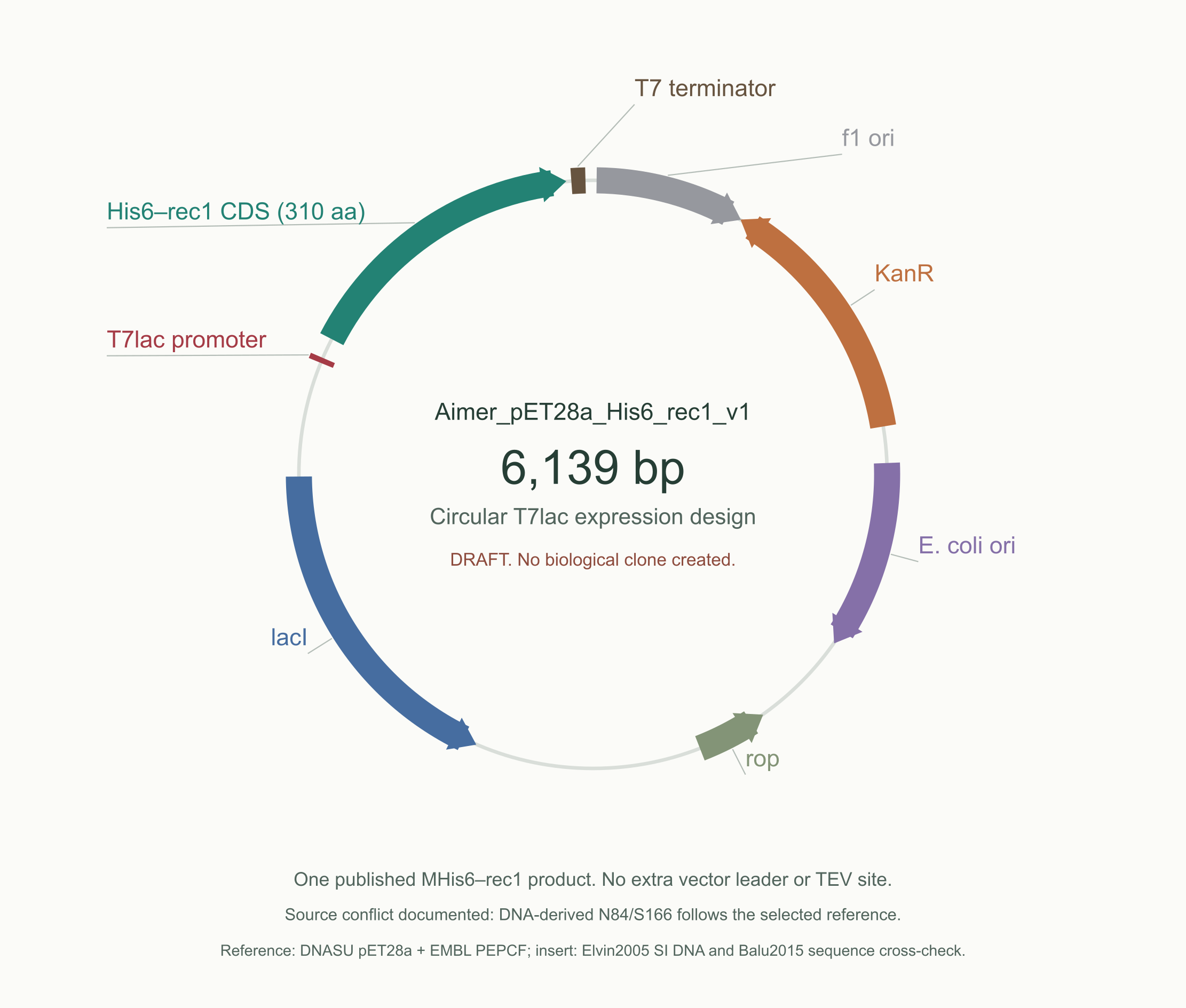
The DNA and manufacturing plan includes a 6,139 bp circular pET28a design. The 933 bp coding sequence includes its stop codon and translates to a predicted 310-amino-acid protein with one His6 tag. I checked the translation against the selected published rec1-resilin reference. The linked plan explains the source discrepancy and records the sequence checks.
I would first confirm access to the construct or to sequence-verified purified rec1. The proposed E. coli workflow uses soluble recovery, Q-Sepharose and nickel affinity purification, followed by buffer exchange and concentration. I would record batch identity, recovered concentration, volume and purity before casting. Intact-protein LC–MS is an optional identity check if available. Photochemical crosslinking forms the hydrated network. I would then treat the specimen surfaces according to their assigned groups.
I would use a liquid handler to dispense equal casting volumes if it can handle the formulation. I would compare dispensed masses at the chosen settings to estimate bias and variation, then check that the actual formulation dispenses consistently. Each sample would receive an ID linking its batch, casting record, exposure condition and measurement files.
What would I compare?
| Group | Question it answers |
|---|---|
| Uncoated in air | How quickly does untreated material lose recovery during air exposure? |
| Oil-coated in air | Does a simple coating extend recovery under the same conditions? |
| Hydrated reference | How much performance changes under comparable cycling while hydration is maintained? |
Groups would share batch, specimen geometry, initial hydration and crosslinking history. I would randomize specimen allocation and test order where practical, record temperature, relative humidity and exposure time, and use the same loading schedule. A casting and loading pilot would set a practical deformation range, sampling times and the initial recovery and stiffness needed for the proposed use. I would fix those settings before comparing the groups.
How would I know if it worked?
Cyclic force–displacement curves give the positive work magnitudes for loading and unloading. I would calculate R = returned work / input work and use the first standardized measurement after treatment assignment as R(0). Absolute R(0) and stiffness would show whether coating changes starting performance. The primary endpoint is the first sampled time with R(t) / R(0) < 0.80. The 80% threshold is a proposed pilot criterion. A crossing falls between two measurements. Specimens that never cross the threshold would be reported as having lasted at least through the observation window.
I would record mass, cracks, permanent deformation, oil loss and grip slipping. For coated specimens, total mass includes water, dry core and oil. Dry-core estimates and coating blanks would help interpret mass change. Grip marks and inspection would help detect slipping that can distort the force curves.
| Observation | Interpretation and next step |
|---|---|
| Recovery lasts longer and initial performance is useful | The pilot supports repeating the comparison with an independent batch |
| Mass retention improves and the recovery curves remain similar | The coating may affect drying. The functional hypothesis remains unsupported |
| Oil leaks, the sample slips or starting recovery drops markedly | Resolve coating coverage or fixture problems before interpreting retention |
| The hydrated and air groups all lose recovery similarly | Check cycling damage, fixture effects and whether the hydrated group stayed hydrated |
What have I completed?
| Evidence | Status |
|---|---|
| Plasmid map, annotated sequence and translation check | Computational design complete |
| Verified protein lot and cast specimens | Pending access and fabrication |
| Mass and force–displacement measurements | Pending |
| Mechanical comparison and hinge decision | Pending data |
When measurements are available, I will add the actual method, sample IDs, individual force curves, absolute initial recovery, recovery and mass versus time, endpoint intervals and records of failed specimens. The first study is a small pilot. I will report variability and missing data alongside group summaries.
What do I need to run it?
The immediate needs are verified rec1-resilin, a supported crosslinking workflow, moulds, a force fixture and a balance sensitive enough for the specimen size. The first practical questions for the node are which protein source is available, how small the fixture can grip reliably and whether a liquid handler can dispense the chosen formulation.
Protein budget (mg) = specimen count × specimen volume (µL) × protein concentration (mg/mL) / 1,000. I will use the pilot geometry and validated casting concentration for this calculation, then add preparation losses. An extra coating group would increase the count from nine to twelve before any independent repeat.
The next checkpoint is confirming protein and fixture access. If those are available, I would cast a small batch, check repeatability and run the simplest comparison first. If access is delayed, I can document the verified design and bench-test the measurement method on a model hydrogel, with any surrogate results labelled and reported separately. The course lists the week of December 1 for finishing project experiments and December 8 for presentations [4].
What I took from other student projects
| Example | How they framed the work | What I used here |
|---|---|---|
| Emiliya Tiumenbaeva, HTBAA Week 1 | Leads with the product, biological system, automation, scale and outputs. Then explains the rationale for each. | A short overview that shows what I am making and measuring before the DNA details |
| Yoobin Nam, HTBAA Week 8 | Asks what surface composition changes, assigns each comparison a purpose and pairs complementary measurements. | A question for each coating group and separate readouts for mechanical function and mass |
| Grown Artifact, HTBAA Week 1 | Treats small prototypes as a way to measure uncertainty before pursuing a large object. Estimates scale from explicit assumptions. | The specimen pilot comes before the hinge, with a protein budget based on measured inputs |
| Alve Lagercrantz, Spring HTGAA final report | Organizes a biomaterials project around an experimental aim, development and longer-term use. Reports computational findings and states what a future lab test would decide. | A progress table and explicit criteria for deciding what to test next |
Presentation
The course asks Global Committed Listeners for three Google Slides and three minutes in the shared deck [4]. My talk follows the research question, the manufacturing design and the experiment that would answer the question.
Three-slide presentation · Three-minute speech
Six-slide discussion deck · Extended speech · DNA design files
References and AI use
- Elvin, C. M., et al. (2005). Synthesis and properties of crosslinked recombinant pro-resilin. Nature, 437, 999–1002.
- Truong, M. Y., et al. (2011). The effect of hydration on molecular chain mobility and the viscoelastic behavior of resilin-mimetic protein-based hydrogels. Biomaterials, 32, 8462–8473.
- Kim, H., et al. (2026). Multi-layered marble for hydrogel encapsulation. Nature Communications, 17, 4375.
- HTBAA Fall 2026 final project guidance.
I used ChatGPT/Codex to compare report structures, check references and organize the proposal and speaking notes. The student examples informed the outline. My experimental plan and computational checks are documented above and in the linked design files.