Week 2 HW: ADAMTSL5 DNA Design
HTBAA Homework #2
Why I changed my project
For Homework #1, my idea was to produce materials for memristors through biomanufacturing. After looking into other possible projects, I decided to focus on psoriasis because I have this condition myself. I want to understand whether biomanufacturing could help address the immune response behind it.
My idea is to produce mRNA encoding a human protein called ADAMTSL5. Researchers have identified this protein as one of the targets of the immune response in psoriasis. That is why I want to explore it. The longer-term question is whether delivering this antigen in the right context could help the immune system tolerate it.
There is research on using antigen-encoding mRNA to induce tolerance in a mouse model of another autoimmune disease, but this does not mean the same approach will work for psoriasis. For this homework, I am designing the DNA template needed to produce the research mRNA.
Part 0 — Set up in Kernel
“A one-sentence note in your write-up with the name of your repository and folder, so we can find your work.”
I registered in Benchling and prepared design files for a project called HTBAA_HW2, with a folder called ADAMTSL5.
The project and folder are visible in the Benchling screenshots below, and the construct has been imported. I still need to add a shareable project or construct link and confirm whether the instructor accepts Benchling while I do not have access to the required Kernel workspace.
“Open an existing part and an existing construct and notice the difference.”
A part is one component of the design, such as the promoter or the coding sequence. A construct is the complete DNA molecule made by putting these parts together in the correct order.
I opened the imported construct in Benchling and viewed its annotated components. Exploring the required examples in Kernel is still pending.
Part 1 — Define your expression target
“What molecule are you expressing?”
I want to produce mRNA that carries the instructions for making human ADAMTSL5. A suitable cell could then translate this mRNA into the protein.
ADAMTSL5 is an autoantigen, which means the immune system can recognize it as a target even though it belongs to the body. Arakawa et al. identified it as an autoantigen involved in psoriasis. My interest is in studying whether this target could be used in an approach that changes the immune response. Producing more ADAMTSL5 by itself would not establish that effect.
“What is the sequence?”
I chose human ADAMTSL5 isoform 1. The reference transcript is NM_001367197.1, and its coding sequence is at positions 105–1550.
The coding sequence is 1,446 bases long, including the stop codon. It encodes a protein with 481 amino acids. The protein reference is NP_001354126.1, and its sequence matches the canonical ADAMTSL5 protein in UniProt entry Q6ZMM2.
The full DNA and protein sequences are included in the GenBank and FASTA files.
“What host or chassis?”
I chose a cell-free system. T7 RNA polymerase would read the DNA template and produce RNA outside living cells.
This makes the manufacturing step relatively simple to describe: DNA is the template, the polymerase makes the RNA, and the RNA is the product I collect.
Human cells would be used in a later expression test. That is why the target for codon optimization is Homo sapiens, even though the RNA is produced in a cell-free reaction.
“Where does the product need to go?”
First, the RNA is collected from the cell-free reaction. For a later expression experiment, it needs to reach the cytoplasm of a suitable cell, where it can be translated.
I kept the native signal peptide in the ADAMTSL5 coding sequence. This is expected to direct the protein into the secretory pathway. I would still need to check whether the cell processes and secretes the protein correctly.
Part 2 — Design your genetic parts
“For each part you use, record the part type and a short name, its sequence and where it came from, and one sentence of justification.”
The complete sequences are included in ADAMTSL5_parts.fasta and ADAMTSL5_parts.gb.
T7_promoter — promoter
The sequence is TAATACGACTCACTATA. I took it from the T7 promoter information provided by New England Biolabs.
I chose it because I am using T7 RNA polymerase to make the RNA.
T7_start_GGG — transcription initiation region
The sequence is GGG. These are the first three bases intended to be transcribed.
I added a G-rich start as an initial design choice for T7 transcription. I would need to measure how well the complete template works.
HBB_5UTR_Kozak — 5′ untranslated region and translation initiation context
This part comes from the first 50 bases of the human beta-globin transcript, NM_000518.5. I changed its final six bases from GACACC to GCCACC.
Together with the beginning of the coding sequence, this gives the start context GCCACCATGG. I chose this as a starting design for translation in human cells. The ATG is already part of the ADAMTSL5 CDS, so it is not added twice.
ADAMTSL5_CDS_native — coding sequence
This is the 1,446-base coding sequence from NM_001367197.1. It starts with ATG and ends with TGA.
I kept the full native sequence so the first version produces the reference protein. It already includes the signal peptide, and I did not add a protein tag.
HBB_3UTR_132 — 3′ untranslated region
This part comes from positions 495–626 of NM_000518.5. It is 132 bases long.
I chose a beta-globin-derived region as a defined starting point for the RNA design. I do not yet know how well it will work with ADAMTSL5. I left out the reference UTR’s final two A bases so the following A tract has an exact length.
polyA80 — poly(A)-encoding region
This part contains 80 consecutive A bases. It is a designed sequence that produces a poly(A) extension in the RNA.
I chose 80 bases for the first version. The main concern is that a long repeated sequence can be difficult to synthesize and verify.
Backbone and transcription end
My first construct is linear DNA. It does not need a bacterial replication origin or antibiotic-selection marker because I am not using it as a replicating plasmid.
The intended transcription endpoint is the physical end of the DNA, immediately after the A tract. I therefore did not add a separate transcription terminator.
The RNA would also need a suitable cap for the later mammalian expression test. That would be added during processing; it is not encoded in the DNA.
Part 3 — Assemble your construct
“Create a new construct … and add your parts in the correct 5′→3′ order.”
The construct is 1,728 base pairs long. Its parts are arranged in this order:
T7 promoter → GGG start → 5′ UTR/Kozak → ADAMTSL5 CDS → 3′ UTR → poly(A)-encoding region.
The file is called ADAMTSL5_IVT_v1.gb.
I imported this file into the ADAMTSL5 folder in my HTBAA_HW2 Benchling project.
“Check the assembled sequence: the reading frame is intact, the start and stop codons are where you expect, and there are no accidental internal stops.”
The coding sequence is at positions 71–1516 in the complete construct. It starts with ATG, ends with TGA, and has no internal stop codons.
The local sequence check produced a translation of 481 amino acids, with an exact match to the selected UniProt protein. This confirms that the assembled coding sequence preserves the intended protein.
“Look at the construct map … and confirm the parts sit in the order and orientation you intended.”
The screenshots below show the imported linear construct in Benchling. The first shows the full map with the ADAMTSL5 CDS selected. The second shows the T7 promoter, the HBB 5′ UTR/Kozak region, and the beginning of the coding sequence in more detail. The screenshots document the imported design; the full reading-frame check is described above.
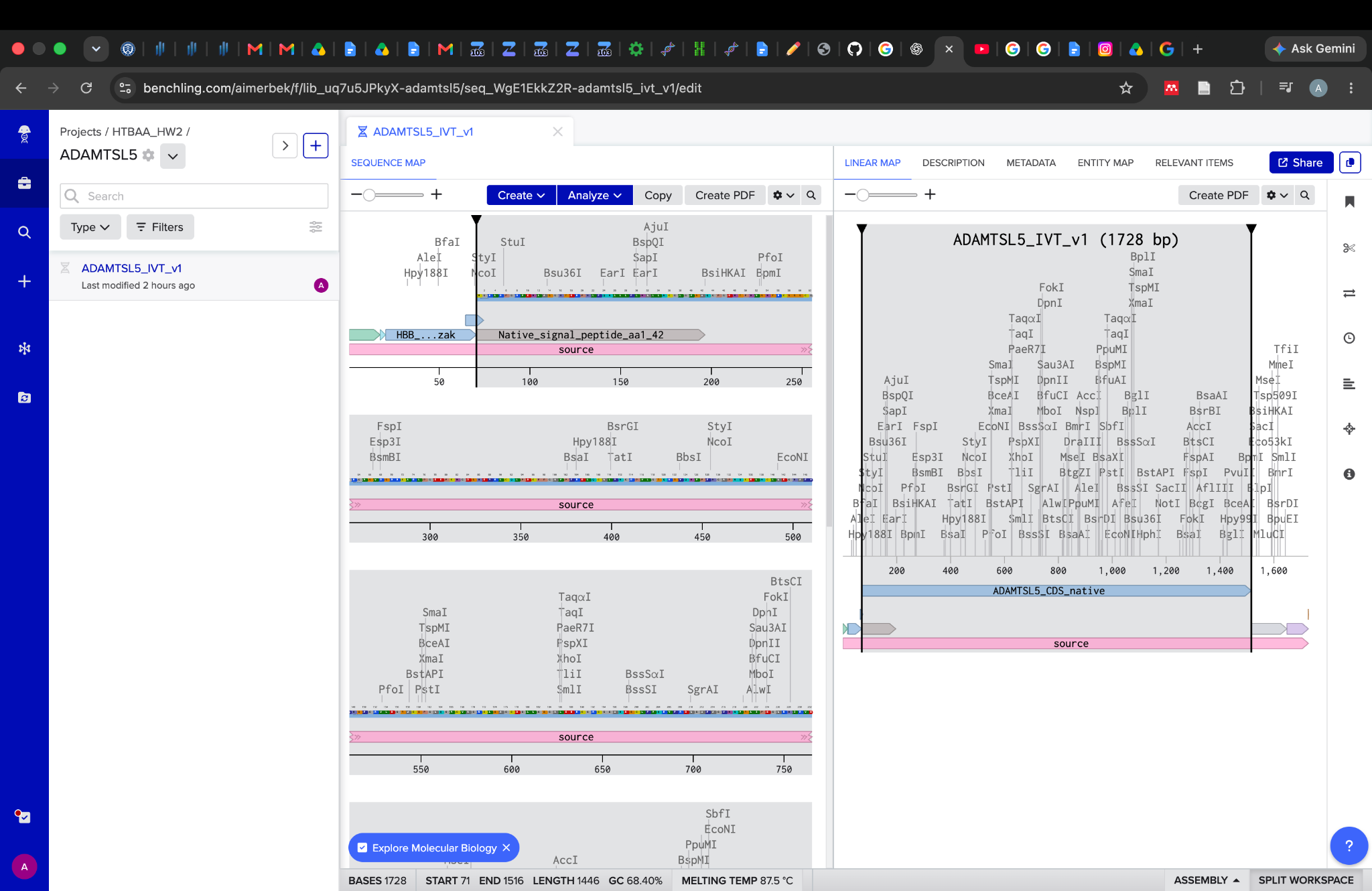
Figure 1. Benchling map of the 1,728 bp ADAMTSL5_IVT_v1 construct. The selected ADAMTSL5 CDS spans positions 71–1516 and is 1,446 bp long.
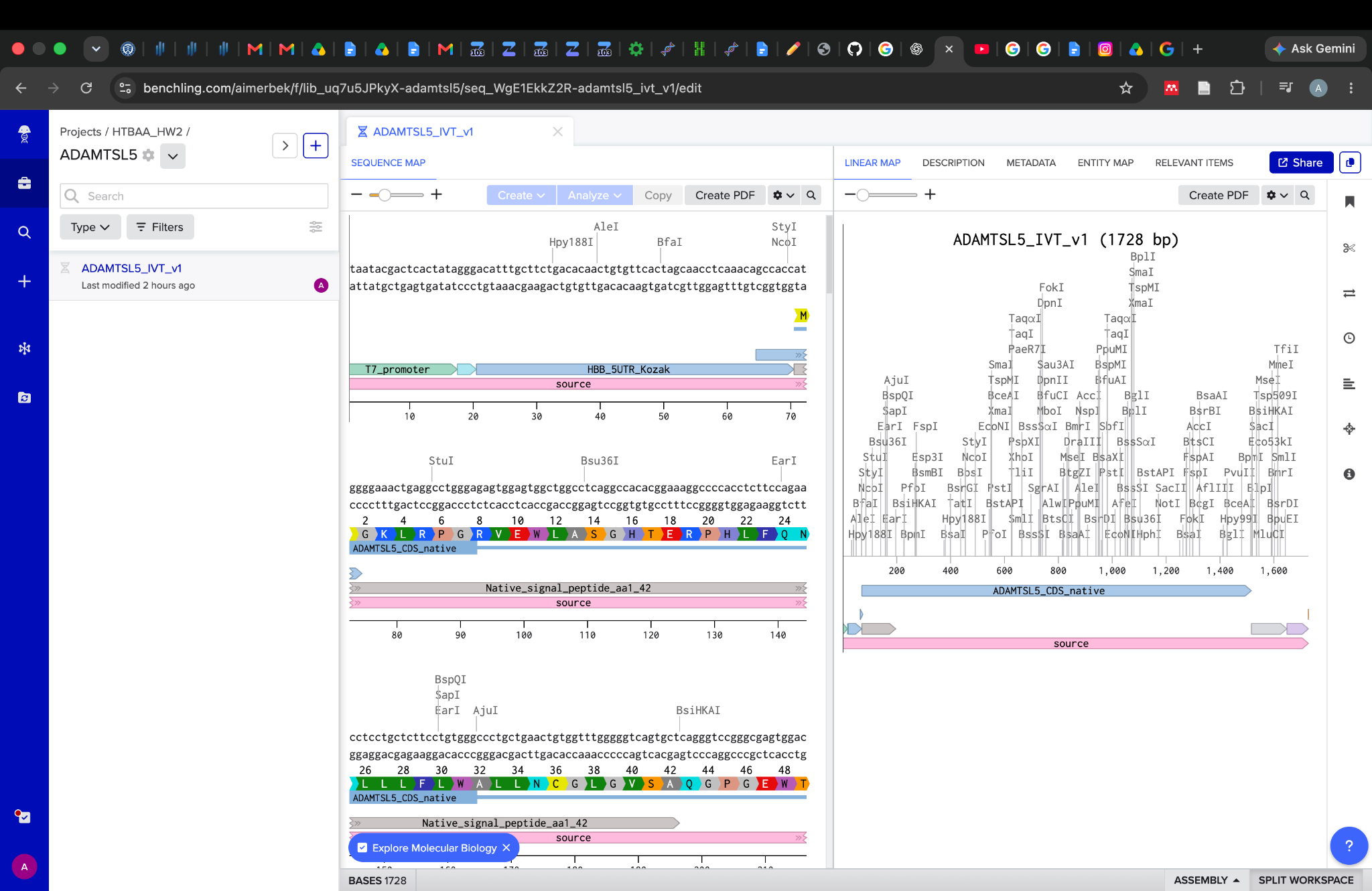
Figure 2. Sequence view showing the T7 promoter, HBB 5′ UTR/Kozak region, and the beginning of the ADAMTSL5 CDS with its translation and native signal-peptide annotation.
Part 4 — Optimize and quality-check
“Codon-optimize your CDS for your chosen host. Compare before and after: what changed, and why does codon usage matter?”
The first version uses the native human coding sequence. Its GC content is 68.4%, and some 100-base regions reach 77%. This gives me a concrete reason to try redesigning the CDS.
I plan to optimize it for Homo sapiens while keeping the protein sequence unchanged. My initial GC target is 40–65%, if the tool supports that setting. I will keep the promoter, UTRs, and poly(A) region unchanged for this comparison.
Several codons can encode the same amino acid. Changing these codons can affect translation and RNA structure. However, I do not want to assume that the optimized version will work better just because the software calls it optimized. I would compare both versions experimentally.
[Still to do: run the optimization and record the actual settings, changes, GC content after optimization, and protein-sequence comparison.]
“Search your sequence against known sequences. Is your CDS what you think it is? Is it identical to a natural gene, or novel? What is the closest match?”
CDS-only search
The native CDS was searched using NCBI BLASTn, with the megablast option, against the refseq_rna database.
The top result was NM_001367197.1, the human ADAMTSL5 transcript variant I intended to use. It matched all 1,446 bases, giving 100% identity, 100% query coverage, zero gaps, and a reported E-value of 0.
This confirms the identity of the coding sequence. The CDS is a natural sequence, while the complete construct is a designed combination of parts.
The search was done through NCBI. The result is saved in BLAST_native_CDS.xml.
Additional search of the complete construct
I also submitted the complete 1,728 bp ADAMTSL5_IVT_v1 construct from Benchling to NCBI BLAST, using the megablast option against the nt database. This is the search shown in the screenshots below.
The top hit was Homo sapiens ADAMTS like 5 (ADAMTSL5), transcript variant 1, mRNA, accession NM_001367197.1. The result reported 100.00% identity over the aligned region, 84% query coverage, and an E-value of 0.0.
The 84% coverage is consistent with the ADAMTSL5 coding sequence being only part of the complete construct: 1,446 out of 1,728 bases is about 83.7%. The template also contains the added promoter, UTRs, and poly(A)-encoding region. The 100% identity therefore refers to the aligned region, not to the entire engineered construct. This is a separate search from the CDS-only result above.
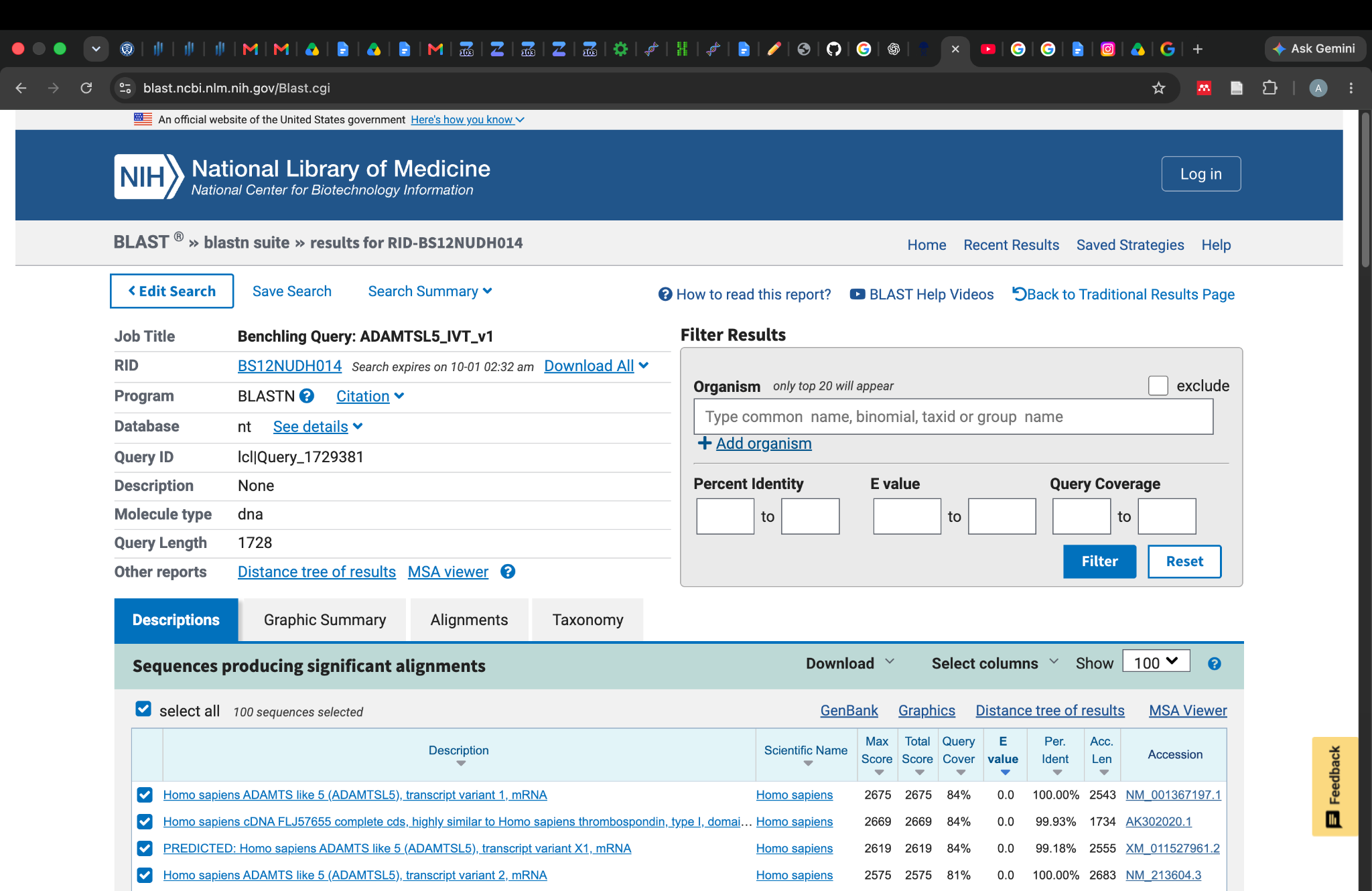
Figure 3. NCBI BLAST search summary for the complete 1,728 bp ADAMTSL5_IVT_v1 construct. The database was nt and the result identifier was BS12NUDH014.
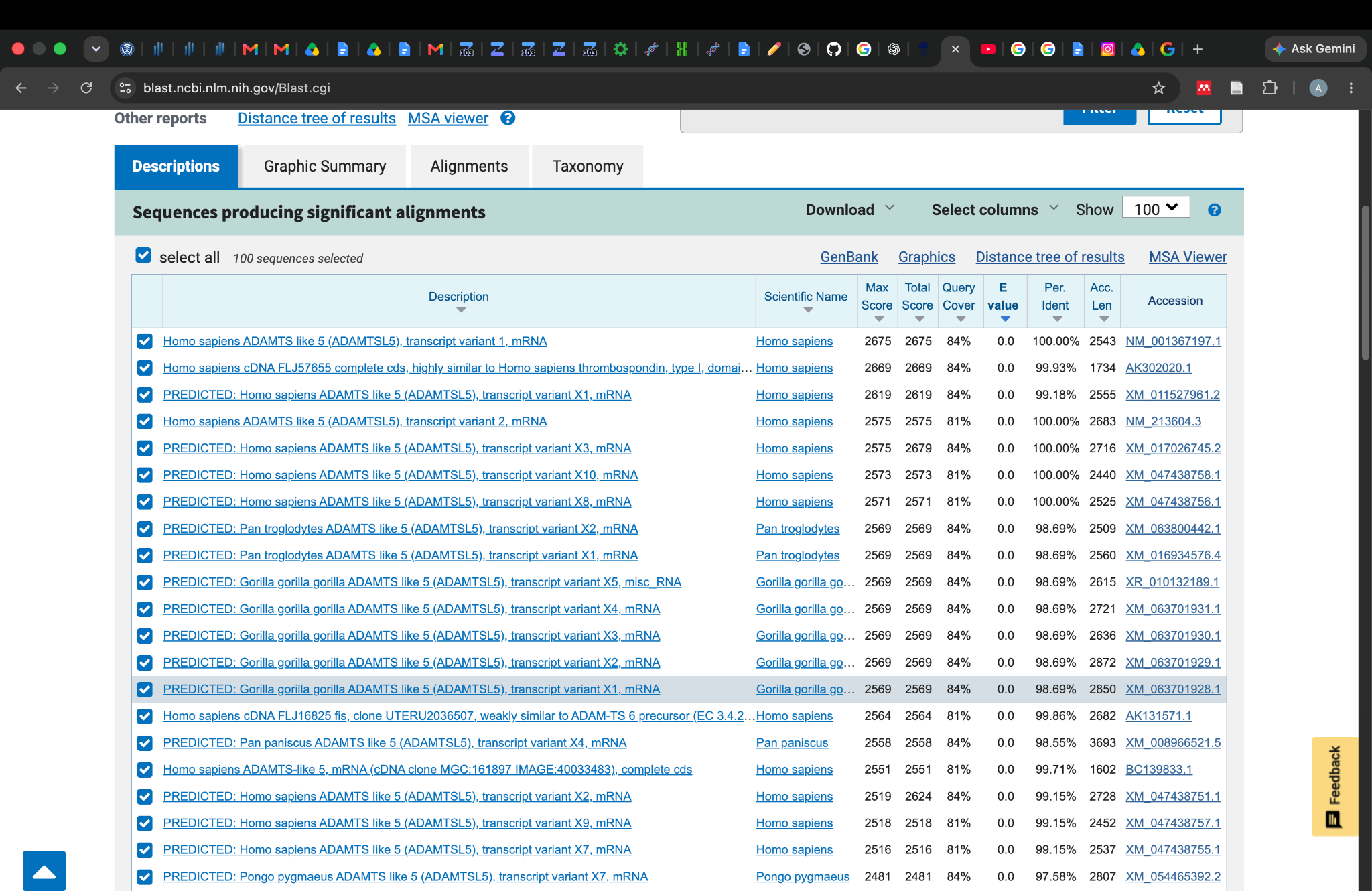
Figure 4. The top match was NM_001367197.1, with 100.00% identity over the aligned region, 84% query coverage, and a reported E-value of 0.0.
“Run the safety screen on your construct. Summarize what it checks for and what it reports.”
I have not completed the dedicated safety screen yet. I need access to the required tool, or an alternative accepted by the instructor, before I can report a result.
Once I run it, I will record what it checks, whether it flags any sequences, and how I would respond to those flags. The BLAST result does not replace this step.
Part 5 — From design to build
“How would you build it?”
For the first version, I would try ordering the complete 1.73 kb construct as sequence-verified double-stranded DNA. Before ordering, I would check whether the supplier can make the GC-rich sequence and the long A tract.
If the complete sequence is difficult to manufacture, I would consider dividing it into overlapping fragments. Gibson et al. describe how overlapping DNA fragments can be joined using exonuclease, polymerase, and ligase. That gives me another assembly option, although I would still need to check the final sequence.
“What does synthesis constrain?”
The two main problems I see are the high GC content and the 80 consecutive A bases. These could make synthesis, amplification, or sequence verification difficult.
For the CDS, I could try changing codons without changing the protein. For the tail, I could compare the encoded A80 design with a version where the poly(A) tail is added to the RNA after transcription.
Carr et al. describe a protein-based method for reducing errors in synthetic DNA. This could help improve the material, but it would not remove the need to verify my final construct.
“Prototype vs. scale.”
For a prototype, I need one verified template and enough RNA to test its quality and expression.
For larger production, I would need a reliable supply of the same DNA template and a repeatable RNA manufacturing process. A DNA template can be used to make multiple RNA molecules, so the amount of RNA produced is not limited to one copy per DNA molecule.
I would also need to control RNA length, cap and tail quality, remaining DNA, and unwanted RNA by-products. Producing a large amount would only be useful if the product remained consistent.
Part 6 — What don’t you know yet?
“Identify the 2–3 biggest unknowns or risks in your construct. For each, state how you would find out.”
1. Can I make the intended DNA and RNA accurately?
The GC-rich sequence and long A tract may cause problems. I would verify the DNA sequence and measure the length distribution of the RNA. If the encoded tail causes problems, I would compare it with a version using post-transcriptional polyadenylation.
2. Will the RNA produce correctly processed ADAMTSL5?
I would compare the native and optimized coding sequences in a suitable mammalian cell model. I would keep the other parts of the RNA the same and compare protein production. I would also check the cells and culture medium to see whether the protein is secreted.
3. Will presenting this antigen produce tolerance or increase immune activation?
This is the biggest biological question. Making the RNA successfully would not answer it.
A later supervised study would need an appropriate antigen-presentation model and measurements of antigen-specific T-cell responses. I cannot conclude from the DNA design that this approach would treat psoriasis.
Future development, Other psoriasis-related autoantigens
I also want to repeat this approach with other proteins that the immune system may target in psoriasis. Different patients may react to different autoantigens, so I do not want to assume that ADAMTSL5 is the right target for everyone.
My idea is to design an expression construct for each selected protein and produce it for research. I would then want to compare how these antigens affect the immune response when delivered in a suitable tolerogenic system. Later, I could investigate whether combining several relevant antigens makes sense. Producing the proteins would be the first step; showing that they can help induce tolerance would require separate experiments.
Future development, Production in eukaryotic cells
I also want to develop a version where living eukaryotic cells produce the proteins directly. I would consider mammalian cells as a starting point. The idea is to introduce an expression construct into cultured cells, let them produce the protein, and then collect and purify it.
For this version, I would need to redesign the current cell-free RNA template into a construct suitable for expression in those cells. I would compare how much protein the cells produce, whether it is secreted, and whether the product has the expected quality. My goal is to develop a repeatable production process that could later be adapted to other selected autoantigens.
AI disclosure
I used OpenAI ChatGPT / Codex to help find sources, assemble the sequence files, perform local sequence checks, run an NCBI BLAST search, and draft the report. I also asked it to use examples of my earlier English writing to make the wording closer to my style and correct the grammar.
My prompts included the homework instructions and requests to prepare the Benchling design, place each question above its answer, and rewrite the answers in my writing style.
The construct has now been imported into Benchling, and platform screenshots and the additional full-construct BLAST result are included above. Codon optimization and the dedicated safety screen are still unfinished.
References
Arakawa et al. (2015). Melanocyte antigen triggers autoimmunity in human psoriasis.
https://doi.org/10.1084/jem.20151093
Krienke et al. (2021). A noninflammatory mRNA vaccine for treatment of experimental autoimmune encephalomyelitis.
https://doi.org/10.1126/science.aay3638
Gibson et al. (2009). Enzymatic assembly of DNA molecules up to several hundred kilobases. Assigned reading.
https://doi.org/10.1038/nmeth.1318
Carr et al. (2004). Protein-mediated error correction for de novo DNA synthesis. Assigned reading.
https://doi.org/10.1093/nar/gnh160
ADAMTSL5 reference transcript:
https://www.ncbi.nlm.nih.gov/nuccore/NM_001367197.1
ADAMTSL5 reference protein:
https://www.uniprot.org/uniprotkb/Q6ZMM2/entry
Human beta-globin reference transcript:
https://www.ncbi.nlm.nih.gov/nuccore/NM_000518.5
T7 promoter reference:
https://www.neb.com/en-ca/faqs/what-is-the-promoter-sequence-of-t7-rna-polymerase