Week 3 HW: Cell-Free Protein Synthesis
Aimer Koshmambetov, Designer Cells at Yonsei University. HTBAA — How to Biomanufacture (Almost) Anything. October 7, 2026.
For this homework, I designed one reaction for each target: sfGFP, PETase and Reteplase. I started from the course presets and changed one component in each recipe. I have not tested these reactions experimentally yet.
Background
Why do potassium and magnesium concentrations vary, and which is more sensitive?
Potassium glutamate provides an ionic environment for the expression machinery. Magnesium supports ribosomes, RNA structure and enzyme activity. Their useful concentrations depend on the lysate and the other ingredients. Nucleotides and phosphate bind magnesium, so the amount added is different from the amount of free magnesium. Magnesium is usually the more sensitive variable: both too little and too much can reduce expression. I would optimize it using the same lysate batch and energy system [1, 2].
How do PEP + NTP and ribose + NMP formulations differ?
PEP + NTP reactions supply ATP, CTP, GTP and UTP directly, while PEP supports energy regeneration through the extract’s enzymes. Ribose + NMP reactions use ribose as a metabolic substrate and supply the cheaper monophosphates AMP, CMP, GMP and UMP. The extract must convert them into the triphosphates needed for transcription. This can reduce reagent costs, but it depends on the metabolic activity of the lysate. A lower reaction cost is only useful if enough functional protein is produced [1, 2].
Comparison of two published formulations
I compared PANOx-SP and RFopt using Table 1 in Olsen et al. (2026) [3]. These are published formulations, rather than the adapted Ginkgo presets used below. All values are in mM unless stated. A dash means no separate addition, not that the lysate contains none.
| Component | PANOx-SP | RFopt |
|---|---|---|
| Potassium glutamate | 130 | 362 |
| Magnesium glutamate | 8 | 8 |
| HEPES | 57 | 75 |
| Amino acids, each | 2 | 5 |
| ATP | 1.2 | — |
| CTP / GTP / UTP, each | 0.85 | — |
| AMP | — | 3 |
| CMP / GMP / UMP, each | — | 2.15 |
| PEP | 30 | — |
| Ribose / glucose | — | 50 / 10 |
| Inorganic phosphate | — | 15 |
| NAD / CoA | 0.4 / 0.27 | — |
| Nicotinamide | — | 4 |
| Ammonium glutamate / oxalate | 10 / 4 | — |
| Putrescine / spermidine | 1 / 1.5 | — |
| Folinic acid / tRNA (mg/mL) | 0.03 / 0.17 | — |
RFopt uses ribose and NMPs and has more potassium glutamate, amino acids and HEPES. PANOx-SP uses PEP and NTPs and includes more separately supplied cofactors. Both list 8 mM magnesium. Their published cost and yield cannot be transferred directly to the course platform because the lysate, reaction format and costing may differ.
My compositions
Each reaction is 20 µL, including 5 µL lysate, 2 µL base buffer and 2 µL of the matching DNA template. The DNA stock is 50 nM, giving 5 nM in the reaction. All volumes are multiples of 25 nL. The concentrations discussed below include the base buffer’s contributions: 200 mM potassium glutamate, 2.6 mM magnesium glutamate and 30 mM HEPES. They do not include an estimate of material already in the lysate [2, 4].
sfGFP: saved composition, sample aimer_koshmambetov_2026-10-07_sfgfp_mg885.
I used the sfGFP Ribose preset and increased magnesium glutamate from 8.225 to 8.85 mM. This adds 25 nL magnesium stock and removes 25 nL water. I want to test whether a small magnesium increase improves expression in this NMP/phosphate formulation. Too much magnesium could also reduce yield. I would compare calibrated sfGFP fluorescence and cost per gram with the unchanged preset. The saved recipe was reopened and its volumes and DNA template matched the intended design.
PETase: saved composition, sample aimer_koshmambetov_2026-10-07_petase_dsbc25.
I used the PETase Ribose preset and reduced DsbC from 5 to 2.5 µM, replacing 500 nL of DsbC stock with water. The course PETase is TfCut2 with one disulfide bond. I want to test whether less DsbC can maintain folding while reducing cost. One disulfide does not mean DsbC is unnecessary. I would compare background-corrected pNP activity per reaction cost with the preset. The saved record identifies PETase, and the reopened variable reagent volumes match. However, the website loader defaults the protein/DNA selection to sfGFP; it must be checked when loading the design.
Reteplase: saved composition, sample aimer_koshmambetov_2026-10-07_reteplase_hepes675.
I used the Reteplase PEP preset and increased HEPES from 57.5 to 67.5 mM by adding 200 nL HEPES stock and removing 200 nL water. I kept DsbC, magnesium, GSH, GSSG and the energy system unchanged. Reteplase has nine disulfide bonds, so I retained the supplied oxidizing DSB lysate and did not add DTT. I want to test whether extra buffering helps maintain activity. I would compare background-corrected AMC activity per reaction cost with the preset.
The Reteplase recipe was correct in the submission form, but I could not confirm its persisted PEP recipe through the website loader. Reopening the saved card removes 6,000 nL PEP and increases water from 425 to 6,425 nL. Importing the same JSON instead interprets PEP as a 0.5 M stock. The intended recipe uses 6,000 nL of 0.1 M PEP mono, giving 30 mM final PEP. This clarification and the loading problem are saved in the existing composition’s Comments. The table below records the intended recipe.
Stock volumes per reaction, in nL. The DNA template matches the protein in each column. Zero means no separate addition.
| Reagent | Stock | sfGFP | PETase | Reteplase |
|---|---|---|---|---|
| Lysate | 1X | 5000 | 5000 | 5000 |
| Matching DNA template | 50 nM | 2000 | 2000 | 2000 |
| Base buffer | 10X | 2000 | 2000 | 2000 |
| Water | — | 150 | 725 | 425 |
| Potassium glutamate | 0.875 M | 3325 | 2275 | 0 |
| Magnesium glutamate | 0.5 M | 250 | 225 | 225 |
| HEPES-KOH pH 7.5 | 1 M | 900 | 900 | 750 |
| Ammonium glutamate | 1 M | 0 | 0 | 200 |
| ATP | 0.1 M | 0 | 0 | 250 |
| CTP | 0.1 M | 0 | 0 | 175 |
| GTP | 0.1 M | 0 | 0 | 175 |
| UTP | 0.1 M | 0 | 0 | 175 |
| 17 amino acid mix | 0.05 M | 1600 | 1600 | 400 |
| Ribose | 100 g/L | 1500 | 1500 | 0 |
| Folinic acid | 10 g/L | 0 | 0 | 50 |
| NAD | 0.1 M | 0 | 0 | 75 |
| Spermidine | 0.25 M | 0 | 0 | 125 |
| Oxidized glutathione (GSSG) | 0.17 M | 0 | 0 | 475 |
| Reduced glutathione (GSH) | 0.1 M | 0 | 0 | 200 |
| Putrescine dihydrochloride | 0.5 M | 0 | 0 | 50 |
| Coenzyme A | 0.05 M | 0 | 0 | 100 |
| AMP | 0.1 M | 600 | 600 | 0 |
| CMP | 0.1 M | 425 | 425 | 0 |
| GMP | 0.1 M | 425 | 425 | 0 |
| UMP | 0.1 M | 425 | 425 | 0 |
| DsbC | 0.0001 M | 0 | 500 | 1000 |
| Potassium phosphate, monobasic:dibasic 1.6:1 | 0.5 M | 600 | 600 | 0 |
| Nicotinamide | 0.1 M | 800 | 800 | 0 |
| PEP mono | 0.1 M | 0 | 0 | 6000 |
| Potassium oxalate | 0.5 M | 0 | 0 | 150 |
| Total | 20000 | 20000 | 20000 |
I would compare each candidate with its preset using the same lysate batch and assay conditions. sfGFP fluorescence can provide a folded-protein titer. The pNP and AMC assays measure PETase and Reteplase activity, not their physical protein yield. I would evaluate cost per functional output and variation between replicates; the two enzyme assays cannot be compared directly [2].
Community reagent and forum
I upvoted the existing FkpA suggestion on October 7. FkpA is a chaperone and peptidyl-prolyl isomerase. Groff et al. showed that FkpA and DsbC helped antibody folding in an E. coli cell-free system [5]. This gives me a reason to test it with Reteplase, but it is not evidence that it improves Reteplase. If available, I would compare the baseline with and without FkpA and measure activity relative to cost. It is not included in my current recipes.
I also visited the CFPS Coopetition forum. I did not post a message.
Optional Kernel work
I imported the three circular T7 constructs into DesignerCells / Aimer-Koshmambetov in the HTBAA 2026 workspace. They use the unchanged official Ginkgo DNA and exact tagged target proteins. GenBank exports from Kernel were checked against the original DNA. Each target CDS has a terminal TAA, no internal stops and the expected translation.
| Target | Kernel construct | DNA length | Tagged protein | Files |
|---|---|---|---|---|
| sfGFP | Open | 2511 bp | 240 aa | GenBank, map |
| PETase | Open | 2696 bp | 309 aa | GenBank, map |
| Reteplase | Open | 2966 bp | 399 aa | GenBank, map |
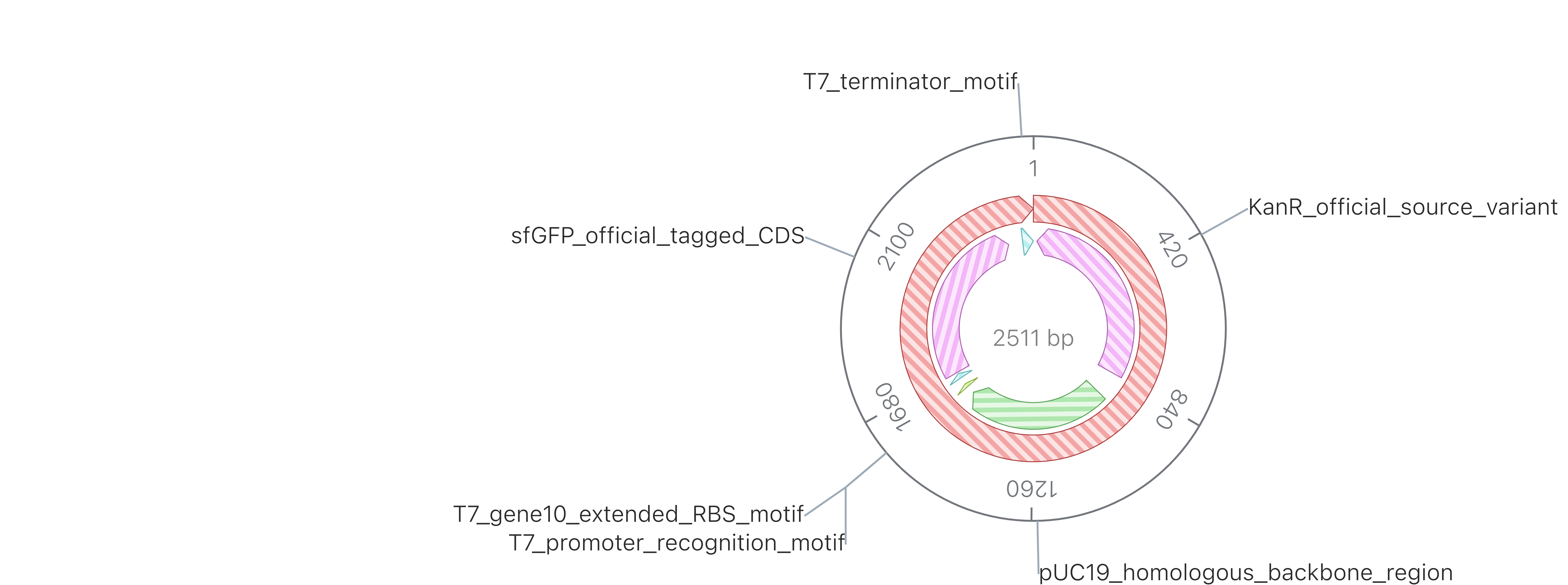
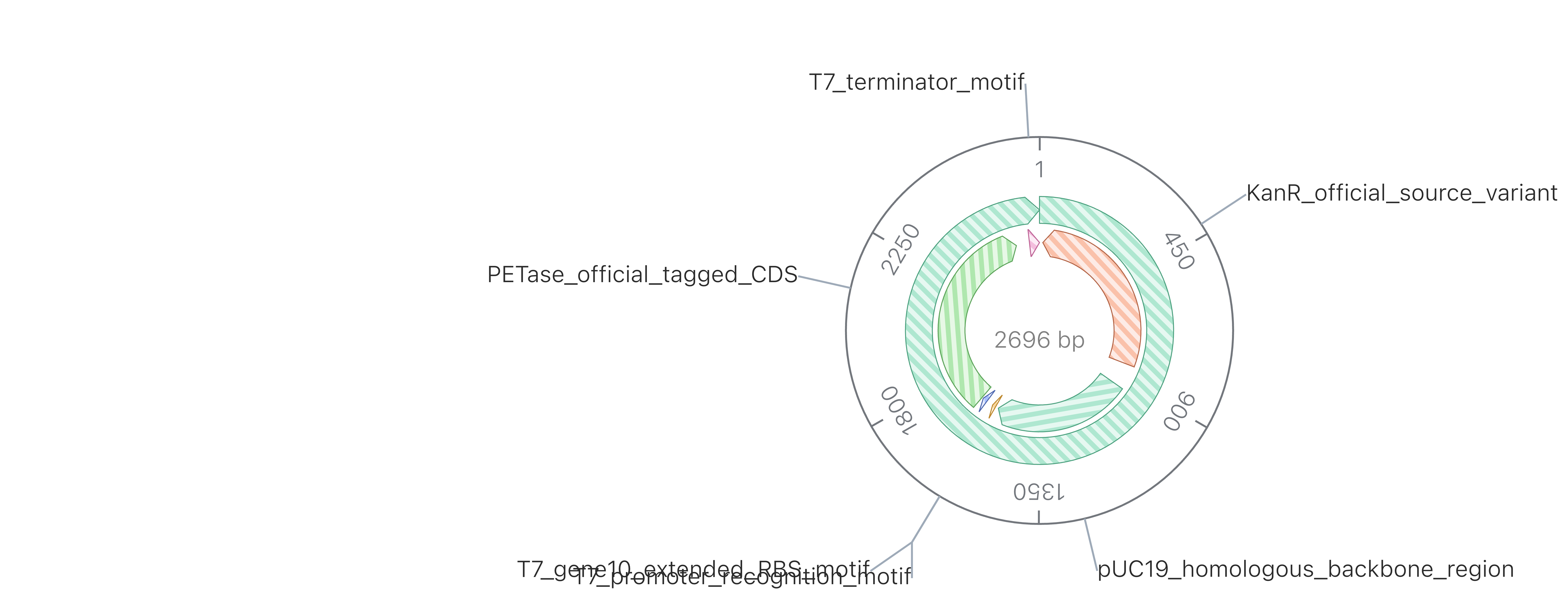
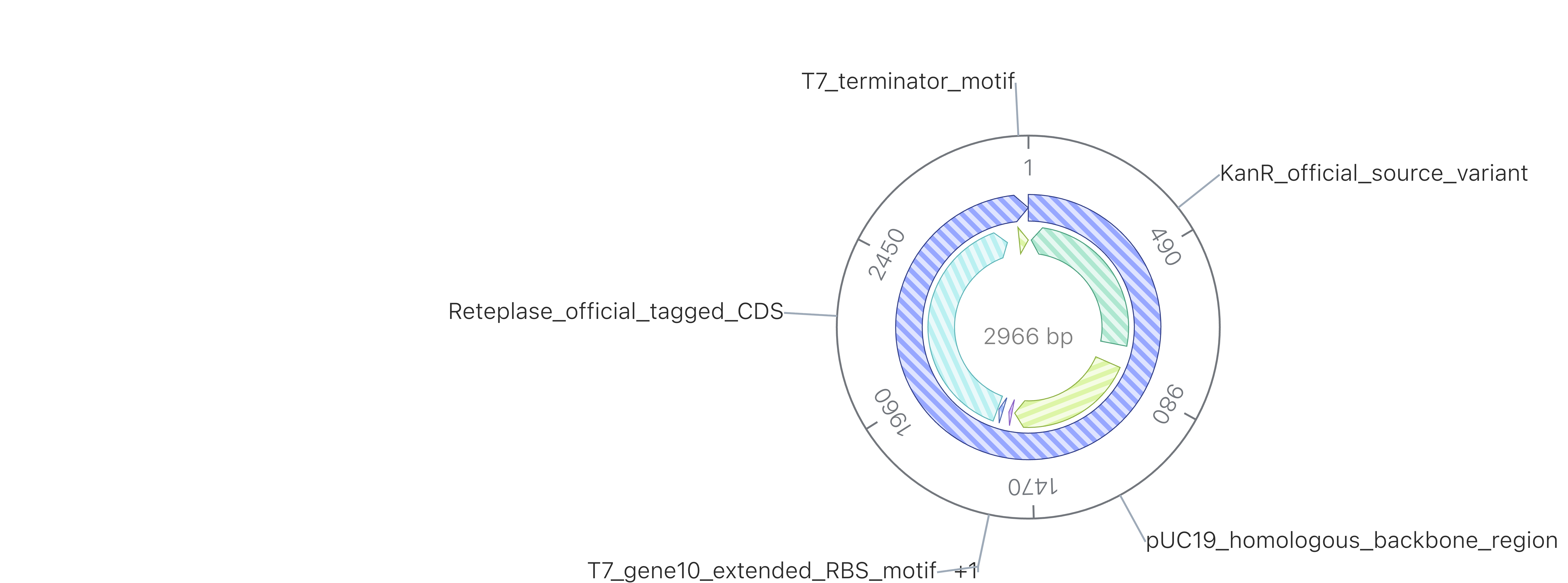
The T7 promoter, RBS and terminator motifs were checked, along with KanR and a pUC19-homologous backbone region. Full replication-origin boundaries remain unverified. The downloadable GenBank files retain the original annotations; Kernel exports flatten them to misc_feature and omit detailed translation qualifiers.
AI assistance
I used OpenAI ChatGPT/Codex to help draft the report, check sources and recipe arithmetic, prepare sequence files and verify their translations. Codex also operated my signed-in Chrome session to save the compositions, record the vote and check Kernel exports. I imported the constructs myself. No experiments were performed by AI.
My instructions included: “Continue my HTBAA Week 3 homework using my Mac’s existing Chrome session” and “Use the exact tagged protein sequences from the official assignment, verified backbone parts, and verify each CDS translation.” I also asked for the report to be written in simpler language with minimal formatting. I need to review the design and explain it during recitation.
References
- HTBAA Week 3 assignment.
- CFPS Coopetition specifications.
- Olsen et al. (2026), Design-driven optimization of low-cost reagent formulations for reproducible and high-yielding cell-free gene expression, Table 1. PANOx-SP originates from Jewett and Swartz (2004), 10.1002/bit.20026.
- CFPS Coopetition designer, course presets and reagent inventory checked October 6–7, 2026.
- Groff et al. (2014), Engineering toward a bacterial “endoplasmic reticulum” for the rapid expression of immunoglobulin proteins.