Week 3 HW: Cell-Free Protocols
Overview
This week I worked on designing cell-free protein synthesis reactions for sfGFP, PETase and Reteplase. I started from Ginkgo reference formulations and used AI to help explain the biology, compare ingredients and check the volume calculations.
My aim was to propose affordable reactions that could still produce functional protein. At this stage, I have submitted my sfGFP design and chosen a PETase design. The reactions have not been tested, and I do not yet have experimental results.
| Assignment component | Status |
|---|---|
| Part A formulation comparison | Documented below |
| sfGFP design | Submitted and verified during the session |
| PETase design | Option B selected; submission pending |
| Reteplase design | To complete |
| Community Reagent contribution | To complete |
| CFPS forum participation | To complete |
| Optional Kernel work | Not completed |
Understanding cell-free protein synthesis
Cell-free protein synthesis, or CFPS, uses machinery extracted from cells to make proteins outside intact living cells.
The DNA template provides the instructions. Transcription produces messenger RNA, and ribosomes translate that message into a protein. The protein must then fold into a functional structure. [1]
I approached the formulation as a material recipe: some ingredients provide building blocks, others supply energy, and others maintain the conditions in which production can happen.
| Function | Examples |
|---|---|
| Instructions | DNA template |
| Protein production machinery | Cell lysate containing ribosomes and enzymes |
| RNA and protein building blocks | Nucleotides and amino acids |
| Energy support | PEP or a ribose-based system |
| Chemical conditions | Potassium glutamate, magnesium glutamate and HEPES |
| Folding support when needed | DsbC and glutathione redox components |
Why three different proteins?
The targets introduce different folding challenges. [1]
| Target | Function | Folding challenge |
|---|---|---|
| sfGFP | Fluorescent reporter | No disulfide bonds |
| PETase, specifically TfCut2 | PET-degrading cutinase | One disulfide bond |
| Reteplase | Therapeutic protease | Nine disulfide bonds requiring correct pairing |
Producing protein and producing active protein are therefore different outcomes.
Reaction constraints
Each reaction must total 20 µL, or 20,000 nL.
The fixed components occupy 9,000 nL, leaving 11,000 nL for supplements and water. All reagent volumes must be multiples of 25 nL. [1]
| Component | Volume |
|---|---|
| Lysate | 5,000 nL |
| DNA template for the selected target | 2,000 nL |
| Base buffer | 2,000 nL |
| Supplements and nuclease-free water | 11,000 nL |
| Total | 20,000 nL |
The base buffer already contributes some salts and amino acids. The concentration displayed by the tool therefore includes contributions from both the fixed buffer and the variable supplements.
Part A Comparing cell-free formulations
A1 Potassium glutamate and magnesium glutamate
Why do their concentrations differ between compositions, and which is more sensitive?
Different formulations are tuned to different extracts and reaction conditions.
In the reference data examined during my session, potassium glutamate ranged from 80 to 362 mM across 12 formulations. Magnesium glutamate ranged from 4 to 12 mM across the 11 formulations with a reported value. [2]
I treated magnesium as the more sensitive setting and left it unchanged in my initial designs.
This is a working interpretation rather than a measured sensitivity result. Variation between published recipes shows the concentrations researchers selected, not what one reaction can tolerate. A controlled titration would be needed to compare sensitivity directly.
A2 PEP and NTPs compared with ribose and NMPs
How does a PEP + NTP formulation differ from a ribose + NMP formulation?
The PEP route supplies nucleotide triphosphates, or NTPs, and a phosphorylated energy substrate.
The ribose route supplies nucleotide monophosphates, or NMPs, with ribose and relies on metabolic activity in the lysate to generate the triphosphates needed for RNA synthesis. [1]
In the Ginkgo sfGFP references, the PEP formulation includes ATP, CTP, GTP and UTP. The ribose formulation instead includes AMP, CMP, GMP and UMP, and omits added PEP, coenzyme A, NAD and folinic acid. [2]
| Ginkgo sfGFP reference | PEP route | Ribose route |
|---|---|---|
| Reported sfGFP yield | 0.613 g/L | 0.464 g/L |
| Potassium glutamate | 279.84 mM | 345.47 mM |
| Magnesium glutamate | 8.22 mM | 8.22 mM |
| Amino acid mix | 2.00 mM | 5.00 mM |
| HEPES | 57.50 mM | 75.00 mM |
These are reference results, not results from my designs.
I chose the ribose route as my starting point because of the lower prices of several nucleotide ingredients. Lower ingredient costs are only useful if enough functional product is retained.
A3 Comparing two literature formulations
Compare the reagent choices and concentrations in two published compositions.
I compared PANOx-SP, associated with Jewett and Swartz (2004), with RFopt from Olsen et al. (2026), using the literature formulation data represented in the course tool. [2–4]
| Feature | PANOx-SP | RFopt |
|---|---|---|
| Energy approach | PEP-based | Ribose-based |
| Nucleotide inputs | NTPs | NMPs |
| Potassium glutamate | 130 mM | 362 mM |
| Magnesium glutamate | 8 mM | 8 mM |
| Amino acid mix | 2 mM | 5 mM |
| Added coenzyme A | Present | Absent |
| Reported sfGFP yield | 1.11 g/L | 2.39 g/L |
| Reported reagent cost per gram | $4,083 | $60 |
RFopt changes the energy strategy and simplifies the added cofactors while using more potassium and amino acids. [2,3]
These reported outcomes come from different experimental systems. They do not predict performance in Ginkgo’s lysate.
I used RFopt to suggest modifications to a Ginkgo reference, rather than assuming that transferring it would reproduce its yield.
Part B Designing reactions
B1 sfGFP
Status: submitted. Experimental performance is unknown.
I selected Ginkgo’s sfGFP Ribose reference as the baseline because it was already a reference for the platform used in the assignment.
I made three changes:
| Ingredient | Reference | My design | Reason |
|---|---|---|---|
| Glucose | No added glucose | 9.71 mM | Test an addition inspired by RFopt |
| Potassium glutamate | 345.47 mM | 361.88 mM | Move toward the RFopt setting |
| 17 amino acid mix | 5.00 mM | 4.06 mM | Free volume for the two additions |
Magnesium glutamate remained at approximately 8.22 mM. Ribose, nicotinamide and the NMP inputs were also retained.
The amino acid reduction is an untested hypothesis. An incorporation calculation suggested that protein assembly alone would not exhaust the remaining supply at the reference yield. However, lysate metabolism also consumes amino acids, so that calculation does not establish that the reduction will preserve performance.
Composition figure
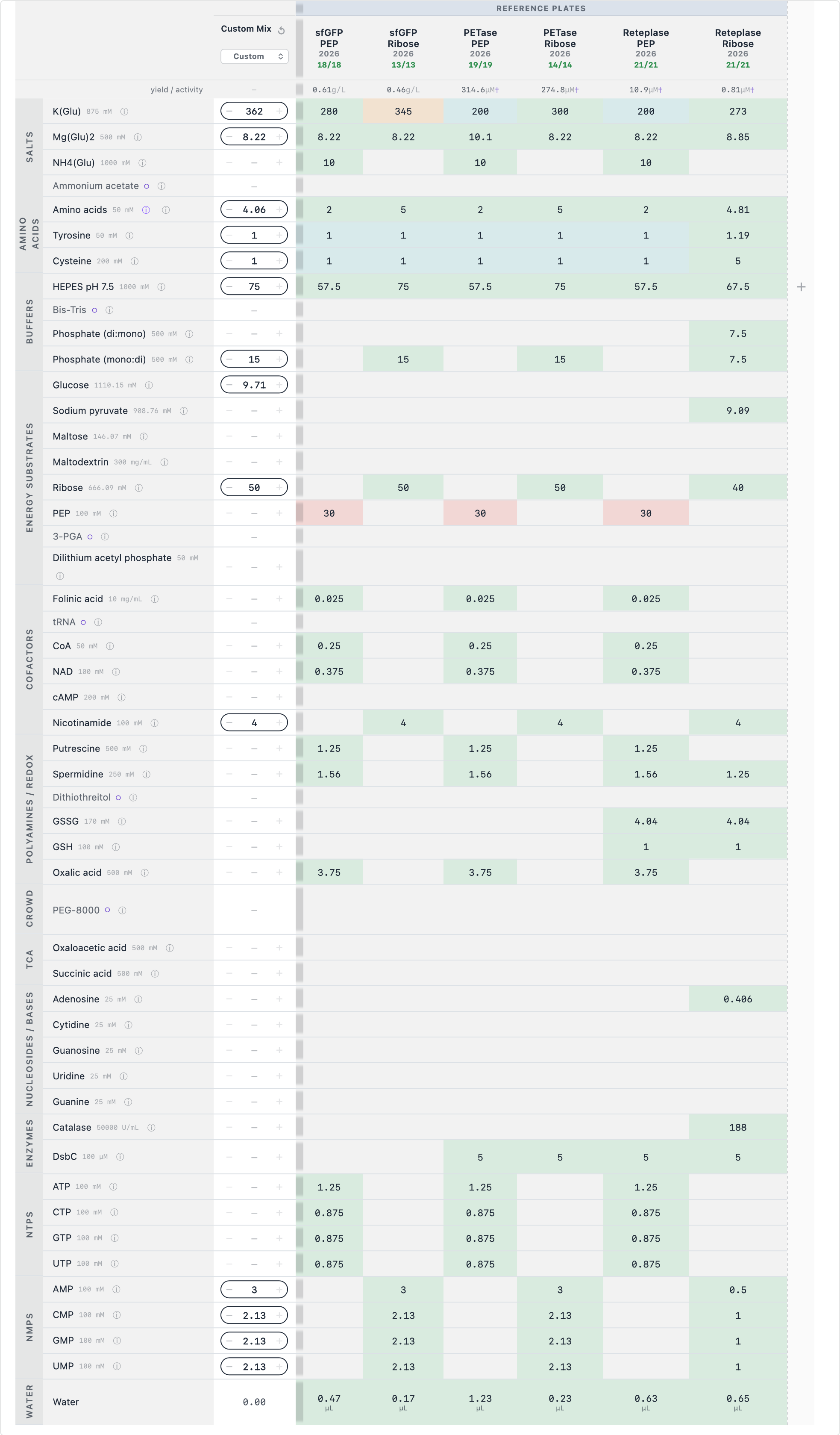
Figure 1. My sfGFP Custom Mix alongside the Ginkgo references. The custom formulation has approximately 362 mM potassium glutamate, 4.06 mM amino acid mix and 9.71 mM glucose. The Water row is 0.00 µL.
Download the six reference formulations as CSV
The CSV export contains the six reference formulations. It does not include my Custom Mix column. The concentrations and JSON below document my design separately.
Concentration rank
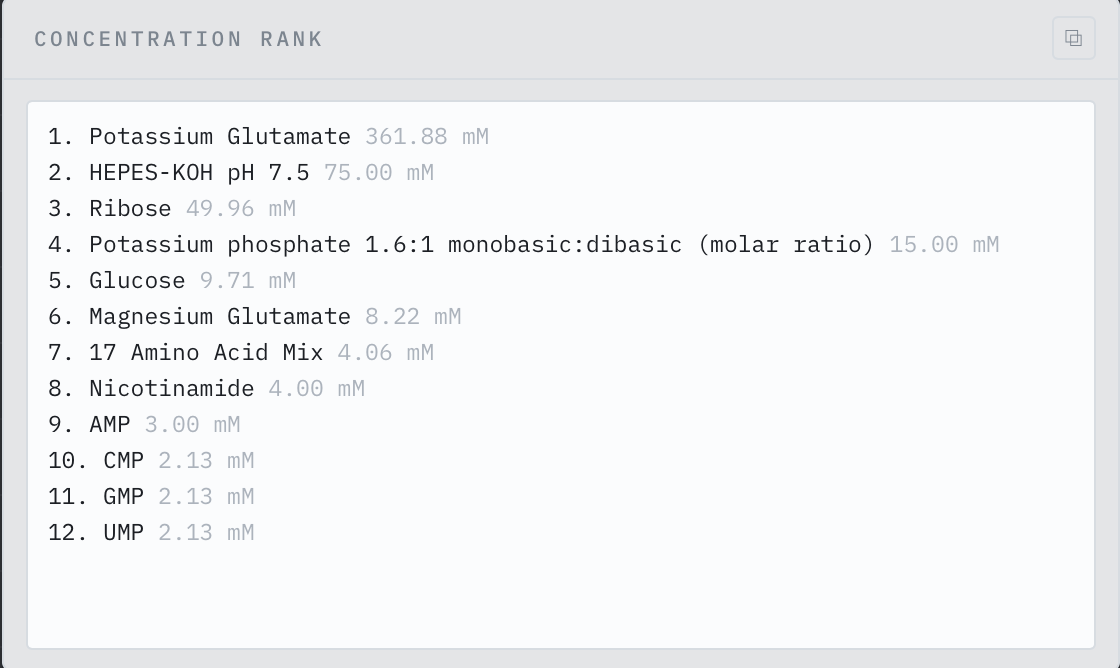
Figure 2. The tool’s concentration-rank panel for my sfGFP formulation.
| Rank | Component | Displayed concentration |
|---|---|---|
| 1 | Potassium glutamate | 361.88 mM |
| 2 | HEPES-KOH pH 7.5 | 75.00 mM |
| 3 | Ribose | 49.96 mM |
| 4 | Potassium phosphate 1.6:1 monobasic:dibasic | 15.00 mM |
| 5 | Glucose | 9.71 mM |
| 6 | Magnesium glutamate | 8.22 mM |
| 7 | 17 amino acid mix | 4.06 mM |
| 8 | Nicotinamide | 4.00 mM |
| 9 | AMP | 3.00 mM |
| 10 | CMP | 2.13 mM |
| 11 | GMP | 2.13 mM |
| 12 | UMP | 2.13 mM |
This table transcribes the rank panel. It does not list every contribution from the fixed base buffer: the composition figure also shows tyrosine and cysteine at 1 mM each.
Concentrations are rounded by the interface. The JSON records the dispensing volumes.
Reagent supplement JSON
The following is the exported JSON supplied with my documentation. Its metadata fields are blank; it records the composition rather than the completed attribution and comments in the saved submission.
All volumes in reagent_list are in nL.
The listed volumes total 20,000 nL, so no additional water is required. Every volume is a multiple of 25 nL.
This establishes that the composition fits the reaction budget. It does not establish its experimental performance.
Submitted design
View my submitted sfGFP composition
Sample ID: aleksandra_piotrowska_2026-10-05_ov06kf
The saved record was read back during the session and matched the intended reagent volumes. [5]
Correction during the design process
An early AI suggestion was to reduce tyrosine from 1.0 to 0.5 mM to create more volume.
This was not possible because the fixed base buffer already supplied 1.0 mM tyrosine. I instead reduced the variable 17 amino acid mix.
The correction showed why the fixed formulation must be accounted for before changing supplements.
B1 PETase
Status: Option B selected and calculated. Submission pending.
I started from Ginkgo’s PETase Ribose reference.
The main cost issue identified in the session was DsbC, a protein that helps rearrange disulfide bonds.
At the recorded inventory price of $5,631.72 per mL of DsbC stock, the reference’s 1,000 nL addition costs approximately $5.63.
The session’s inventory calculation put the complete reference near $5.75 per reaction, making DsbC approximately 98% of that estimate. [2]
Two variants were considered:
- Reduce DsbC from 5 µM to 1 µM.
- Remove added DsbC entirely.
I chose Option B, removing DsbC and adding glucose.
| Ingredient | Reference | Selected design |
|---|---|---|
| DsbC | 5 µM | 0 µM |
| Glucose | No added glucose | 9.71 mM |
| Potassium glutamate | 299.53 mM | Unchanged |
| Magnesium glutamate | Approximately 8.22 mM | Unchanged |
Hypothesis and uncertainty
My hypothesis is that TfCut2 may retain sufficient activity without added DsbC to improve cost per unit of activity.
The homework’s summary table lists no folding helper for the reducing regime, whereas the PETase reference includes DsbC. This difference is worth clarifying with a TA. [1,2]
Yin and Swartz demonstrated benefits from a combination of folding interventions, including DsbC, for a protein with nine disulfide bonds. [6]
That evidence does not establish that DsbC is unnecessary for TfCut2. Having one disulfide bond is a reason to investigate removal, not proof that removal will work.
Using the session’s inventory prices, the selected formulation was estimated at approximately $0.116 per reaction.
Dividing this by the approximately $5.747 reference estimate gives a break-even activity fraction of roughly 2%.
This is cost arithmetic, not a prediction of retained activity. The prices, assay basis and activity measurements need confirmation before claiming a cost advantage.
Selected volumes
| Component | Volume in nL |
|---|---|
| Lysate | 5,000 |
| PETase DNA template | 2,000 |
| Base buffer | 2,000 |
| Potassium glutamate | 2,275 |
| Magnesium glutamate | 225 |
| HEPES-KOH | 900 |
| 17 amino acid mix | 1,600 |
| Ribose | 1,500 |
| Nicotinamide | 800 |
| Phosphate mix | 600 |
| AMP | 600 |
| CMP | 425 |
| GMP | 425 |
| UMP | 425 |
| Glucose | 175 |
| DsbC | 0 |
| Nuclease-free water | 1,050 |
| Total | 20,000 |
The supplements excluding water total 9,950 nL. All volumes are multiples of 25 nL.
This is the calculated design selected at the end of the session. It has not been verified against a saved PETase submission.
B1 Reteplase
To complete.
Reteplase requires correct pairing of nine disulfide bonds, so I cannot simply reuse the sfGFP formulation.
The course describes an oxidizing formulation with an appropriately prepared lysate, GSSG/GSH redox components and DsbC. [1]
I have not yet selected modifications or published a Reteplase design.
This section will include the baseline, exact changes, rationale, volume validation and submission link once that work is complete.
B2 Community Reagent
To complete.
The assignment requires contributing or upvoting at least one Community Reagent and documenting the rationale with relevant research. [1]
No completed contribution is recorded in this session.
I will add the selected reagent, supporting paper and evidence of the contribution here.
B3 CFPS forum
To complete.
The session established access to the HTGAA Zulip forum, but it does not demonstrate that I completed the required visit to the dedicated CFPS discussion channel.
I will confirm access and document any relevant question or discussion.
Posting an optimization idea is a bonus in the brief. [1]
Part C Optional Kernel work
I did not complete the optional T7-compatible plasmid designs or helper-plasmid task in this session.
AI use and verification
I used Claude Science through the OPERON workspace for explanations, source comparison, reaction design and arithmetic.
I subsequently used ChatGPT to turn the exported session into this documentation and check selected references.
The sfGFP submission used the model: claude-opus-5.
The following are exact prompts or decisions from my session. They are examples of the interaction rather than a complete prompt history.
| Prompt or response | Role in the work |
|---|---|
| “let’s do homework 3. give me step by step instruction and teach me” | Requested a beginner-level walkthrough |
| “ribose” | Selected the initial energy route |
| “ginko” | Selected the Ginkgo reference baseline |
| “i dont get it. tell me again which to set up” | Requested clearer interface instructions |
| “B” | Selected PETase removal of DsbC over partial reduction |
AI helped produce both the rationale and the calculations.
I checked the sfGFP concentrations and saved volumes against the tool. The tyrosine correction is one example of why AI suggestions still need verification.
Interpretation and limitations
The sfGFP submission is a valid recorded composition, not a demonstrated improvement.
The PETase composition is a selected hypothesis, not a tested or confirmed submission.
Both designs change several ingredients at once. Comparing them with their references could reveal a net performance difference, but would not isolate the effect of each change. Follow-up comparisons would be needed to identify which ingredient caused an improvement or loss.
The cost figures also need care. The course brief and the tool’s recorded inventory use different prices for some reagents, and an early cost calculator in the session did not reproduce published costs.
I therefore do not report a predicted sfGFP cost per gram. The PETase estimate is explicitly tied to the recorded inventory prices.
The connection to my fashion-material project is the design method: compare input cost with functional output, record assumptions and use experimental results to decide what to change.
This homework does not test methane conversion or production of my proposed material.
Next steps
- Submit PETase Option B and check the saved record.
- Design and submit the Reteplase formulation.
- Complete the Community Reagent contribution.
- Confirm participation in the dedicated CFPS forum.
- Add PETase and Reteplase figures and submission links.
- Add experimental results when available.
References
Donovan, R. and Yue, M. HTBAA Week 3 Designing a Cell-Free Reaction Composition. Homework brief due 6 October 2026. Assignment text and reaction constraints supplied during the session.
Cell-Free Synthesis Coopetition for HTBAA. Reaction design tool. Reference formulations, reagent inventory and prices retrieved during the session on 5 October 2026.
Olsen, M. L. et al. (2026). Design-driven optimization of low-cost reagent formulations for reproducible and high-yielding cell-free gene expression. Nature Communications, 17, 3478. DOI. Open-access full text.
Jewett, M. C. and Swartz, J. R. (2004). Mimicking the Escherichia coli cytoplasmic environment activates long-lived and efficient cell-free protein synthesis. Biotechnology and Bioengineering, 86(1), 19–26. DOI. Formulation values above are taken from the course tool’s comparison.
My submitted sfGFP composition. Saved design. Submission details and read-back verification are preserved in the session export.
Yin, G. and Swartz, J. R. (2004). Enhancing multiple disulfide bonded protein folding in a cell-free system. Biotechnology and Bioengineering, 86(2), 188–195. DOI. PubMed abstract.