Week 4 LAB: Cell-Free Manufacturing
Overview
Week 3 asked for one reaction composition per protein. Week 4 asks for a batch: several compositions that are identical except for one reagent, submitted together under a single hypothesis.
That change exists because of a weakness in my own Week 3 work. Each of my three designs altered two or three ingredients at once, so if one of them outperforms its reference I will not be able to say which change was responsible. A batch removes the ambiguity by varying one thing and holding everything else still.
It is the difference between dyeing one swatch and dyeing a strip of five at different temperatures. The swatch tells you whether that setting worked. The strip tells you where the useful setting is.
| Assignment component | Status |
|---|---|
| A. Batch of reaction compositions | Submitted and verified |
| B1. Research team discussion, optimisation status | Documented below |
| B2. Data analysis, 384-well versus 96-well | Documented below |
| B3. Metascience, rubric criterion | Documented below |
| B4. A Recipe for Flourishing (optional) | Documented below |
| C. Agentic contribution (optional) | Token created, API used read-only, one batch validated |
This homework was submitted late, after the 20 October deadline.
The assignment
4. WEEK 4 ASSIGNMENT: CFPS REACTION DESIGN FOR SFGFP, PETASE, RETEPLASE · Due: October 20, 2026
A. DESIGN A BATCH OF CELL-FREE REACTION COMPOSITIONS. When designing experiments, you’ll often want to compare several conditions that differ only slightly, such as one reagent at a few different concentrations, and batches let you submit those together. To make a batch, click “+ add mix” in the designer to copy your current composition into additional columns, change reagent(s) to a different concentration in each column, add an overall hypothesis plus a short rationale for each mix when submitting. You should batch experimental conditions that are intended to be directly compared with each other. When we pick the final experimental conditions, we’ll try to include whole batches rather than splitting them up.
A batch is a JSON object with an overall
experiment_hypothesisand asampleslist. Each item in the list is a dictionary for one composition: a uniquesample_idandreagent_listof reagent volumes in nL that sum to exactly 20,000, and metadata with that composition’sprotein_targetandcomments.B. RESEARCH TEAM DISCUSSION, DATA ANALYSIS, METASCIENCE.
- Research Team Discussion: … Even if you do not wish to sign up to share publicly, please document on your homework page the current status of your CFPS optimization ideas!
- Data Analysis: Familiarize yourself with the autonomous-cfps repository. Experimental results are stored in
autonomous_cfps/data/reference_setand data analysis files are in thereference_resultsfolder. Review thesfGFP_control_20260722-39-L_96w_report.pdf. What does it show about how the same 20 µL sfGFP reaction performs in a 384-well plate versus a 96-well deep-well plate? Can you suggest what might explain some of the differences (for example: oxygen access, evaporation).- Metascience: With hundreds of proposed reactions and a limited number of experimental wells during round 1 of the coopetition, deciding which experiments to run is itself a scientific question. A shared rubric, a set of criteria we score every proposal against, can make that choice transparent and fair. Propose one rubric criterion you think we should use to decide which experiments make it onto the plate, and explain in a sentence or two why it matters.
- (optional) A Recipe for Flourishing: … If HTBAA were one big cell-free reaction and you were a reagent or cellular component, what would you be and why?
C. AGENTIC CONTRIBUTION (OPTIONAL). coopetition.htgaa.org has been updated to allow for AI agents to programmatically create and submit CFPS compositions based on your guidance. [1]
Part A: my batch — a DsbC dose series for PETase
Status: submitted and verified.
Why this batch
In Week 3 I argued that DsbC, the enzyme that rearranges wrongly paired disulfide bonds, may be unnecessary for PETase. TfCut2 has a single disulfide bond, while the cell-free work I could verify showing a DsbC benefit concerns proteins with several — nine in the plasminogen activator studied by Yin and Swartz, several in the urokinase studied by Kim and Swartz. I found no published dose–response for a single-disulfide protein in a cell-free system. [6,7]
The reason it matters is cost. At the tool’s recorded price of $5,631.72 per mL of stock, the reference dose of DsbC is roughly 97% of the entire cost of a PETase reaction, and PETase is scored on cost per unit of activity. [2]
But a single well at one reduced dose cannot test that claim. It can only tell me whether that one dose worked. A dose series can tell me the shape of the response, which is the thing I actually want to know: whether activity is flat across the range, or falls off somewhere I should not go below.
The design
Base: Ginkgo’s PETase Ribose reference, plus about 9.7 mM glucose. Only DsbC varies. Water absorbs the volume difference so that every sample totals exactly 20,000 nL.
| Mix | DsbC | DsbC volume | Water | Role |
|---|---|---|---|---|
| 1 | 0.25 µM | 50 nL | 1,000 nL | Near-zero probe, 20-fold below reference |
| 2 | 0.75 µM | 150 nL | 900 nL | Low dose |
| 3 | 2 µM | 400 nL | 650 nL | Intermediate |
| 4 | 4 µM | 800 nL | 250 nL | Just below the 5 µM reference |
A 16-fold span, with every point below the reference dose.
Shared across all four mixes (final concentrations): potassium glutamate 299.53 mM, magnesium glutamate 8.22 mM, 17 amino acid mix 5.00 mM, tyrosine 1.00 mM, cysteine 1.00 mM, HEPES pH 7.5 75.00 mM, potassium phosphate 1.6:1 monobasic:dibasic 15.00 mM, glucose 9.71 mM, ribose 49.96 mM, nicotinamide 4.00 mM, AMP 3.00 mM, CMP, GMP and UMP 2.13 mM each.
Choosing the base: a deliberate repair
I built this on the ribose base rather than the PEP base, and that was not arbitrary.
My Week 3 PETase single was submitted on the PETase PEP reference, by mistake — I loaded the wrong column and documented the error on my Week 3 page rather than correcting it silently. Putting this batch on the ribose base at an overlapping dose turns that mistake into something useful: my existing PEP-base well at 1 µM now sits between Mix 2 (0.75 µM) and Mix 3 (2 µM) on the ribose base, so the pair isolates the effect of the energy route at near-equal DsbC.
Why there is no zero
My first attempt at this batch had Mix 1 at DsbC = 0. The tool reported that this exact reaction had already been submitted by another participant on the same base, and noted that I could still submit the batch anyway.
I chose not to. The plate is a shared, finite resource, and a well that repeats an existing well buys the group nothing. So I moved Mix 1 to 0.25 µM and starred the existing entry instead.
The result is a better experiment than the one I set out to make. The DsbC-free point already exists on the plate; what did not exist was the gradient between zero and the reference. My four wells supply that, and a four-point curve across a 16-fold span resolves the shape of the response in a way that a zero-versus-reference comparison cannot.
Overall experiment hypothesis, as submitted
TfCut2 (PETase) has a single disulfide bond, so its activity should be largely independent of DsbC concentration. DsbC is roughly 98% of the reagent cost of a PETase reaction, so if activity is flat across this range then cost per unit activity falls steeply as DsbC is reduced. This batch varies DsbC alone across 0.25, 0.75, 2 and 4 µM on a non-phosphorylated (ribose + NMP) base — a 16-fold span, all below the 5 µM reference dose. Every other reagent is identical across the four mixes, with water absorbing the volume difference. A DsbC-free version of this same base is already on the plate (Oleg Gutsol,
oleg_gutsol_t_rf_g10_20261020, starred), supplying the zero point, so this batch contributes the gradient between zero and the reference rather than repeating either endpoint. If activity is flat, the cheapest well wins; if it rises with dose, the curve shows where the useful minimum sits.
Submitted batch
View the batch on the coopetition site
| Mix | DsbC | Sample ID | Saved design |
|---|---|---|---|
| 1 | 0.25 µM | aleksandra_piotrowska_2026-10-24_kwvwfg_1 | design |
| 2 | 0.75 µM | aleksandra_piotrowska_2026-10-24_kwvwfg_2 | design |
| 3 | 2 µM | aleksandra_piotrowska_2026-10-24_kwvwfg_3 | design |
| 4 | 4 µM | aleksandra_piotrowska_2026-10-24_kwvwfg_4 | design |
I read all four saved records back and checked them. Each totals exactly 20,000 nL with every volume a multiple of 25, each carries template_petase and the target PETase, DsbC reads 50, 150, 400 and 800 nL as intended, and every non-DsbC reagent is identical across the four — which is the property that makes this a valid single-variable sweep rather than four unrelated designs.
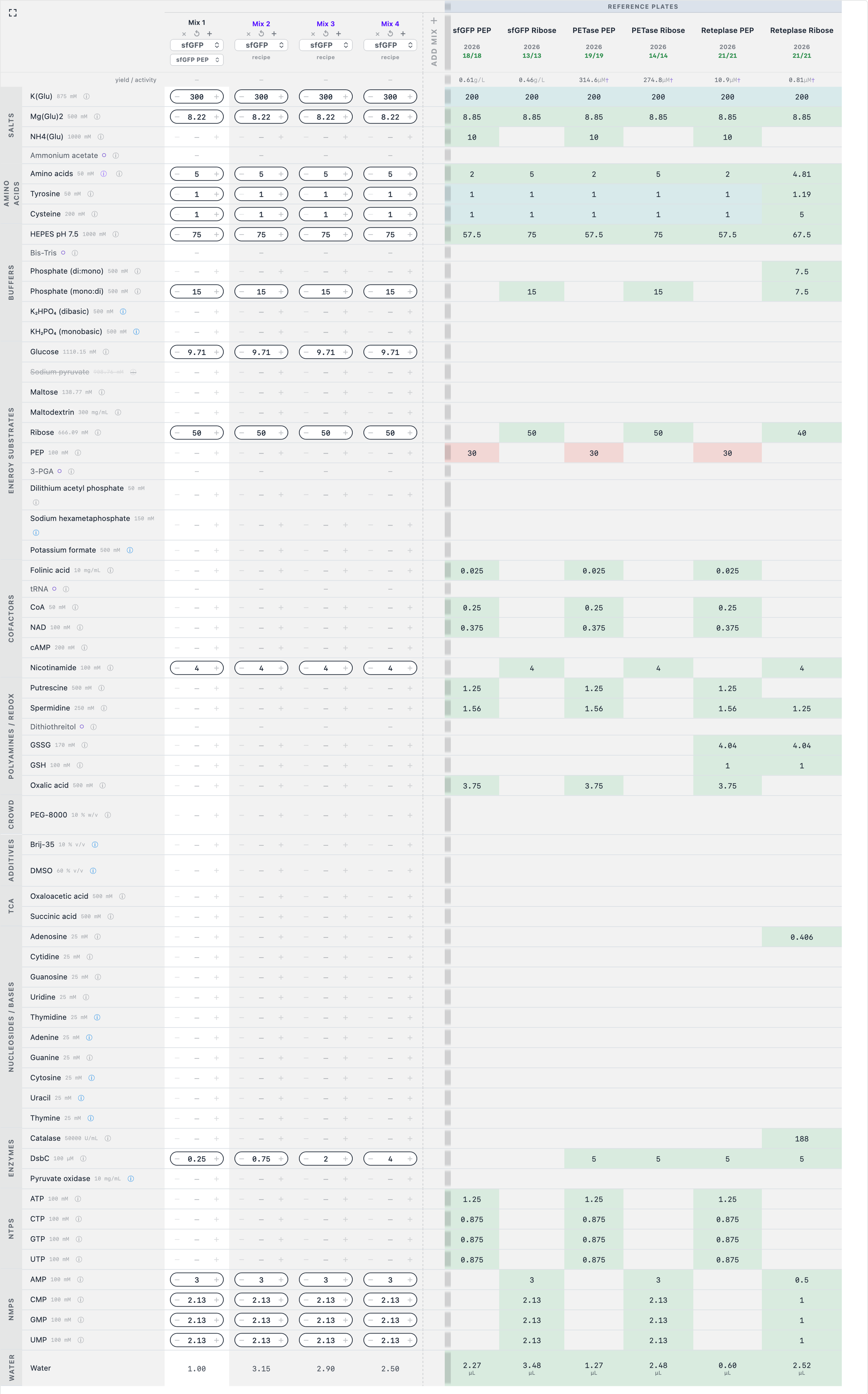
Figure 1. Mix 1 to Mix 4 alongside the Ginkgo references. Only the DsbC row differs between my four columns.
Download the batch composition table as CSV
Part B1: status of my CFPS optimisation ideas
My optimisation work centres on one question: how much of a reaction’s cost is buying something the protein actually needs?
For PETase the answer looks like “most of it, for something it may not need.” DsbC is about 97% of the reagent cost. TfCut2 has one disulfide bond. The literature demonstrating a DsbC benefit in cell-free systems concerns multi-disulfide proteins, and I could find no dose–response for a single-disulfide one. That gap is my hypothesis. [6,7]
I have now tested it two ways: a single composition at 1 µM in Week 3, and this week’s four-point batch across 0.25 to 4 µM with everything else held constant.
The mirror of this is my Reteplase design, where I deliberately kept the full oxidising machinery — DsbC at 5 µM, GSSG, catalase, cysteine. Reteplase has nine disulfide bonds and no activity until all of them pair correctly, so it is the case where the expensive reagent earns its cost. The same reagent is the first thing I cut from one protein and the last thing I would touch on the other. That contrast, rather than any single composition, is the idea I would bring to a discussion.
What I am least sure about is the glucose addition I carried into all four designs. See Part B2: the 96-well report shows glucose raising yield in deep-well plates but lowering it in 384-well plates, which is the format round 1 uses. My next batch should treat glucose as a variable rather than carrying it as a constant.
Beyond the current round, the direction I find most interesting is testing the evaporation hypothesis described in B2 directly, by pre-concentrating salts in a 384-well reaction to see whether the deep-well behaviour can be reproduced chemically rather than geometrically. That question is open in Ginkgo’s own report.
Part B2: 384-well plate versus 96-well deep-well plate
Source: sfGFP_control_20260722-39-L_96w_report.pdf, run processopt_20261008, dated 9 October 2026, compared against the 384-well run jewett_20260824. The two runs share all 80 designs, identical recipes, and the same lysate lot (20260722-39-L), which is what makes the comparison meaningful. [3]
What it shows
| Quad 96-well deep-well | 384-well | |
|---|---|---|
| Median titre across design wells | 2.71 g/L | 0.36 g/L |
| Target control | 2.65 g/L | 0.35 g/L |
| Median per-design fold | 7.3× (IQR 4.5–13.6) | reference |
| Median replicate CV | 7.2% | 14.6% |
| Designs above 20% CV | 4 of 80 | 32 of 80 |
| Design 10th–90th percentile | 1.61–3.61 g/L | 0.11–0.58 g/L |
So the deep-well format yields roughly seven times more sfGFP from the same recipe, and is about twice as reproducible. The report notes the precision gain follows partly from the yield gain: in 384 the CV rises steeply below about 0.3 g/L, which is where many recipes sit, while in the deep-well run nearly every design is above 1 g/L and therefore out of the noisy range.
The finding that matters more
The two formats disagree about which recipe is best.
Spearman rank correlation between the runs: −0.12, which is no relationship at all.
None of the top ten designs is shared.
The family order inverts. In 384 it is PANOx > Ginkgo3 > RFopt. In the deep-well run it is Ginkgo3 ≈ RFopt > PANOx. The nine best designs in 384 are all PANOx; in the deep-well run PANOx ranks 58th to 72nd.
The mechanism is unequal gain: PANOx gains 2.7×, Ginkgo3 7.3×, RFopt 15.1×. Multiply one contestant by 2.7 and another by 15 and the order changes.
By design block:
| Design block | n | ρ between formats |
|---|---|---|
| K-phosphate titration | 11 | +0.84 |
| Mg / K(Glu) antidiagonal | 5 | +0.70 |
| Mg at fixed K-phosphate | 5 | +0.70 |
| Mg(Glu)₂ titration | 24 | −0.03 |
| Nucleotide swap | 6 | −0.54 |
| Glucose titration | 6 | −0.71 |
| K(Glu) titration | 18 | −0.75 |
Only phosphate survives the format change: removing it is catastrophic in both, and in both the yield rises to a plateau at 20–35 mM.
Three responses reverse outright:
Low magnesium is rescued. In 384, RFopt collapses about 65-fold between 4.2 and 2.6 mM Mg (0.10 to 0.0015 g/L). The same recipes make 1.8–2.0 g/L in the deep well. The Ginkgo3 magnesium optimum shifts down from 9.8 to 5.6 mM.
Glucose changes sign. It raises Ginkgo3 from 2.7 to 4.2 g/L at 19 mM in the deep well, and lowers yield in 384 (0.28 to 0.20 g/L).
Potassium glutamate costs more. Ginkgo3 loses about 35% between 235 and 300 mM in the deep well, against 15% in 384.
What might explain it
The report offers three explanations and states plainly that none has been tested. These are its hypotheses, not established mechanism.
Evaporative concentration. Losing part of the volume during the 30 °C incubation in a 2 mL deep well would raise the concentration of every salt. That one mechanism predicts all three reversals at once: the apparent magnesium and potassium optima shift down, because a recipe nominally at 2.6 mM Mg is really running higher, and the under-dosed low-magnesium recipes get lifted into the working range. It would also mean the quoted deep-well titres overstate product per nominal volume, which the report lists among its own caveats. Its proposed test is a post-incubation volume or weight check.
Better aeration. A thin reaction film under a large headspace gives better oxygen access, supporting oxidative energy regeneration. This fits both the higher overall yield and the relative gain of RFopt and Ginkgo3 over PANOx. The coopetition overview states the same principle directly: “Since CFPS reactions produce more protein with better oxygenation, in each round, Ginkgo will select the top-performing conditions and re-test them in 96-well plates.” [4]
Base buffer lot. The runs used different lots (20260512-2-BB against 20260721-4-BB), a confound that cannot be separated from format without a same-buffer side-by-side.
To those I would add that the runs differ in more than format: different dates, different reagent preparations, and different read handling — the deep-well run used a hand-diluted re-read because the first read exceeded the top standard, against a single direct read in 384. The report puts the resulting calibration difference at about 1.3× over the sample range, small against 7.3× but not zero.
Testing the evaporation explanation against the report’s own numbers
The report says evaporation has not been tested, and proposes weighing the plates. But part of it can be tested without new experiments, because evaporation makes a prediction that is easy to check.
If the deep well loses volume, everything in it becomes more concentrated by some factor. A reagent whose real optimum is a fixed concentration would then appear to have a lower nominal optimum in the deep well — and crucially, by the same factor for every reagent, since they all concentrate together.
The report lists ten reagent optima across its three recipe families. Three shift in the direction evaporation predicts. Two do not move. Five move the opposite way.
| Reagent | Family | Quad optimum | 384 optimum | Direction |
|---|---|---|---|---|
| Mg(Glu)₂ | Ginkgo3 | 5.6 mM | 9.8 mM | lower in quad (factor 1.75) |
| Mg(Glu)₂ | PANOx | 9.8 mM | 8.6 mM | higher in quad |
| Mg(Glu)₂ | RFopt | 7.4 mM | 7.4 mM | unchanged |
| K(Glu) | Ginkgo3 | 235 mM | 235 mM | unchanged |
| K(Glu) | PANOx | 200 mM | 300 mM | lower in quad (factor 1.50) |
| K(Glu) | RFopt | 260 mM | 315 mM | lower in quad (factor 1.21) |
| K-phosphate | Ginkgo3 | 35 mM | 25 mM | higher in quad |
| K-phosphate | RFopt | 5 mM | 0 mM | higher in quad |
| Glucose | Ginkgo3 | 19 mM | 0 mM | higher in quad |
| Glucose | RFopt | 10 mM | 0 mM | higher in quad |
The three consistent cases imply factors of 1.21, 1.50 and 1.75, and a single evaporative loss cannot produce three different factors in the same wells.
Glucose and phosphate are the clearest counter-evidence. Evaporation can only make a reagent more concentrated in the deep well, so it should reduce how much you need to add. Both need substantially more added there.
Aeration fits the pattern better. Glucose and phosphate both feed oxidative central metabolism, which requires oxygen. A thin reaction film under a large headspace would make exactly those reagents useful in the deep well and useless, or worse than useless, in a 384 well. It also explains the unequal family gains: PANOx carries its own phosphorylated energy source and gains least at 2.7×, while RFopt depends on regenerating energy and gains most at 15.1×.
I want to be careful about how much weight this carries. Evaporation and aeration are not mutually exclusive, and some evaporation almost certainly occurs. Optima read off a titration grid are coarse, the three families differ in composition, and a shift of one grid step may be noise. This is an argument from the direction and consistency of ten optima, not a measurement, and the decisive test is still the one the report proposes.
It does, though, suggest an experiment that can be run on a 384-well plate: titrate glucose alone, in the format round 1 uses. If aeration is the explanation, glucose should not help there at any dose, and the 19 mM well — the deep-well optimum — should be the worst. That is the batch I prepared through the agent in Part C.
A discrepancy in the brief
The homework asks about “the same 20 µL sfGFP reaction” in both formats. The reactions were not the same volume. The report states 40 µL reactions in the deep-well plates against 20 µL in 384, and lists that among its confounds. The coopetition overview says all scales use 20 µL, so the written materials and this run disagree. [1,3,4]
This matters for interpretation. A doubled volume in a much larger well changes the surface-area-to-volume ratio and the absolute reagent per well, so “format” here bundles geometry, fill volume and headspace rather than isolating geometry.
Why this changes my own design
Round 1 runs in 384-well plates, and this report says results from one format should not be used to choose a recipe for the other.
My glucose addition may be working against me. I added about 9.7 mM glucose to all three Week 3 designs and to every mix of this week’s batch, justified from RFopt and from Olsen et al.’s reported glucose–phosphate synergy. [5] In this report glucose lowers yield in 384-well plates, the format my designs will run in, and the glucose block is the second most strongly anti-correlated between formats. I am not reversing the decision on one dataset for one protein, but it is now the weakest-supported change I made, and it belongs in a batch as a variable.
Leaving magnesium alone looks right, for a better reason than I had. I held Mg at the reference value because it is the sensitive salt. This report shows its optimum is not merely sensitive but format-dependent, moving from 9.8 to 5.6 mM. Holding it at the value Ginkgo measured on the platform my reaction will run on is the defensible choice.
Published optima transfer worse than I assumed. My Week 3 method was to take settings from RFopt and apply them to a Ginkgo reference. The same recipe with the same lysate lot changes rank completely when the vessel changes. A number copied from a paper carries its vessel with it.
The general point is the one my Week 3 page was circling. A reaction composition is not a property of the recipe alone; it is a property of the recipe in a particular container, at a particular scale, with a particular amount of air above it. Anyone who makes materials knows a formulation behaves differently in a beaker and in a mould. This is the same observation with a number attached: 7.3×, and a reordering of which recipe wins.
Part B3: a rubric criterion
Proposed criterion: cost concentration — what share of the reaction’s cost does the varied reagent control, and does the proposal test it?
Score a proposal higher when the reagent it varies accounts for a large fraction of the reaction’s cost. My own case is the clearest I found: DsbC is roughly 97% of a PETase reaction’s cost, so a well that varies DsbC decides almost the whole cost term for that protein, while a well that varies a cheap salt cannot move it however informative it may be about yield. [2]
This matters because two of the three targets are scored on cost per unit of activity, which is a ratio. A plate full of wells that explore only the numerator leaves the denominator unmeasured. With a limited number of wells, some should be spent on the reagents that dominate the denominator — and because those are identifiable in advance from the published price list, the criterion can be scored objectively before any experiment runs.
There is also a practical reason. The recitation noted that much of the DsbC loaded onto a source plate cannot be transferred and is lost as dead volume, so experiments on expensive reagents are also the ones where wasted material costs most. [8] Establishing a minimum effective dose reduces that waste on every future plate, not only on the well that measured it.
Part B4: a recipe for flourishing
If HTBAA were one cell-free reaction, I would be the nuclease-free water.
Water is the row in the designer that nobody chooses. It is whatever is left after everyone else’s additions, and its only job is to make the total come to exactly 20,000 nL. When I add glucose, water gives up the space. It contributes no energy, no building blocks and no catalysis.
But nothing can be added without it. The reaction has a fixed volume, so every real ingredient is only addable because water is willing to be displaced. In a plate shared with the whole class, where my well exists alongside everyone else’s and a duplicate submission helps nobody, that is not a modest role. It is the thing that makes a shared, finite system work at all.
It is also honest about where I am. I arrived with no biology or chemistry background, into a course where other people brought the enzymes. For most of this term I have been the component that makes room, asks what the fixed parts already contain, and checks that the totals add up — and I found two real errors that way, which is more than I expected to contribute by arithmetic alone.
Water is also the part that evaporates, which this week turned out to be the most interesting thing on the plate.
Part C: agentic contribution
I built and submitted the batch above by hand, through the designer interface. I set the agent up afterwards, and I intend to work through it from here on.
What I did
I created an agent token from the Participate section of the coopetition site and stored it as a credential in my workspace rather than pasting it into a conversation, so that it is injected into the code that needs it and never written into a transcript or a saved file. The token lasts seven days and acts only as me: it cannot touch anyone else’s compositions, and every write it makes is recorded as agent-made, so my own contributions and the agent’s stay distinguishable. [9]
The agent then read the state of play through the API: my own seven compositions, the 37 community reagent suggestions, the 14 papers in the shared literature list and the 2 ideas in the metascience list. It built a four-composition batch and validated it with a dry run, which returned success: true without saving anything.
I have not yet let it write. The instructions that come with the token require the agent to confirm with me before anything that submits, edits, votes or comments, and I wanted to read what it proposed before it went onto a shared plate.
Two things the agent found that I would not have
A gap in my own Week 3 homework. Reading the community reagent list through the API showed zero suggestions and zero votes belonging to me. My Week 3 page describes choosing Skp as my community reagent contribution and marks that component complete — but I had reasoned about it without ever submitting or upvoting anything. The list already contains two Skp entries, so the right action is to upvote the existing one rather than file a third, which is what the brief allows. I would not have noticed this by looking at the website, because the page I was checking was my own documentation rather than the record.
A quantitative argument I could not have made by reading. Having the reference data and the report together made it possible to test the report’s own explanation against its own numbers; that analysis is in Part B2 above, and it is what the batch the agent prepared is designed to test.
What I plan to use it for
The thing that makes the API interesting is not that it submits faster. It is that submitting, reading the community list, checking for duplicates and validating volumes become the same operation. Every composition I built by hand this term needed a separate manual check: does it total 20,000 nL, is every volume on the 25 nL grid, has someone already submitted this exact reaction. The dry run answers all three before anything is saved, and the duplicate check runs against the live plate rather than against my memory of it.
The constraint I am keeping is the one in the instructions: the agent asks before every write. Designing is cheap and reversible; submitting to a shared plate is neither. I also will not attach a public link to my working conversation to any submission, which the API offers as an option — the reasoning belongs on this page, in a form I have read and stand behind, rather than as a raw transcript.
What I would do differently
I should have set the token up before building the batch rather than after. Doing it by hand first meant I found the duplicate collisions one at a time through the submit dialog, cancelling and re-entering values, when a dry run would have reported them all before I touched anything. That is the clearest practical argument for the agent that I have: not speed, but finding out what is wrong before it matters.
Use of AI, and what I checked myself
I used Claude Science for the design arithmetic, the literature checks and the analysis in Part B2, and the batch records ai_model as claude-opus-5.
Two checks are worth recording from this week, both of which caught something.
The batch was verified against its saved records, not against the screen. I exported the composition table and, separately, read back all four saved designs from the site. An intermediate screenshot showed the wrong protein target and water values inconsistent with four otherwise-identical mixes; the exported data and the saved records both read PETase throughout, with the correct volumes. Had I trusted the screenshot I would have reported an error that did not exist, and had I trusted only the screen I might have submitted one that did.
The report contradicted a choice I had already made and documented. Part B2 undermines the glucose addition I had carried into four compositions. I have written that down rather than leaving the Week 3 justification standing unqualified.
Limitations
The batch tests one protein in one format. It says nothing about whether DsbC matters for Reteplase, and nothing about how the dose response would look in a deep-well plate — which Part B2 suggests could be different.
It still carries glucose as a constant. Every mix contains about 9.7 mM glucose, an addition this week’s data call into question for 384-well plates. The sweep remains internally valid, since glucose is identical across all four, but the whole series sits on a base I would no longer choose without testing.
No results exist. Nothing here is a measurement of my own designs. The titres and fold-changes in Part B2 are Ginkgo’s, from a control experiment on 80 designs that are not mine.
The B2 comparison is confounded. Format, fill volume, date, base buffer lot and read handling all differ between the two runs. The 7.3× figure is reproducible across two quad runs against the same reference, but “format” in that number is a bundle, not a single variable.
Next steps
Treat glucose as a swept variable rather than a constant in the next batch, on the 384-well format that round 1 uses.
Design a batch that tests the evaporation hypothesis chemically: pre-concentrate the salts of a 384-well reaction to see whether deep-well behaviour can be reproduced without changing the vessel.
Ask a TA about the 20 µL versus 40 µL discrepancy between the brief, the overview and the report.
Add results when the plate has been run.
References
HTBAA Week 4 homework brief, CFPS Reaction Design for sfGFP, PETase, Reteplase, section 4, due 20 October 2026.
Cell-Free Synthesis Coopetition for HTBAA — reference formulations, reagent inventory and prices, retrieved 24 October 2026.
sfGFP_control_20260722-39-L_96w_report.pdf— sfGFP process optimization, quad 96-well incubation (processopt_20261008), compared with the 384-well runjewett_20260824, 9 October 2026. Linked from the Week 4 brief.CFPS coopetition overview and guidelines (HTBAA copy), Ginkgo Bioworks, draft.
Olsen et al. (2026), Design-driven optimization of low-cost reagent formulations for reproducible and high-yielding cell-free gene expression, Nature Communications. doi:10.1038/s41467-026-69605-8
Yin and Swartz (2004), Enhancing multiple disulfide bonded protein folding in a cell-free system, Biotechnology and Bioengineering. doi:10.1002/bit.10827 · PubMed
Kim and Swartz (2004), Efficient production of a bioactive, multiple disulfide-bonded protein using modified extracts of Escherichia coli, Biotechnology and Bioengineering. doi:10.1002/bit.10865 · PubMed
HTBAA recitation, 8 October 2026. Points cited are from the automatic transcript.
Cell-Free Synthesis Coopetition — agent instructions, issued with the agent token from the Participate section of coopetition.htgaa.org/cfps, retrieved 24 October 2026.