Subsections of Ali Shirazi — HTBAA Fall 2026
Week 1 HW: Final Project Ideas
(1) What you would like to biomanufacture and why?
The compound I’m considering as a target for biomanufacturing is Shinorine, a mycosporine-like amino acid, that’s produced by alga and it’s in consist of UV absorbing properties. It has a great potential for mass production by fermentation for commercial purposes, and the shift from conventional methods of cultivation and harvest toward biomanufacturing, make it a greener and more sustainable alternative. The reason I choose this compound comes from my background in marine biotechnology, and the whole Idea that we can leverage environmental benefits without causing ecological harm is one of my objectives.
(2) What living system would you use?
I think microalgae like C.vulgaris or some cyanobacter could be a good match, because of their similarity in pathways, and other merits like the rapid reproduction rate of C.vulgaris also could be a boost for scaling and mass production. Although, it could cause some difficulties in designing and the behavior of the organism, as it’s not a model organism (I guess), in that case maybe E.coli K-12 strain would be a good choice.
(3) How would you use automation?
I’m not actually familiar to the concept of using the automations for lab work, but based on some research I’ve conducted, it seems Opentrons liquid -handling robots could be a real contributor as it able to handle the wet lab techniques and gene manipulation without error and gives a boost to DBTL procedures. Besides we can integrate the results of genome scale metabolic network analysis, and utilize this computational tool to optimize the fermentation process and the final yield.
(4) How much would you need to make, and how long would it take?
I cannot be sure about my estimation, but considering the yield of 1 g/l, a pilot scale production for 1000 users and 3% w/w of shinorine into formulation, requires 10 kg of products per year (without calculating downstream process efficiency rate). At 1 g/l and considering a 1m³ photobioreactor, and a 72 h/batch, It requires 10 batches and approximately a month.
- What don’t you know yet?
I don’t have a clue about the actual achievable titer and the costs of production. Also, the downstream processing could be a challenge. Another concern is legal issues with patents, I’m not familiar with the regulatory on biomanufacturing these types of compounds.
Week 2 HW: DNA Design
Part 0: Set up in Kernel
Logged in kernel by adrian.filip@canada.ca, repository: ali-shirazi, folder name: shinorine
Part 1: Define your expression target
What molecule are you expressing? The compound in mind was shinorine, which is a Mycosporine like amino acid. The BGC is a set of four genes that is responsible for a biosynthetic pathway. The BGC encodes these enzymes: Ava_3858, Ava_3857, Ava_3856, Ava_3855 from cyanobacterium Trichormus variabilis.
What is the sequence?
https://www.kegg.jp/entry/gn:T00277
Ava_3858: KEGG, 3-dehydroquinate synthase
Ava_3857: KEGG, O-methyltransferase, family 3
Ava_3856: KEGG, ATP-grasp enzyme-like protein
Ava_3855: KEGG, Amino acid adenylation
What host or chassis? The organism of choice is C.reinhardtii.
Where does the product need to go? Its designed to integrate into the genome of the chloroplast and express those enzymes in there, in order to access a pool of initial substrate for the first enzyme and avoid transportation and enzyme titer bottleneck.
Part 2: Design your genetic parts
- The part type and a short name.
First of all, I chose pWFK.4, which is designed for integration into C.reinhardtii ptDNA by left and right homology arms and the construct would place in between, it’s suitable for golden gate assembly, (which the sequence examined for BsaI exonuclease cut site).
doi: 10.1111/ppl.70088
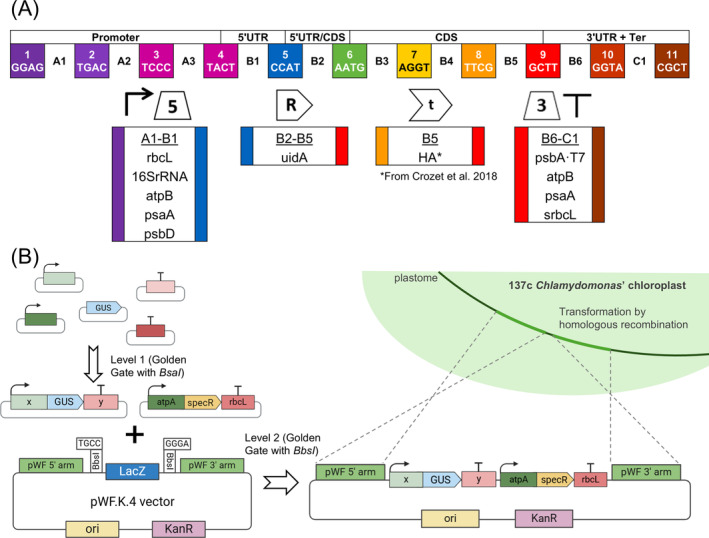
Promotors:
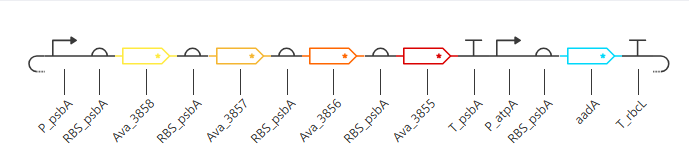
P_psbA Chloroplast Promoter High-efficiency PEP promoter (Chosen because it is one of the strongest, light-inducible plastid promoters available, maximizing transcription of the 6 kb pathway operon.)
P_atpA Selection Promoter Constitutive
CDS:
https://www.kegg.jp/entry/gn:T00277
Ava_3858: KEGG, 3-dehydroquinate synthase
Ava_3857: KEGG, O-methyltransferase, family 3
Ava_3856: KEGG, ATP-grasp enzyme-like protein
Ava_3855: KEGG, Amino acid adenylation
Terminators:
T_psbA Chloroplast Terminator 3’ UTR stabilization element (Selected to cleanly terminate transcription and stabilize the 3’ end of the multi-gene operon transcript)
T_rbcLSelection TerminatorRubisco large subunit 3’ UTR
(Selected because its native 3’ UTR hairpin structure prevents exonucleolytic degradation of the upstream aadA transcript.)
Marker:
Transposon Tn7 aadA gene for streptomycin adenylyltransferase (3"(9)-0-nucleotidyltransferase) GenBank: X03043.1
Part 3: Assemble your construct
The design is in consist of four main enzymes involved in the biosynthesis process of shinorine. promoters, terminators and RBSs are from the related chloroplast, in addition to aadA gene, which act as a selection marker (spectinomycin resistance).
Part 4: Optimize and quality-check
Codon-optimize I optimized the CDS for those enzymes for E.coli as for the chloroplast of C.reinhardtii, it was the closest option available in kernel’s optimizer. Also avoided BsaI cut site, because it’s a necessity for golden gate assembly. The only problem is that chloroplast has about 29 tRNA, while E.coli has about 40, and the GC concents are different, and we must adjust the GC content in about 35%, so in my opinion, we can not call that an optimized CDS.
.png)
Search your sequence: run blast in NCBI, all those elements belongs to BGC of Trichormus variabilism.
Run the safety screen: there’s a flag on the sequence in AVA_3855 sequence, and it flagged as Microcystin/cyanoginosins.
.png)
Part 5: From design to build
How would you build it?
Step 1: Level 0 Part Domesticated Synthesis
Before assembly, each individual sequence is “domesticated”:
Any internal BsaI recognition sites within AVA_3858-5 are silently mutated without altering the amino acid sequence.
Flanking BsaI recognition sites are appended to each part to generate standardized 4-bp fusion overhangs upon cleavage.
Step 2: Level 1 Module Assembly
Two separate Level 1 assemblies are performed (gene cassette and selection marker aadA) concurrently in single tubes containing BsaI enzyme and T4 DNA Ligase
Step 3: Level 2 Final Vector Ligation
To build the final transformation vector (pWFK.4):
Parts Mixed: Level 1 Module A + Level 1 Module B + Left Homology Arm (LHA) + Right Homology Arm (RHA) + Destination Vector Backbone (pWFK.4).
Reaction: BsaI enzyme and T4 DNA Ligase cut the outer flanks of Modules A and B and the homology arms.
What does synthesis constrain?
Prototyping: To test design variants, small oligo pools are synthesized on high-density microchips (Tian et al., 2004; Kosuri et al., 2010) and assembled via Goldengate (one pot reaction) assembly to build and screen variant libraries.
Scale Production: Once the optimal construct is validated, DNA synthesis is no longer needed. High-fidelity master plasmids are transformed into C. reinhardtii chloroplasts via biolistic bombardment, and selection on spectinomycin achieves stable, homoplasmic lines (100% genome copy integration) that self-replicate indefinitely during phototrophic growth.
Carr, P. A. et al. Protein-mediated error correction for de novo DNA synthesis. Nucleic Acids Research 32, e162 (2004). https://doi.org/10.1093/nar/gnh160
Gibson, D. G. et al. Enzymatic assembly of DNA molecules up to several hundred kilobases. Nature Methods 6, 343–345 (2009). https://doi.org/10.1038/nmeth.1318
Part 6: What don’t you know yet?
First thing in my mind, is that the host selected might not be the best chassis for production of this compound in high concentrations and scaling up. Secondly, I used same RBS for four genes in the construct, which I guess it might impose problem in translation. Another thing is that I’m not sure that chloroplast (which is prokaryotic) would be able to express the the operon (which is 6kb) sufficiently, as it might be too long. In that case, I might add other promoters for each individual genes, and that might also impose other problems.
Week 3 HW: Cell-Free Protocols
A. COMPARE CELL-FREE REACTION COMPOSITIONS
- Why does the concentration of potassium glutamate and magnesium glutamate differ between compositions? Which is more sensitive?
The best salt concentrations are not fixed numbers. They depend on what else is in the
reaction. Magnesium is the clearest example: NTPs, NMPs, phosphate and amino acids all bind
Mg²⁺, so a recipe that carries more of these needs more magnesium to leave enough free
Mg²⁺ for the ribosomes and T7 RNA polymerase. Potassium and glutamate mostly set the ionic
strength, so a formulation that already contains many charged components can get away with
less added K-glutamate. On top of that, every lysate batch and every target protein has its own
tolerance, which is why published recipes land on different values.Magnesium is the more sensitive of the two. Its optimum is sharp, and a change of only 1 to 2mM can noticeably reduce yield. Too little stalls transcription and translation, and too much
inhibits them and can precipitate with phosphate. Potassium has a broad plateau and tolerates
changes of tens of mM. For that reason Mg is normally titrated in small steps of about 1 mM,
while K is scanned more coarsely.
- Explain how a PEP+NTP reaction formulation is different from a Ribose+NMP reaction formulation.
The two formulations differ in how they supply energy and nucleotides. In a PEP+NTP
formulation such as PANOx-SP, phosphoenolpyruvate regenerates ATP directly by donating its
phosphate to ADP through pyruvate kinase, and the nucleotides are added already as
triphosphates (about 1.25 mM ATP and 0.875 mM each of CTP, GTP and UTP on the reference
plates). The system also includes cofactors such as CoA and NAD. It works quickly and gives
good yields, but the NTPs, CoA and NAD are expensive, and PEP releases inorganic
phosphate as it is consumed, which lowers pH and binds magnesium.
A ribose+NMP formulation, such as RFopt, takes a cheaper route. The nucleotides are added
as monophosphates (about 3 mM AMP and 2.13 mM each of CMP, GMP and UMP), and ribose
is used as the energy source. The lysate's own metabolism, through the pentose phosphate
pathway and glycolysis, regenerates ATP and its kinases convert the NMPs to NTPs. Because
the cells can make NAD from nicotinamide, CoA and NAD are replaced by about 4 mM
nicotinamide. Phosphate has to be added (about 15 mM), since the metabolism needs it. This
version costs much less, but it relies on the lysate's enzymes, so it is slower and less robust.
The yield trade-off shows up in the reference data. The PEP formulation reaches 0.61 g/L of
sfGFP, 314.6 µM PETase activity and 10.9 µM Reteplase activity, while the ribose formulation
reaches 0.46 g/L, 274.8 µM and 0.81 µM. Ribose therefore loses about a quarter of the sfGFP
yield, around 13% of the PETase activity and most of the Reteplase activity, in exchange for a
much cheaper recipe.
- Choose two cell-free reaction compositions from the literature, compare and contrast the choice of reagents and the concentration of reagents.
I compared PANOx-SP (Jewett & Swartz 2004) with the cost-optimized RFopt formulation
(Olsen et al. 2026), using the Ginkgo sfGFP PEP and sfGFP ribose reference plates that follow
these designs.
In terms of reagents, PANOx-SP is designed to imitate the cytoplasm of E. coli, so it contains
many components: PEP, NTPs, CoA, NAD, folinic acid, putrescine, spermidine and oxalate.
RFopt is stripped down. It removes PEP, NTPs, CoA, NAD, putrescine, spermidine and oxalate,
which are either costly or contribute little, and keeps ribose, NMPs, nicotinamide and added
phosphate.
In terms of concentrations, RFopt makes up for the cheaper chemistry by using more of the
cheap components. It has more potassium glutamate (345 vs 280 mM), more HEPES for pH
control (75 vs 57.5 mM), more amino acids (5 vs 2 mM) and a larger total amount of nucleotide
in monophosphate form (about 9.4 mM NMPs vs 3.9 mM NTPs). The energy source is 50 mM
ribose instead of 30 mM PEP. Magnesium glutamate is identical in both at 8.22 mM, which fits
with magnesium having a narrow optimum.
Overall, PANOx-SP gives the higher titer (0.61 vs 0.46 g/L sfGFP), while RFopt wins on reagent
cost. Which is better for the coopetition depends on cost per gram, that is, whether the savings
outweigh the lost yield.
B. DESIGN ONE REACTION COMPOSITION FOR EACH OF THE THREE PROTEINS (40 minutes)
- Sign in to coopetition.htgaa.org and publish your first unique 20 µL CFPS reaction composition for each of the following (don’t worry, you can resubmit later):
Note: if you’re unable to login with your HTGAA keycloak account, please post in Zulip so that you can participate in the coopetition!
For each composition, specify the reagents you would adjust from the relevant categories, including salts, energy sources, building blocks, cofactors, and redox components.
- As a HTBAA research team, we will have the opportunity to suggest new reagents to add to the cell-free reagent inventory. Contribute (or upvote) at least one reagent to the “Community Reagents” section of the website and provide a short rationale. Include in your homework documentation how you decided on that specific reagent and provide links to any relevant research.
Suggestion: PfPDO, the protein disulfide oxidoreductase from the hyperthermophilic archaeon ‘Pyrococcus furiosus’. It’s a PDI-like foldase.
- It’s a highly thermostable protein with two CXXC redox sites, and assays showed it has oxidative, reductive and isomerase activity. Isomerase activity is what Reteplase needs to fix wrong pairings among its nine disulfides. And the isomerase activity requires both active sites, it works as a full two-domain enzyme, not just a simple oxidase. cnr
- It’s thought to be the archaeal counterpart of bacterial DsbA and eukaryotic PDI, both involved in oxidative protein folding. Reteplase’s eukaryotic origin makes a PDI-like helper a sensible match. nih
Down sides:
- It comes from a ~100 °C organism, so activity at the ~30 °C reaction temperature may be lower.
- It also has reductase activity, so it needs the GSSG/GSH oxidizing buffer to push folding in the right direction.
Links
- Visit the cfps-coopetition forum page to ensure you will be able to take part in the discussion. Bonus: send a note in the channel about a CFPS optimization idea that you have! If you would like clarification on aspects of the project, please message in this dedicated channel.
C. ASIMOV KERNAL (OPTIONAL)
2. Bonus question: design a T7 helper plasmid that you could add to the cell-free reaction to improve the yield of functional reteplase (general chaperones, disulfide-bond machinery, etc).
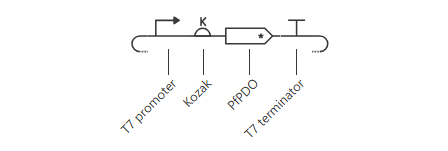
there’s a construct of T7 plasmid with the sequence of my suggested enzyme.
Pr sequence:
MGLISDADKKVIKEEFFSKMVNPVKLIVFVRKDHCQYCDQLKQLVQELSELTDKLSYEIVDFDTPEGKELAKRYRIDRAPATTITQDGKDFGVRYFGLPAGHEFAAFLEDIVDVSREETNLMDETKQAIRNIDQDVRILVFVTPTCPYCPLAVRMAHKFAIENTKAGKGKILGDMVEAIEYPEWADQYNVMAVPKIVIQVNGEDRVEFEGAYPEKMFLEKLLSALS
https://www.uniprot.org/uniprotkb/Q51760/entry#sequences
Back translated via gene runner app
ATGGGNYTNATHWSNGAYGCNGAYAARAARGTNATHAARGARGARTTYTTYWSNAARATGGTNAAYCCNGTNAARYTNATHGTNTTYGTNMGNAARGAYCAYTGYCARTAYTGYGAYCARYTNAARCARYTNGTNCARGARYTNWSNGARYTNACNGAYAARYTNWSNTAYGARATHGTNGAYTTYGAYACNCCNGARGGNAARGARYTNGCNAARMGNTAYMGNATHGAYMGNGCNCCNGCNACNACNATHACNCARGAYGGNAARGAYTTYGGNGTNMGNTAYTTYGGNYTNCCNGCNGGNCAYGARTTYGCNGCNTTYYTNGARGAYATHGTNGAYGTNWSNMGNGARGARACNAAYYTNATGGAYGARACNAARCARGCNATHMGNAAYATHGAYCARGAYGTNMGNATHYTNGTNTTYGTNACNCCNACNTGYCCNTAYTGYCCNYTNGCNGTNMGNATGGCNCAYAARTTYGCNATHGARAAYACNAARGCNGGNAARGGNAARATHYTNGGNGAYATGGTNGARGCNATHGARTAYCCNGARTGGGCNGAYCARTAYAAYGTNATGGCNGTNCCNAARATHGTNATHCARGTNAAYGGNGARGAYMGNGTNGARTTYGARGGNGCNTAYCCNGARAARATGTTYYTNGARAARYTNYTNWSNGCNYTNWSN
Final Project
![cover image]()
![cover image]()