Week 2 HW: DNA Design
Part 0: Set up in Kernel Logged in kernel by adrian.filip@canada.ca, repository: ali-shirazi, folder name: shinorine
Part 1: Define your expression target
What molecule are you expressing? The compound in mind was shinorine, which is a Mycosporine like amino acid. The BGC is a set of four genes that is responsible for a biosynthetic pathway. The BGC encodes these enzymes: Ava_3858, Ava_3857, Ava_3856, Ava_3855 from cyanobacterium Trichormus variabilis.
What is the sequence? https://www.kegg.jp/entry/gn:T00277 Ava_3858: KEGG, 3-dehydroquinate synthase Ava_3857: KEGG, O-methyltransferase, family 3 Ava_3856: KEGG, ATP-grasp enzyme-like protein Ava_3855: KEGG, Amino acid adenylation
What host or chassis? The organism of choice is C.reinhardtii.
Where does the product need to go? Its designed to integrate into the genome of the chloroplast and express those enzymes in there, in order to access a pool of initial substrate for the first enzyme and avoid transportation and enzyme titer bottleneck.
Part 2: Design your genetic parts
- The part type and a short name.
First of all, I chose pWFK.4, which is designed for integration into C.reinhardtii ptDNA by left and right homology arms and the construct would place in between, it’s suitable for golden gate assembly, (which the sequence examined for BsaI exonuclease cut site).
doi: 10.1111/ppl.70088
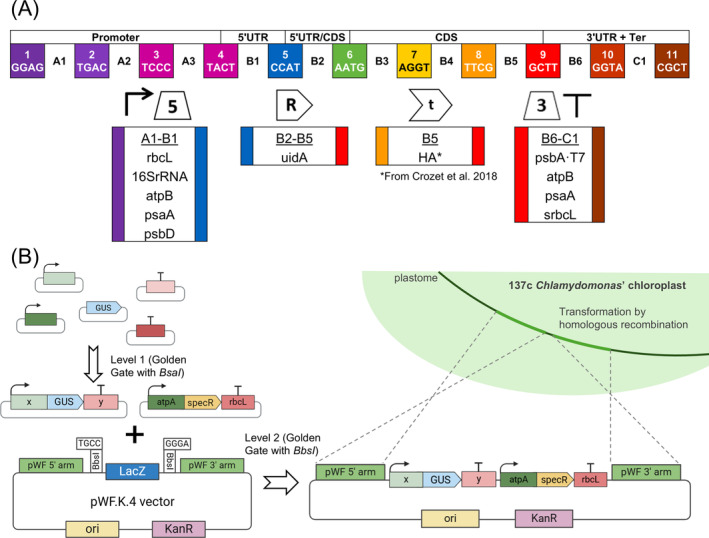
Promotors:
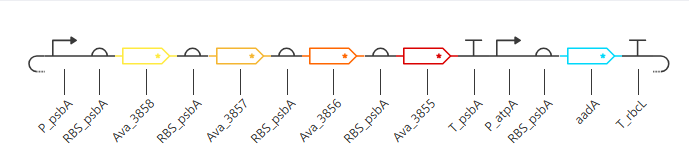
P_psbA Chloroplast Promoter High-efficiency PEP promoter (Chosen because it is one of the strongest, light-inducible plastid promoters available, maximizing transcription of the 6 kb pathway operon.) P_atpA Selection Promoter Constitutive
CDS:
https://www.kegg.jp/entry/gn:T00277 Ava_3858: KEGG, 3-dehydroquinate synthase Ava_3857: KEGG, O-methyltransferase, family 3 Ava_3856: KEGG, ATP-grasp enzyme-like protein Ava_3855: KEGG, Amino acid adenylation
Terminators:
T_psbA Chloroplast Terminator 3’ UTR stabilization element (Selected to cleanly terminate transcription and stabilize the 3’ end of the multi-gene operon transcript)
T_rbcLSelection TerminatorRubisco large subunit 3’ UTR (Selected because its native 3’ UTR hairpin structure prevents exonucleolytic degradation of the upstream aadA transcript.)
Marker:
Transposon Tn7 aadA gene for streptomycin adenylyltransferase (3"(9)-0-nucleotidyltransferase) GenBank: X03043.1
Part 3: Assemble your construct
The design is in consist of four main enzymes involved in the biosynthesis process of shinorine. promoters, terminators and RBSs are from the related chloroplast, in addition to aadA gene, which act as a selection marker (spectinomycin resistance).
Part 4: Optimize and quality-check
Codon-optimize I optimized the CDS for those enzymes for E.coli as for the chloroplast of C.reinhardtii, it was the closest option available in kernel’s optimizer. Also avoided BsaI cut site, because it’s a necessity for golden gate assembly. The only problem is that chloroplast has about 29 tRNA, while E.coli has about 40, and the GC concents are different, and we must adjust the GC content in about 35%, so in my opinion, we can not call that an optimized CDS.
.png)
Search your sequence: run blast in NCBI, all those elements belongs to BGC of Trichormus variabilism.
Run the safety screen: there’s a flag on the sequence in AVA_3855 sequence, and it flagged as Microcystin/cyanoginosins.
.png)
Part 5: From design to build
How would you build it?
Step 1: Level 0 Part Domesticated Synthesis Before assembly, each individual sequence is “domesticated”: Any internal BsaI recognition sites within AVA_3858-5 are silently mutated without altering the amino acid sequence. Flanking BsaI recognition sites are appended to each part to generate standardized 4-bp fusion overhangs upon cleavage.
Step 2: Level 1 Module Assembly Two separate Level 1 assemblies are performed (gene cassette and selection marker aadA) concurrently in single tubes containing BsaI enzyme and T4 DNA Ligase
Step 3: Level 2 Final Vector Ligation To build the final transformation vector (pWFK.4): Parts Mixed: Level 1 Module A + Level 1 Module B + Left Homology Arm (LHA) + Right Homology Arm (RHA) + Destination Vector Backbone (pWFK.4). Reaction: BsaI enzyme and T4 DNA Ligase cut the outer flanks of Modules A and B and the homology arms.
What does synthesis constrain?
Prototyping: To test design variants, small oligo pools are synthesized on high-density microchips (Tian et al., 2004; Kosuri et al., 2010) and assembled via Goldengate (one pot reaction) assembly to build and screen variant libraries. Scale Production: Once the optimal construct is validated, DNA synthesis is no longer needed. High-fidelity master plasmids are transformed into C. reinhardtii chloroplasts via biolistic bombardment, and selection on spectinomycin achieves stable, homoplasmic lines (100% genome copy integration) that self-replicate indefinitely during phototrophic growth.
Carr, P. A. et al. Protein-mediated error correction for de novo DNA synthesis. Nucleic Acids Research 32, e162 (2004). https://doi.org/10.1093/nar/gnh160
Gibson, D. G. et al. Enzymatic assembly of DNA molecules up to several hundred kilobases. Nature Methods 6, 343–345 (2009). https://doi.org/10.1038/nmeth.1318
Part 6: What don’t you know yet?
First thing in my mind, is that the host selected might not be the best chassis for production of this compound in high concentrations and scaling up. Secondly, I used same RBS for four genes in the construct, which I guess it might impose problem in translation. Another thing is that I’m not sure that chloroplast (which is prokaryotic) would be able to express the the operon (which is 6kb) sufficiently, as it might be too long. In that case, I might add other promoters for each individual genes, and that might also impose other problems.