Week 3 HW: Cell-Free Protocols
A. COMPARE CELL-FREE REACTION COMPOSITIONS
- Why does the concentration of potassium glutamate and magnesium glutamate differ between compositions? Which is more sensitive?
The best salt concentrations are not fixed numbers. They depend on what else is in the reaction. Magnesium is the clearest example: NTPs, NMPs, phosphate and amino acids all bind Mg²⁺, so a recipe that carries more of these needs more magnesium to leave enough free Mg²⁺ for the ribosomes and T7 RNA polymerase. Potassium and glutamate mostly set the ionic strength, so a formulation that already contains many charged components can get away with less added K-glutamate. On top of that, every lysate batch and every target protein has its own tolerance, which is why published recipes land on different values.Magnesium is the more sensitive of the two. Its optimum is sharp, and a change of only 1 to 2mM can noticeably reduce yield. Too little stalls transcription and translation, and too much inhibits them and can precipitate with phosphate. Potassium has a broad plateau and tolerates changes of tens of mM. For that reason Mg is normally titrated in small steps of about 1 mM, while K is scanned more coarsely.
- Explain how a PEP+NTP reaction formulation is different from a Ribose+NMP reaction formulation.
The two formulations differ in how they supply energy and nucleotides. In a PEP+NTP formulation such as PANOx-SP, phosphoenolpyruvate regenerates ATP directly by donating its phosphate to ADP through pyruvate kinase, and the nucleotides are added already as triphosphates (about 1.25 mM ATP and 0.875 mM each of CTP, GTP and UTP on the reference plates). The system also includes cofactors such as CoA and NAD. It works quickly and gives good yields, but the NTPs, CoA and NAD are expensive, and PEP releases inorganic phosphate as it is consumed, which lowers pH and binds magnesium. A ribose+NMP formulation, such as RFopt, takes a cheaper route. The nucleotides are added as monophosphates (about 3 mM AMP and 2.13 mM each of CMP, GMP and UMP), and ribose is used as the energy source. The lysate's own metabolism, through the pentose phosphate pathway and glycolysis, regenerates ATP and its kinases convert the NMPs to NTPs. Because the cells can make NAD from nicotinamide, CoA and NAD are replaced by about 4 mM
nicotinamide. Phosphate has to be added (about 15 mM), since the metabolism needs it. This version costs much less, but it relies on the lysate's enzymes, so it is slower and less robust. The yield trade-off shows up in the reference data. The PEP formulation reaches 0.61 g/L of sfGFP, 314.6 µM PETase activity and 10.9 µM Reteplase activity, while the ribose formulation reaches 0.46 g/L, 274.8 µM and 0.81 µM. Ribose therefore loses about a quarter of the sfGFP yield, around 13% of the PETase activity and most of the Reteplase activity, in exchange for a much cheaper recipe.
- Choose two cell-free reaction compositions from the literature, compare and contrast the choice of reagents and the concentration of reagents.
I compared PANOx-SP (Jewett & Swartz 2004) with the cost-optimized RFopt formulation (Olsen et al. 2026), using the Ginkgo sfGFP PEP and sfGFP ribose reference plates that follow these designs. In terms of reagents, PANOx-SP is designed to imitate the cytoplasm of E. coli, so it contains many components: PEP, NTPs, CoA, NAD, folinic acid, putrescine, spermidine and oxalate. RFopt is stripped down. It removes PEP, NTPs, CoA, NAD, putrescine, spermidine and oxalate, which are either costly or contribute little, and keeps ribose, NMPs, nicotinamide and added phosphate. In terms of concentrations, RFopt makes up for the cheaper chemistry by using more of the cheap components. It has more potassium glutamate (345 vs 280 mM), more HEPES for pH control (75 vs 57.5 mM), more amino acids (5 vs 2 mM) and a larger total amount of nucleotide in monophosphate form (about 9.4 mM NMPs vs 3.9 mM NTPs). The energy source is 50 mM ribose instead of 30 mM PEP. Magnesium glutamate is identical in both at 8.22 mM, which fits with magnesium having a narrow optimum. Overall, PANOx-SP gives the higher titer (0.61 vs 0.46 g/L sfGFP), while RFopt wins on reagent cost. Which is better for the coopetition depends on cost per gram, that is, whether the savings outweigh the lost yield.
B. DESIGN ONE REACTION COMPOSITION FOR EACH OF THE THREE PROTEINS (40 minutes)
- Sign in to coopetition.htgaa.org and publish your first unique 20 µL CFPS reaction composition for each of the following (don’t worry, you can resubmit later):
- sfGFP
- PETase
- Reteplase
Note: if you’re unable to login with your HTGAA keycloak account, please post in Zulip so that you can participate in the coopetition!
For each composition, specify the reagents you would adjust from the relevant categories, including salts, energy sources, building blocks, cofactors, and redox components.
- As a HTBAA research team, we will have the opportunity to suggest new reagents to add to the cell-free reagent inventory. Contribute (or upvote) at least one reagent to the “Community Reagents” section of the website and provide a short rationale. Include in your homework documentation how you decided on that specific reagent and provide links to any relevant research.
Suggestion: PfPDO, the protein disulfide oxidoreductase from the hyperthermophilic archaeon ‘Pyrococcus furiosus’. It’s a PDI-like foldase.
- It’s a highly thermostable protein with two CXXC redox sites, and assays showed it has oxidative, reductive and isomerase activity. Isomerase activity is what Reteplase needs to fix wrong pairings among its nine disulfides. And the isomerase activity requires both active sites, it works as a full two-domain enzyme, not just a simple oxidase. cnr
- It’s thought to be the archaeal counterpart of bacterial DsbA and eukaryotic PDI, both involved in oxidative protein folding. Reteplase’s eukaryotic origin makes a PDI-like helper a sensible match. nih
Down sides:
- It comes from a ~100 °C organism, so activity at the ~30 °C reaction temperature may be lower.
- It also has reductase activity, so it needs the GSSG/GSH oxidizing buffer to push folding in the right direction.
Links
- Structure paper (Ren et al., 1998, Nat Struct Biol): https://pubmed.ncbi.nlm.nih.gov/9665175/
- Functional characterization (Pedone et al., isomerase activity): https://iris.cnr.it/handle/20.500.14243/122488
- Domain family page: https://www.ncbi.nlm.nih.gov/Structure/cdd/cd02975
- Visit the cfps-coopetition forum page to ensure you will be able to take part in the discussion. Bonus: send a note in the channel about a CFPS optimization idea that you have! If you would like clarification on aspects of the project, please message in this dedicated channel.
C. ASIMOV KERNAL (OPTIONAL) 2. Bonus question: design a T7 helper plasmid that you could add to the cell-free reaction to improve the yield of functional reteplase (general chaperones, disulfide-bond machinery, etc).
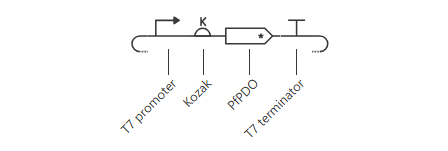
there’s a construct of T7 plasmid with the sequence of my suggested enzyme.
Pr sequence: MGLISDADKKVIKEEFFSKMVNPVKLIVFVRKDHCQYCDQLKQLVQELSELTDKLSYEIVDFDTPEGKELAKRYRIDRAPATTITQDGKDFGVRYFGLPAGHEFAAFLEDIVDVSREETNLMDETKQAIRNIDQDVRILVFVTPTCPYCPLAVRMAHKFAIENTKAGKGKILGDMVEAIEYPEWADQYNVMAVPKIVIQVNGEDRVEFEGAYPEKMFLEKLLSALS https://www.uniprot.org/uniprotkb/Q51760/entry#sequences
Back translated via gene runner app ATGGGNYTNATHWSNGAYGCNGAYAARAARGTNATHAARGARGARTTYTTYWSNAARATGGTNAAYCCNGTNAARYTNATHGTNTTYGTNMGNAARGAYCAYTGYCARTAYTGYGAYCARYTNAARCARYTNGTNCARGARYTNWSNGARYTNACNGAYAARYTNWSNTAYGARATHGTNGAYTTYGAYACNCCNGARGGNAARGARYTNGCNAARMGNTAYMGNATHGAYMGNGCNCCNGCNACNACNATHACNCARGAYGGNAARGAYTTYGGNGTNMGNTAYTTYGGNYTNCCNGCNGGNCAYGARTTYGCNGCNTTYYTNGARGAYATHGTNGAYGTNWSNMGNGARGARACNAAYYTNATGGAYGARACNAARCARGCNATHMGNAAYATHGAYCARGAYGTNMGNATHYTNGTNTTYGTNACNCCNACNTGYCCNTAYTGYCCNYTNGCNGTNMGNATGGCNCAYAARTTYGCNATHGARAAYACNAARGCNGGNAARGGNAARATHYTNGGNGAYATGGTNGARGCNATHGARTAYCCNGARTGGGCNGAYCARTAYAAYGTNATGGCNGTNCCNAARATHGTNATHCARGTNAAYGGNGARGAYMGNGTNGARTTYGARGGNGCNTAYCCNGARAARATGTTYYTNGARAARYTNYTNWSNGCNYTNWSN