I am a researcher and student specializing in computational biology, synthetic biology, and industrial biotechnology. My research and academic focus center on how biological systems can be designed, optimized, and translated into scalable production—ranging from de novo proteins and enzymes to engineered pathways, metabolic engineering, and automated biofoundry workflows.
My technical foundation combines computational biology, molecular modeling, structural bioinformatics (AlphaFold, RFdiffusion, Rosetta, GROMACS), and reproducible workflows (Python, Linux/Bash, Snakemake, Nextflow) with hands-on laboratory training in molecular biology, PCR, and protein expression. Beyond academia, I serve as a Board Member and Technical Operations & Business Development Manager at Fanavaran Borna, driving industrial machinery design, technical infrastructure, and project coordination.
See the nav bar on the left to look through my work for How To Biomanufacture Almost Anything (Fall 2026)!
Subsections of AmirAshkan Pejmanmanesh — HTBAA Fall 2026
Week 1 HW: Final Project Ideas
HTBAA Homework #1 — DNA written with light
AmirAshkan Pejmanmanesh · Due 22 September
1. What to biomanufacture, and why
The product is DNA — synthetic oligonucleotides, and the genes assembled from them — made on a chip where light rather than liquid handling chooses which base goes where.
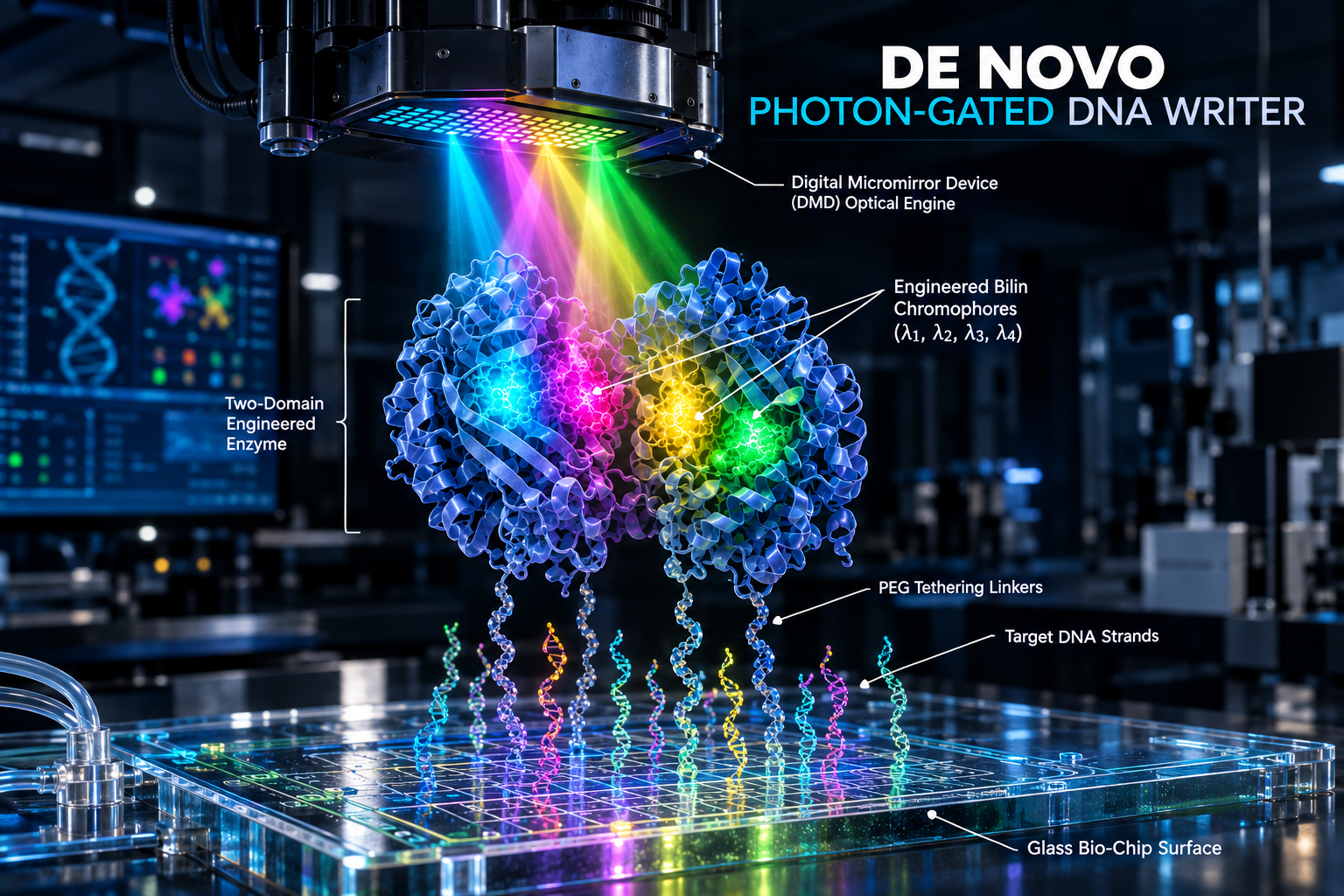
The machine that makes it is itself a manufactured protein. It is a de novo designed, template-independent DNA polymerase, called here a photon-gated writer: a fold with four light-sensing pigment pockets built into it, which adds exactly one ordinary, unmodified dNTP to a DNA 3′ end when, and only when, two specific wavelengths illuminate it at the same instant.
Four writers, one per base, share a surface. $\lambda_1+\lambda_2$ on a spot puts an A there; $\lambda_3+\lambda_4$ puts a T. The light is the instruction set, the protein is the interpreter, and DNA is the output.
The proposal therefore has two biomanufacturing stages, and both are biological:
stage
what is made
what makes it
1
the writer enzyme, ~80 kDa, four chromophores
E. coli expressing the designed gene together with a pigment pathway
2
synthetic DNA — ~$10^7$ bases per design campaign
a cell-free chip carrying $2 \times 10^{12}$ tethered writers
Stage 1 is conventional recombinant protein manufacturing of an unconventional protein. Stage 2 is a cell-free reaction whose only catalyst is the stage-1 product. Every section below treats them separately.
Why DNA. Synthetic DNA is the rate-limiting consumable of protein and strain engineering. At roughly $0.08 per base and three to four weeks of vendor queue, a design round is sized by what can be afforded and waited for, not by what is worth testing — twenty variants rather than ten thousand. That asymmetry is the motivation here, and it is one I meet in my own work: computational enzyme design generates candidate sequences cheaply and in bulk, and every one of them then waits on a vendor to become a physical gene. Shortening that step from weeks to an hour changes which experiments are thinkable.
Why this route and not a faster DNA printer. Every existing platform buys base-by-base control by paying somewhere else:
All four move the problem into a consumable. Here it moves into protein structure: the gate is a conformational state, the key is a pair of colours, and the reset is a second light pulse. Nothing is consumed except the nucleotide that ends up in the DNA, and that nucleotide is the cheap, natural, commodity kind.
One consequence is worth stating. Because the manufacturing device is a protein, it is a gene, and a gene is copyable. A laboratory that can express a protein can own a DNA printer.
2. What living system would make it
2a. Stage 1 — E. coli makes the writer
The writer is an ~80 kDa two-domain protein carrying four covalently bound chromophores. Cyanobacteriochromes are the natural precedent: single-domain photoreceptors that bind a linear tetrapyrrole (phycocyanobilin) autocatalytically and whose absorbance can be tuned across essentially the whole visible spectrum by mutation — a “rainbow” of variants from one protein family (Annu. Rev. Microbiol., doi:10.1146/annurev-micro-041522-094613).
In: glucose, ammonium salts, trace metals, and $\delta$-aminolevulinic acid to feed the tetrapyrrole pathway. Process:E. coli co-expressing heme oxygenase and a bilin reductase makes phycocyanobilin in situ; the writer autoligates its own chromophores as it folds, so pigment loading needs no chemistry after purification. Out: soluble, self-pigmented, four-colour protein, recovered in one affinity step. Pichia pastoris is the fallback if secretion or yield in E. coli proves limiting at production scale.
Assumption: that four spectrally distinct chromophore pockets can coexist in one fold without energy transfer between them. This is on the unknowns list (§5A(ii)).
2b. Stage 2 — a cell-free surface makes the DNA
The writing reaction is not a cell. It is a glass chip carrying ~$108$ tethered writer molecules per 100 $\mu$m × 100 $\mu$m pixel, bathed in a single bulk solution of the four ordinary dNTPs and $\text{Mg}{2+}$, with a micromirror array projecting the light pattern.
In: a design file and commodity nucleotides. Process: per-pixel arm–incorporate–disarm cycles driven entirely by light. Out: oligonucleotides, pooled and assembled into genes, then transformed into whatever chassis the campaign is about — E. coli, yeast, or a cell-free expression reaction for screening.
Why tethered rather than free in solution. An 80 kDa protein has $D \approx 63 , \mu\text{m}^2/\text{s}$ in water, so in a 15 s reaction window its rms displacement is ~61 $\mu$m — six to twelve pixels. An armed enzyme free in the chamber would wander into a neighbouring pixel and write the wrong base there. Anchoring each writer on a $\le$100 nm PEG tether makes its reach 100× smaller than the pitch, so cross-talk becomes geometrically impossible rather than merely improbable. Tethering is not a refinement; it is what makes optical addressing work at all.
3. How automation is used — at both ends
Two separate automation problems, requiring different capabilities: the research programme that produces the writer, and the manufacturing run that uses it.
3a. Automating the search for the writer
The writer does not exist. Finding it is a design–build–test–learn campaign in which every stage must be automated, because the hit rate for de novo catalytic designs is on the order of a fraction of a percent. A round therefore has to produce designs in the tens of thousands to return a handful of hits, and tens of thousands of individually pipetted reactions is not a screen. That ratio, not convenience, is the argument for automation.
Software capabilities required. The right-hand column is a candidate, not a commitment — the field moves, but the function each stage performs will not.
function required
what it does here
plausible tool today
Generate backbones around a specified catalytic geometry
Build backbones holding a two-metal-ion nucleotidyl-transferase site in the correct arrangement while leaving room for four bilin pockets. Atom-level placement is needed; sequence-level motif grafting is not precise enough for a metal-ion mechanism.
RFdiffusion2, developed for atom-level enzyme active-site scaffolding (doi:10.1038/s41592-025-02975-x)
Design for two states, not one
Drive the generator toward a pair of geometries with opposite requirements at the same residues: catalytic site assembled in the arm state, disassembled in the dark state. No off-the-shelf tool is sufficient here.
Multi-state protocols in Rosetta, or conditioning layered on the diffusion generator — custom work, and the likely home of most method development
Design sequences onto a fixed backbone
Produce sequences that fold into each backbone with catalytic and chromophore-coordinating residues held fixed, biased toward soluble cytoplasmic expression; several per backbone for diversity through downstream filters.
ProteinMPNN, or its soluble-biased variant
Predict structure as a filter
Re-predict every designed sequence independently and keep only those recovering the intended backbone with high confidence. The cheapest filter available, and it removes most of the library before anything is made.
AlphaFold2/3 or ESMFold — the latter is faster, which matters at library scale
Score energetics in both chromophore states
Relax and score each surviving design twice, once per chromophore configuration, and rank by the difference. A design equally stable in both states has no switch, however good its absolute score.
Rosetta, with scoring extended to the bilin cofactor
Establish a barrier between the two states
Show the two states are distinct basins rather than two labels on one floppy ensemble. Equilibrium simulation will not reach the transition, so enhanced sampling is required.
GROMACS or AMBER with metadynamics or umbrella sampling (e.g. via PLUMED)
Learn from each round
Each round returns thousands of measured sequence $\rightarrow$ (light/dark contrast, rate) pairs. A model fitted on one round biases generation in the next, so the campaign gets cheaper instead of being a series of independent lotteries.
A sequence-to-property regressor on protein language model embeddings — standard machine learning; the value is in the data
Orchestrate jobs and keep provenance
Tens of thousands of jobs per round across mixed hardware, every design traceable from generation parameters to the well it was measured in. Without that join the learning loop cannot exist.
A workflow manager (Nextflow or Snakemake) on a cluster scheduler
Computing hardware. The generative and structure-prediction stages are GPU work, energy scoring is CPU work, and the enhanced-sampling simulations dominate: a single round runs to thousands of GPU-hours, most of it in simulation. Storage is modest for structures and scores, large for trajectories, which would be written strided. In practice this means a small institutional GPU cluster with a CPU partition and a scheduler — not exotic hardware, but not a workstation either.
Laboratory capabilities required.
capability
what it does here
Acoustic (contact-free) liquid dispenser
Sets up the round in 384-well format at sub-microlitre volumes. Volume is the point: at a few microlitres per reaction the cell-free expression reagent stays affordable; an order of magnitude larger and it does not.
Desktop liquid-handling robot
Plate-to-plate transfers, assembly-PCR setup, reagent addition, hit cherry-picking. This is what makes a round unattended rather than supervised.
Cell-free protein expression, not cloning
Genes go straight from assembly PCR into expression — no transformation, no colonies, no overnight growth. This removes the day-scale steps and makes plate-format screening of a large library coherent.
Multimode plate reader with monochromator and controllable illumination
Two optical, plate-format readouts. (1) Did it bind its pigment? — a four-wavelength absorbance scan, a label-free check on chromophore loading and spectral position. (2) Did it write, and only in the light? — a primer carrying a 3′ fluorophore with an internal quencher, read dark $\rightarrow$ illuminated $\rightarrow$ dark. The measured quantity is the light/dark ratio, which is what a plate reader measures reliably.
Programmable two-colour illumination across a whole plate
Light must be a controlled variable: defined wavelengths, intensity and timing, uniform across all wells, inside or alongside the reader.
Benchtop sequencing
Verifies hit identity and returns confirmed sequence–phenotype pairs to the learning model.
Protein expression and purification
For hits only: milligram-scale expression in E. coli, chromatography, and spectroscopy on the real photocycle of a design that passed the screen.
Specialised instrumentation for hits. Two measurements cannot be made in a plate reader and decide whether the design principle is sound: transient absorption spectroscopy (picosecond–nanosecond) for the actual photocycle — isomerisation speed, arm-state lifetime, and whether the four pigments talk to each other, which §5A(ii) predicts they do not; and time-resolved structural or spectroscopic probing of the two states, to show the catalytic site really does form and unform. Both are shared-facility or collaboration instruments; the project assumes access rather than ownership.
The consumable that sets the running cost is the cell-free expression reagent, spent once per design across a large library. Commercial kits cost roughly an order of magnitude more than in-house preparation, which over a multi-round campaign is the difference between a routine cost and a prohibitive one — making in-house reagent preparation a design decision rather than housekeeping. Oligos, assembly and assay reagents, plasticware and sequencing are small by comparison.
3b. Automating the manufacture of DNA
Once the writer exists, the automation is the light engine, and it replaces liquid handling rather than performing it.
capability
what it does
A spatial light modulator — a micromirror array of ~$10^6$ independently switchable pixels
The addressing element. Each pixel is an independent reaction whose base identity is set by which colours are projected onto it. Mirrors switch at kilohertz, far faster than the chemistry.
Two arming wavelengths plus one disarming wavelength, with per-pixel timing
The information channel. Which pair of colours coincides sets the base; how long the arming pulse lasts sets the run-on error. Both are settings on the light source.
A tethered, temperature-controlled reaction chip
Holds writers on short PEG tethers at defined density under a single bulk solution of ordinary dNTPs. Temperature control matters not for the optics — thermal load is ~0.02 K over a full run — but for reproducible enzyme kinetics.
Downstream liquid handling and assembly
Pools the chip eluate, runs assembly PCR from oligos into genes, plates or transforms as required. Conventional automation, and the only liquid handling in the manufacturing loop.
Sequencing for verification
Closes the loop back into the design model.
What is absent is the point. No reagent exchange, no wash step, no valve, no flow-cell plumbing, no cycle-by-cycle liquid handling during a run — because the switch is inside the protein rather than on the nucleotide. The closest published work parallelises only the cleavage step of enzymatic synthesis on an electrochemical array (ACS Synth. Biol. 2023, doi:10.1021/acssynbio.3c00044); base selection there is still sequential liquid flow. Optical addressing removes the sequential step, because light is the only thing that can be patterned across tens of thousands of spots simultaneously.
4. How much, and how long
The scale chosen here is the one the product is for: one directed-evolution campaign of 10,000 gene variants — the size of round a protein-engineering group would like to run and currently cannot afford. At 1 kb per gene that is $10^7$ bases of synthetic DNA.
Assumptions.
assumption
value
basis
addressable pixels on one chip
20,736 (144 × 144 at 100 $\mu$m pitch)
a standard micromirror array, mirrors binned to a 100 $\mu$m spot
tethered writers per pixel
~$10^8$ (one per 10 nm × 10 nm)
close packing of an anchored protein, deliberately conservative
writer mass
80 kDa
the two-domain architecture forced by the geometry in §5A(ii)
oligo length written per run
200 nt
set by cumulative error, not by the machine
turnover number $k_{\text{cat}}$
$1 , \text{s}^{-1}$
an assumption, and the weakest one here — see §5A(iii)
E. coli titre for the writer
20 mg/L
routine for a soluble cytoplasmic protein
commercial DNA price
$0.08 per base
current vendor pricing for a synthetic gene
(a) How much
Product — DNA. One run writes 200 nt at every pixel:
loaded once and reused for every base of every run. The comparison that matters is against the published architecture this proposal is defined against, in which the enzyme is covalently tied to the nucleotide it delivers and is therefore consumed once per base (doi:10.1038/nbt.4173). Over a 200-base run that route needs $200 \times 2.07 \times 10^{12} = \mathbf{4.1 \times 10^{14}}$ enzyme molecules where this one needs $2.07 \times 10^{12}$ — a 200-fold difference in molecules, independent of any mass assumption. Taking the conjugate’s terminal transferase at ~58 kDa, that is 40 $\mu$g against 0.28 $\mu$g, ~145× by mass. A single 1 L E. coli preparation at 20 mg/L therefore yields
so stage-1 manufacturing is not a constraint on stage-2 output at any scale a research institute would run. Reuse, not expression titre, is what makes the catalyst cheap.
(b) How long
Stage 1 — making the writer. Conventional recombinant production: a 1 L fermentation and one affinity step, on the order of two days, supplying tens of thousands of chip-loads. This stage does not appear on the critical path once it has been run.
Stage 2 — making the DNA. One base = one arm–incorporate–disarm cycle. The light steps are milliseconds (§5A(i)); the chemistry needs $\sim 3/k_{\text{cat}}$ for >95 % completion. At $k_{\text{cat}} = 1 , \text{s}^{-1}$ the cycle is 3.0 s, so a 200-base run is ~10 minutes, with all 20,736 pixels written simultaneously because light addresses them in parallel.
$k_{\text{cat}}$
cycle
200 nt run
the $10^4$-variant campaign (2.9 runs)
$0.1 , \text{s}^{-1}$
30 s
100 min
~5 h
$1 , \text{s}^{-1}$
3 s
10 min
~29 min
$10 , \text{s}^{-1}$
0.3 s
1 min
~3 min
Throughput is set almost entirely by the turnover number of a protein that does not yet exist, which is why §5A(iii) is on the unknowns list.
Against the alternative. The same $107$ bases ordered commercially cost $107 \times 0.08 = \mathbf{$800,000 \text{ with three to four weeks of queue}}$. On-chip the writing is ~30 minutes and the marginal cost is nucleotides. Downstream biology — assembly, expression, screening, sequencing — is unchanged; the claim is narrower and more useful: DNA stops being the thing you wait for. A campaign of this size currently has its schedule set by a vendor; here it would be set by the experiment.
Prototype scale versus manufacturing scale. These differ, in an unusual direction. Scaling up does not mean bigger reactors: one chip already produces enough DNA for a large campaign, and more throughput means more pixels — a finer pitch or a larger array — not more volume. The automation that prototypes the system (§3a: liquid handling, plate-format expression, optical screening) is completely different from the automation that runs it (§3b: a light engine and essentially no liquid handling), because the prototyping problem is finding one protein and the manufacturing problem is addressing it with light.
Scope of this estimate. The arithmetic above covers manufacturing with the writer. It is not a schedule for designing it: that means creating a class of enzyme that has never been designed and giving it a four-input optical switch — a multi-year programme with a real chance of failing early, and any timeline attached to it would be invented. What can be said is that the phases are separable — a photoswitchable designed fold, then a designed nucleotide-adding enzyme, then the integration, then the chip — and each is a result worth having even if the next one does not follow.
5. What is not known yet
Three kinds of not-knowing, with different consequences: physical questions about this design that an experiment would settle (§5A, in the order in which they would kill the project); gaps in what the field can currently do, which no single experiment closes and which set the realistic timescale (§5B); and what the project would need in order to be attempted at all, which is a matter of access and collaboration (§5C).
5A. Three technical unknowns that decide whether it works
(i) How fast can the gate be shut again? — the run-on problem
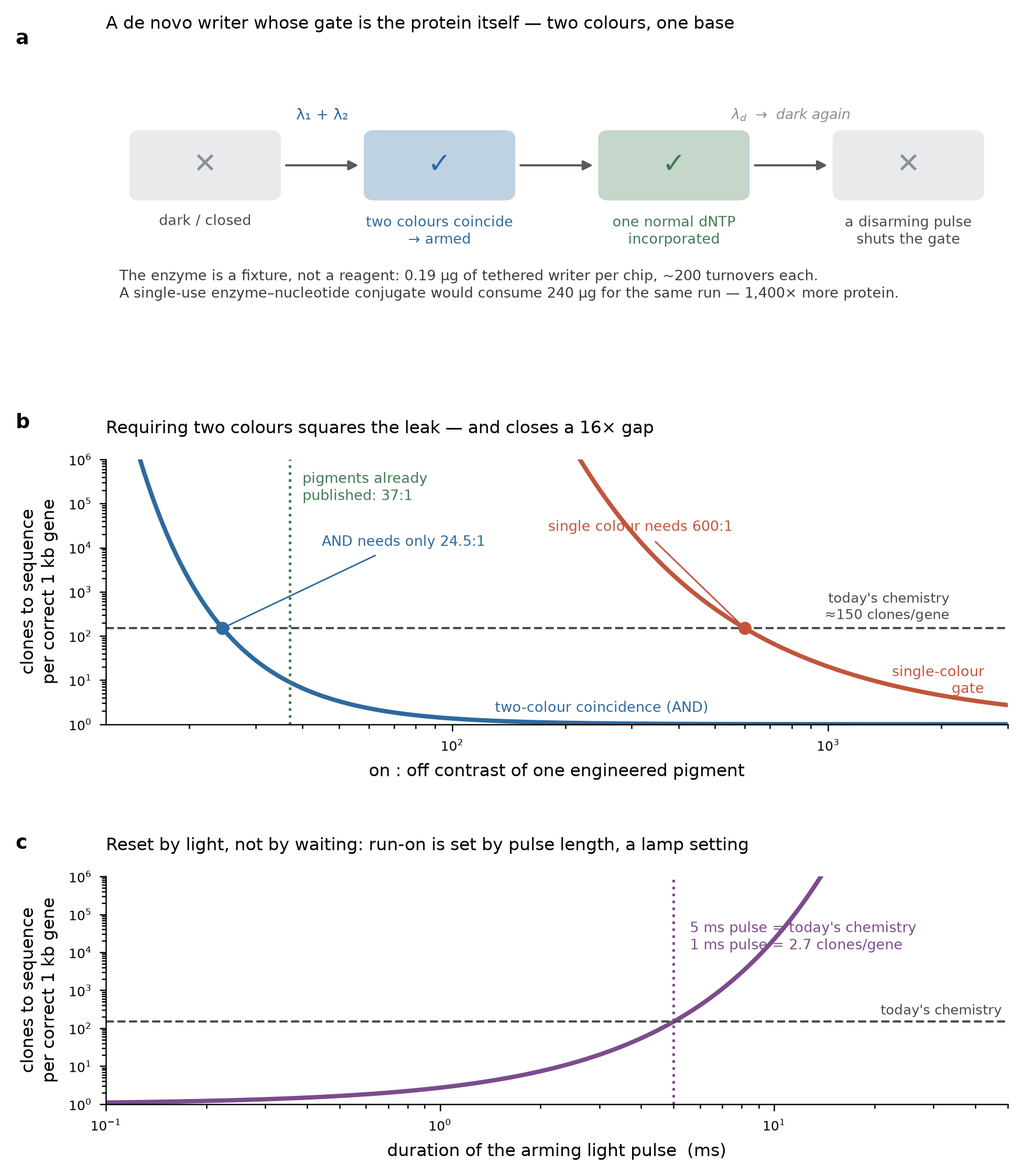
This is the direct price of insisting on normal nucleotides. With no blocking group on the dNTP, nothing physically prevents a second addition; the only thing stopping it is that the gate shuts. An armed writer is therefore in a race: add another base ($k_{\text{cat}}$) versus return to the closed state ($k_{\text{reset}}$). $P(\text{run-on})$ per base $= k_{\text{cat}}/(k_{\text{cat}} + k_{\text{reset}})$, and matching phosphoramidite chemistry (150 clones screened per correct 1 kb gene) requires $k_{\text{reset}} \ge 199 \times k_{\text{cat}}$ — at $k_{\text{cat}} = 1 , \text{s}^{-1}$, a closing time of $\tau \le 5 , \text{ms}$.
If closing had to happen by thermal relaxation that number would probably kill the project: natural LOV domains and cyanobacteriochromes revert in seconds to minutes, $103$–$105$× too slow, and engineering a $10^5$× faster dark reversion without losing the conformational change is not a credible ask.
So the reset is not thermal. It is photochemical, which is why the pigment family matters. Cyanobacteriochromes are photoreversible: one wavelength drives the forward isomerisation, a second drives it back, and both states are thermally stable in between. The cycle is $\text{ARM}(\lambda_1+\lambda_2) \rightarrow \text{incorporate} \rightarrow \text{DISARM}(\lambda_d)$: two light steps per base, no waiting. The run-on window is then not a protein lifetime at all — it is the duration of the arming pulse, a setting on the light engine.
At $k_{\text{cat}} = 1 , \text{s}^{-1}$: a 5 ms arming pulse matches today’s chemistry, 3 ms gives ~20 clones per gene, and 1 ms gives 2.7. Millisecond pulse timing is well within micromirror capability, since mirrors switch in microseconds.
Cost of the disarming pulse: with a typical bilin extinction coefficient ($105 , \text{M}{-1}\text{cm}{-1}$) and photoisomerisation yield ~0.2, reaching $k_{\text{reverse}} = 199 , \text{s}{-1}$ needs $\approx 1 , \text{W/cm}^2$ continuous-wave — an ordinary laser-diode or high-power-LED specification, three orders of magnitude below what a microscope objective routinely delivers. The absorbed energy per pulse raises the 20.7 $\mu$L chamber by $\sim 6 \times 10^{-2} , \text{K}$, assuming no heat leaves through the glass.
Unknown: whether a designed fold retains bistability — both states must be thermally stable on the seconds timescale, or the scheme reverts to the thermal problem it just escaped.
Measurement: forward and reverse photoconversion cross-sections and the dark stability of both states (flash photolysis plus absorbance held over minutes), alongside single-turnover $k_{\text{cat}}$ on a tethered primer in the same buffer.
(ii) Can four pigments share one protein without talking to each other?
Cross-talk sets the substitution rate. Under single-photon gating, a writer whose pigment has on:off contrast r leaks at $3/r$ (three wrong bases), and matching chemistry demands $r \approx 600:1$. The best published two-colour photocage is 37:1 — a 16× shortfall.
This is where the two-colour requirement earns its place. If arming requires two pigments to absorb in coincidence, a wrong base must suffer two independent leaks, so the error rate goes as $3/r^2$ instead of $3/r$. Matching chemistry then needs only $r \approx 24.5:1$ — below what is already published. At $r = 37$ the coincidence code gives ~9 clones per correct gene, ~17× better than phosphoramidite chemistry. Insisting on two colours converts a 16× deficit into a 1.5× margin.
Two clarifications, because this is the point most likely to be misread.
This is two independent linear absorptions, not nonlinear two-photon absorption. Nonlinear 2PA requires femtosecond pulses at $\text{GW/cm}2$ peak intensity, which across 20,000 pixels would indeed cook the chamber. Nothing here needs it. Each chromophore absorbs one ordinary photon by ordinary linear photochemistry; the AND is a structural requirement — the active site only assembles when both pockets are in their converted state. Total photon budget for arming a whole chip: $2.07 \times 10{13}$ photons, 8.2 $\mu$J, delivered as ~8 mW for 10 ms including a 10× allowance for optical losses. Temperature rise: $9.5 \times 10^{-5} , \text{K}$ per cycle, 0.02 K over a 200-base run, assuming zero heat loss. Thermal denaturation is not a constraint in this design.
Förster transfer is why the fold must exceed 55 kDa and why the pigments are bilins. A 55 kDa globular protein has a radius of ~25 Å, so four pockets at the vertices of an inscribed tetrahedron sit ~41 Å apart — not the 15–25 Å the molecular weight alone would suggest. FRET efficiency also depends on the donor’s excited-state lifetime, and bilin photoreceptors are essentially non-fluorescent because photoisomerisation happens in ~1–30 ps and outruns energy transfer. At a donor quantum yield of $10^{-3}$ the Förster radius collapses to $R_0 \approx 19$ Å, giving <1 % transfer at 41 Å. An 80 kDa two-domain fold widens the separation to 46 Å and halves that again.
This is a design commitment rather than a free parameter: the writer is probably not 55 kDa. A two-domain 80–110 kDa architecture — two chromophores per domain, catalytic site at the interface — is the geometry to build, and it is still an ordinary protein to express.
Unknown: whether the excited-state lifetime in a designed pocket stays as short as in the natural protein. A pocket that accidentally makes its bilin fluorescent would reintroduce FRET and collapse the four channels into one.
Measurement: transient absorbance and fluorescence lifetime on single-, double-, triple- and quadruple-chromophore variants, to find the point at which the spectra stop being additive. Combined error budget at plausible values (1 ms arming pulse, $r = 37$): ~3 clones per gene, 50× better than chemistry; at the conservative corner (5 ms pulse, $r = 37$), roughly at parity.
(iii) Does a de novo scaffold reach a useful $k_{\text{cat}}$?
De novo enzymes are real but slow: designed luciferases and serine hydrolases work, and they are orders of magnitude below evolved catalysts. Everything in §4 scales with $k_{\text{cat}}$, and at $0.1 , \text{s}^{-1}$ a run takes 100 minutes instead of 10 — still useful, but no longer transformative. Because no de novo nucleotidyl transferase exists to calibrate against (§5B.1), there is no prior for where a first-generation design would land.
Measurement: incorporation rate under saturating dNTP on a tethered primer, for the top 20 designs — and whether activity survives immobilisation, which is a separate question from whether it exists in solution.
5B. What the field cannot do yet
These are limits of the current state of the art rather than of a particular experiment — places where the project asks the discipline for something it does not yet reliably deliver.
1. There is no de novo nucleotidyl transferase, anywhere. Designed luciferases (doi:10.1038/s41586-023-05696-3) and serine hydrolases (doi:10.1126/science.adu2454) are real, and both are single-substrate reactions with a well-understood nucleophilic mechanism. A polymerase is a different category: two catalytic metal ions held at a precise separation, a templating interaction that reads a base and selects its partner from solution, and a translocation step after every addition. A literature search returns no de novo design of this mechanism, so the first unknown is whether the class is reachable with current generative methods.
2. Allostery cannot be designed to order. The idea rests on a conformational switch: the catalytic geometry must exist in one chromophore state and not the other. Current methods are very good at producing a structure stable in one state. Designing a controlled change between two states — of specified magnitude, at a specified place, triggered by a specified input — is unsolved. Two-state and multi-state methods work in favourable cases; none has placed a catalytic site under the control of four independent inputs. This is the deepest gap in the proposal.
3. The transmission from photoisomerisation to catalysis cannot be specified. The chromophore’s structural change is small and local. Converting it into the formation or destruction of an active site tens of ångströms away is a signal-transmission design problem, and no method takes “this motion here” and “this geometric change there” as inputs and returns a scaffold. Natural photoreceptors do it; it cannot yet be specified.
4. Computational scoring cannot predict catalysis. Every available filter — structure-prediction confidence, energy scores, simulated barriers — predicts structure and stability, not turnover number. That is why §3a screens tens of thousands rather than calculating on ten: the fraction-of-a-percent hit rate for de novo catalytic designs measures how poorly the in-silico stage predicts the thing that matters. Improving that prediction would change this project more than any hardware would.
5. Engineered bilin photochemistry in a non-natural scaffold is largely uncharted. Cyanobacteriochromes are well characterised inside their own domains. What happens to quantum yield, isomerisation speed, absorption maximum and bistability when the same cofactor sits in a fold evolution never made is not predictable today — and that is exactly the set of properties §5A(i) and §5A(ii) depend on. No systematic map of bilin behaviour across designed pockets exists.
6. Quantitative photochemistry of designed proteins is measured one at a time. Transient absorption spectroscopy is slow, expensive and expert. A campaign needing the photocycle of hundreds of variants would need a high-throughput version of that measurement, which does not exist. Partly solving it would be a piece of the project.
7. Immobilised-enzyme kinetics are not predictable from solution behaviour. The writer only works tethered. Whether a designed enzyme retains its activity and its photocycle when anchored at high density on a surface is not something the design stage can anticipate, and the general question is unresolved.
5C. What the project would require
A facilities and collaboration question rather than a scientific one.
Sustained large-scale computing. The design loop in §3a runs to thousands of GPU-hours per round, dominated by enhanced sampling, and only makes sense over many rounds. A personal GPU workstation is enough to build, test and validate the pipeline end-to-end at small scale; a production round needs cluster-scale allocation — normal to have inside a research group, normal to lack outside one.
Ultrafast spectroscopy. The measurements that decide §5A(i) and §5A(ii) — transient absorption on picosecond–nanosecond timescales, fluorescence lifetime, photoconversion cross-sections — belong to shared facilities or photophysics laboratories. This is a collaboration to arrange before committing to the design, not after.
High-throughput protein production and screening. The design round in §3a assumes acoustic dispensing, plate-format cell-free expression, and a reader with programmable illumination. Each piece is standard in an automated protein-engineering laboratory; assembling them is the difference between a round every few weeks and a round every few months.
Photochemistry expertise alongside protein design. The design, modelling, screening and directed-evolution half is protein and computational biology. The photophysics half — quantum yields, excited-state lifetimes, the spectroscopy itself — is a distinct craft, so the sensible structure is a protein-design effort with a photochemistry partner rather than one person attempting both.
A first success to build on. Section 4 assumes a writer that works at all. The honest sequencing is: first show that a designed fold can hold a bilin and switch something with light; then that a designed fold can add one nucleotide; then attempt the integration. Each is a publishable result on its own, and the failure of any of them would still leave the field better informed.
Figure
(a) The cycle: closed $\rightarrow$ two colours coincide $\rightarrow$ one ordinary dNTP $\rightarrow$ a disarming pulse shuts the gate. (b) Requiring two colours squares the leak, turning a 16× photochemistry deficit into a 1.5× margin over what is already published. (c) Because the reset is photochemical rather than thermal, the run-on error is set by the length of the arming pulse — a setting on the light engine, not a protein lifetime.
References
Hoogenboom, J. et al. Cyanobacteriochromes: a rainbow of photoreceptors. Annu. Rev. Microbiol. doi:10.1146/annurev-micro-041522-094613
Yeh, A. H.-W. et al. De novo design of luciferases using deep learning. Nature doi:10.1038/s41586-023-05696-3
Lauko, A. et al. Computational design of serine hydrolases. Science doi:10.1126/science.adu2454
Ahern, W. et al. Atom-level enzyme active site scaffolding using RFdiffusion2. Nat. Methods doi:10.1038/s41592-025-02975-x
Palluk, S. et al. De novo DNA synthesis using polymerase–nucleotide conjugates. Nat. Biotechnol. (2018) doi:10.1038/nbt.4173 — the single-use-enzyme architecture this proposal is defined against.
Parallelised enzymatic DNA synthesis on an electrochemical array. ACS Synth. Biol. (2023) doi:10.1021/acssynbio.3c00044 — closest prior art; parallelises cleavage only, not base selection.
Baumschlager, A. et al. Optical control of transcription: photoswitchable T7 RNA polymerase variants. ChemBioChem doi:10.1002/cbic.201900298
AI use
AI client: Claude (Anthropic), used through the Claude Science research environment.
What is mine. The idea, the system, and the architecture are my own: a de novo designed enzyme that carries its own engineered pigments, is gated by the coincidence of two colours, uses ordinary unmodified nucleotides, and is tethered to a surface so that light can address it. The choice to put the gate inside the protein rather than on the nucleotide, the decision to require two colours rather than one, the four-pigment layout, and the two-stage automation plan are all mine, and I arrived at them before this document existed.
What I used the AI for. Two things: numerical work and drafting.
Numbers. I asked it to set up and run the back-of-the-envelope calculations in §4 and §5 as Python, and to plot the results — the 1/e bound on time-gated addition, the diffusion length of the writer in a reaction window, the clones-per-correct-gene error model, the scaling of the coincidence code, the photon and thermal budget, the Förster-radius and pocket-separation geometry, the photoreversion power requirement, and the campaign and catalyst-reuse arithmetic. I specified what to compute and which assumptions to use; it did the arithmetic and produced the figure from that code.
Writing. I drafted and directed the content, and used the AI to help organise and phrase it in English, which is not my first language.
How it changed the design. Usefully, and twice. The diffusion calculation showed that the original free-solution version could not work — the writer would cross several pixels before reacting — which is why the design is now tethered. The Förster-radius calculation showed that four pockets do not fit comfortably in 55 kDa, which is why the fold is now two-domain and 80–110 kDa. I asked for the numbers that would break the idea, and where they did, I changed the idea.