Final Project
From biological colour to spatial pattern formation
Living Inkblot for Bees · Research development and presentation preparation, October–November 2026
Status. Ongoing investigation. Computational design and experimental planning are underway. No spatial cell-free prototype is claimed, and laboratory validation is pending.
Download the crit slides (PDF)
Final project crit · three slides
1. Revisiting the original proposition
Preparing a three-slide progress presentation gave me a reason to review how Living Inkblot for Bees has developed since its proposal in September, through the molecular and computational investigations of the weeks that followed.
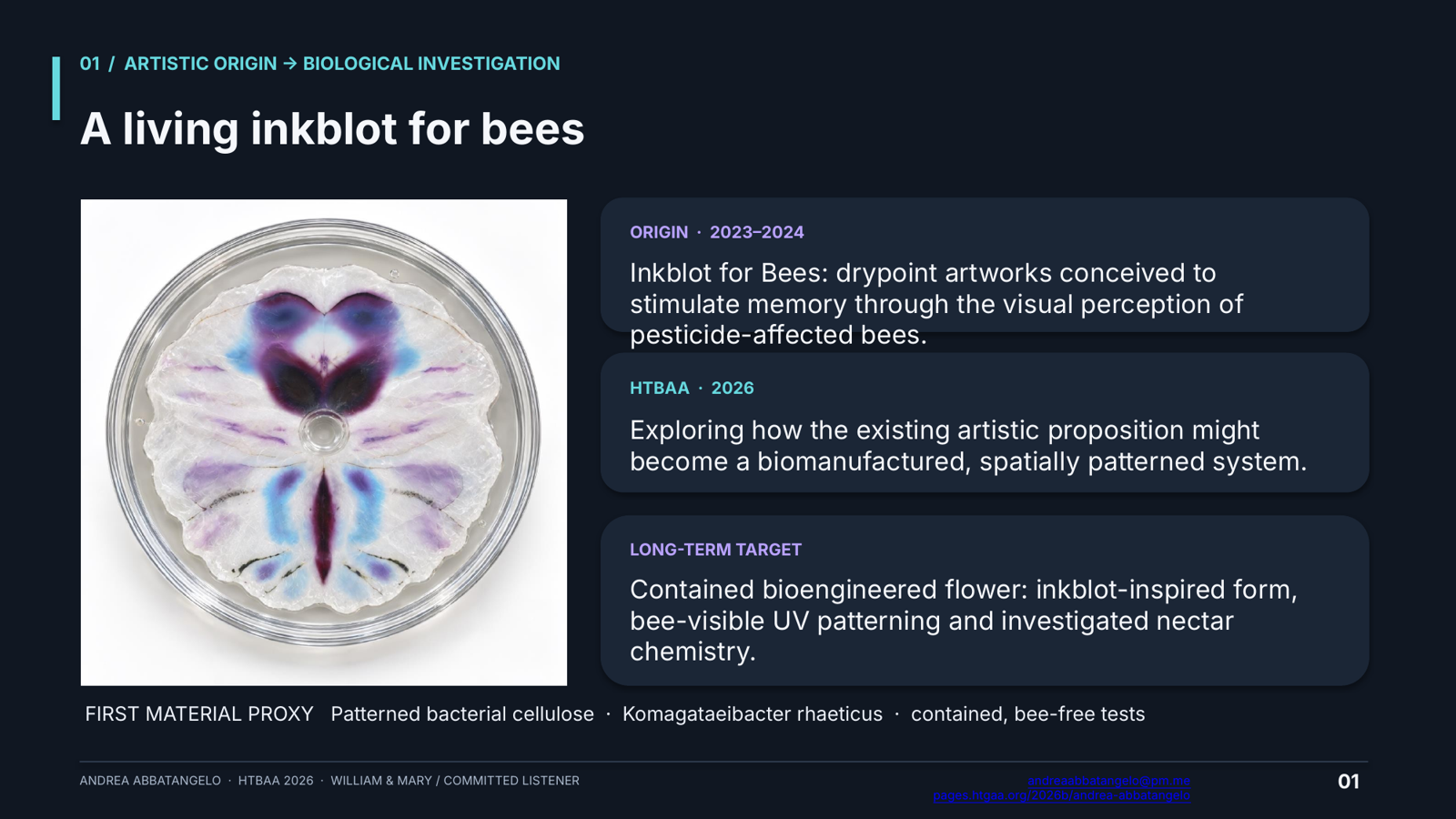
The project originates in Inkblot for Bees (2023–2024), a series of drypoint prints made to investigate whether the memory of bees might be stimulated through visual perception following pesticide exposure. The series proposed an artistic intervention into the relationship between perception, memory and environmental toxicity, and its cognitive effects were speculative instead of experimentally demonstrated.
For HTBAA I began investigating whether that proposition could be translated into a biomanufactured system. The long-term objective is a contained, bioengineered flower combining inkblot-inspired morphology, bee-visible ultraviolet patterning and experimentally investigated nectar chemistry. The immediate research concerns which biological manufacturing processes could contribute to that objective.
2. Returning to Homework #1
The first stage involved revisiting my original nine-page proposal alongside the assignment’s five questions: what should be biomanufactured and why, which living system could produce it, how automation could contribute, what quantities and production times would be required, and which technical uncertainties remain unresolved.
The proposal established two parallel biological systems, and the distinction between them remains central.
The long-term system. A genetically engineered flowering plant, with investigations into floral developmental regulation, UV-absorbing pigment distribution and nectar chemistry.
The experimental proxy. A contained bacterial-cellulose material grown by Komagataeibacter rhaeticus, potentially supporting patterned pigmentation and a chemically defined liquid reservoir.
The cellulose object allows selected optical and material questions to be investigated without requiring the immediate engineering of a living flower. The original manufacturing estimate proposed 12 to 20 experimental units, each approximately 50 cm², giving a maximum patterned area near 0.1 m². A 10 to 14 day parallel culture cycle served as a planning assumption, beyond which no production result has been measured.
3. Investigating biological colour
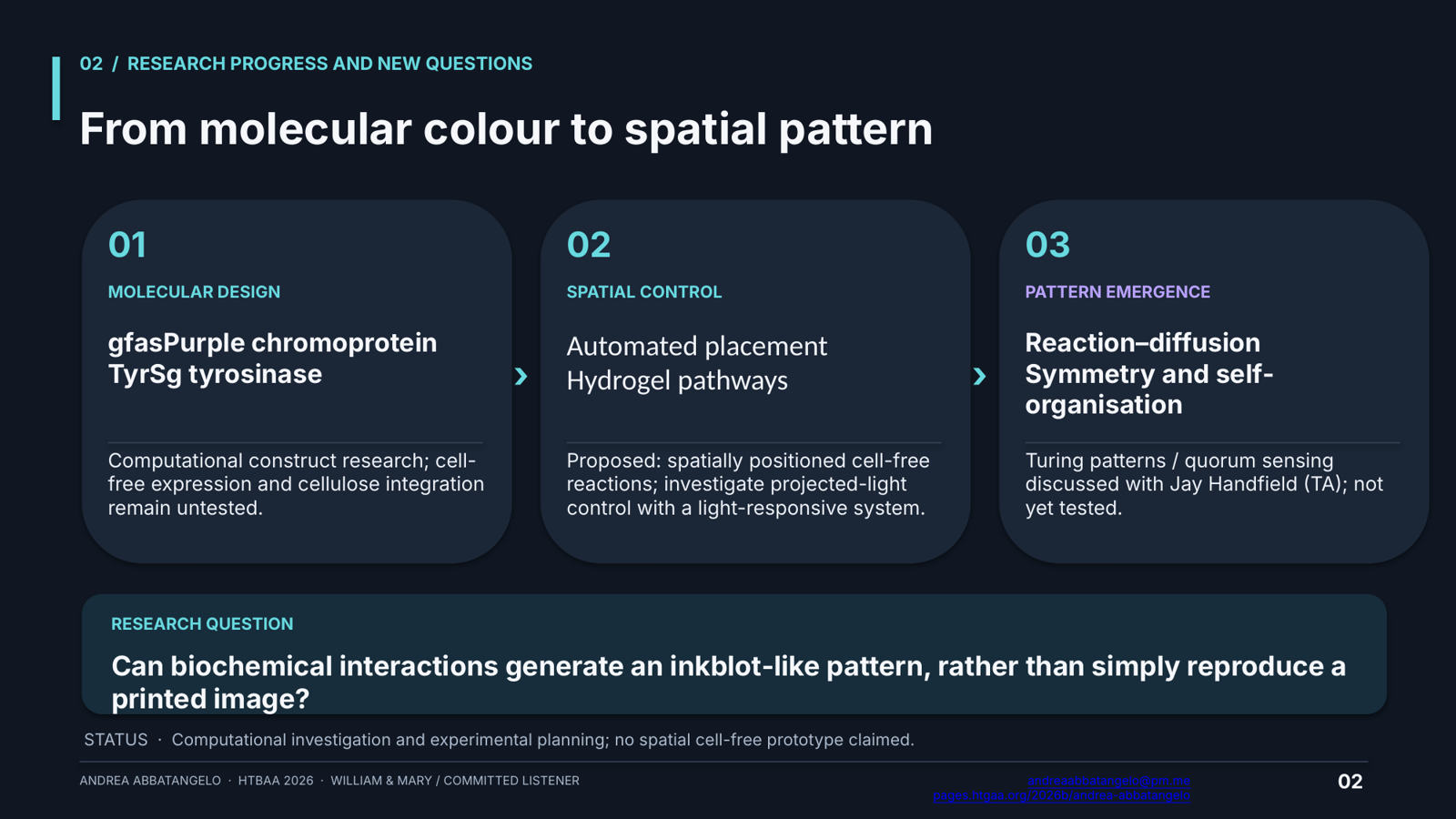
The next stage reviewed the course work on cell-free protein synthesis and biological pigment production. Through the computational exercises I investigated candidate chromoproteins and pigment-generating enzymes, including gfasPurple and a tyrosinase identified as TyrSg (UniProt P06845, Streptomyces glaucescens), covering molecular sequence research, construct design, sequence verification and protein-expression systems.
These investigations introduced a distinction that now runs through the whole project: producing a protein is one thing, and obtaining a functional pigment-producing system is another.
They also raised further questions. How could a pigment be localised? Could its production be spatially regulated? Would the resulting material retain its optical properties through growth, drying and rehydration?
The computational work provides a foundation for experimental design. It stops short of a demonstrated cell-free pigment or a patterned-cellulose prototype.
4. Symmetry, randomness and biological organisation
A further stage focused on how biological patterns emerge, considering the relationship between bilateral symmetry, developmental morphogenesis, randomness and self-organisation. How Symmetry Shapes Randomness and Patterns in Nature provided a conceptual reference for understanding how local interactions produce structured forms, and how development generates departures from perfect symmetry.
This led to a more specific question:
Could the inkblot’s visual structure emerge through biochemical processes, instead of being imposed as a predetermined image?
The distinction matters. A pattern printed onto a biological material is a different thing from a pattern generated through the interactions of that material’s own processes. For this project it opens the possibility of treating the inkblot as an evolving biochemical organisation in place of a fixed visual composition.
5. Tutorial: Turing patterns and quorum sensing
A tutorial with Jay Handfield identified two relevant directions.
Turing reaction–diffusion patterns. Chemical interactions and diffusion can, under suitable conditions, generate spatial structures through self-organisation.
Quorum sensing. Microorganisms coordinate aspects of gene expression through chemical signalling associated with population density.
The two mechanisms operate differently, and both offer approaches to the relationship between local biochemical interactions and larger-scale organisation. The tutorial moved the investigation from the production of biological colour toward the regulation of its spatial distribution. Neither mechanism has been implemented here, and neither guarantees the emergence of bilateral inkblot structures.
6. A new direction: spatially programmable cell-free reactions
During the final stage of preparing the slides a technical question emerged. Could an automated cell-free system position biochemical components spatially, controlling which reactions occur together with where and how their products develop?
That prompted an investigation into spatially programmable cell-free synthetic biology, which identified several approaches for further study:
- Automated positioning of reaction mixtures through liquid handling and droplet deposition.
- Cell-free protein expression within patterned hydrogels and microfluidic networks.
- Controlled diffusion between spatially separated reaction regions.
- Light-regulated biochemical activation.
- Reaction–diffusion networks capable of generating spatial structures through chemical interactions.
These suggest three experimental stages.
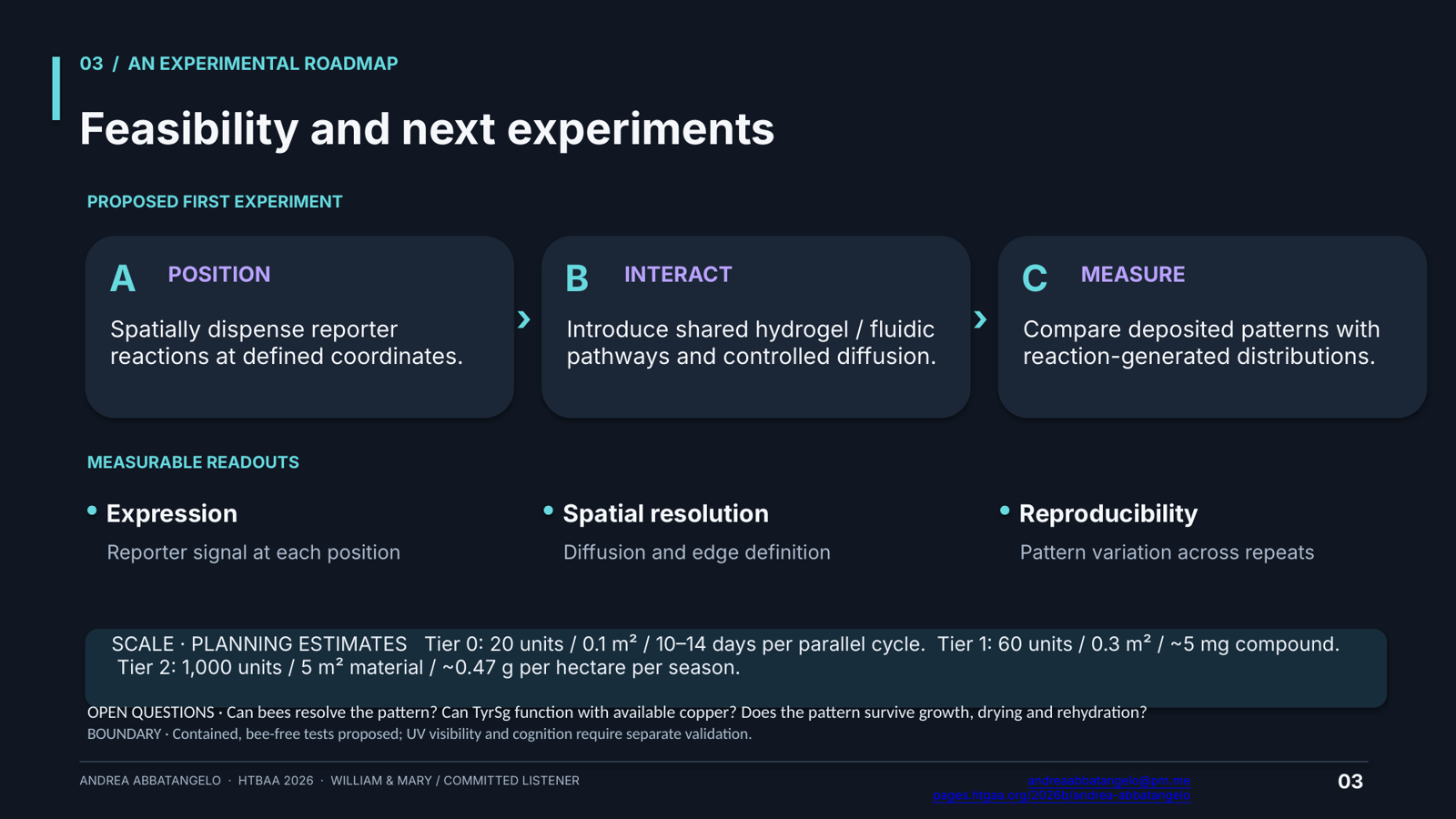
| Stage | Focus | Description |
|---|---|---|
| A | Spatial positioning | Place cell-free reactions at defined coordinates and measure their individual outputs. |
| B | Spatial interaction | Investigate how reaction products move and interact through a shared material or fluidic environment. |
| C | Emergent organisation | Explore whether biochemical feedback and diffusion generate patterns the initial arrangement leaves unspecified. |
The progression offers an experimental bridge between molecular pigment production and the longer-term objective of biological pattern formation. It remains a research direction ahead of an established experimental capability.
7. The three slides
The presentation was organised around three connected subjects, and revised iteratively to separate completed research from experimental proposals.
Slide 1 · Artistic origins and biological ambition. The relationship between the drypoint series and the proposed biomanufactured flower, identifying the engineered plant as the long-term objective and bacterial cellulose as the experimental proxy.
Slide 2 · From pigment to pattern. The cell-free pigment investigations, computational molecular design, biological symmetry research and emerging interest in spatially programmable biochemical reactions.
Slide 3 · Feasibility, unknowns and next tests. A return to the practical questions of Homework #1: scale, automation, experimental progression, material stability, bee-visible pattern resolution and containment.
Scale, as presented
| Tier | Units | Material | Compound |
|---|---|---|---|
| 0 · course prototype | 20 | 0.1 m² | — |
| 1 · behavioural study | 60 | 0.3 m² | ~5 mg |
| 2 · one hectare | 1,000 | 5 m² | ~0.47 g per season |
The striking result of the calculation is that the active compound costs almost nothing. The whole engineering problem lives in the material and the pattern.
Open questions, as presented
Can bees resolve the pattern? Bee vision has poor spatial acuity compared with ours, on the order of a few degrees of visual angle, so an inkblot designed for a human eye may register as a single blur.
Can TyrSg function with available copper? Tyrosinase requires copper at its catalytic centre, excess free copper may inhibit the cell-free machinery, and incorporation may depend on the MelC1 chaperone.
Does the pattern survive growth, drying and rehydration?
8. Current research position
Preparing the slides clarified three connected areas of investigation.
Biological production. How can proteins, pigments and other functional compounds be manufactured through cell-free or microbial systems?
Spatial organisation. How can biochemical reactions be positioned, coupled or allowed to self-organise within a material?
Pollinator perception. How might the resulting morphology, optical pattern and chemistry eventually be evaluated against the visual and cognitive capacities of pesticide-affected bees?
The immediate priority is to establish which biological manufacturing approaches produce measurable, spatially organised materials suitable for further investigation. Demonstrating an effect on bee memory belongs much later. The first experimental stages remain contained and bee-free.
9. Reflection
Preparing this presentation revealed a development in the project. The initial question concerned whether an existing artistic proposition could be translated into a living biological artefact. The emerging investigation is more specific: whether biochemical reactions can be spatially organised so that a visual structure develops through the material’s own processes.
That identifies a possible experimental route toward the original ambition of Living Inkblot for Bees, which it leaves intact. The project is moving from an investigation of biological colour toward an investigation of biological pattern formation as an artistic and biomanufacturing process.
Containment and ethical boundaries
These are design constraints of the proposal, and they shape what the first generation can be.
The first generation stays out of any natural environment and is presented to no living bees. Its purpose is to establish whether the material can be grown, patterned in the ultraviolet range, biologically contained and used to hold a chemically defined sugar solution.
During manufacture the engineered microorganism remains inside a controlled laboratory system. Before the material leaves containment or enters any exhibition context, it is rendered non-viable while the cellulose structure and the optical pattern are preserved. In that sense the first object is a material biomanufactured by a living system.
Any later experiment involving living bees constitutes a separate research phase, proceeding after the material’s chemical composition, microbial containment, stability, dosage and potential toxicity have been characterised, and after consultation with pollinator researchers, biosafety specialists and the relevant ethics or regulatory bodies.
The engineered plant carries its own version of these constraints: sterility, contained growth, and no release of a first generation.
Related documentation
The cell-free work that informs this project is documented in Week 3 and Week 4, covering twenty-one Reteplase conditions submitted to the CFPS coopetition across five batches. The target protein is unrelated to this project. The reaction economy it teaches is not, since a pigment that arrives by expression depends on the same budget as any other protein.
References and resources
- HTBAA Homework #1, assignment and original Living Inkblot for Bees proposal, September 2026.
- HTBAA computational investigations into cell-free protein synthesis, chromoproteins and tyrosinase, October 2026.
- How Symmetry Shapes Randomness and Patterns in Nature, Revive Biotech, October 2025.
- Turing patterns · Quorum sensing
- Cell-Free Gene Expression in Bioprinted Fluidic Networks, ACS Synthetic Biology, 2024.
- Programmable Patterns in a DNA-Based Reaction–Diffusion System, Soft Matter, 2020.
- Wright, G. A., et al. (2013). Caffeine in floral nectar enhances a pollinator’s memory of reward. Science, 339(6124), 1202–1204. doi:10.1126/science.1228806
Use of AI
Clients: OpenAI GPT-6, Anthropic Claude (Opus 5).
Used for biochemical reasoning, construct verification against UniProt and the Ginkgo reference formulations, arithmetic checking on reaction volumes, slide review, and editorial development of this documentation. The framing, the artistic motivation and the decision to test before treating are mine. Per-assignment prompt citations appear on the individual week pages.