Week 1 HW: Final Project Ideas
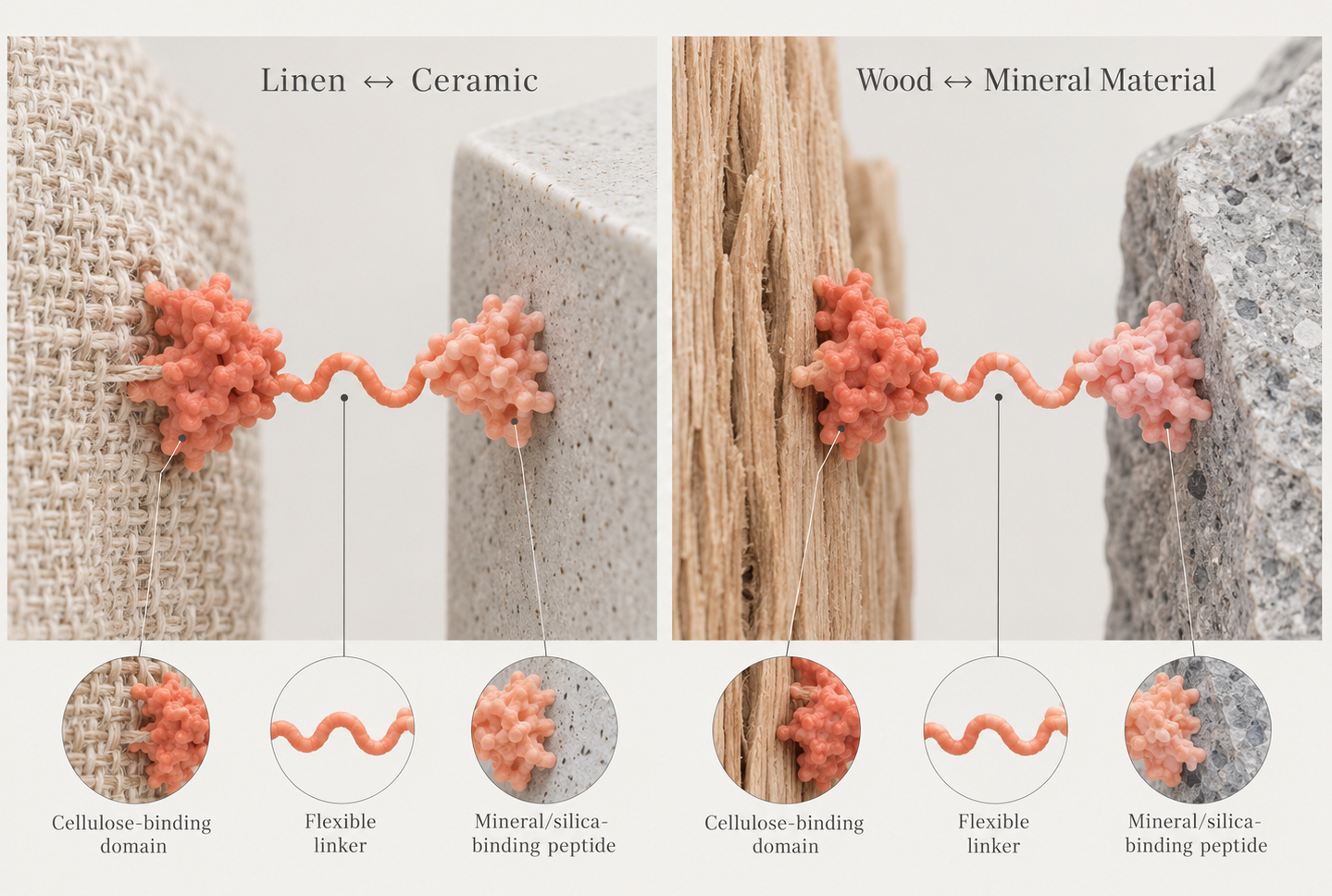
Molecular Bridge
Genetically Encoded Bio-Connectors for Programmable Material Interfaces
1. What am I biomanufacturing and why?
I would like to biomanufacture a protein-based bio-connector that can be genetically programmed to interact with specific material surfaces.
My interest comes from my previous work with mycelium-based material systems, where I explored the ability of fungal growth to bind different materials together. That work made me interested in a larger question:
Can biological attachment be designed at the molecular level, rather than relying only on a living organism to grow across an interface?
In architecture, product design, and construction, materials are commonly joined using mechanical fasteners or synthetic adhesives. Adhesives are effective, but permanent bonding can make multi-material assemblies difficult to repair, separate, reuse, or recycle. Instead of developing one universal biological glue, I propose a modular protein connector whose two ends can be selected according to the materials being joined.
Cellulose ↔ cellulose: cellulose-binding domain → linker → cellulose-binding domain
Cellulose ↔ silica: cellulose-binding domain → linker → silica-binding peptide
Silica ↔ silica: silica-binding peptide → linker → silica-binding peptide
For the first prototype, I propose a bifunctional protein with the general architecture:
graph LR
A[Cellulose-binding domain] --> B[Flexible linker] --> C[Silica-binding domain]

style A fill:#F7D9D3,stroke:#D98F83,stroke-width:1.5px,color:#4A332F
style B fill:#FBE7E2,stroke:#DFA49A,stroke-width:1.5px,color:#4A332F
style C fill:#F4CFC7,stroke:#D78274,stroke-width:1.5px,color:#4A332F
The first domain would recognize cellulose-rich materials such as paper, cotton, linen, hemp, or wood.Cellulose-binding domains, often described as carbohydrate-binding modules, are naturally occurring protein domains that have strong non-covalent affinity for cellulose.The second end of the protein would contain a short silica-binding peptide, giving it affinity toward silica-rich surfaces. A flexible peptide linker would connect the two binding regions and allow them some freedom to orient toward their respective surfaces. The hypothesis is therefore:
graph LR
A["Cellulose / Paper / Cotton"] -->|binds| B["Cellulose-binding domain"]
B --> C["Flexible linker"]
C --> D["Silica-binding peptide"]
D -->|binds| E["Glass / Silica"]

style A fill:#F7F7F5,stroke:#A8A8A3,stroke-width:1.5px,color:#3F3F3C
style B fill:#F7D9D3,stroke:#D98F83,stroke-width:1.5px,color:#4A332F
style C fill:#FBE7E2,stroke:#DFA49A,stroke-width:1.5px,color:#4A332F
style D fill:#F4CFC7,stroke:#D78274,stroke-width:1.5px,color:#4A332F
style E fill:#F7F7F5,stroke:#A8A8A3,stroke-width:1.5px,color:#3F3F3C
If successful, later versions could be translated into more architecturally relevant interfaces such as:
linen ↔ ceramic or wood ↔ mineral material
The same strategy could potentially work between similar materials as well. A connector containing cellulose-binding functions at both ends could be explored for cellulose-to-cellulose interfaces, while mineral-binding domains could potentially connect two mineral surfaces. The broader vision is therefore a library of programmable biological connectors, where different material-binding protein domains could be combined depending on which materials need to interface. For this course, I am not trying to demonstrate a structural replacement for epoxy or construction adhesive. My first goal is much smaller and experimentally measurable: Can I genetically design and manufacture a bifunctional protein that demonstrates measurable interaction with both cellulose and silica-based surfaces?
2. What living system would I use?
I would use an E. coli-based cell-free protein synthesis system (CFPS) as the primary biomanufacturing chassis. Instead of maintaining an intact genetically engineered organism, cell-free protein synthesis uses the molecular machinery extracted from cells, including ribosomes, enzymes, and other components required for transcription and translation. The simplified manufacturing process would be:
DNA → transcription → mRNA → translation → Bio-connector protein
The DNA would contain the genetic instructions encoding the complete connector protein. The cell-free reaction would receive:
DNA template + cell lysate + amino acids + nucleotides + energy system + salts/cofactors
and produce: the bio-connector protein
I am choosing cell-free manufacturing because it allows rapid iteration. If I change the DNA sequence of the connector, I can test a new protein without first establishing an entirely new engineered cell line. It also creates a direct connection between genetic design and material performance:
change DNA → change protein → test material interaction
Cell-free systems are also well suited to automated, small-volume experiments. For larger-scale manufacturing in the future, an engineered microbial chassis such as E. coli could potentially produce the protein through fermentation. Therefore: Prototype chassis: cell-free protein synthesis Future scale-up chassis: microbial protein production Although the primary manufacturing chassis for this project will be an E. coli-based cell-free protein synthesis system, the proteins being manufactured do not need to originate from E. coli. One direction I would like to investigate is the use of fungal-derived surface-active proteins, particularly hydrophobins, as components of the bio-connector system. Hydrophobins are small proteins naturally produced by filamentous fungi that assemble at interfaces and alter surface properties. Rather than genetically engineering and culturing fungi during the first stage of the project, DNA encoding a selected fungal protein could be introduced into a cell-free expression system and the resulting protein tested directly on different material surfaces.
The project could therefore combine:
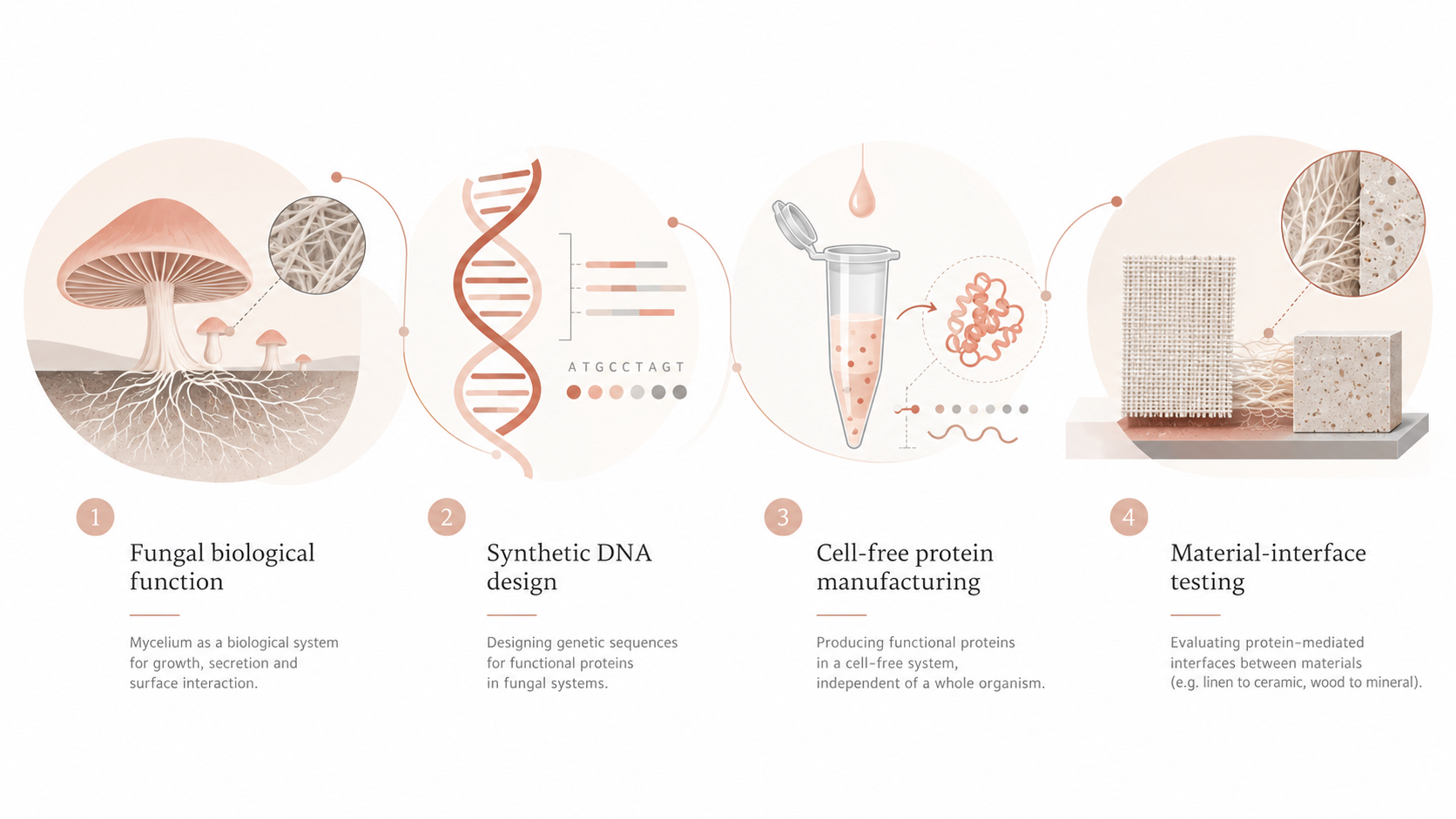
In later research, promising protein designs could potentially be transferred back into a fungal chassis, allowing an engineered fungus to produce or secrete the material-binding proteins directly at an interface. This would extend the system from a manufactured protein connector toward a living material capable of growing its own connection.
3. How would I use automation?
I would use automated liquid handling to create a small Design–Build–Test–Learn workflow. A desktop liquid-handling robot such as an Opentrons system, or a larger automated laboratory platform, could prepare multiple cell-free reactions while precisely controlling reagent volumes. The workflow would be: Design DNA ↓ Automated cell-free protein production ↓ Apply protein to material samples ↓ Measure binding ↓ Compare designs and conditions ↓ Improve the next design
During early experiments, automation could vary parameters such as protein concentration, pH, salt concentration, linker design, and material type.The first tests could use small cellulose and silica particles or material coupons rather than full architectural components. For example, multiple wells could contain:
cellulose + connector protein silica + connector protein material + no protein material + non-specific control protein
After incubation, controlled washing could remove weakly associated protein. A fluorescent reporter or protein-labeling method could initially be used to quantify how much protein remains bound after washing.This would allow me to answer a very basic but essential question: Does the engineered protein bind preferentially to the material it was designed to recognize? Once promising conditions are found at small scale, the same protein could be applied to a physical joint between two material coupons. In the longer term, the same workflow could screen a library of material-binding domains and generate a database connecting: protein design → material chemistry → binding performance
4. How much needs to be made, and how long would it take?
For this course, I define a meaningful scale as a small material-interface demonstrator supported by replicated laboratory tests. I would initially make two types of joints: cellulose ↔ cellulose and cellulose ↔ silica I would prepare three replicates of each condition: 3 cellulose–cellulose joints + 3 cellulose–silica joints= 6 connector-treated samples
Assume each sample has an overlap area of: 2 cm × 2 cm = 4 cm²
Total treated interface area: 6 × 4 cm² = 24 cm²
For an initial screening assumption, I will estimate approximately: 20 µg of protein per cm² The exact optimal surface loading is unknown and would need to be experimentally determined. Protein needed for the physical samples: 24 cm² × 20 µg/cm² = 480 µg
I would also need protein for small-scale binding assays, measurement, repeat experiments, and handling losses.I would therefore set an initial target of approximately: 1 mg of bio-connector protein for one complete prototype campaign.
For an initial calculation, I will assume a usable cell-free yield of: 0.5 mg/mL The actual yield of this particular fusion protein is currently unknown and would need to be measured. Required CFPS reaction volume would therefore be approximately: 1 mg ÷ 0.5 mg/mL = 2 mL total cell-free reaction
I would not begin directly with a 2 mL reaction. Initial expression screening could happen at microliter scale. Only after confirming that the protein is successfully produced would the reaction be scaled up.A complete experimental cycle could approximately be:
Protein expression: several hours
Protein recovery / concentration / quality check: approximately 1 day
Material-binding experiment: approximately 1 day
Wash, measurement and physical interface testing: approximately 1 day
Therefore, after the DNA template is available, I estimate a complete design-test cycle could occur in approximately: 2–4 days depending on protein purification and equipment availability. At larger architectural scales, the manufacturing strategy would likely change. For example, a surface area of 1 m² is: 10,000 cm² At the same assumed protein loading of 20 µg/cm²: 10,000 cm² × 20 µg/cm² = 200,000 µg = 200 mg protein This calculation shows why cell-free synthesis may be ideal for early prototyping while microbial fermentation or another scalable production strategy could eventually become more appropriate for architectural quantities.
5. What I don’t know yet?
The first major unknown is whether both binding domains will still function when combined into one protein.Both cellulose-binding domains and silica-binding peptides have independently demonstrated material affinity. However, combining them into one protein may affect folding, orientation, accessibility, or solubility.The flexible linker may therefore be an important design variable. The second major unknown is whether molecular surface binding will translate into meaningful mechanical adhesion. A protein may bind strongly to cellulose or silica at the molecular level but still fail to generate enough collective force to create a useful macroscopic joint. Therefore, I need to distinguish between: molecular binding and mechanical bonding The first experimental milestone is proving selective material binding. Mechanical joint strength would be the next level of investigation.The third major unknown is how strongly real material surfaces will affect performance.A clean silica surface and an architectural ceramic surface are not identical. Likewise, purified cellulose differs significantly from wood, linen, or hemp.Variables such as surface chemistry, roughness, porosity, moisture, contamination, and coatings could all influence protein attachment.I would therefore begin with controlled surfaces such as cellulose/paper and glass before progressing toward wood, textile, ceramic, or other construction materials.
Proposed Course-Scale Success Criterion
I would consider the project successful if I can demonstrate that: A genetically encoded bifunctional protein can be produced using cell-free protein synthesis and shows measurable material-specific binding to both cellulose and silica surfaces compared with appropriate controls. A successful mechanical joint would be an additional achievement, but it is not required to prove the underlying biological concept. The longer-term research direction would investigate: stronger connector variants → similar-material connectors → reversible connectors → architectural material systems → engineered organisms capable of producing connectors locally The eventual vision is a new type of material interface that is not simply glued together chemically, but whose binding behavior is encoded biologically.
References
Abdelhamid, M. A. A., Motomura, K., Ikeda, T., Ishida, T., Hirota, R., & Kuroda, A. (2014). Affinity purification of recombinant proteins using a novel silica-binding peptide as a fusion tag. Applied Microbiology and Biotechnology, 98, 5677–5684.
Chong, S. (2014). Overview of cell-free protein synthesis: Historic landmarks, commercial systems, and expanding applications. Current Protocols in Molecular Biology, 108, 16.30.1–16.30.11.
Li, S., & Liu, G. (2024). Harnessing cellulose-binding protein domains for the development of functionalized cellulose materials. Bioresources and Bioprocessing, 11, 74.
Silverman, A. D., Karim, A. S., & Jewett, M. C. (2020). Cell-free gene expression: An expanded repertoire of applications. Nature Reviews Genetics, 21, 151–170.
Use of AI
I used ChatGPT (OpenAI, GPT-5.6 Sol) as a learning and research assistant to help me understand molecular biology concepts, explore material-binding proteins and cell-free protein synthesis, evaluate project feasibility, structure the proposal, and develop preliminary scale calculations. Representative prompts included:
How can I develop a biomanufacturing project that connects biology with architecture and material interfaces while remaining achievable within the course?
Can a genetically encoded protein connector work between similar and dissimilar materials?
Can cell-free protein synthesis be used as the chassis for producing a material-binding fusion protein?
What are existing cellulose-binding and silica-binding protein systems, and how could they be combined into a testable material-interface project?
Based on the HTBAA Homework 1 requirements, develop a realistic biomanufacturing proposal for a genetically encoded bio-connector and clearly identify assumptions and unknowns.