Week 4 LAB: Cell-Free Manufacturing
1. sfGFP — NTP to NMP Replacement
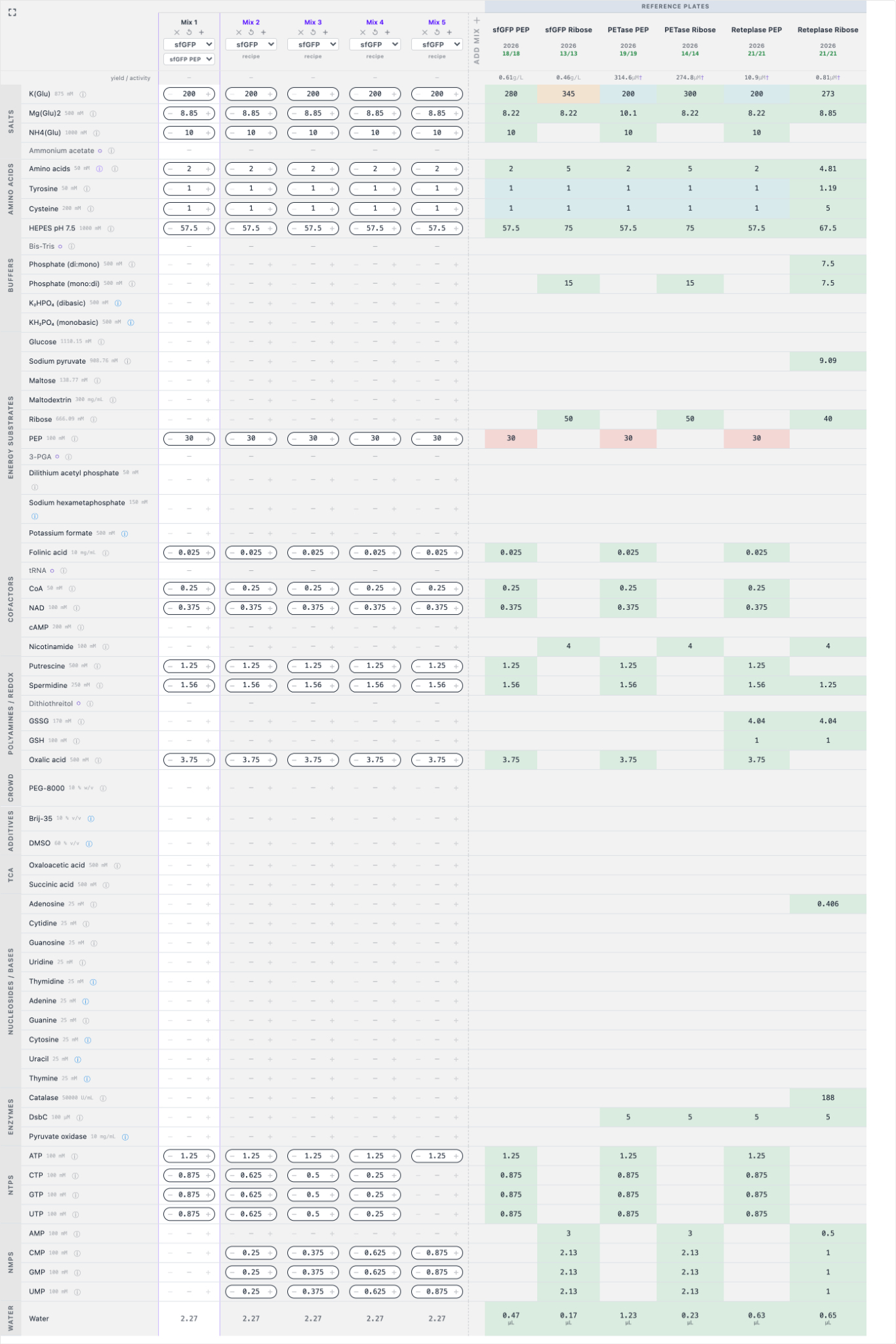
For sfGFP, I tested whether the more expensive NTPs CTP, GTP and UTP could be gradually replaced with the cheaper NMPs CMP, GMP and UMP.
| Mix | CTP / GTP / UTP | CMP / GMP / UMP |
|---|---|---|
| Mix 1 | 0.875 mM each | 0 |
| Mix 2 | 0.625 mM each | 0.25 mM each |
| Mix 3 | 0.50 mM each | 0.375 mM each |
| Mix 4 | 0.25 mM each | 0.625 mM each |
| Mix 5 | 0 | 0.875 mM each |
Hypothesis: The lysate may be able to regenerate usable NTPs from the cheaper NMPs. I wanted to see how far I could make this substitution before sfGFP production dropped too much.
2. PETase — Reducing DsbC
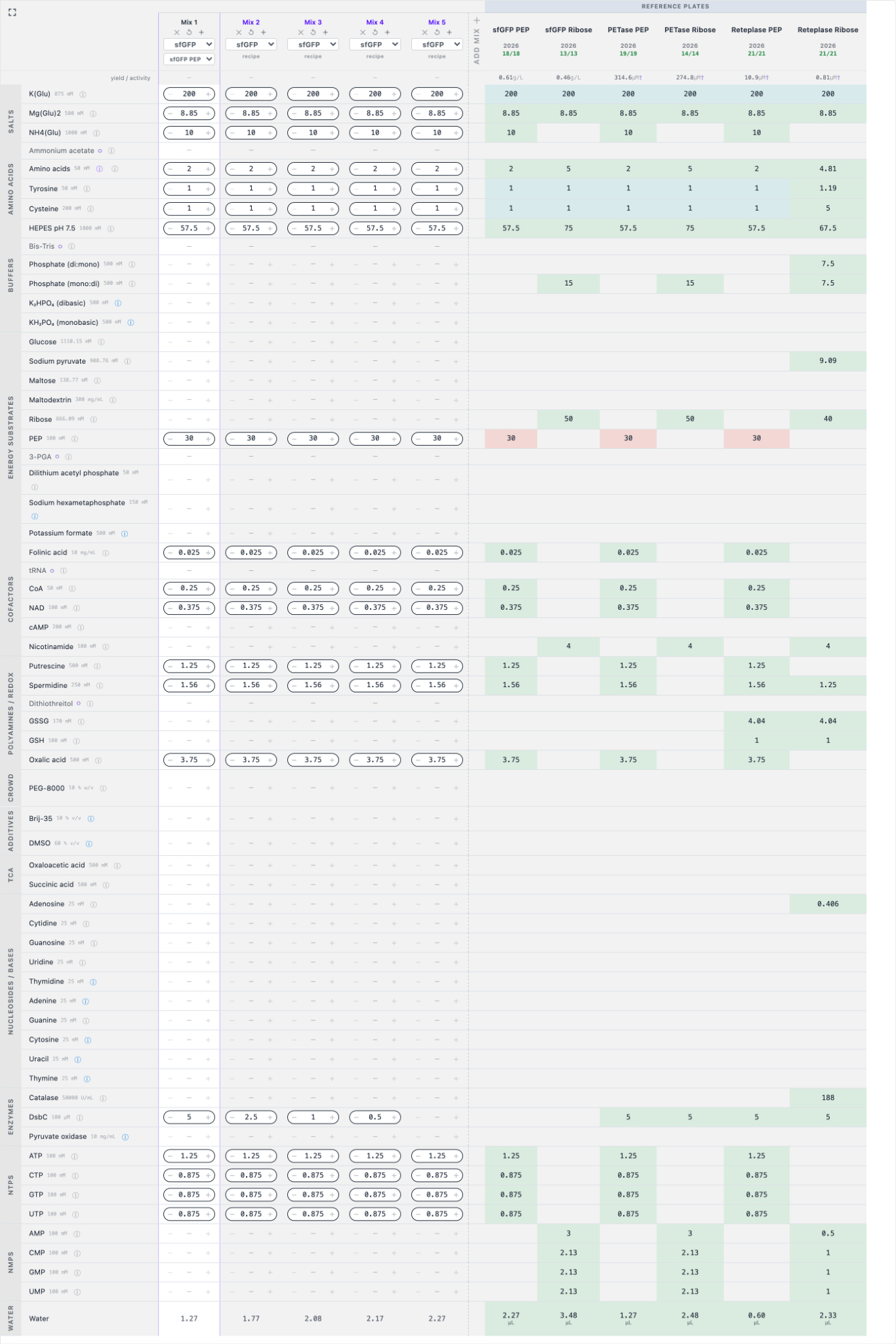
For PETase, I tested progressively lower amounts of DsbC, an expensive protein-folding helper.
| Mix | DsbC |
|---|---|
| Mix 1 | 5 µM |
| Mix 2 | 2.5 µM |
| Mix 3 | 1 µM |
| Mix 4 | 0.5 µM |
| Mix 5 | 0 µM |
Hypothesis: PETase may remain active with less DsbC. If so, the reaction could become cheaper without losing too much functional enzyme.
3. Reteplase — Changing the Redox Balance
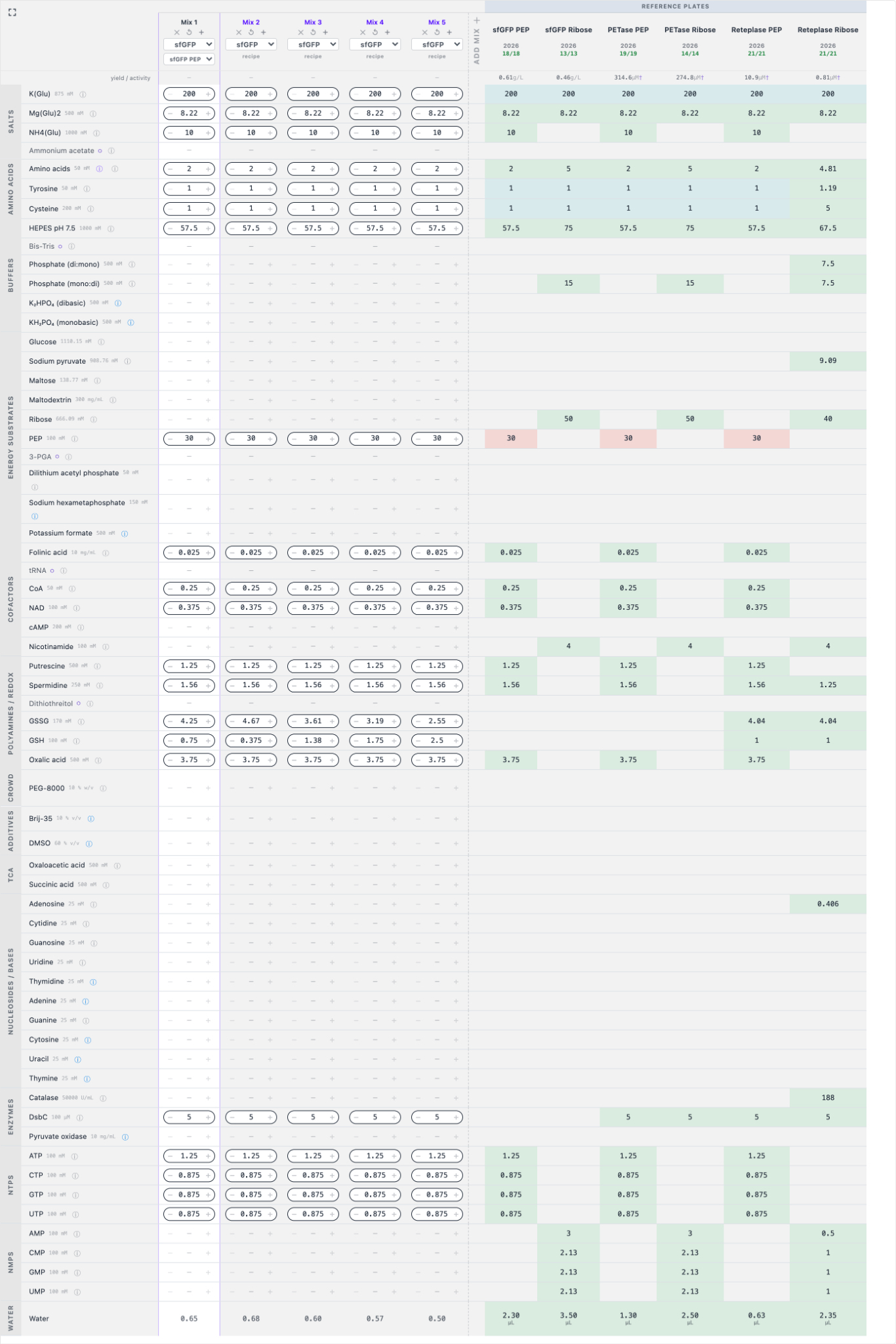
Reteplase has several disulfide bonds that need to form correctly for the protein to work. I kept DsbC at 5 µM and varied oxidized glutathione (GSSG) and reduced glutathione (GSH).
| Mix | GSSG | GSH |
|---|---|---|
| Mix 1 | 4.25 mM | 0.75 mM |
| Mix 2 | 4.67 mM | 0.375 mM |
| Mix 3 | 3.61 mM | 1.38 mM |
| Mix 4 | 3.19 mM | 1.75 mM |
| Mix 5 | 2.55 mM | 2.50 mM |
Hypothesis: Changing the GSSG:GSH balance may help Reteplase form its disulfide bonds more correctly and increase the amount of functional protein.
Use of AI
I used ChatGPT (OpenAI) mainly to help me understand the role of different CFPS reagents and to think through the hypotheses behind my reaction batches.
Some of the questions I explored were:
- Why might NMPs partially replace NTPs?
- Could PETase remain active with less DsbC?
- How does the GSSG:GSH balance affect Reteplase folding?
- How should I design a batch so that each condition gives useful information?
I reviewed the final reaction designs and submitted the batches through the Coopetition platform.
References
Jewett, M. C. & Swartz, J. R. (2004). Mimicking the Escherichia coli cytoplasmic environment activates long-lived and efficient cell-free protein synthesis. Biotechnology and Bioengineering, 86(1), 19–26. DOI: 10.1002/bit.20026.
Olsen, M. L., Copeland, C. E., Sundberg, C. A., Aw, R., Shaver, Z. M., Rao, G., Swartz, J. R., Karim, A. S. & Jewett, M. C. (2026). Design-driven optimization of low-cost reagent formulations for reproducible and high-yielding cell-free gene expression. Nature Communications, 17, 3478. DOI: 10.1038/s41467-026-69605-8.
Smith, A. A. et al. (2026). Using a GPT-5-driven autonomous lab to optimize the cost and titer of cell-free protein synthesis. bioRxiv preprint. DOI: 10.64898/2026.02.05.703998.
Silverman, A. D., Karim, A. S. & Jewett, M. C. (2020). Cell-free gene expression: an expanded repertoire of applications. Nature Reviews Genetics, 21, 151–170. DOI: 10.1038/s41576-019-0186-3.
Rasor, B. J., Vögeli, B., Landwehr, G. M., Bogart, J. W., Karim, A. S. & Jewett, M. C. (2021). Toward sustainable, cell-free biomanufacturing. Current Opinion in Biotechnology, 69, 136–144. DOI: 10.1016/j.copbio.2020.12.012.