Week 1 HW: Final Project Ideas
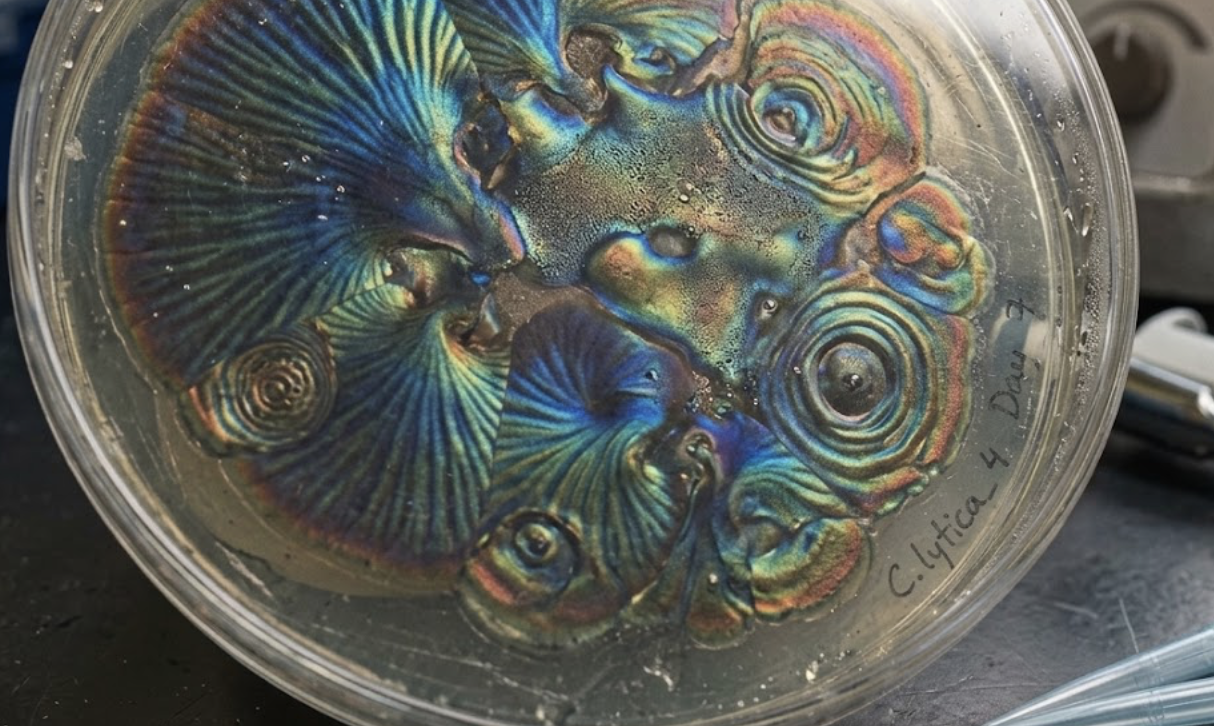
1. What do you want to make?
A biofabricated photonic material that can detect changes in the environment through a measurable optical response, ideally a change in color.
2. What living system could make it?
Cellulophaga lytica, because its cells can self-organize into periodic biofilms that produce structural color.
3. How could automation help you make it?
Automation could help control the growth conditions, monitor biofilm formation, and measure optical responses in parallel, allowing systematic optimization of the conditions that produce the desired color.
4. What would it take to make it at a meaningful scale?
I would define a meaningful scale as producing enough biofilm to fabricate a specified number or area of photonic sensors and estimate the required culture area, biomass, production time, and number of parallel cultures.
Include in detail:
(1) What you would like to biomanufacture and why?
I am interested in developing a simple and direct environmental monitoring system that can respond to its surrounding conditions without requiring the environment to be chemically modified. A visible optical response could make environmental changes easier to detect and monitor, while automation could allow the system to continuously monitor changing conditions. This could be useful for environmental monitoring, particularly in the context of air and water pollution and other environmental stressors. In the longer term, I am interested in exploring whether this type of system could be adapted to larger-scale or extreme environments, including potential space applications.
(2) What living system would you use?
Cellulophaga lytica, a marine bacterium capable of self-organizing into iridescent biofilms with periodic cellular structures that produce structural color. The proposed system assumes that environmental conditions can be used to modulate the biofilm’s optical response.1-3
(3) How would you use automation?
A programmable bioprinter such as the Allevi 3 could be used to automate the deposition of C. lytica in defined patterns and areas. A 2023 study demonstrated that C. lytica could be deposited using an Allevi 3 and maintain the programmed patterns after growth. Automated imaging and optical measurements could then be used to monitor biofilm formation and quantify changes in color or reflected wavelength under different environmental conditions.4
(4) How much would you need to make, and how long would it take?
As an initial prototype, I would define a meaningful scale as a 10 × 10 cm photonic sensing surface. Based on a 2023 study, C. lytica biofilms can be produced on larger surfaces, and an accelerated growth strategy achieved iridescent biofilms in approximately 24 hours. Therefore, I would initially aim to produce a 100 cm² biofilm within approximately 24 hours. This is an engineering estimate based on the reported results and would need to be experimentally validated.4
(5) What don’t you know yet?
• Can the biofilm’s optical response be reliably controlled by environmental conditions such as temperature and hydration? • Can C. lytica maintain its photonic structure and optical function over time and under changing environmental conditions, with a response that is stable, reversible, and reproducible? • Can the system maintain reproducible optical properties when scaled to larger areas and adapted to different applications?
AI
I used ChatGPT, Sci -Bot, Notebook and Gemini as a learning and brainstorming tool during the development of this project. I used it to explore possible biomanufacturing systems, clarify scientific concepts, identify technical uncertainties, organize my ideas, and check preliminary calculations. I reviewed and revised the information generated by AI and take responsibility for the final content, assumptions, and decisions presented in this submission.
Representative prompts used:
• “What living systems could produce an adaptive photonic material with a measurable optical response?”
• “What are the advantages and limitations of using Cellulophaga lytica for this concept?”
• “How could automation be applied to the biomanufacturing of Cellulophaga lytica biofilms?”
• “Help me check the back-of-the-envelope calculation for producing a 10 × 10 cm photonic biofilm.”
• “An authentic lab photo of a Petri dish with written marker labels, condensation, and realistic iridescent biofilm patterns.”
References used:
- Kientz, B., Vukusic, P., Luke, S., & Rosenfeld, E. (2012). Iridescence of a marine bacterium and classification of prokaryotic structural colors. Applied and Environmental Microbiology, 78(6), 2092–2099. https://doi.org/10.1128/AEM.07339-11
- Kientz, B., Luke, S., Vukusic, P., Péteri, R., Beaudry, C., Renault, T., Simon, D., Mignot, T., & Rosenfeld, E. (2016). A unique self-organization of bacterial sub-communities creates iridescence in Cellulophaga lytica colony biofilms. Scientific Reports, 6, 19906. https://doi.org/10.1038/srep19906
- Rosenfeld, E., Kientz, B., Ducret, A., Luke, S., Vukusic, P., & Mignot, T. (2012). Effect of abiotic factors on the unique glitter-like iridescence of Cellulophaga lytica. FEMS Microbiology Letters, 333(2), 101–108. https://doi.org/10.1111/j.1574-6968.2012.02614.x
- Sullivan, C. J., Brown, K., Hung, C.-S., Tang, J. K.-H., DeSimone, M., Chen, V., Lloyd, P. F., Gupta, M., Juhl, A., Crookes-Goodson, W., Vasudev, M., Dennis, P. B., & Kelley-Loughnane, N. (2023). Iridescent biofilms of Cellulophaga lytica are tunable platforms for scalable, ordered materials. Scientific Reports, 13, 13192. https://doi.org/10.1038/s41598-023-38797-0