Week 2 HW: DNA Design
HTBAA Homework #2: DNA Design
Part 0: Set up in Kernel
I logged in to Kernel and joined the HTBAA 2026 workspace. In the repository HTBAA26_WilliamandMary there is a folder with my name Aranza Cantu Puga, where the folder HW2-Cellulopagha-project and my work done is located.
Part 1: Define your expression target
What molecule are you expressing?
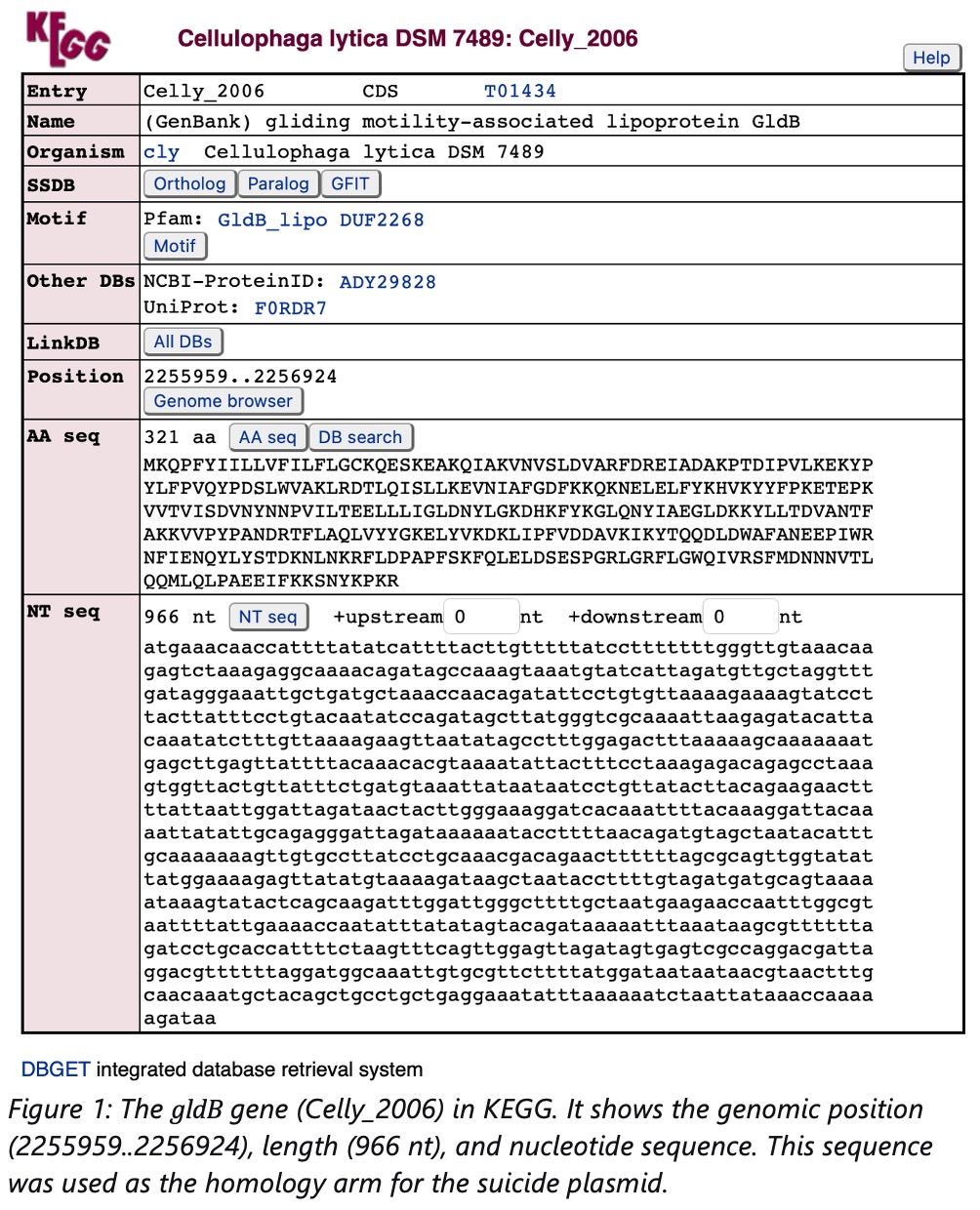
I am not expressing a heterologous protein. Instead, I designed a suicide plasmid to perform a knockout of the native gldB gene in Cellulophaga lyticaDSM 7489. The gldB gene encodes a gliding motility-associated lipoprotein (GldB). Deleting this gene interrupts the cell’s ability to self-organize into periodic biofilms, which are responsible for the structural color (iridescence) of the biofilm.
What is the sequence?
The sequence used as the homology arm is the complete gldB gene (966 bp). It was obtained from the KEGG database (entry: cly:Celly_2006). The selection cassette is the ermF gene (705 bp), which confers resistance to erythromycin and comes from Bacteroides fragilis.
What host or chassis?
The knockout is performed in Cellulophaga lytica DSM 7489 (a marine bacterium). The plasmid is propagated in E. coli DH5α for cloning.
Where does the product need to go?
The cassette needs to integrate into the chromosome of C. lytica via homologous recombination. This is why we use a suicide plasmid (it cannot replicate in C. lytica, so it must integrate or be lost).
Part 2: Design your genetic parts
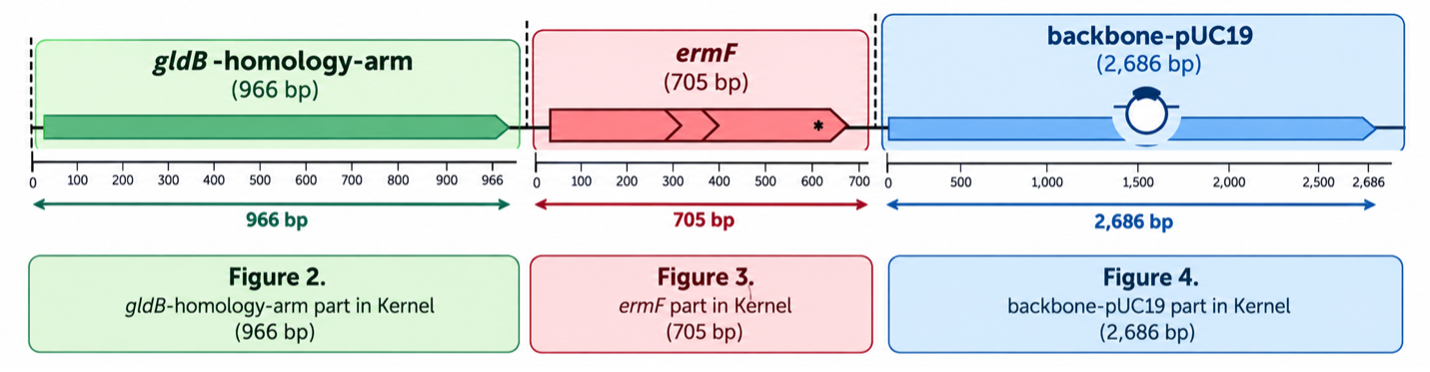
Since my host is a prokaryote (C. lytica for the knockout, E. coli for cloning), I designed a suicide plasmid with the following parts:

Part 3: Assemble your construct
Part 4: Optimize and quality-check
Codon optimization
I did not perform codon optimization because the gldB sequence is used as a homology arm (not as a coding sequence for expression). ermF is a native bacterial resistance gene that is already expressed correctly in C. lytica. Therefore, codon optimization was not necessary for this design.
BLAST / sequence search
I ran a BLAST search of the ermF sequence against the NCBI nucleotide database. The top hits were erythromycin resistance genes from Bacteroides fragilis and related bacteria, with E-values < 1e-100 and 100% query coverage. No significant matches were found against the C. lytica genome, confirming that ermF is heterologous and will not interfere with native genes.
Safety screen
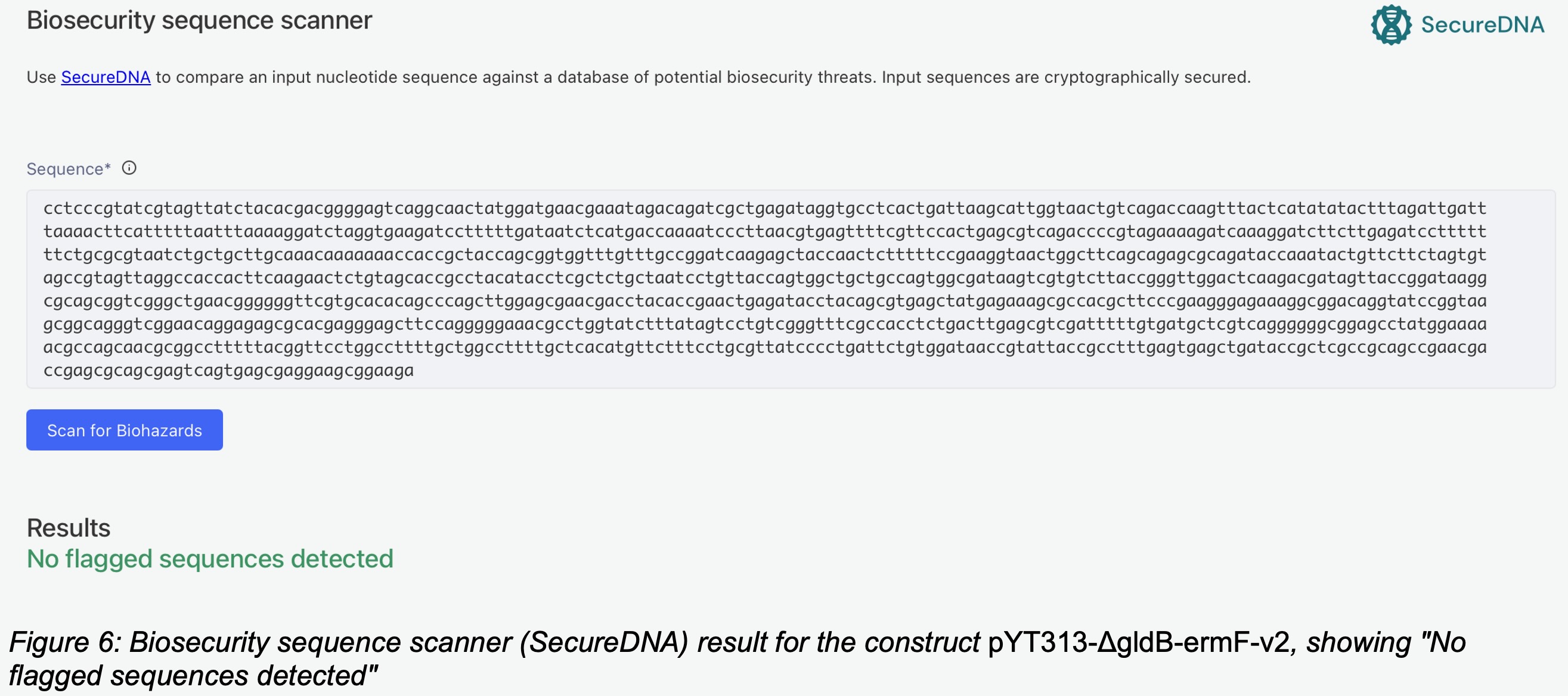
I ran the Biosecurity sequence scanner (SecureDNA) on the construct pYT313-ΔgldB-ermF-v2 in Kernel. The scanner checks for sequences that could be hazardous (e.g., toxin genes, virulence factors). The result was “No flagged sequences detected”, which means the construct is safe. This is expected because the construct contains only a homology arm to a native C. lytica gene and a standard antibiotic resistance marker.
Conclusion: The construct is suitable for the intended knockout experiment. The gldBhomology arm is specific to C. lytica, and ermF is a standard selection marker with no safety concerns.
Part 5: From design to build
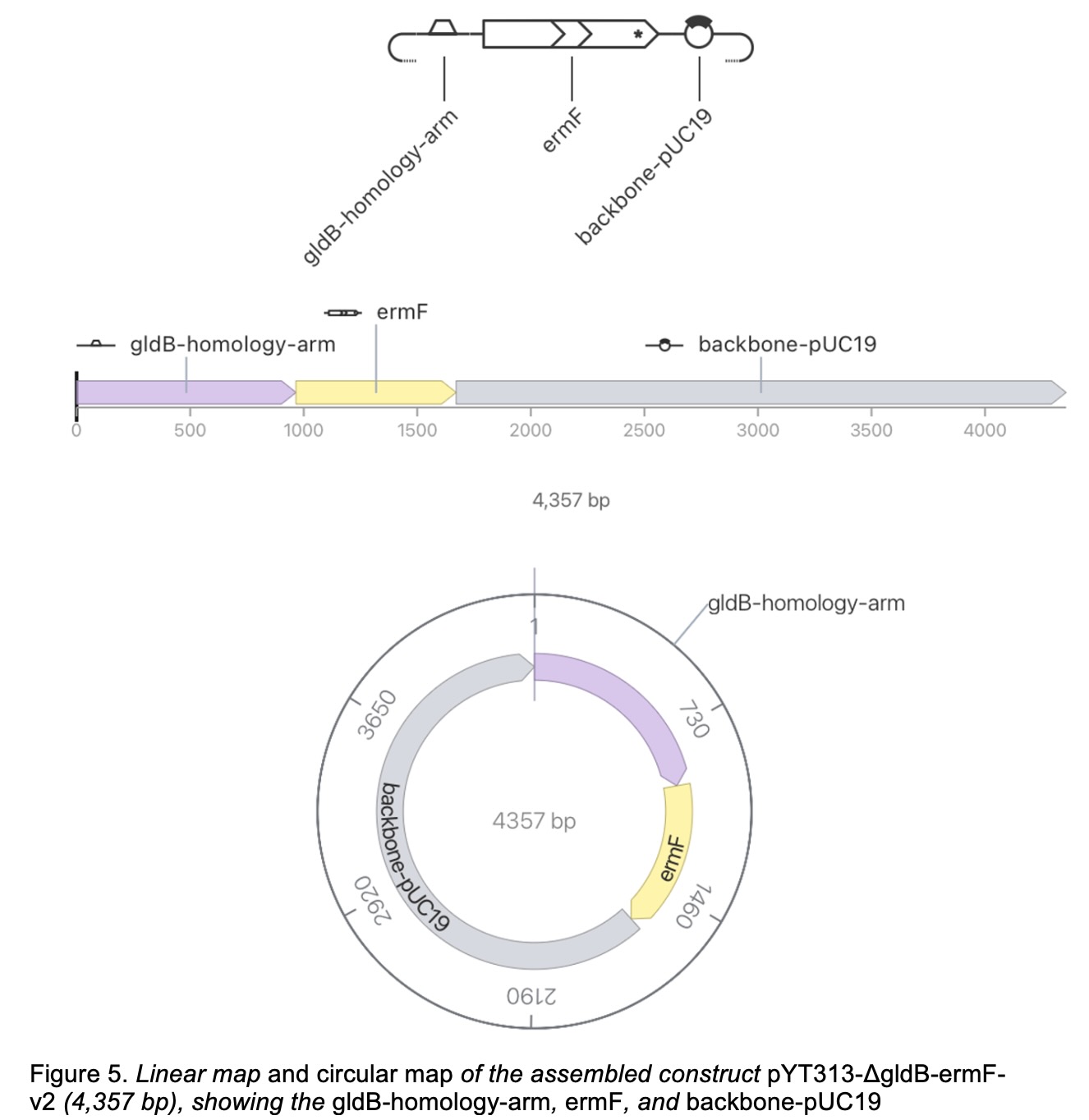
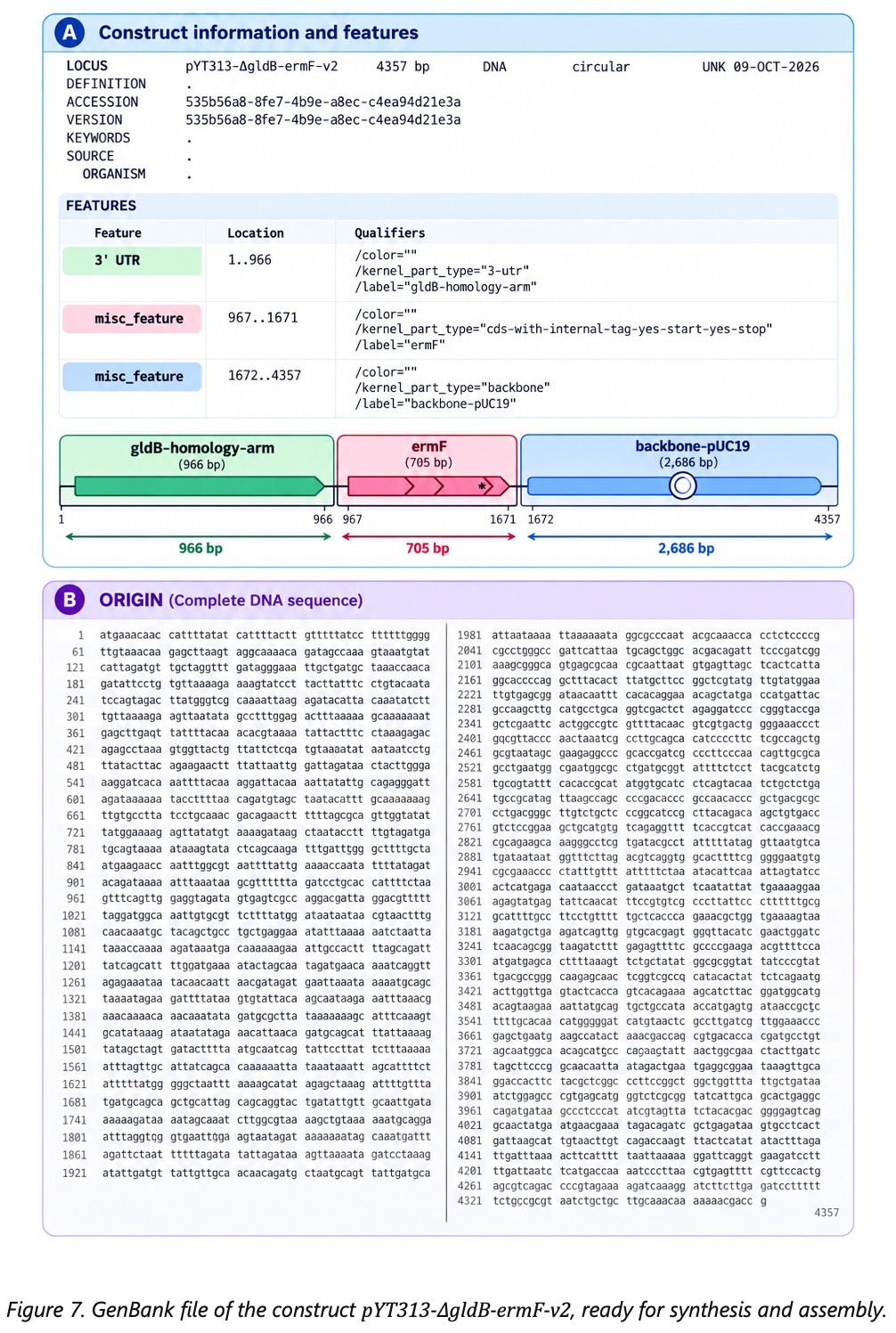
A sequence in software is not yet DNA. Here I explain how my construct (pYT313-ΔgldB-ermF-v2, 4,357 bp) would actually be synthesized and assembled.
How would I build it?
I would build this construct by commercial DNA synthesis of the cassette (gldB-homology-arm + ermF, ~1,671 bp) followed by Gibson Assembly into the pUC19 backbone (2,686 bp). The total construct is 4,357 bp, which is well within the range of commercial synthesis. Gibson Assembly is ideal here because it allows joining multiple fragments in a single isothermal reaction, without needing restriction sites (Gibson et al. 2009). This is simpler and more flexible than traditional restriction cloning.
What does synthesis constrain?
DNA synthesis has error rates and can struggle with sequences that have high GC content, repeats, or secondary structures. My homology arm (gldB, 966 bp) is a native C. lytica sequence, so it may contain some repeats or high-GC regions. To address this, I would order the cassette in two or three smaller fragments and assemble them by Gibson. If errors are detected, I could use protein-mediated error correction (Carr et al. 2004) to remove incorrect sequences before assembly.
Prototype vs. scale
For the prototype, I would order the synthesized cassette and clone it into pUC19 using Gibson Assembly, then transform into E. coli for propagation. This is a standard, cost-effective approach for a single construct. For scale, if I needed many variants of the knockout plasmid (e.g., to test different homology arm lengths), I could use chip-based oligo synthesis (Kosuri et al. 2010; Tian et al. 2004) to generate pools of variants, then assemble them by Gibson. This would be more cost-effective than ordering each construct individually.
References:
- Gibson, D. G., et al. (2009). Enzymatic assembly of DNA molecules up to several hundred kilobases. Nature Methods, 6, 343–345.
- Carr, P. A., et al. (2004). Protein-mediated error correction for de novo DNA synthesis. Nucleic Acids Research, 32, e162.
- Kosuri, S., et al. (2010). Scalable gene synthesis by selective amplification of DNA pools from high-fidelity microchips. Nature Biotechnology, 28, 1295–1299.
Part 6: What don’t you know yet?
The main uncertainties in my current design are:
1. Will the knockout of gldB actually eliminate iridescence?
The main assumption of my project is that gldB is required for the self-organization that produces structural color. However, it is possible that deleting gldB does not completely eliminate iridescence or that other genes compensate for its loss.
How I would find out: I would compare the wild-type and ΔgldB strains visually and with optical measurements (reflectance spectroscopy). If iridescence is not fully lost, I would test additional motility genes (e.g., gldJ, gldK) as alternative targets.
2. Will the suicide plasmid integrate correctly into the C. lytica chromosome?
Homologous recombination is not always efficient, and the plasmid may integrate at the wrong site or not at all. Additionally, C. lytica is a marine bacterium and may be difficult to transform.
How I would find out: I would use colony PCR with primers that flank the gldB locus. A larger PCR product (due to the inserted ermF cassette) would confirm integration. I would also sequence the PCR product to verify the insertion site. If transformation fails, I would optimize the electroporation protocol (voltage, capacitance, recovery time).
3. Will ermF provide reliable selection in C. lytica?
Although ermF is a standard erythromycin resistance marker, its expression level in C. lytica may not be sufficient for selection, or the antibiotic concentration may need optimization.
How I would find out: I would plate transformed cells on increasing concentrations of erythromycin (e.g., 1, 5, 10, 20 µg/mL) and identify the minimum concentration that inhibits wild-type growth but allows transformed cells to grow. If selection is weak, I would test a stronger promoter or a different resistance marker.
Conclusion: These are the main bets in my design. The knockout of gldB is the central hypothesis and the transformation and selection steps are the main technical risks. Each can be tested with simple experiments (optical measurements, colony PCR, antibiotic titration) before scaling up.
AI
I used ChatGPT (OpenAI) as a learning and brainstorming tool during the development of this project. I used it to explore the biology of Cellulophaga lytica, understand the mechanism of gliding motility, find the gldB gene sequence in KEGG, and organize my ideas for the construct design.
I reviewed and revised all information generated by AI and I take responsibility for the final content, assumptions, and decisions presented in this submission.
Representative prompts used:
- “What living systems could produce an adaptive photonic material with a measurable optical response?”
- “How does the gldB gene relate to gliding motility and iridescence in Cellulophaga lytica?”
- “Help me find the sequence of the gldB gene (Celly_2006) in KEGG.”
- “How do I design a suicide plasmid for gene knockout in a marine bacterium?”
- “What parts do I need to assemble a knockout construct in Kernel?”
- “How do I connect the DNA design from HW2 with the cell-free reaction design for HW3?”
References
- Kientz, B., Vukusic, P., Luke, S., & Rosenfeld, E. (2012). Iridescence of a marine bacterium and classification of prokaryotic structural colors. Applied and Environmental Microbiology, 78(6), 2092–2099.
- Kientz, B., Luke, S., Vukusic, P., Péteri, R., Beaudry, C., Renault, T., Simon, D., Mignot, T., & Rosenfeld, E. (2016). A unique self-organization of bacterial sub-communities creates iridescence in Cellulophaga lytica colony biofilms. Scientific Reports, 6, 19906.
- Sullivan, C. J., et al. (2023). Iridescent biofilms of Cellulophaga lytica are tunable platforms for scalable, ordered materials. Scientific Reports, 13, 13192.
- KEGG: cly:Celly_2006 (gldB). https://www.kegg.jp/entry/cly:Celly_2006
- ENA Accesión M77789.2 (pUC19). https://www.ebi.ac.uk/ena/browser/view/M77789.2
- Gibson, D. G., et al. (2009). Enzymatic assembly of DNA molecules up to several hundred kilobases. Nature Methods, 6, 343–345.
- Carr, P. A., et al. (2004). Protein-mediated error correction for de novo DNA synthesis. Nucleic Acids Research, 32, e162.