Week 4 LAB: Cell-Free Manufacturing
HTBAA Homework #4: Cell-Free Manufacturing
Part A: Design a batch of cell-free reaction compositions
I designed a batch of three CFPS compositions for sfGFP to test the effect of magnesium glutamate (Mg-Glu) concentration on protein yield. All reagents are identical across the three mixes except for Mg-Glu, which varies from low to high. The total volume remains 20,000 nL, with nuclease-free water adjusted automatically. The Mg-Glu values are the concentrations added in the Designer; the lysate and the base buffer may contribute additional Mg²⁺, so the real total in each reaction is somewhat higher.
Experiment Hypothesis: Finding the optimal magnesium glutamate concentration will maximize sfGFP yield by balancing translation efficiency and protein folding.
- Mix 1 (Low Mg-Glu): 5.1 mM Mg-Glu
- Mix 2 (Medium Mg-Glu): 7.6 mM Mg-Glu
- Mix 3 (High Mg-Glu): 10.1 mM Mg-Glu (reference condition)
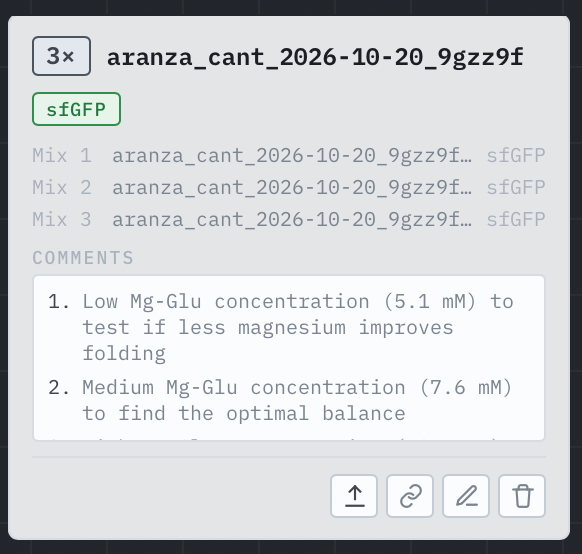
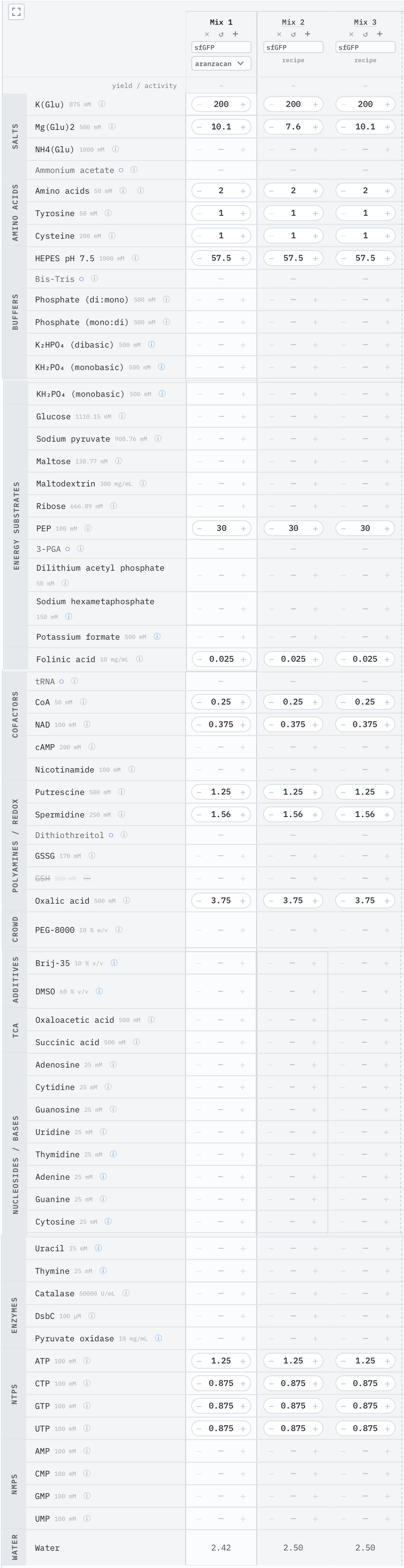
Batch of three sfGFP compositions varying magnesium glutamate concentration submitted to coopetition.htgaa.org
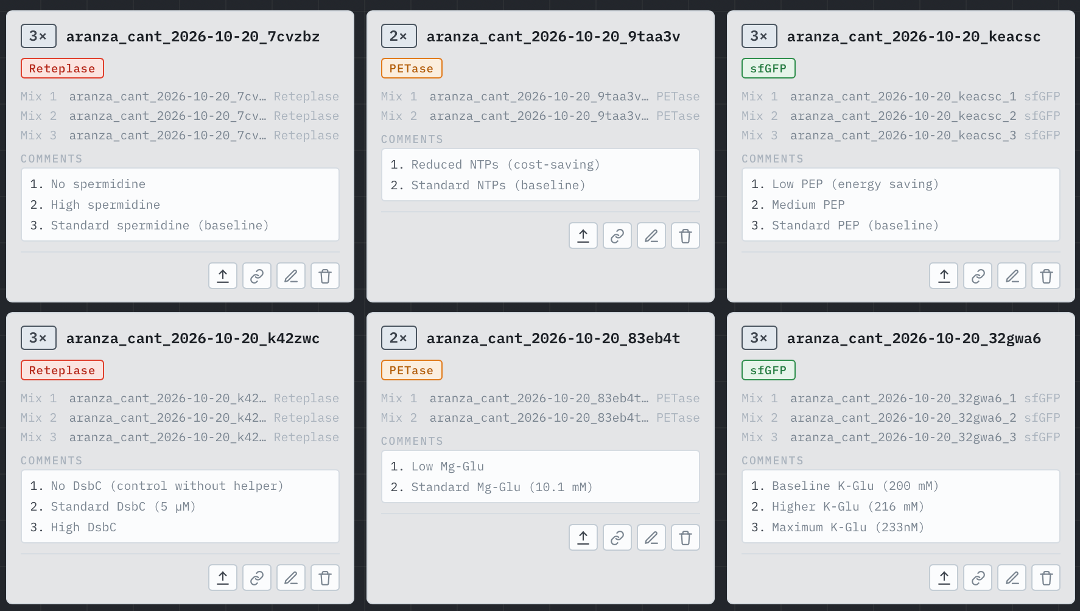
Additional Batch:
Part B: Research Team Discussion, Data Analysis, Metascience
B.1: Research Team Discussion
My main optimization idea is to systematically test how magnesium glutamate (Mg-Glu) concentration affects protein yield and folding. I designed a batch of three sfGFP compositions that vary only in Mg-Glu concentration (5.1 mM, 7.6 mM, and 10.1 mM). My hypothesis is that there is an optimal Mg-Glu concentration that balances translation efficiency (which requires Mg²⁺) and protein folding.
In future rounds, I plan to apply the same batching approach to PETase and Reteplase. For Reteplase, I would test different ratios of GSSG/GSH to find the optimal oxidizing environment for its many disulfide bonds (the sequence I used has 20 cysteines). I am also interested in exploring whether replacing NTPs with NMPs (a cost-optimization strategy from Olsen et al. 2026) can reduce cost without sacrificing yield.
B.2: Data Analysis
To compare the performance of the same 20 µL sfGFP CFPS reaction in a 384-well plate versus a 96-well deep-well plate, I reviewed the control data shown in the Designer reference panels.
Observations: The reference plates (384-well format) show sfGFP yields of 0.61 g/L (PEP formulation) and 0.46 g/L (Ribose formulation). I did not find directly comparable sfGFP yields for the 96-well deep-well format, so I describe the geometric differences between the two formats qualitatively below, without comparing numbers.
Possible explanations (hypotheses, not tested):
Oxygen access: sfGFP requires oxygen for chromophore maturation. In a 96-well deep-well plate the wider well spreads the 20 µL into a thinner layer, which gives a larger surface-area-to-volume ratio and may allow more oxygen to diffuse into the reaction.
Evaporation: with a 20 µL volume, even a small loss by evaporation changes the concentration of the reaction. The smaller wells of a 384-well plate are more exposed to this, so the way the plate is sealed and incubated could affect the yield.
B.3: Metascience
Proposed rubric criterion: Information Gain vs. Cost (Efficiency).
My proposed criterion is to score each experiment based on how much new information it gives us compared to its cost (especially the cost of expensive reagents like lysate and NTPs).
For example, if two researchers propose a similar experiment but one is testing a completely new reagent combination (high information gain) and the other is just slightly tweaking a known recipe (low information gain), we should prioritize the first one. This ensures we don’t waste limited resources repeating things we already know and helps us find the best CFPS conditions faster.
Part C: Agentic Contribution (Optional)
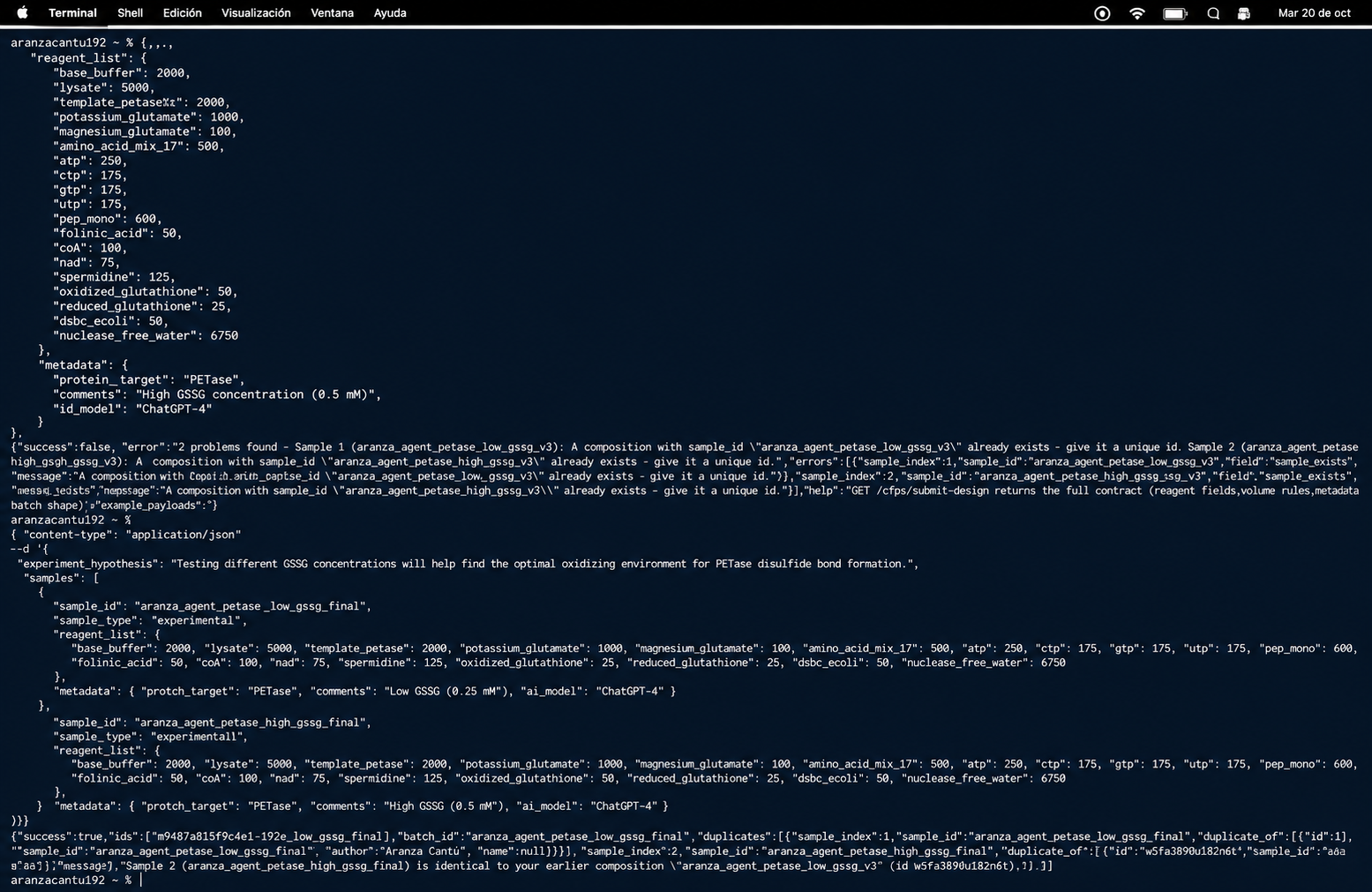
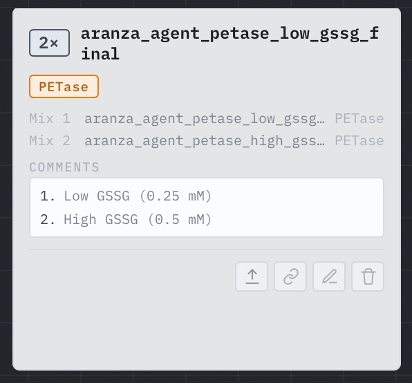
Figures 4 and 5. Batch of PETase compositions submitted programmatically through the coopetition API by an AI agent. Submitted to coopetition.htgaa.org
AI Usage
I used ChatGPT (OpenAI) as an AI agent to assist with the experimental design for the coopetition. I used it to understand CFPS principles, design reagent compositions, and programmatically submit a batch of PETase compositions via the API. I also used Claude (Anthropic) to review this page against the assignment instructions and my data.
References
- Ginkgo Bioworks & HTBAA. (2026). Cell-Free Synthesis Coopetition: Design and Experimental Framework. https://coopetition.htgaa.org/cfps
- Jewett, M. C., & Swartz, J. R. (2004). Mimicking the Escherichia coli cytoplasmic environment activates long-lived and efficient cell-free protein synthesis. Biotechnology and Bioengineering, 86(1), 19–26. https://doi.org/10.1002/bit.20026
- Olsen, M. L., et al. (2026). Design-driven optimization of low-cost reagent formulations for reproducible and high-yielding cell-free gene expression. Nature Communications. https://doi.org/10.1038/s41467-026-69605-8