I’m a BS Biotechnology student at Virtual University of Pakistan, based in Pakistan.
My main interests are synthetic biology, systems biology, bioinformatics, and biomanufacturing. I am currently building a strong foundation in molecular biology, genetics, and computational biology while exploring how biological systems can be designed and engineered for practical applications.
Alongside my core biotechnology studies, I am learning genomics, transcriptomics, biological modeling, and computational approaches that help in understanding and optimizing biological systems. I am particularly interested in the intersection of biology, computation, and engineering, and how these fields can work together to solve real-world problems.
I am also exploring how modern tools in synthetic biology and biomanufacturing can make advanced biotechnology more accessible, especially in regions where laboratory infrastructure is limited.
Why HTBAA
Most of my learning so far has focused on understanding and designing biological systems — molecules, cells, genetic sequences, and biological networks. What I want to explore next is the manufacturing and engineering side of biotechnology.
I am interested in automation, robotics, microfluidics, fabrication methods, and programmable systems that allow us to work with biology in more controlled and scalable ways. I want to understand how these technologies can make biological experimentation and manufacturing more efficient and accessible to smaller research groups and students.
Through HTBAA, I hope to learn how to move beyond designing biological systems on a computer and actually build, automate, and manufacture with biology. My long-term goal is to work at the intersection of synthetic biology, computation, and engineering to develop biological systems that can address practical challenges.
See the navigation bar on the left to explore my work for How To Biomanufacture Almost Anything (Fall 2026).
Subsections of Awais Ur Rehman – HTBAA Fall 2026
Week 1 HW: Biomanufacturing with Xerophiles
Homework 1: Biomanufacturing Idea using Xerophiles / Extremophiles
(1) What I would like to biomanufacture and why
Target product: Deinoxanthin (and related carotenoid antioxidants) produced by the xerotolerant polyextremophile Deinococcus radiodurans.
Deinoxanthin is a unique carotenoid with strong antioxidant and radioprotective properties. It is more stable under oxidative stress and desiccation than many common carotenoids.
Why this is interesting:
Deinococcus radiodurans naturally survives extreme dryness (xerotolerance) and high radiation.
This makes it ideal for producing protective compounds for space missions, arid environments, or long-term storage of sensitive materials (vaccines, foods, cosmetics).
The project connects sustainability, space biomanufacturing, and extremophile synthetic biology (inspired by Ye et al. 2023 and Averesch et al. 2023).
Process: Engineered carotenoid pathway (overexpression of key genes such as crtB and dxs) to increase deinoxanthin production. The organism already has native desiccation and radiation resistance.
Outputs: Deinoxanthin-rich biomass that can be extracted.
Assumption: Recent genetic toolkits for Deinococcus make pathway engineering feasible.
(3) How would I use automation?
Primary tool for R&D: Opentrons OT-2 liquid-handling robot.
I would automate:
Media preparation
High-throughput strain screening
Parallel small-scale cultivations
Sampling and basic quantification of pigment
This speeds up the Design-Build-Test-Learn cycle. At larger scale, continuous or semi-open fermentation could be used, taking advantage of the extremophile’s robustness (less need for strict sterility).
(4) How much would I need to make, and how long would it take?
(a) How much? Target: 10 kg of purified deinoxanthin (enough for a pilot space/medical application or small commercial batch).
Published titers are around 0.4 g/L. Assuming ~0.25 g/L recovered after processing → approximately 40,000 liters of culture.
(b) How long? With optimized continuous or fed-batch fermentation in a few thousand liters of working volume, production of this amount could take several weeks to a couple of months. Lab-scale optimization with Opentrons would take weeks first.
(5) What don’t I know yet?
Actual yields under low water-activity conditions.
Robustness of current genetic tools for high-flux pathway engineering in Deinococcus.
Efficient and scalable downstream extraction and long-term stability of the purified product.
AI use disclosure AI client: Grok (xAI). I used it to research xerophiles/Deinococcus, structure the four required questions, estimate scale, and refine the proposal. All final scientific understanding and decisions are my own.
Week 2 HW: Genetic Circuit Design for Deinoxanthin
I designed a genetic construct to increase deinoxanthin production in Deinococcus radiodurans.
Molecules: Two enzymes – CrtB (phytoene synthase) and Dxs
Host: Deinococcus radiodurans
Location: Cytoplasm
Part 2 & 3: Genetic Parts and Construct
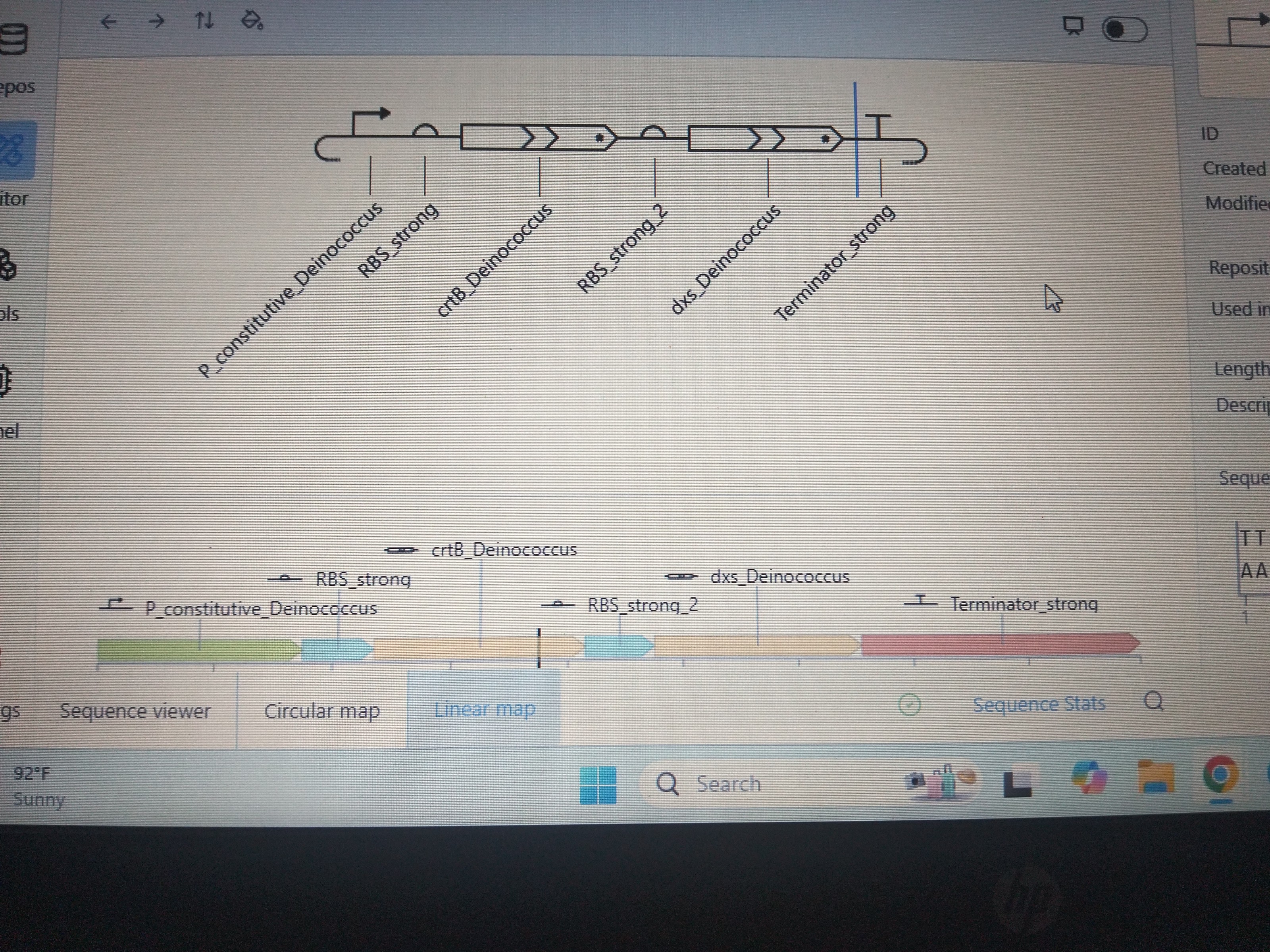
I created the following parts in Kernel:
Promoter: P_constitutive_Deinococcus
RBS: RBS_strong
CDS: crtB_Deinococcus
RBS: RBS_strong_2
CDS: dxs_Deinococcus
Terminator: Terminator_strong
Construct name: Deinoxanthin_Expression_Cassette
Order of parts: Promoter → RBS → crtB → RBS → dxs → Terminator
Part 4: Optimize and Quality Check
I codon-optimized the coding sequences for Deinococcus. I checked the sequences using BLAST and ran the safety screen. No high-risk sequences were found.
Part 5: From Design to Build
For the first version, I will order the complete construct as synthetic DNA. If multiple versions are needed later, I can use Gibson assembly.
Part 6: What I don’t know yet
Will the promoter work well in Deinococcus radiodurans?
Will the cells grow normally after overexpressing these two genes?
How much extra deinoxanthin will be produced?
AI Note I used Grok to help structure the design and understand the Kernel workflow. The final decisions and understanding are my own.
I designed cell-free protein synthesis (CFPS) reaction compositions for three proteins: sfGFP, PETase, and Reteplase using the coopetition.htgaa.org platform.
Compositions Submitted
1. sfGFP
Type: Reducing condition
Energy source: PEP-based
Comments: Simple PEP-based composition based on reference plate.
2. PETase
Type: Reducing condition
Energy source: PEP-based
Comments: Similar to sfGFP but suitable for an enzyme with one disulfide bond.
3. Reteplase
Type: Oxidizing (DSB) condition
Special reagents: GSSG, GSH, and DsbC
Comments: Oxidizing composition to support formation of 9 disulfide bonds.
Community Reagent
I suggested Trehalose as a community reagent. Reason: It acts as a protein stabilizer and can improve functional yield, especially for difficult proteins like Reteplase.
AI Note
I used Grok to help understand the requirements and structure the designs. Final decisions are my own.