Week 3 HW: Cell-Free Protocols
3. ASSIGNMENT: CFPS REACTION DESIGN FOR SFGFP, PETASE, RETEPLASE
Goal: using the collective intelligence of the HTBAA community and accessible AI systems, design novel CFPS reaction compositions for each of the three target proteins: sfGFP, PETase, and Reteplase to reduce the cost per gram of functional protein. Each design should be compatible with the experimental framework described above and should reflect the distinct expression and folding requirements of that protein. You can learn more about the details of the coopetition here.
A. COMPARE CELL-FREE REACTION COMPOSITIONS (20 minutes)
Why does the concentration of potassium glutamate and magnesium glutamate differ between compositions? Which is more sensitive?
The concentrations differ between compositions due to the different ions provided by the salts. Consequently, different biochemical functions are enabled:
- Potassium glutamate mainly supplies K+, which enables the reproduction of the ioinic environment that is required for tRNA binding, RNA polymerase activity, translation-factor function, and ribosome activity. Glutamate contributes to the overall strength of the ion and can play a role in extract metabolism.
- Magnesium glutamate supplies Mg2+, which contributes to ribosome assembly and stability, RNA folding, nucleotide binding, and catalysis by polymerases and other enzymes. Also, free Mg2+ ions also bind ATP, NTPs, DNA, RNA, and phosphate-containing intermediates. This means that when there is excessive magnesium, transcription can be inhibited or the balance of the available substrates can be altered.
- Therefore, potassium glutamate is usually present at a higher concentration. For instance, the PANOx-SP formulation used ~175 mM potassium glutamate and 20 mM magnesium glutamate, whereas other formulations used 130-170 mM potassium glutamate and 12-20 magnesium glutamate. (1)
Which is more sensitive? Magnesium glutamate is usually more sensitive. Its optimum often falls within a narrow window in standard formulations (8-14 mM) and depends strongly on:
- the lysate batch;
- the concentrations of ATP, NTPs, DNA, and phosphate;
- the extract preparation method;
- the transcription–translation system being used.
Too little magnesium glutamate compromises ribosome assembly and enzymatic activity; whereas too much can sequester nucleotides and inhibit transcription. Due to this, magnesium is usually titrated experimentally for each new extract (often within the 6-18 mM range). It is worth noting that potassium glutamate is also important, but its useful range is generally broader. It is commonly adjusted to maintain an appropriate intracellular-like ionic strength, often around 130–175 mM.
Practially, this could be summarised as potassium glutamate sets the bulk ionic environment, while magnesium glutamate must be fine-tuned to balance ribosome function, enzyme catalysis, and nucleotide availability. (2)
Explain how a PEP+NTP reaction formulation is different from a Ribose+NMP reaction formulation.
Choose two cell-free reaction compositions from the literature, compare and contrast the choice of reagents and the concentration of reagents.
Note: A recommended starting point would be to review a least one published formulation, such as PANOx-SP (Jewett & Swartz 2004), a cost-optimized formulation from Olsen et al. (2026), and/or an AI-designed formulation from Smith et al. (2026).
B. DESIGN ONE REACTION COMPOSITION FOR EACH OF THE THREE PROTEINS (40 minutes)
Sign in to coopetition.htgaa.org and publish your first unique 20 µL CFPS reaction composition for each of the following (don’t worry, you can resubmit later):
- sfGFP
- PETase
- Reteplase
For each composition, specify the reagents you would adjust from the relevant categories, including salts, energy sources, building blocks, cofactors, and redox components.
Here is a table summarising the current baseline and the reagents I modified:
| Protein | Reference baseline | Reagents to modify | First modification |
|---|---|---|---|
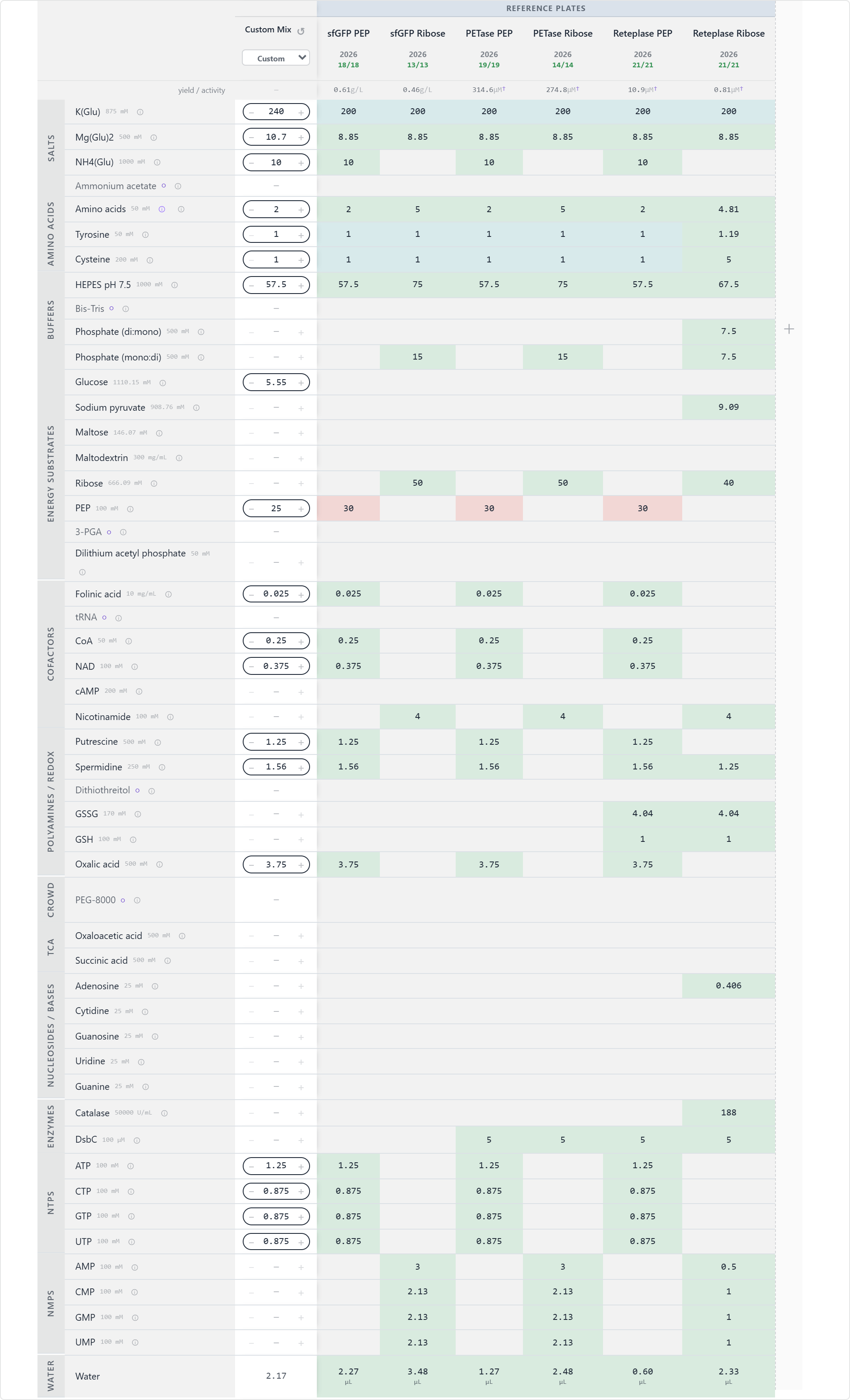
| sfGFP | sfGFP PEP | Energy, salts, amino acids, translation cofactors | K(Glu) 240 mM; Mg(Glu)₂ 10 mM; NH₄(Glu) 10 mM; amino acids 2 mM; HEPES 57.5 mM; PEP 25 mM; ATP 1.25 mM; CTP/GTP/UTP 0.875 mM; glucose 5 mM |
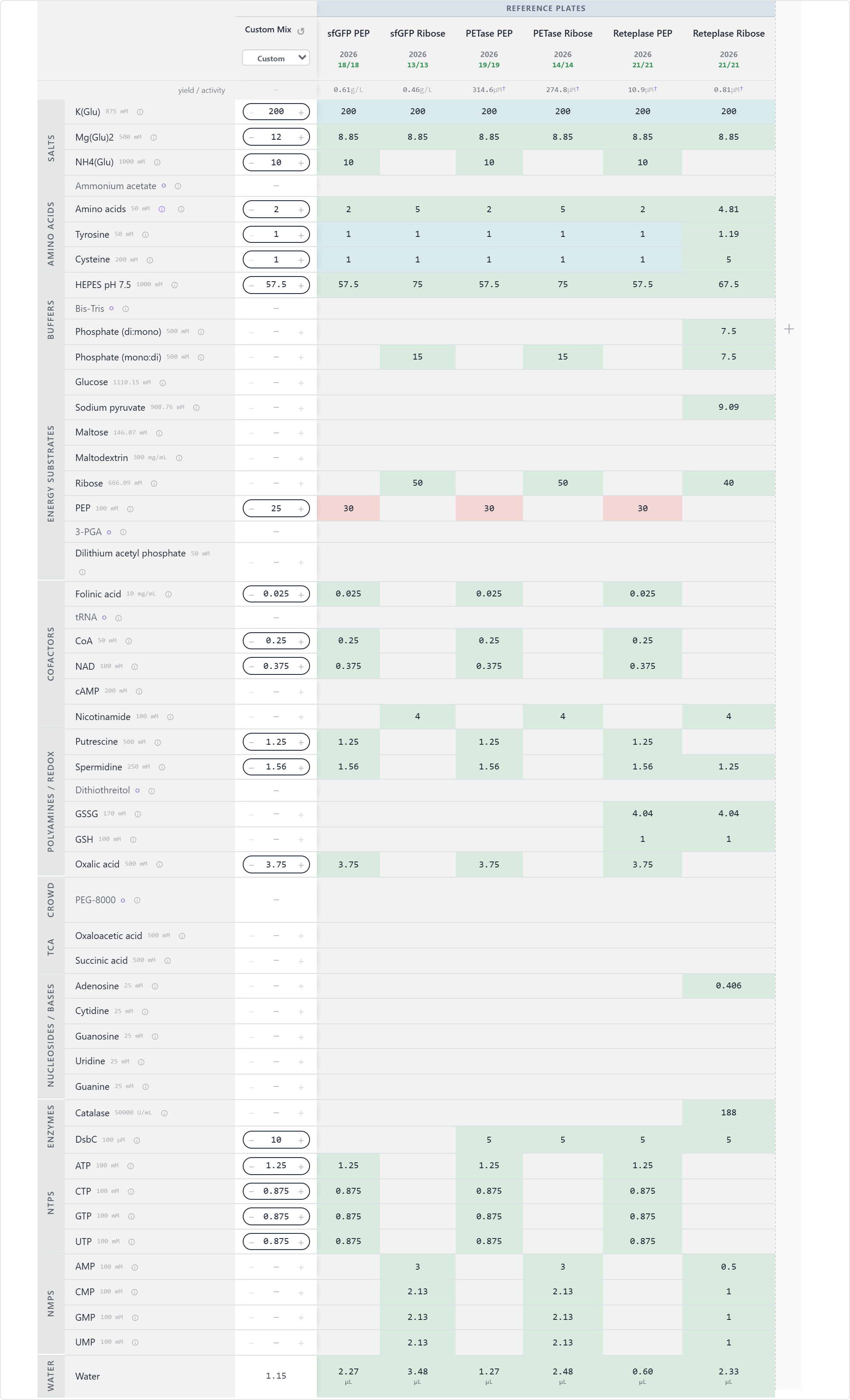
| PETase | PETase PEP | Magnesium, potassium, energy source, folding support | K(Glu) 180 mM; Mg(Glu)₂ 12 mM; NH₄(Glu) 10 mM; amino acids 2 mM; HEPES 57.5 mM; PEP 25 mM; add DsbC 10 µM |
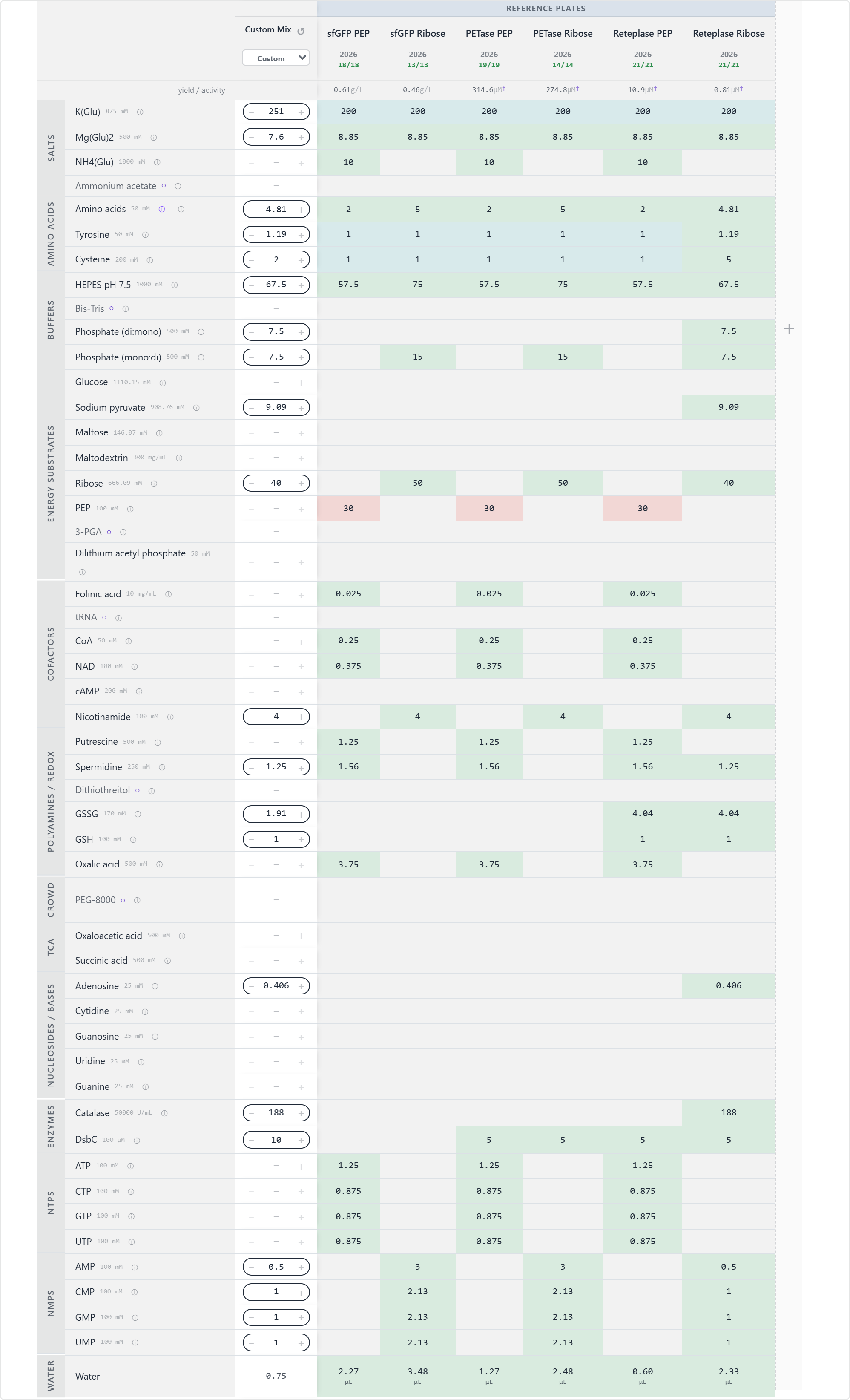
| Reteplase | Reteplase Ribose | Redox system, disulfide isomerase, amino acids, magnesium | K(Glu) 250 mM; Mg(Glu)₂ 8 mM; amino acids 4.8125 mM; cysteine 2 mM; HEPES 67.5 mM; ribose 40 mM; AMP 0.5 mM; CMP/GMP/UMP 1 mM; DsbC 10 µM; GSSG 2 mM; GSH 1 mM; catalase 187.5 U/mL |
Rationale:
- sfGFP: Since this is a soluble fluorescent reporter, a relatively conventional PEP/NTP-based reaction would be a good starting point. A modest reduction in PEP, together with lower potassium glutamate, provides a straightforward test of whether the reference formulation is constrained by energy balance or ionic strength while preserving the direct-energy regeneration system.
- PETase: PETase is an enzyme whose performance depends on producing a soluble, correctly folded protein. A moderate increase in magnesium, combined with DsbC, therefore provides a targeted way to test whether folding or disulfide-bond management is limiting expression. DsbC is particularly relevant for proteins that are susceptible to non-native disulfide formation, although its benefit will depend on the specific PETase variant and its cysteine content.
- Reteplase: Reteplase warrants the most substantial change because it contains multiple disulfide bonds and is consequently more challenging to fold correctly in the reducing environment of the bacterial cytoplasm. Introducing glutathione-based redox control alongside DsbC provides a mechanistically well-justified strategy for supporting productive disulfide formation and folding. Previous studies have also reported improved soluble and correctly folded reteplase production when DsbA/DsbC-assisted systems are used.
A key aspect here is to distinguish at which stage the concentrations are reported (e.g. final concentration, stock solution concentration).
Also, the concentration of potassium glutamate greatly exceeds magnesium glutamate, echoing what has been discussed in Section A.
sfGFP
Submitted composition — saved as i6w4559520x2dtf.
PETase
Submitted composition — saved as 26443750p271d0e.
Reteplase
Submitted composition — saved as 118174x593n9m6p.
As a HTBAA research team, we will have the opportunity to suggest new reagents to add to the cell-free reagent inventory. Contribute (or upvote) at least one reagent to the “Community Reagents” section of the website and provide a short rationale. Include in your homework documentation how you decided on that specific reagent and provide links to any relevant research.
I upvoted trehalose as this sugar could be useful for a number of applications….
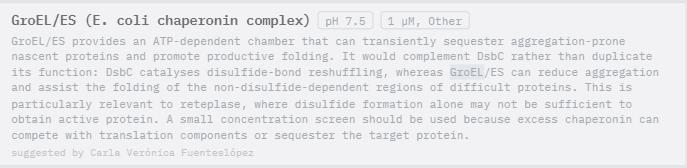
I also contributed a reagent: GroEL/ES GroEL/ES (E. coli chaperonin complex) Category: Other / folding support Suggested starting concentration: 0.5–2 µM complex Proposed test concentration: 1 µM pH: 7.5
Visit the cfps-coopetition forum page to ensure you will be able to take part in the discussion. Bonus: send a note in the channel about a CFPS optimization idea that you have! If you would like clarification on aspects of the project, please message in this dedicated channel.
C. ASIMOV KERNAL (OPTIONAL)
Sorry, I could not get access to Kernel.
Build T7 compatible plasmids for cell-free expression using the amino acid coding sequences below:
sfGFP MSKGEELFTGVVPILVELDGDVNGHKFSVRGEGEGDATIGKLTLKFICTTGKLPVPWPTLVTTLTYGVQCFSRYPDHMKRHDFFKSAMPEGYVQERTISFKDDGKYKTRAVVKFEGDTLVNRIELKGTDFKEDGNILGHKLEYNFNSHNVYITADKQKNGIKANFTVRHNVEDGSVQLADHYQQNTPIGDGPVLLPDNHYLSTQTVLSKDPNEKGTRDHMVLHEYVNAAGITWSHPQFEK
PETase MEKKIWSHPQFEKGGSGENLYFQSGGASPAGGGANPYERGPNPTDALLEASSGPFSVSEENVSRLSASGFGGGTIYYPRENNTYGAVAISPGYTGTEASIAWLGERIASHGFVVITIDTITTLDQPDSRAEQLNAALNHMINRASSTVRSRIDSSRLAVMGHSMGGGGTLRLASQRPDLKAAIPLTPWHLNKNWSSVTVPTLIIGADLDTIAPVATHAKPFYNSLPSSISKAYLELDGATHFAPNIPNKIIGKYSVAWLKRFVDNDTRYTQFLCPGPRDGLFGEVEEYRSTCPFGGSGVSGWRLFKKIS
Reteplase MEKKIWSHPQFEKGGSGENLYFQSGGASPAGGGNSDCYFGNGSAYRGTHSLTESGASCLPWNSMILIGKVYTAQNPSAQALGLGKHNYCRNPDGDAKPWCHVLKNRRLTWEYCDVPSCSTCGLRQYSQPQFRIKGGLFADIASHPWQAAIFAKHRRSPGERFLCGGILISSCWILSAAHCFQERFPPHHLTVILGRTYRVVPGEEEQKFEVEKYIVHKEFDDDTYDNDIALLQLKSDSSRCAQESSVVRTVCLPPADLQLPDWTECELSGYGKHEALSPFYSERLKEAHVRLYPSSRCTSQHLLNRTVTDNMLCAGDTRSGGPQANLHDACQGDSGGPLVCLNDGRMTLVGIISWGLGCGQKDVPGVYTKVTNYLDWIRDNMRPGGSGVSGWRLFKKIS
Bonus question: design a T7 helper plasmid that you could add to the cell-free reaction to improve the yield of functional reteplase (general chaperones, disulfide-bond machinery, etc).
Sources Cited
(1) Calhoun KA, Swartz JR. Energizing cell-free protein synthesis with glucose metabolism. Biotechnol Bioeng. 2005 Jun 5;90(5):606-13. doi: 10.1002/bit.20449. PMID: 15830344. (2) Stark JC, Jaroentomeechai T, Warfel KF, Hershewe JM, DeLisa MP, Jewett MC. Rapid biosynthesis of glycoprotein therapeutics and vaccines from freeze-dried bacterial cell lysates. Nat Protoc. 2023 Jul;18(7):2374-2398. doi: 10.1038/s41596-022-00799-z. Epub 2023 Jun 16. PMID: 37328605; PMCID: PMC13360663.