Week 5 HW: Digital Microfluidics
Part A
A1. I am choosing to follow the example in the lecture, and I will aim to express the human β1-adrenergic receptor (β1AR). My downstream objective is ligand-binding measurements. Successful manufacturing of β1AR means the fraction of purified receptor that successfully binds β1AR ligand. Aggregated, misfolded, or improperly inserted receptors could be found through protein concentration tests, but would not tell us how much functional protein is found.
A2. The lipid environment is essential for GPCR structure and function. The GPCR is essentially part of the membrane, as it influences the conformational equilibrium (fluidity, electrostatic interactions, and folding pressure) of the receptor’s flexible transmembrane helices. In biology, structure designates function, so this structural conformation will impact its ligand-binding capabilities. An example in the lecture of a tradeoff: A lipid formulation such as DOPG could promote increased purified yield but favored a conformation that exhibited worse activity (i.e. ligand binding).
A3. Thermostabilizing mutations. This could improve receptor stability, reduce aggregation, and increase the homogeneity of purified protein. However, it could create a structural confirmation that doesn’t bind agonists as well and could prevent activation/G-protein coupling.
Part B
B1. Incorporating cholesterol into POPC/POPS nanodiscs will increase the ligand-binding-competent fraction by stabilizing the β1AR receptor’s transmembrane structure. A result that would refute this hypothesis: POPC/POPS/cholesterol produces an equal or lower ligand-binding-competent fraction than POPC/POPS alone in both MSP formats. The initial screening readout would be purified protein yield measured through Nuclera’s split-GFP fluorescence system, and the downstream measurement would be F-SEC to assess monodispersity and quantitative cyanopindolol binding assay to determine binding affinity.
B2.
| # | MSP | Lipid formulation (Additive 1) | Additive 2 | Predicted effect |
|---|---|---|---|---|
| 1 | MSP1D1 | DOPG | PDI/GSSG | High yield; moderate binding competence |
| 2 | MSP1D1 | DOPG/Cardiolipin | PDI/GSSG | Potential improvement in binding competence |
| 3 | MSP1D1 | POPC/POPS | PDI/GSSG | Moderate yield; reference for cholesterol |
| 4 | MSP1D1 | POPC/POPS/Cholesterol | PDI/GSSG | Increased binding competence |
| 5 | MSP1E3D1 | DOPG | PDI/GSSG | Potentially highest yield |
| 6 | MSP1E3D1 | DOPG/Cardiolipin | PDI/GSSG | Improved insertion and binding competence |
| 7 | MSP1E3D1 | POPC/POPS | PDI/GSSG | Improved insertion; reference for cholesterol |
| 8 | MSP1E3D1 | POPC/POPS/Cholesterol | PDI/GSSG | Potentially highest functional yield |
Part C
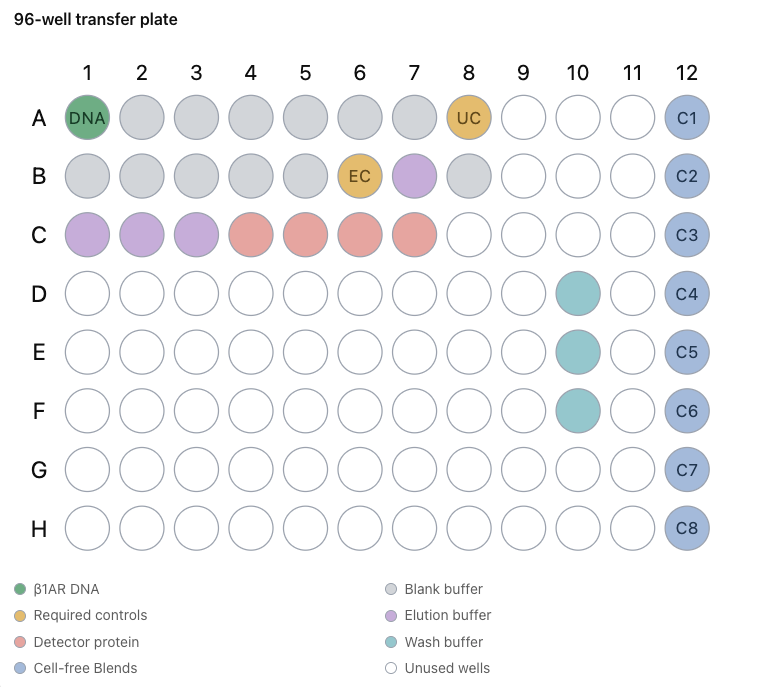 Source: ChatGPT
| Wells | Contents | Volume per well |
|---|---|---|
| A1 | Human β1AR DNA | 5 µL |
| A2–A6, B1–B5 | Blank buffer | 5 µL |
| A7, B8 | Blank buffer | 10 µL |
| A8 | Universal control | 10 µL |
| B6 | Expression control | 10 µL |
| B7 | Elution buffer | 10 µL |
| C1–C3 | Elution buffer | 16 µL |
| C4–C7 | Detector protein | 16 µL |
| D10–F10 | Wash buffer | 16 µL |
| A12–H12 | Cell-free Blends 1–8 | 20 µL each |
| Well | MSP | Lipid formulation (Additive 1) | Additive 2 |
|---|---|---|---|
| A12 | MSP1D1 | DOPG | PDI/GSSG |
| B12 | MSP1D1 | DOPG/Cardiolipin | PDI/GSSG |
| C12 | MSP1D1 | POPC/POPS | PDI/GSSG |
| D12 | MSP1D1 | POPC/POPS/Cholesterol | PDI/GSSG |
| E12 | MSP1E3D1 | DOPG | PDI/GSSG |
| F12 | MSP1E3D1 | DOPG/Cardiolipin | PDI/GSSG |
| G12 | MSP1E3D1 | POPC/POPS | PDI/GSSG |
| H12 | MSP1E3D1 | POPC/POPS/Cholesterol | PDI/GSSG |
C5. 3 operational mistakes might be: 1) leaving unused construct wells empty (they must contain blank buffer to prevent droplet-handling failures, 2) incorrectly handling purification beads (not on ice, loaded in directly), and 3) mislabeling cell-free blends would screw up results and understanding from the experiment.
Part D
D1. Ranking by purified yield (A > D > B > C) does not match ranking by functional yield (C > B > D > A). Although Condition C produces the least purified protein, it produces the most functional receptor. I would scale that one up. D2. To obtain 100 µg of binding-competent, monodisperse receptor using Condition C, I would need 2.20 mL (assuming 70% recovery) D3. Before trusting these results, I would verify that fluorescence proportional to receptor quantity, that F-SEC monodisperse peak represents correctly inserted, monomeric receptor, that the binding-competent fraction is representative of the same receptor population quantified by F-SEC, and that protein yield and functionality scale proportional from nanoliter-scale reactions to milliliter-scale reactions. One orthogonal measurement might be a quantitative radioligand-binding assay using cyanopindolol to independently measure binding affinity and the binding-competent receptor fraction. D4. Based on my Part B predictions, MSP1E3D1–DOPG could produce the highest purified yield. However, this would result in only two unique conditions following Nuclera’s selection rule. I would therefore propose the following four conditions:
| MSP | Lipid formulation | Selection rationale |
|---|---|---|
| MSP1E3D1 | DOPG | Predicted yield leader |
| MSP1D1 | DOPG | Alternative MSP and reference |
| MSP1E3D1 | POPC/POPS | Cholesterol-free reference |
| MSP1E3D1 | POPC/POPS/Cholesterol | Predicted improvement in binding competence |
All four conditions would retain PDI/GSSG.
This selection allows me to evaluate the effect of MSP size while also directly testing my original hypothesis that incorporating cholesterol into POPC/POPS nanodiscs improves β1AR ligand-binding functionality.