Week 1 HW: Final Project Ideas
(1) What you would like to biomanufacture and why?
Describe the target product or output you would like to make. Why are you interested in making it? Your motivation might be utilitarian—for example, addressing a problem in health, sustainability, food, energy, or manufacturing—but it does not need to be. Your project might instead have a social, cultural, artistic, or personal motivation. Clearly articulate what you want to make, who or what it is for, and why you think it is interesting or important.
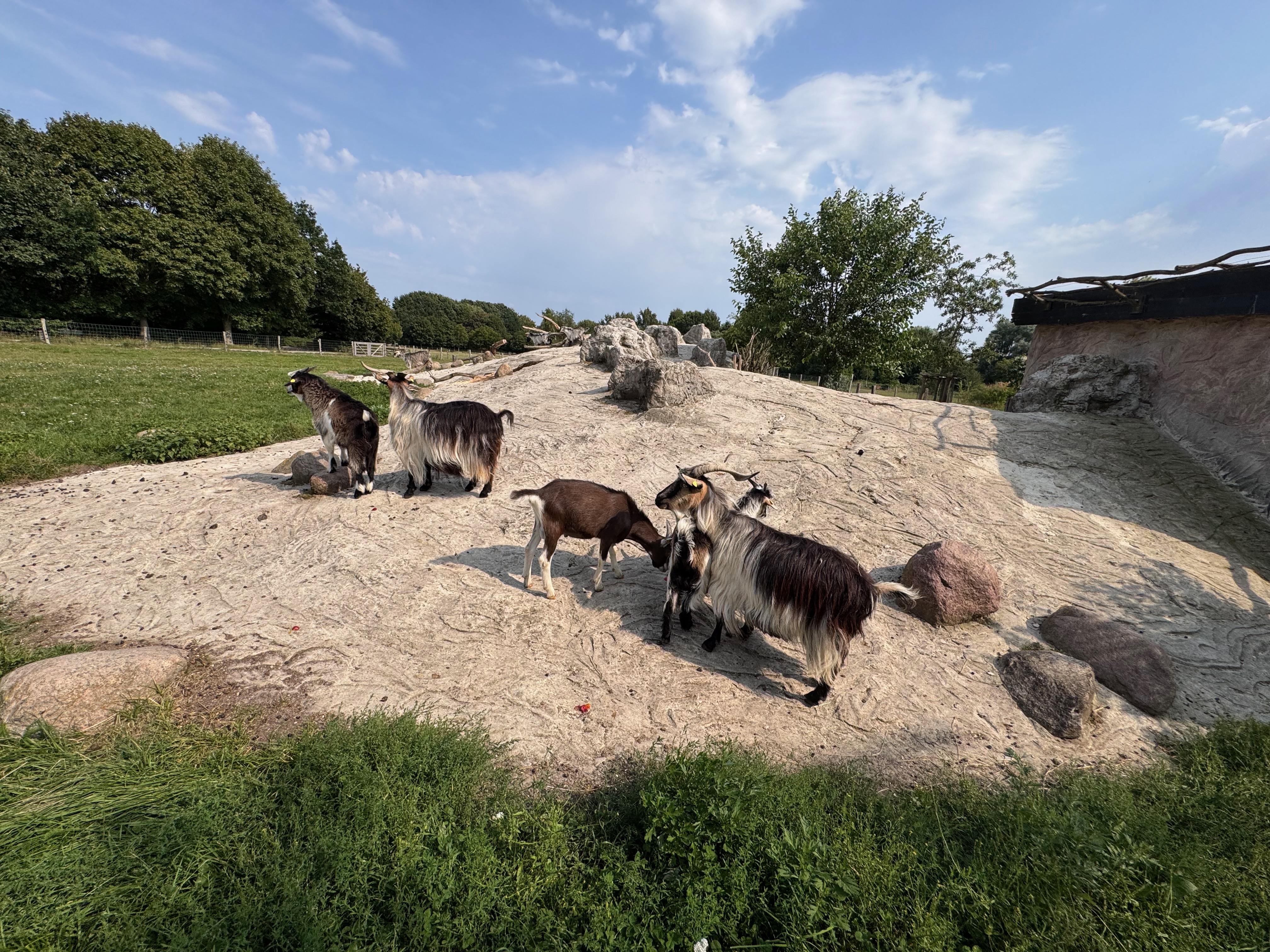
This semester, for my project, I am tackling the problem of how to use wasted hay on the goat farm as a biomanufacturing medium. I believe a goat’s preference for living in a hay-filled environment dates back in evolutionary history to mountain patches at the edge of woodlands, particularly at higher elevations. The picture above isn’t my farm. Those goats live at the Archie Warder Tierpark in Northern Germany, a conservation park for historic domestic animal breeds. During my visit, the owner explained that some of the goats maintained there descend from the type of goats associated with the Galápagos populations described by Herman Melville in The Encantadas. Archie Warder taught me that conservation has inspired my desire to better engineer environments for animals on my farm to support animal health and further renewable agriculture objectives secondary to this project.
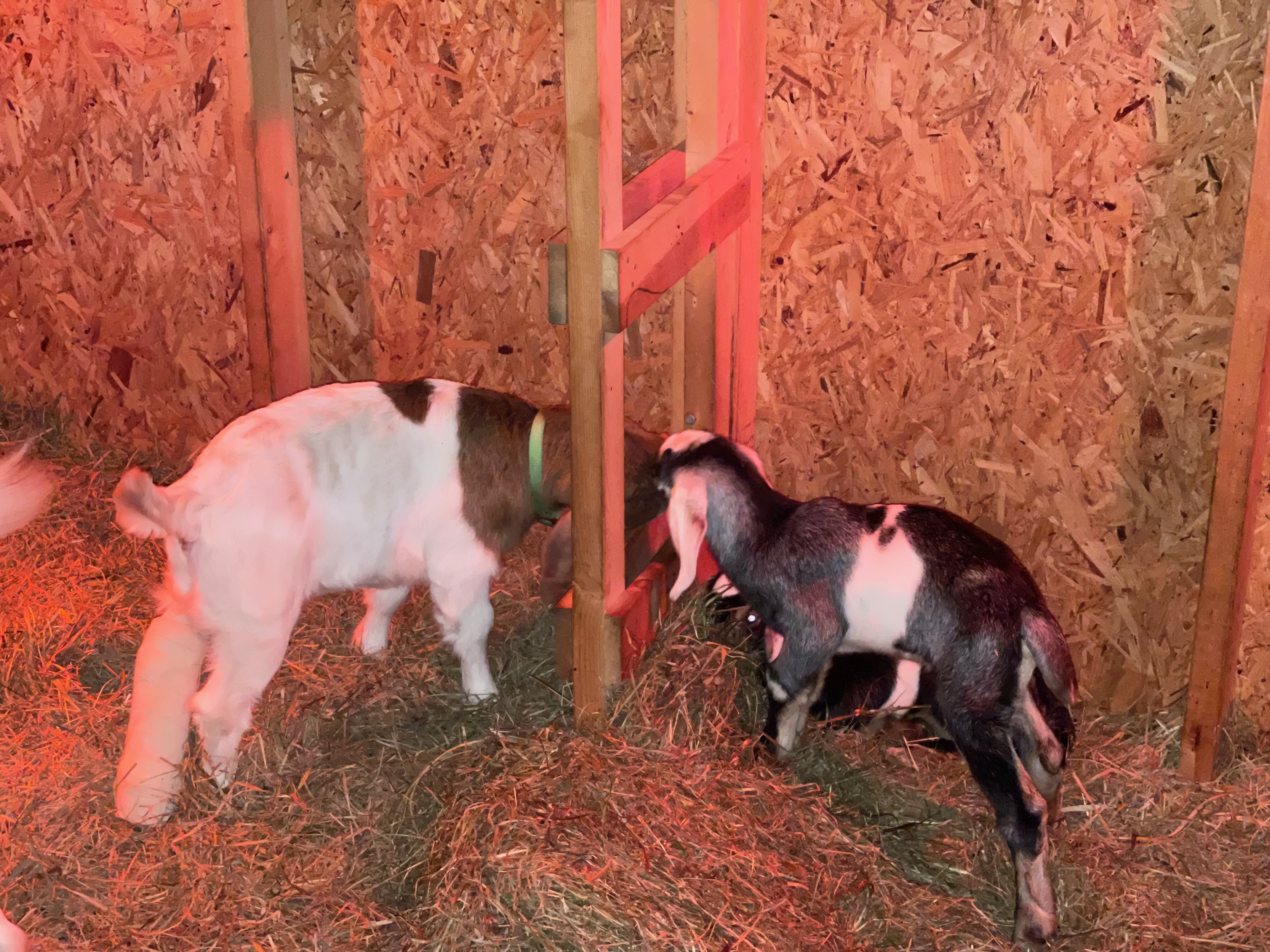
Let me back up a bit. My name is Charley Naney, and I am a goat and sheep farmer and a Ph.D. student in Bioscience at North Carolina Agricultural and Technical State University.
In the lab, I study bidirectional interactions between Metazoan host physiology and Microbiomes related to oxidative stress in aging and spaceflight (Naney, 2026).
On the farm, in second picture, I push hay and shovel waste from my goats and sheep. I also have chickens and turkeys, but cycling their waste is an entirely different challenge that I won’t address this semester. I spend a lot of time moving animals around the land and maintaining hay supplies when the goats and sheep have eaten all of the available forage. Much of that hay eventually ends up on the ground, where it becomes mixed with manure, soil, and moisture. From the perspective of farm maintenance, this material is waste that I have to move. From the perspective of biomanufacturing, however, it is a continuously generated biological feedstock.
That distinction is the starting point for my project. Rather than asking how to dispose of this material, I want to ask whether a living system can transform it into something useful for the animals that produced it. Specifically, I want to investigate whether waste hay, goat manure, and locally available mineral material can become feedstocks for a biomineralized composite that could eventually be used to construct an artificial climbing landscape for goats.
(2) What living system would you use? Propose at least one living-system manufacturing chassis that could produce your target—for example, a microbial, mammalian, or cell-free system. At a high level, describe how the system would make your target product. What goes into the system? What biological process or processes occur? What comes out? You do not need to design the complete biological system yet. Make reasonable assumptions where necessary and identify them.
I have already discovered that soiled goat hay is highly valuable for building biologically active soil rich in bacteria and earthworms. When waste hay becomes mixed with manure, urine, soil, and water, it does not remain waste for very long. Bacteria, fungi, earthworms, insects, plant roots, and other organisms gradually decompose and redistribute this material. I already take advantage of this process on my farm by burying organic material and allowing the existing soil community to cycle it back into the land.
For this project, I want to build on that living system rather than replace it. My goal is to create an artificial climbing landscape for goats—a small “Goat Mountain”—whose construction incorporates materials already moving through the farm. I envision a core constructed from locally available clay or compressed-earth blocks, potentially incorporating waste hay as fiber. Soil, hay, manure-derived material, and other suitable farm residues could then be incorporated around and within the structure where the farm’s existing decomposer community could continue breaking down organic matter and building soil.
The engineered biological component would introduce a second process: microbial biomineralization. A selected bacterial system capable of promoting calcium carbonate precipitation could be used to mineralize portions of the earthen composite. Microbial activity changes the local chemical environment so that calcium and carbonate can precipitate as solid calcium carbonate:
\mathrm{Ca^{2+}+CO_3^{2-}\rightarrow CaCO_3(s)}
Rather than asking bacteria to manufacture an entire mountain, I would use this process to help form mineral bridges between particles in selected blocks or surface layers. The clay or earthen core would provide bulk and support, while microbial mineralization could contribute cohesion, erosion resistance, and a harder climbing surface. Whether it actually provides those properties—and how much mineralization is necessary—would need to be experimentally measured.
What interests me most is that construction would not necessarily end when the structure was built. I could continue using the biological processes already operating on my farm by adding or burying appropriate organic residues in designated soil-filled areas of the structure. Earthworms and soil microorganisms could decompose those materials, plants could colonize portions of the surface, roots could stabilize soil, and nutrients could continue cycling through the system. Meanwhile, selected mineralized regions could provide the harder surfaces necessary for hoof traffic and climbing.
The resulting structure would therefore contain two complementary biological processes. One promotes decomposition and nutrient cycling, turning organic waste back into biologically active soil. The other promotes mineralization, turning part of the mineral matrix toward a more persistent solid state. Instead of treating these as opposing processes, I want to investigate whether they can occupy different compartments of the same structure.
The full-scale structure I have in mind resembles the climbing landscape shown in the photograph from Arche Warder. Rather than manufacturing that entire volume as an experimental biomaterial, I would use clay or earthen blocks for much of the core and reserve biomineralized composite for the portions where its properties are useful. This should reduce the quantity of biologically manufactured material required while allowing the structure itself to remain integrated with the biological cycling already occurring on the farm.
At the beginning of the project, I do not yet know which microbial species, mineral composition, calcium source, or farm-derived feedstock will produce the best material. I also do not know how the mineralized and biologically active regions will interact over time. Those uncertainties are part of what I want to measure rather than assumptions I want to make.
What interests me most is that construction would not necessarily end when the structure was built. I could continue using the biological processes already operating on my farm by adding or burying appropriate organic residues in designated soil-filled areas of the structure. Earthworms and soil microorganisms could decompose those materials, plants could colonize portions of the surface, roots could stabilize soil, and nutrients could continue cycling through the system. Meanwhile, selected mineralized regions could provide the harder surfaces necessary for hoof traffic and climbing.
The shape of the mountain could itself contribute to this cycling process. Goats using the elevated climbing surfaces would inevitably deposit manure, wasted hay, hair, and other organic material on the structure. Some of this material would remain in cracks and soil-filled pockets, while some would be transported downslope by gravity, animal movement, and rainfall. Rather than allowing that material simply to accumulate or wash away, the perimeter of the mountain could be designed as a biologically active capture zone containing soil, buried organic matter, plant roots, earthworms, and the microbial communities already present on the farm. Organic material moving off the harder mineralized surface would therefore be intercepted at the periphery, where it could decompose and be reincorporated into the soil.
This would make Goat Mountain more than a static climbing structure. It would function as a small engineered landscape with different biological compartments: a durable mineralized surface for animal use, protected areas where organic matter can accumulate and decompose, and a living perimeter that captures material moving off the structure and returns nutrients to the surrounding soil.
(3) How would you use automation? Identify at least one automation technology that you would combine with your living system. This could include a large-scale Cloud Lab, a desktop liquid-handling robot such as an Opentrons, a programmable microfluidics platform such as Nuclera’s, or another automation technology. Describe what part of the biomanufacturing workflow you would automate and why. For example, you might automate liquid handling, culturing, assembly, screening, sampling, measurement, optimization, or another step.
I would initially use automation to optimize the biological process rather than to manufacture the final structure. The composition of the farm-derived material and the conditions required for microbial mineralization contain many variables that could influence calcium carbonate precipitation. These could include the proportion of waste hay, manure-derived material or ash, soil and clay composition, calcium availability, pH, moisture, microbial inoculum, and incubation time.
At the laboratory scale, an automated liquid-handling platform such as an Opentrons robot could prepare and maintain a matrix of small experiments in which these variables are systematically changed. Automation could dispense microbial cultures, nutrients, calcium-containing solutions, and other liquid components; collect samples at predetermined intervals; and prepare samples for measurements of pH, microbial growth, and mineral precipitation. This would allow many candidate formulations to be compared under reproducible conditions rather than developing the material through trial and error.
The most promising conditions could then be transferred from liquid or slurry screening into larger material coupons or blocks containing the actual farm-derived substrate. At this stage, automation would shift from liquid handling toward process control. Pumps and valves could regulate water, nutrients, or mineralization solutions; sensors could monitor moisture, temperature, and pH; and imaging could document changes in cracking, shrinkage, and surface structure over time.
Automation at manufacturing scale would therefore look very different from automation during discovery. A laboratory robot could help identify the biological and chemical recipe, whereas a larger reactor or controlled delivery system would reproduce those conditions while mineralizing kilograms of material. The goal would not be to have a robot construct the mountain one pipette tip at a time, but to use automation to determine and maintain the environmental conditions under which the microorganisms manufacture the mineral cement.
(4) How much would you need to make, and how long would it take? Perform a back-of-the-envelope calculation estimating what it would take to manufacture your target at a meaningful scale. (a) How much? Define a scale relevant to your project and calculate approximately how much of your target product you would need to manufacture. For example, if you are producing a medicine, you might estimate the amount required to treat 1,000 people, everyone in Massachusetts, or everyone in the world. If you are producing a building material, you might calculate the amount required for one structure or an entire neighborhood. If you are producing an art or design artifact, define an appropriate scale yourself. Clearly show your calculation, including units, assumptions, and sources for important numbers.
For this project, I define meaningful manufacturing scale as enough biomineralized composite to cover one goat climbing structure comparable to the one shown at Arche Warder. Using the goats in the photograph as approximate scale references, I estimate the structure to be approximately 10–12 m long, 6–8 m wide, and 2–3 m high. Rather than manufacturing the entire mound from biomaterial, I propose constructing a bulk earthen core and manufacturing an approximately 10-cm-thick biologically mineralized climbing surface. A preliminary geometric estimate places the required composite volume on the order of 10 m³.
(b) How long? Using your proposed living system and automation technology, estimate how long it would take to manufacture that amount. Consider quantities such as production rate, yield, volume, number of parallel experiments or reactors, automation throughput, or whatever parameters are most appropriate for your system. You may discover that the automation technology you would use to prototype your system is very different from what you would use to manufacture at scale. If so, describe both. Again, we are looking for a reasonable engineering estimate. Show your assumptions and calculations. 5. What don’t you know yet? After completing your analysis, identify the 2–3 biggest technical unknowns, bottlenecks, or assumptions in your proposed biomanufacturing system. What would you need to learn, measure, or experimentally determine to know whether your idea could actually work?
Two observations provide the starting conditions for this project. First, goats waste a substantial amount of hay. Second, on my farm I have repeatedly observed that when this hay is incorporated into soil with animal waste and sufficient moisture, biological decomposition can convert it into soil-like organic material over a period of months. This process does not depend on whether my proposed biomineralized composite ultimately succeeds.
The farm also already contains other materials that could contribute to construction. Clay-rich soil is abundant in North Carolina and on my land, providing a readily available mineral material that could be evaluated for compressed-earth blocks, fill, or the matrix of the mountain itself. Naturally fallen trees provide another material stream. Rather than removing decomposing wood from the system, suitable pieces could be incorporated into non-load-bearing portions of the mountain or its peripheral decomposition zones, where they could retain moisture, provide organic carbon, create habitat for decomposer organisms, and gradually become incorporated into the developing soil. Waste hay, manure, fallen wood, clay, soil, microorganisms, earthworms, water, and eventually plant roots would therefore become components of the same engineered landscape.
The engineering problem is not simply how to decompose goat waste, because that biological process already occurs. The challenge is to balance containment with moisture removal. Organic material must remain in the system long enough for microorganisms, fungi, earthworms, and other decomposers to act on it, while excess water must be able to drain away. I envision the harder climbing surfaces shedding water and loose organic material downslope toward biologically active peripheral capture zones. These zones could contain soil, waste hay, manure, and decomposing wood and be designed to retain organic matter while permitting infiltration and drainage.
This creates two coupled but independently useful systems. The first is an existing biological process in which farm residues are captured, decomposed, and incorporated into soil. The second is experimental: using microbial biomineralization to precipitate calcium carbonate and produce or strengthen selected surface materials. If the biomineralized composite is unsuccessful, the mountain can still function as a landscape for capturing and cycling organic matter. If it succeeds, the same system gains a biologically manufactured, more durable climbing surface.
My longer-term goal is therefore not to import enough manufactured material to build an artificial rock and place it on the farm. It is to determine how much of the structure can be built from materials and living processes already present within the farm system, while identifying the minimum external inputs necessary to make the structure durable and safe.
AI
Feel free to use AI and our learning tools to be shared in recitation to assist you, but remember that you will present in class, so make sure you have a solid understanding of your responses.
Please also cite your AI client and prompts.
AI Use Statement: OpenAI ChatGPT (GPT-5.6 Sol) was used to help organize the project concept, refine written explanations, and explore potential biological manufacturing approaches. The author evaluated and revised the resulting material and is responsible for the final content.
Representative prompts: “Can you help me organize this biomanufacturing project around using wasted hay from my goat farm?” “What living system could transform farm-derived material through microbial mineralization?” “How could microbial calcium carbonate precipitation be incorporated into an artificial climbing landscape for goats?” “How could automation be used to prototype and optimize this biomanufacturing process?”
Readings:
Asin-Garcia, E., Fawcett, J. D., Batianis, C., & Martins dos Santos, V. A. P. (2025). A snapshot of biomanufacturing and the need for enabling research infrastructure. Trends in Biotechnology, 43(5), 1000–1014. https://doi.org/10.1016/j.tibtech.2024.10.014 Averesch, N. J. H., Berliner, A. J., Nangle, S. N., Zezulka, S., Vengerova, G. L., Ho, D., Casale, C. A., Lehner, B. A. E., Snyder, J. E., Clark, K. B., Dartnell, L. R., Criddle, C. S., & Arkin, A. P. (2023). Microbial biomanufacturing for space-exploration—what to take and when to make. Nature Communications, 14, 2311. https://doi.org/10.1038/s41467-023-37910-1 Karim, A. S. & Jewett, M. C. (2021). “Toward sustainable, cell-free biomanufacturing.” Current Opinion in Biotechnology 69, 136–144. DOI: 10.1016/j.copbio.2020.12.012. OpenAI. (2026). ChatGPT (GPT-5.6 Sol) [Large language model]. https://chatgpt.com/ Petzold, C. J., & Mukhopadhyay, A. (2025). From bench to biofactory: High-throughput technologies and automated workflows to accelerate biomanufacturing. Current Opinion in Biotechnology, 94, 103320. https://doi.org/10.1016/j.copbio.2025.103320 Yap, W. S., Choudhury, D., & Suntornnond, R. (2023). Towards biomanufacturing of cultured meat. Trends in Biotechnology, 41(3), 292–294. https://doi.org/10.1016/j.tibtech.2023.01.014 Ye, J.-W., Lin, Y.-N., Yi, X.-Q., Yu, Z.-X., Liu, X., & Chen, G.-Q. (2023). Synthetic biology of extremophiles: A new wave of biomanufacturing. Trends in Biotechnology, 41(3), 342–357. https://doi.org/10.1016/j.tibtech.2022.11.010 Zhang, Y.-H. P., Sun, J., & Ma, Y. (2017). Biomanufacturing: History and perspective. Journal of Industrial Microbiology & Biotechnology, 44, 773–784. https://doi.org/10.1007/s10295-016-1863-2