Week 1 HW: Final Project Ideas
Wearable Sweat Biosensor Proposal
1. Project Idea
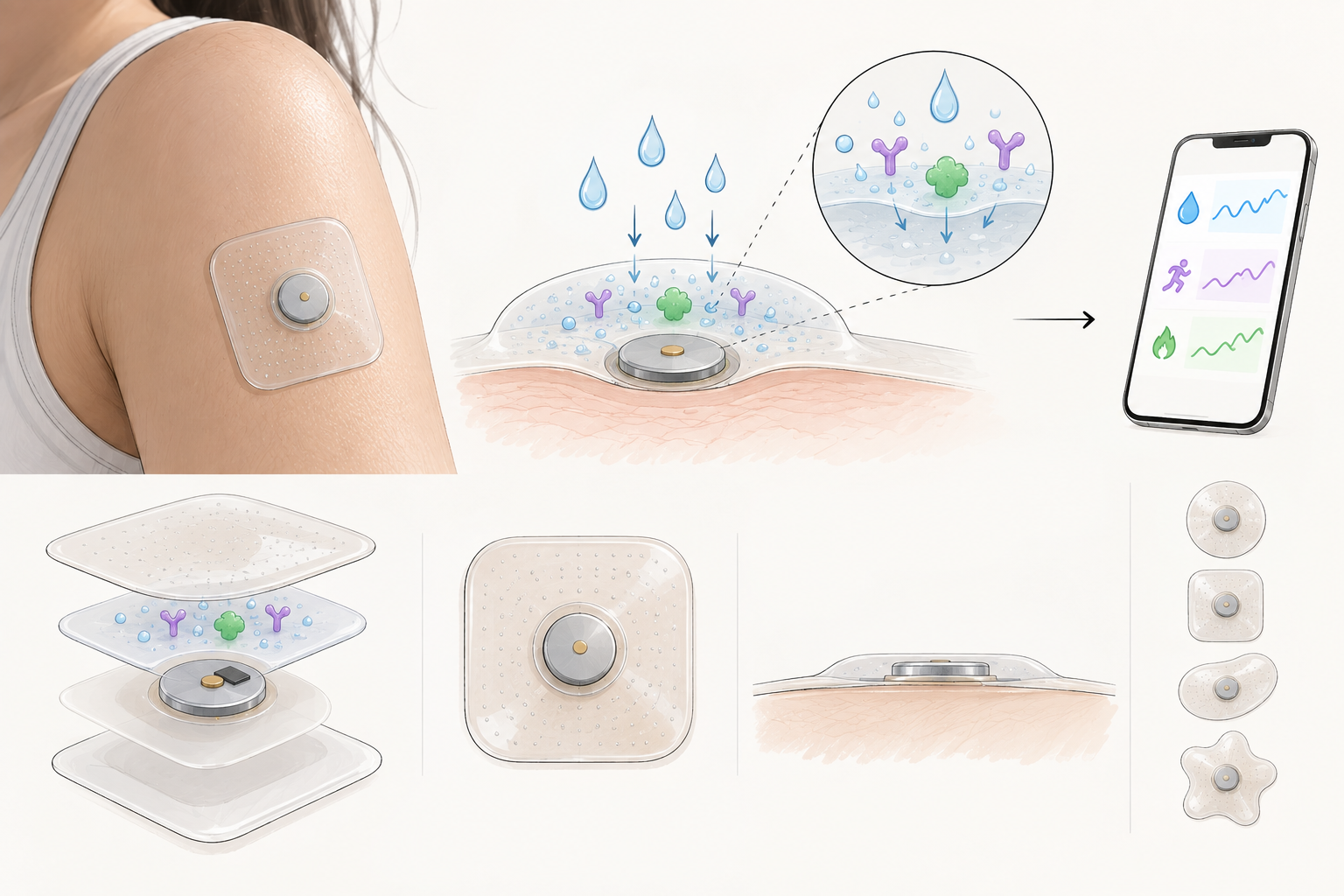
I would like to biomanufacture a wearable biosensor that provides useful, real-time information about a person’s health in a non-invasive way. The product would be a flexible patch worn on the skin that analyzes biomarkers in sweat. Using biological sensing components such as enzymes, antibodies, or engineered proteins, it could measure indicators related to hydration, stress, physical exertion, and metabolism. Possible targets include electrolytes, lactate, glucose, and cortisol, with the results displayed on a phone or another connected screen.
I have not fully narrowed down the biomarker, but I am most interested in lactate because it is associated with metabolism and physical exertion (Garcia et al., 2016). A lactate sensor could potentially help a wearer understand changes that occur during exercise or other physically demanding activities.
I am interested in this product because many health measurements require blood samples, medical appointments, or other inconvenient methods. They also usually provide information from only one moment in time. A wearable biosensor could collect information as someone goes about daily life and help the wearer understand how exercise, sleep, diet, stress, and the environment affect the body.
This product could be useful for anyone exposed to physical exertion, including athletes, people who exercise recreationally, and people performing physically demanding activities. It could help users monitor patterns related to hydration, exertion, and recovery. I am also interested in how the manufacturing process could influence the form of the device. Biomanufacturing may make it possible to create useful biological sensing components and could eventually support more renewable or biodegradable materials for disposable wearable devices.
2. Living System
I am not yet sure which living-system manufacturing chassis I would use. My wearable biosensor would be biofluid-based because it would analyze sweat. The two candidates that currently seem to fit my project best are microbial and cell-free systems.
One microbial option would be to use engineered bacteria as a manufacturing system. The inputs would include bacteria, nutrients, and DNA instructions for producing a sensing enzyme or protein. As the bacteria grow, they would produce the desired protein. The protein would then be collected, purified, and attached to an electrode in the wearable patch. The bacteria would act as small biological factories but would not be present in the final product. Tamborelli et al. (2024) demonstrated this approach by using engineered E. coli to produce a recombinant form of lactate oxidase, which was purified and attached to an electrode to create an electrochemical lactate sensor.
Another microbial option would be to use living engineered bacteria as the sensing component. The bacteria could be contained inside a protective hydrogel in the patch. A target chemical could enter the hydrogel and activate a genetic circuit inside the bacteria, causing them to produce a visible or fluorescent signal. Liu et al. (2017) demonstrated stretchable patches and gloves containing engineered bacteria that responded to specific chemicals. However, a living-cell patch would be more difficult to maintain and would require nutrients, suitable environmental conditions, and strong containment.
A cell-free system would use biological components without complete living cells. One version could use a purified enzyme attached to an electrode. When sweat reaches the patch, the enzyme would react with the target biomarker and produce an electrical change. Garcia et al. (2016), for example, developed a wearable sweat sensor that used lactate dehydrogenase to produce an electrical response to different lactate concentrations.
Another possibility would be a freeze-dried cell-free genetic circuit. The inputs could include DNA instructions, amino acids, enzymes, ribosomes, energy sources, and salts. Sweat would rehydrate the materials and allow the system to produce a color, fluorescent signal, or another measurable response. Nguyen et al. (2021) demonstrated this idea by placing freeze-dried cell-free systems into flexible materials and textiles.
At this stage, the most practical option appears to be using engineered bacteria to manufacture an enzyme and then using the purified enzyme in a cell-free electrochemical sweat patch. I have not made a final decision because the best system will depend on the biomarker, the stability of the sensing component, and the type of result I want the patch to provide. I am assuming that the electronic and structural parts of the patch would be manufactured separately and later combined with the biologically produced sensing component.
3. Automation
I am not yet familiar with many automation technologies used in biomanufacturing. One technology that appears useful for my project is an Opentrons Flex liquid-handling robot. It is a programmable pipetting system that can automatically measure, transfer, and mix small amounts of liquid. Instead of preparing every sample by hand, the robot can repeat the same steps across many samples (Opentrons, n.d.).
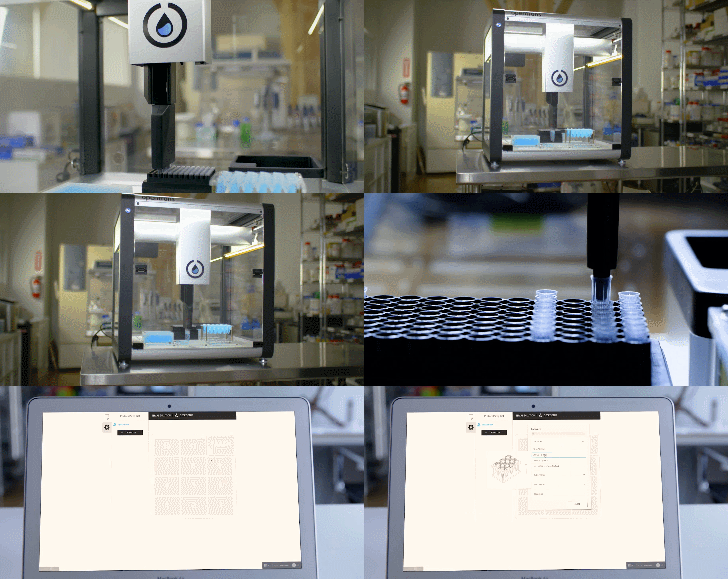
I would use the robot to test and compare different versions of the biological sensing system. It could prepare samples containing different enzymes, biomarker concentrations, or environmental conditions. If I use a microbial system, it could help prepare samples containing bacteria, nutrients, and materials needed for protein production. If I use a cell-free system, it could mix the biological components and prepare different lactate concentrations for testing.
Automating these steps would make testing faster and more consistent while reducing small differences caused by manual pipetting. I am assuming that the robot and other laboratory equipment would be available through the course or a shared laboratory. I would also need to learn how to operate the equipment safely. For early prototypes, I could use the Opentrons with a laser cutter and manual assembly. At a larger scale, roll-to-roll printing and automated dispensing would be more practical.
4. Manufacturing Scale and Time
Because I have not chosen a final living system, I will use one possible design for this estimate. I will assume that engineered E. coli produces lactate oxidase. The enzyme would then be removed from the bacteria, purified, and placed on the electrode of a cell-free sweat patch.
4a. How Much?
A meaningful first scale would be a study involving 100 people. I will assume that each person uses 10 disposable patches and that I manufacture 10% extra for setup and failed quality checks.
| Step | Calculation | Result |
|---|---|---|
| Usable patches | 100 people × 10 patches | 1,000 patches |
| Including 10% extra | 1,000 × 1.10 | 1,100 patches |
| Enzyme per patch | 20 µL × 0.50 mg/mL | 0.010 mg = 10 µg |
| Enzyme for all patches | 1,100 × 10 µg | 11 mg |
| Including 20% process loss | 11 mg × 1.20 | 13.2 mg |
| Growth liquid required | 13.2 mg ÷ 15 mg/L | 0.88 L, rounded to 1 L |
| Prepared enzyme solution | 1,100 × 20 µL × 1.20 | 26.4 mL |
Tamborelli et al. (2024) used 20 µL of a 0.50 mg/mL lactate oxidase solution per electrode and reported a purified enzyme yield of approximately 15–20 mg per liter of bacterial growth liquid. I used the lower value of 15 mg/L for a conservative estimate. In this context, bacterial growth liquid simply means nutrient-containing liquid in which the engineered bacteria grow and produce the enzyme.
My estimated manufacturing target is therefore 1,100 total patches, including 1,000 usable patches for 100 people. Producing them would require approximately 13.2 mg of lactate oxidase, 1 liter of bacterial growth liquid, and 26.4 mL of prepared enzyme solution.
4b. How Long?
I will assume that growing the bacteria and producing the enzyme takes about 24 hours. Collecting, purifying, and preparing the enzyme could take another 12 hours, for a total of 36 hours. I would round this to approximately two days for enzyme production.
The Opentrons Flex can transfer liquid to 96 positions at the same time. If the patches were arranged in compatible trays, the number of robot runs would be:
1,100 patches ÷ 96 patches per run = 11.5, rounded up to 12 runs
12 runs × 5 minutes per run = 60 minutes
The Opentrons could therefore place the enzyme solution onto the patches in approximately one hour. The five-minute run time is my assumption and would depend on the final setup.
For larger-scale production, the patch layers could be made using roll-to-roll printing and automated laser cutting. Nyein et al. (2019) demonstrated production of printed sweat-sensor layers at 60 devices per minute:
1,100 patches ÷ 60 patches per minute = 18.3 minutes
This rate applies only to printing the basic layers. I will assume another eight hours for cutting, laminating, packaging, and quality testing, along with approximately 12 hours for the enzyme to stabilize on the patches.
| Manufacturing step | Estimated time |
|---|---|
| Enzyme production | 36 hours |
| Automated enzyme placement | 1 hour |
| Assembly and quality testing | 8 hours |
| Enzyme stabilization | 12 hours |
| Total | 57 hours |
The total is approximately two and a half days. I would round the estimate to three to four days, or up to one week if there are delays or failed quality tests. Some physical parts of the patch could be manufactured while the bacteria are producing the enzyme, so the steps may overlap.
5. What Do I Not Know Yet?
Since I am still learning about biomanufacturing and wearable biosensors, the three biggest unknowns are choosing the right biomarker, determining whether the sensor will work reliably on the body, and finding a manufacturing process that produces consistent patches.
The first unknown is which sweat biomarker would provide the most useful information. Lactate is one possible starting point, but I still need to understand what a sweat lactate measurement can reliably tell the wearer. Sweat composition may also change with the person, body location, temperature, hydration level, and sweat rate. I would need to test the patch on different people and under different levels of physical exertion to determine whether the results are consistent and useful.
The second unknown is whether the biological sensing component would continue to work after being placed in the patch. Temperature, pH, storage time, movement, and other substances in sweat could affect the enzyme. I would test the patch with artificial sweat under different conditions, compare it with real sweat samples, and measure how long the enzyme remains active during storage.
The third unknown is whether the patch could be manufactured consistently at a meaningful scale. I would need to compare microbial and cell-free production methods and determine whether each patch receives the same amount of active enzyme. A small manufacturing test of approximately 100 patches could be used to compare sensitivity, response time, and failure rate before moving to a larger scale.
AI Use Disclosure
I used ChatGPT to help develop prompts for analyzing the specific papers listed in this document, explain concepts that I had trouble understanding, and identify relevant tools such as the Opentrons liquid-handling robot (OpenAI, 2026). I reviewed the original sources, checked the calculations, and revised the final responses in my own words so that I could understand and present the project in class.
Proposal image was also generated by ChatGPT. However, it is here as a placeholder to be replaced for once I understand the components and layers better in the upcoming week.
References
Garcia, S. O., Ulyanova, Y. V., Figueroa-Teran, R., Bhatt, K. H., Singhal, S., & Atanassov, P. (2016). Wearable sensor system powered by a biofuel cell for detection of lactate levels in sweat. ECS Journal of Solid State Science and Technology, 5(8), M3075–M3081. https://doi.org/10.1149/2.0131608jss
Liu, X., Tang, T. C., Tham, E., Yuk, H., Lin, S., Lu, T. K., & Zhao, X. (2017). Stretchable living materials and devices with hydrogel-elastomer hybrids hosting programmed cells. Proceedings of the National Academy of Sciences, 114(9), 2200–2205. https://doi.org/10.1073/pnas.1618307114
Nguyen, P. Q., Soenksen, L. R., Donghia, N. M., Angenent-Mari, N. M., de Puig, H., Huang, A., Lee, R., Slomovic, S., Galbersanini, T., Lansberry, G., Sallum, H. M., Zhao, E. M., Niemi, J. B., & Collins, J. J. (2021). Wearable materials with embedded synthetic biology sensors for biomolecule detection. Nature Biotechnology, 39, 1366–1374. https://doi.org/10.1038/s41587-021-00950-3
Nyein, H. Y. Y., Bariya, M., Kivimäki, L., Uusitalo, S., Liaw, T. S., Jansson, E., Ahn, C. H., Hangasky, J. A., Zhao, J., Lin, Y., Happonen, T., Chao, M., Liedert, C., Zhao, Y., Tai, L. C., Hiltunen, J., & Javey, A. (2019). Regional and correlative sweat analysis using high-throughput microfluidic sensing patches toward decoding sweat. Science Advances, 5(8), eaaw9906. https://doi.org/10.1126/sciadv.aaw9906
OpenAI. (2026). ChatGPT [Generative AI tool]. https://chatgpt.com/
Opentrons. (n.d.). Opentrons Flex robot. Retrieved September 22, 2026, from https://opentrons.com/products/opentrons-flex-robot
Tamborelli, A., López Mujica, M., Amaranto, M., Barra, J. L., Rivas, G., Godino, A., & Dalmasso, P. (2024). L-lactate electrochemical biosensor based on an integrated supramolecular architecture of multiwalled carbon nanotubes functionalized with avidin and a recombinant biotinylated lactate oxidase. Biosensors, 14(4), 196. https://doi.org/10.3390/bios14040196