Week 1 HW: Final Project Ideas
RE:BRAIN — Regenerative Engineered Biomaterial for Repair and Integration of Neural tissue
(1) What you would like to biomanufacture and why? I want to biomanufacture an implantable, plasticity-promoting “band-aid” for open or penetrating brain injuries: an in situ-forming regenerative hydrogel that could fill an irregular tissue cavity after surgical debridement. The intended users are patients who survive open/penetrating traumatic brain injury (TBI) with focal tissue loss. I am interested in this because survival can still leave major neurological deficits, and a material that supports repair at the wound site could complement conventional surgical care. The band-aid would consist of a mechanically soft hydrogel scaffold designed for compatibility with the central nervous system extracellular environment. It would slowly release neurotrophic factors such as BDNF and VEGF to support neurite growth, vascularization, and plasticity. It could also incorporate an antibacterial component to reduce infection risk. The goal would not be to replace lost brain tissue directly, but to create a temporary local environment that supports healing and remodeling.
(2) What living system would you use? Two biomanufactured components are central to the concept: alginate for the hydrogel matrix and recombinant trophic factors. For the scale-up estimate below, I would use alginate-producing bacteria such as Azotobacter vinelandii rather than algae, so that the proposed living system is consistent with the manufacturing calculation. Carbon and nutrient feed plus oxygen would enter the fermenter; bacterial metabolism would produce extracellular alginate; the cells would then be removed and the polymer purified and formulated as sodium alginate. For BDNF and VEGF, I would initially use recombinant expression hosts engineered with the relevant genes. Bacterial expression could be screened during prototyping, although a eukaryotic expression system may ultimately be preferable if correct folding, secretion, or post-translational processing proves limiting. After purification, the trophic factors would be mixed into the alginate precursor before crosslinking. This choice is deliberately provisional and is one of the technical unknowns in Section 5.
(3) How would you use automation? During development, I would use an automated liquid-handling platform such as Opentrons to prepare many formulations varying alginate concentration, crosslinker concentration, and BDNF/VEGF dose. Automated plate-based workflows could handle mixing, sampling, and screening for gelation, release kinetics, and neural-cell compatibility. This would reduce operator variability and make formulation optimization systematic [13]. At manufacturing scale, the automation would be different: computer-controlled bioreactors would monitor pH, dissolved oxygen, temperature, agitation, and feed rate, with automated sampling and downstream purification. The prototype automation therefore accelerates design-space exploration, while industrial process control supports reproducible production at scale [13].
(4) How much would you need to make, and how long would it take? For this back-of-the-envelope calculation, I will assume 100 mL of hydrogel per patient. This is a deliberately conservative design allowance rather than a clinical requirement, intended to accommodate an irregular wound cavity and some material loss during use. Figure 1 is illustrative only and is not an epidemiologically fitted distribution.
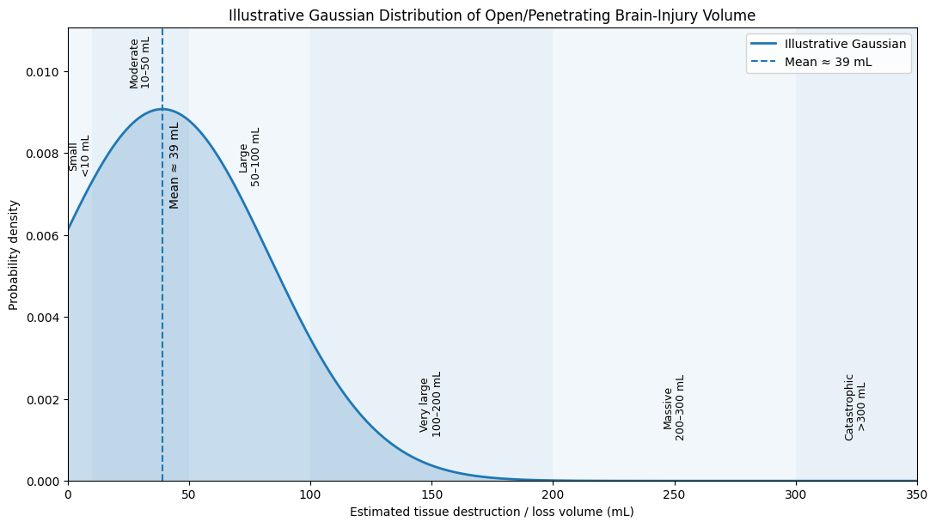
Figure 1. Illustrative distribution used to motivate a conservative 100 mL design allowance. The Gaussian is schematic and should not be interpreted as a fitted epidemiological distribution.
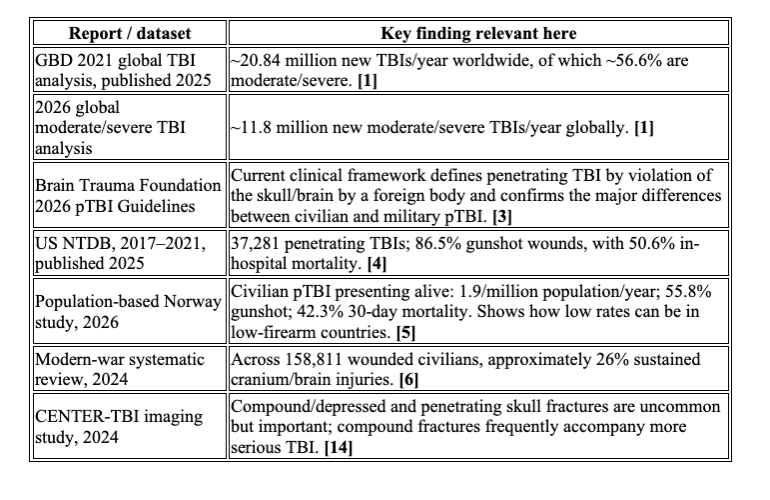
Based on the global TBI and penetrating-TBI reports summarized in Table 1, I use approximately 120,000 nonfatal open/penetrating brain injuries worldwide each year as a working estimate [1-10]. This is an extrapolated planning estimate rather than a directly reported global registry count. If the goal were to manufacture enough material for one year of this estimated global patient population, the annual hydrogel requirement would be: 120,000 patients/year x 100 mL/patient = 12,000,000 mL/year = 12,000 L/year. Because most of the band-aid would be hydrogel matrix, I will use alginate production as the rate-limiting material step. I assume a 1.5% w/v alginate formulation (15 g/L), consistent with CNS-oriented alginate hydrogel studies that used 1.5-2% w/v formulations and tuned their mechanical properties toward brain tissue [11]. The dry-polymer requirement is therefore: 12,000 L x 15 g/L = 180,000 g = 180 kg sodium alginate/year. To estimate manufacturing time, I assume an alginate fermentation titer of approximately 15 g/L, close to a reported 15.6 g/L high-producing A. vinelandii process after 48 h [12], and I assume 60% overall recovery after downstream purification. A 20,000 L batch would therefore contain approximately 300 kg crude alginate, and 300 kg x 0.60 recovery = 180 kg purified alginate. In principle, one 20,000 L batch could therefore supply the annual alginate requirement. I estimate approximately 2-3 days for fermentation plus 3-5 days for recovery, purification, drying, and formulation, or roughly 5-8 days of physical manufacturing. Biomedical release testing, including sterility and endotoxin testing, could extend total turnaround by additional weeks.
Table 1:
(5) What don’t you know yet? Three major technical unknowns would determine whether this concept could actually work:
- Hydrogel formulation and mechanics. What alginate molecular weight, concentration, and crosslink density provide brain-like mechanics while remaining stable in an irregular traumatic cavity? I would measure rheology, swelling, degradation, and mechanical properties under physiological conditions.
- Biological payload and release. What BDNF/VEGF doses and release kinetics support repair without undesirable effects, and which expression system gives sufficiently active proteins? I would measure protein yield and activity, release curves, neuronal survival and neurite growth, and endothelial responses.
- Purification and manufacturability. Can bacterially produced alginate meet the endotoxin, sterility, consistency, and material-property requirements of an implantable CNS material? I would measure endotoxin and bioburden, molecular weight, G/M composition, batch-to-batch variability, and downstream recovery.
References:
[1] Zhong H, Feng Y, Shen J, Rao T, Dai H, Zhong W, Zhao G. Global burden of traumatic brain injury in 204 countries and territories from 1990 to 2021. American Journal of Preventive Medicine. 2025;68(4):754–763. doi:10.1016/j.amepre.2025.01.001.
[2] Zheng C, Sun H, Ma J. Global epidemiological trends of moderate/severe TBI from 1990 to 2021: A study based on Global Burden of Disease Study 2021. Medicine (Baltimore). 2026;105(26):e49515. doi:10.1097/MD.0000000000049515.
[3] Bell RS, Selph S, Ghajar J, Aarabi B, Lumba-Brown A, Mangat HS, et al. Brain Trauma Foundation Guidelines for the Management of Penetrating Traumatic Brain Injury, Second Edition. Neurosurgery. 2026;98(3S):S6–S164. doi:10.1227/neu.0000000000003738.
[4] Lauinger AR, Mishra A, Kemprecos H, Tsai K, Patel V, Yu A, Hassaneen W. Risk factors for patient outcomes following penetrating traumatic brain injury. World Neurosurgery: X. 2025;29:100550. doi:10.1016/j.wnsx.2025.100550.
[5] Aarhus M, Netteland DF, Tverdal C, Stenset V, Rønning P, Helseth E. Civilian penetrating traumatic brain injury in South-East Norway. Scandinavian Journal of Trauma, Resuscitation and Emergency Medicine. 2026;34:114. doi:10.1186/s13049-026-01623-3.
[6] Chevalley K, Zimmerman J, Mittendorf A, Sennersten F, Dalman A, Frogh S, Ringart T, Robinson Y, Sandström G. Civilian pattern of injuries in armed conflicts: a systematic review. Scandinavian Journal of Trauma, Resuscitation and Emergency Medicine. 2024;32:125. doi:10.1186/s13049-024-01299-7.
[7] Ou Z, Ren Y, Duan D, Tang S, Zhu S, Feng K, et al. Global burden and trends of firearm violence in 204 countries/territories from 1990 to 2019. Frontiers in Public Health. 2022;10:966507. doi:10.3389/fpubh.2022.966507.
[8] Vande Vyvere T, Pisică D, Wilms G, Claes L, Van Dyck P, Snoeckx A, et al. Imaging findings in acute traumatic brain injury: a NINDS Common Data Element-based pictorial review and analysis of over 4,000 admission brain CT scans from the CENTER-TBI study. Journal of Neurotrauma. 2024. doi:10.1089/neu.2023.0553.
[9] Lindberg MA, Moy Martin EM, Marion DW. Military traumatic brain injury: the history, impact, and future. Journal of Neurotrauma. 2022;39(17–18):1133–1145. doi:10.1089/neu.2022.0103.
[10] Blankenship BA, Chadduck WM, Boop FA. Infection rate with replacement of bone fragment in compound depressed skull fractures. Surgical Neurology. 1998. This paper provides the commonly cited epidemiological estimate of approximately 20 depressed skull fractures per million population per year, with 75–90% being compound/open.
[11] Eleftheriadou D, Evans RE, Atkinson E, Abdalla A, Gavins FKH, Boyd AS, Williams GR, Knowles JC, Roberton VH, Phillips JB. An alginate-based encapsulation system for delivery of therapeutic cells to the CNS. RSC Advances. 2022;12(7):4005-4015. doi:10.1039/D1RA08563H.
[12] Saeed S, Hashmi AS, Ikram-Ul-Haq, Tayyab M, Awan AR, Anjum AA, Firyal S. Hyperproduction of alginate by mutated strain of Azotobacter vinelandii through submerged fermentation. Pakistan Journal of Zoology. 2016;48(5):1585-1589.
[13] Petzold CJ, Mukhopadhyay A. From bench to biofactory: High-throughput technologies and automated workflows to accelerate biomanufacturing. Current Opinion in Biotechnology. 2025;94:103320. doi:10.1016/j.copbio.2025.103320.
[14] Vande Vyvere T, Pisică D, Wilms G, Claes L, Van Dyck P, Snoeckx A, et al. Imaging findings in acute traumatic brain injury: a National Institute of Neurological Disorders and Stroke Common Data Element-based pictorial review and analysis of over 4000 admission brain computed tomography scans from the Collaborative European NeuroTrauma Effectiveness Research in Traumatic Brain Injury (CENTER-TBI) Study. Journal of Neurotrauma. 2024;41(19–20):2248–2297. doi:10.1089/neu.2023.0553.
AI use: OpenAI ChatGPT (GPT-5.6 Sol), with the following prompts:
- Find me some up to date reports on the worldwide number of non-lethal open-wound brain injuries. Based on these, how many people get such wounds each year? Make a table classifying the type of wound, their origins, and average number.
- Organize a bibliography for these reports
- What is the maximum volume of those types of injuries?
- Plot a gaussian distribution, highlighting each type of injury like in the table you gave.
- how much dry hydrogel do I need to make to have a final volume of 1l, for a hydrogel that is biocompatible with the human brain?
- How long does it take to manufacture 15g of sodium alginate in living cells?
- How long would that take for 180 kg using industrial scale methods
- Based on the coursework instructions in the attached file, provide feedback to the attached Cyril Homework 1 file
- Implement the edits you suggest as track changes in the document, and call it v2
- Make a very simplistic but cool looking cover image highlighting the product
- Give me 22 technical but cool sounding names for this project. include puns and acronyms