Week 1 HW: Final Project Ideas
(1) WHAT WOULD YOU LIKE TO BIOMANUFACTURE AND WHY?
Project Proposal: Towards New Pickaxes - Improving rare earth element (REE) capture in biomining
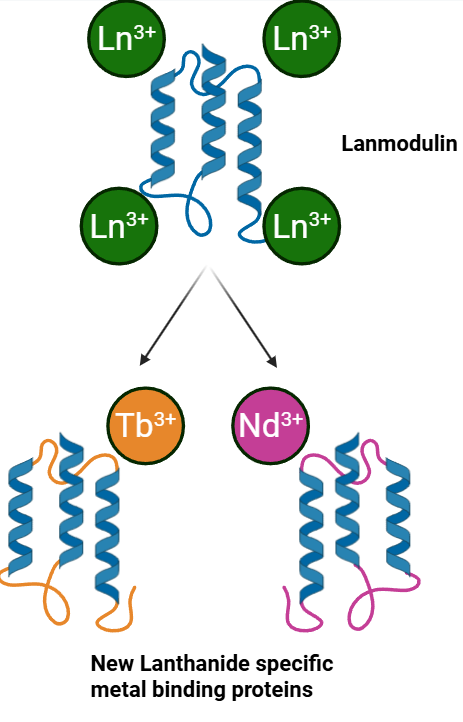
I want to create a library of molecular “pickaxes and shovels” that are proteins with ultra-high specificity for capturing valuable rare Earth elements. This project will expand upon the current knowledge of Lanmodulin (LanM), a Methylobacterium extorquens metal binding protein with 100 million fold specificity for Ln3+ (Lanthanides) ions over Ca2+ ions.
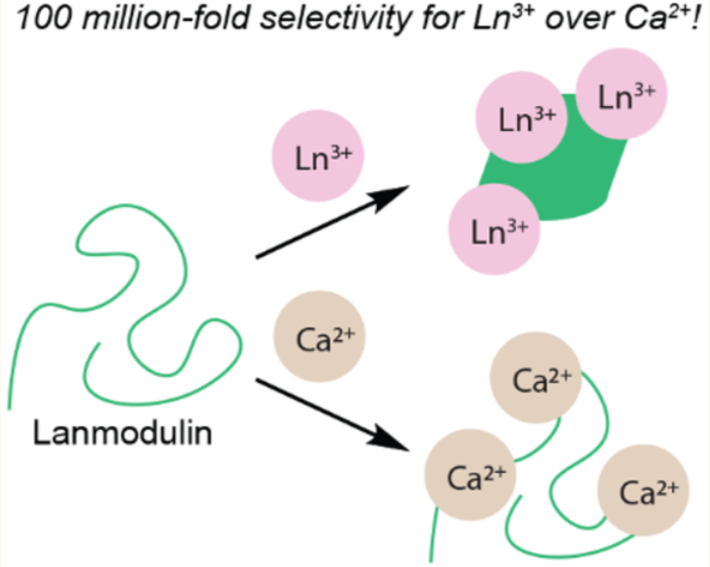
Image Source: Joseph A. Cotruvo, Emily R. Featherston, Joseph A. Mattocks, Jackson V. Ho, Tatiana N. Laremore; Lanmodulin: A Highly Selective Lanthanide-Binding Protein from a Lanthanide-Utilizing Bacterium. Journal American Chemical Society 7 November 2018; 140 (44): 15056–15061. https://doi.org/10.1021/jacs.8b09842
I am interested in pursuing the design of novel high-REE affinity proteins because I believe it would be the foundation of a good startup, just selling picks and shovels in the new proverbial gold rush.
I am interested in learning how to take the structure of a known protein with a desired property, and either A) engineer changes to improve those properties or B) find homologues in databases to bioprospect or discover new ones.
With the current geopolitical climate, and the increase in investment into AI, drones, and electric vehicles, access to rare Earth elements will continue to be important. The government released a list of critical minerals in 2025, https://www.federalregister.gov/documents/2025/11/07/2025-19813/final-2025-list-of-critical-minerals
Mining is typically associated with harsh chemicals and the total and complete destruction of nature. Bio-mining is an interesting tool that utilizes microbes (or their products/metabolites) with high affinity for capturing or reducing particular metal ions of value.
My Dream Goals for a new suite of biomining tools would be
- Specific metal affinities
- Activity in wide temperature/pH range
- Activity in sea water/saline conditions
- Recyclable (ie, can remove metal ions and protein can be reused)
(2) WHAT LIVING SYSTEM WOULD YOU USE?
Vibrio natriegens would make an ideal chassis because it is gram negative, like M. extorquens, which may help with protein folding. Vnat also has the fastest doubling time of any known bacteria, so it should increase yields. V. natriegens can also grow on a number of substrates, which may improve biomanufacturing parameters over M. extorquens which usually grows on methanol or C1 carbon sources more slowly.
A CFPS system (Cell Free Protein Synthesis) may also be ideal if AI or software could help rationally design improvements/changes to protein structure which could enable higher or more specific metal binding affinity under various conditions which may be found in real-world mining scenarios.
For example, according to this paper, 12-amino acids make up the sequence of each of the 4 EF-Hands which are helix-loop-helix structures that bind the actual Ln3+ ions.
Modifications to these amino acids could change the binding affinity and specificity, and would be a logical place to start to determine the amino acids that have the most impact on REE binding. This would plug well into an automated CFPS with linear DNA made via synthesis as opposed to modifying up to 4x12 amino acids via site directed mutagenesis in the EF hands with plasmid constructs and transforming them.
–Overall goal for Aim 2 is to mass produce LanM (and homologues if CFPS identifies better candidates) in V. natriegans. This raw material can then be packed into columns or other custom end-products for selective capturing of Rare Earth Elements.–
The Full Genome sequence of M. extorquens is found HERE
The amino acid sequence of Lanmodulin (LanM) is:
sp|C5B164|LANM_METEA Lanmodulin OS=Methylorubrum extorquens (strain ATCC 14718 / DSM 1338 / JCM 2805 / NCIMB 9133 / AM1) OX=272630 GN=lanM PE=1 SV=1 MAFRLSSAVLLAALVAAPAYAAPTTTTKVDIAAFDPDKDGTIDLKEALAAGSAAFDKLDPDKDGTLDAKELKGRVSEADLKKLDPDNDGTLDKKEYLAAVEAQFKAANPDNDGTIDAREL ASPAGSALVNLIR
Unit Prot Entry for Lan M https://www.uniprot.org/uniprotkb/C5B164/entry#function
https://www.rcsb.org/structure/6MI5 Full Structure of Lanmodulin (LanM)
(3)HOW WOULD YOU USE AUTOMATION?
Automation would be best used in the synthesis and testing of mutant proteins.
I asked Claude;
If I have a protein with a binding domain of 12 amino acids, and wanted to vary one amino acid at a time in all possible combinations, how many new proteins would I need to make?
Here was Claude’s response.
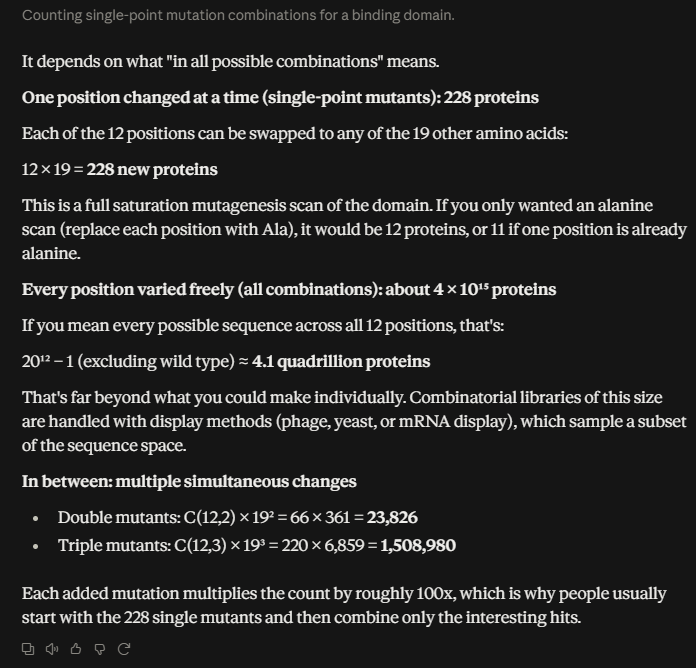
228 New proteins seems feasible. A lot more feasible than 4.1 quadrillion. This is assuming we swap only one amino acid, and we do the same to all 4 EF-hand metal binding domains.
The synthesizing mutant proteins, producing them in a CFPS system, and then measuring their ability to bind Lanthanides via some analytical method is well-suited to automation.
(4)HOW MUCH WOULD YOU NEED TO MAKE, AND HOW LONG WOULD IT TAKE?
I did a simple calculation on how much protein, LanM, would be needed to capture 1g of Neodymium (Nd) ions. 1 protein unit of LanM can “hold” 4 3+ ions.
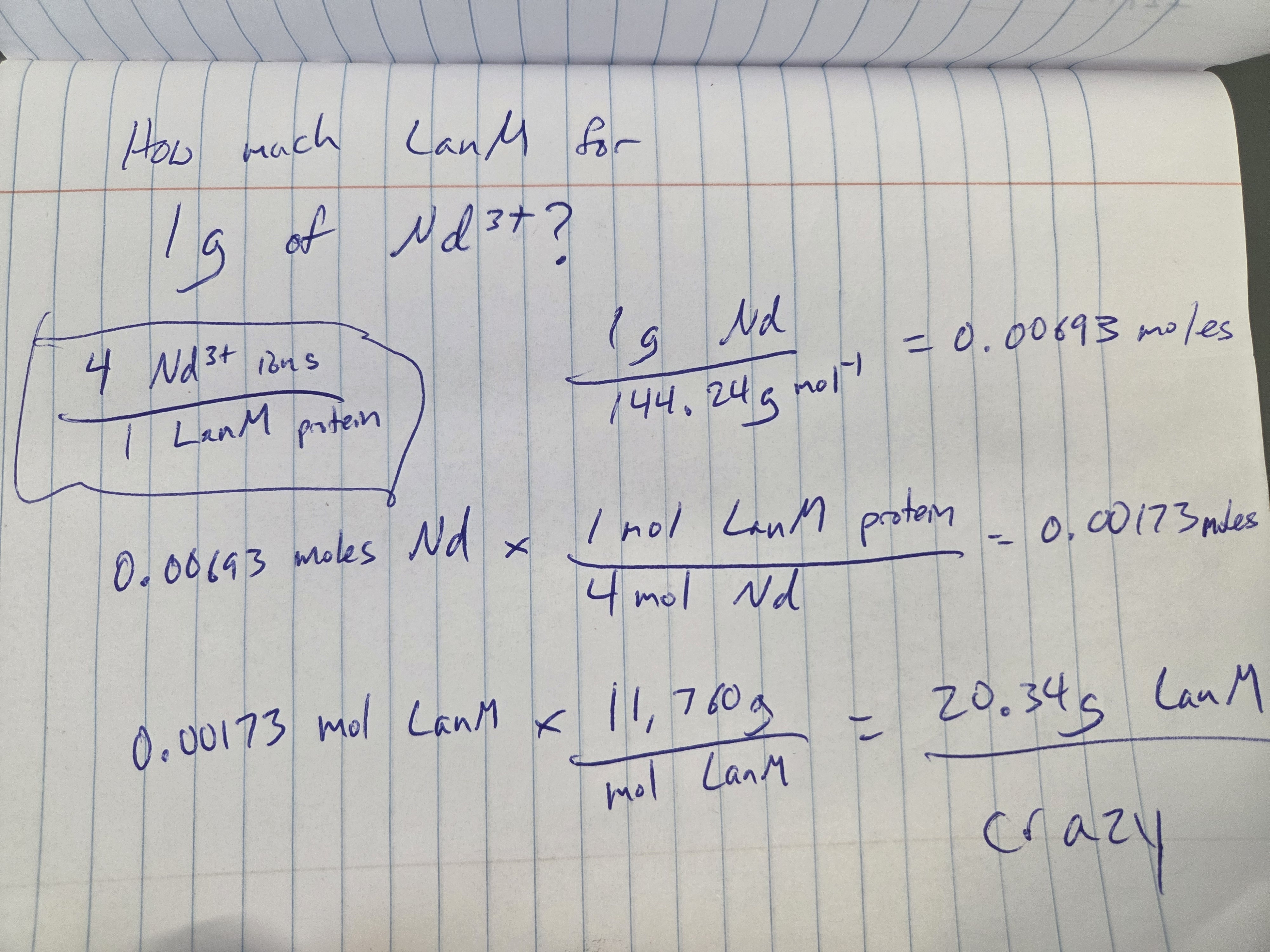
That’s a lot of protein.
Digging into the Supplementary Information from the earlier linked paper, His-Tagged LanM yielded ~20 mg / L of culture.
So to make 20g of LanM protein, we’d need 20g/0.020g/L = 1000L
It’s probably safe to say a single 1000L fermentation run would cost >$20,000->$50,000 on a good day just for time and materials, let alone CapX.
So, it is incredibly expensive and commercially not feasible it appears now, especially to treat massive volumes of mine waste tailings.
If the protein can be attached to a resin or other surface which would allow the capture and washing of valuable metals numerous times, special use cases might be made.
Time - It would probably take a week-10 days to do a 1,000L run and do downstream bioprocessing and lyophilization.
(5) WHAT DON’T YOU KNOW YET?
- Does increasing binding affinity for 3+ Lanthanides even matter past a certain point?
- Is the effort spent on engineering mutant REE binding proteins even worth it if LanM appears to have hih affinity, high temperature stability, and low pH stability already?
- Will LanM express in Vibrio natriegens?
- What would the yield be?
Need to determine if a column loaded with LanM on some resin could continually pull out Ln3+ ions from solution, and then rapidly wash it out to concentrate it, to be re-used again. The only way the price-point for using a biomining protein would make sense is if it’s re-useable or the yield is dramatically higher in Vnat.
AI - Google Search - What are EF-hands?
Answer - Helix Lettering: When researchers mapped the structure of parvalbumin (a small calcium-binding muscle protein), they labeled its alpha-helical regions with letters in sequential order from the start (N-terminus) of the protein chain
Claude - 1 prompt for # of mutants + answer posted above.
If I have a protein with a binding domain of 12 amino acids, and wanted to vary one amino acid at a time in all possible combinations, how many new proteins would I need to make?
Readings:
Coimbra, C., Morais, P. V., & Branco, R. (2026). A lanmodulin homologous protein, from Mesorhizobium qingshengii J19, involved in yttrium immobilization. Scientific Reports, 16(1), 15015. https://doi.org/10.1038/s41598-026-45294-7
Diep, P., Madsen, C. S., Choi, W., Dong, Z., Kang-Yun, C. S., Uychoco, P. F. V., Seidel, J. A., Eaton, S. A., Jiao, Y., Cotruvo, J. A., & Park, D. M. (2026). A family portrait of lanmodulin selectivity for enhanced rare-earth separations. Nature Chemical Biology, 22(5), 829–839. https://doi.org/10.1038/s41589-026-02176-3
Mattocks, J. A., Jung, J. J., Lin, C.-Y., Dong, Z., Yennawar, N. H., Featherston, E. R., Kang-Yun, C. S., Hamilton, T. A., Park, D. M., Boal, A. K., & Cotruvo, J. A. (2023). Enhanced rare-earth separation with a metal-sensitive lanmodulin dimer. Nature, 618(7963), 87–93. https://doi.org/10.1038/s41586-023-05945-5
Mattocks, J. A., Tirsch, J. L., & Cotruvo, J. A. (2021). Determination of affinities of lanthanide-binding proteins using chelator-buffered titrations. Methods in Enzymology, 651, 23–61. https://doi.org/10.1016/bs.mie.2021.01.044