Week 1 HW: Final Project Ideas
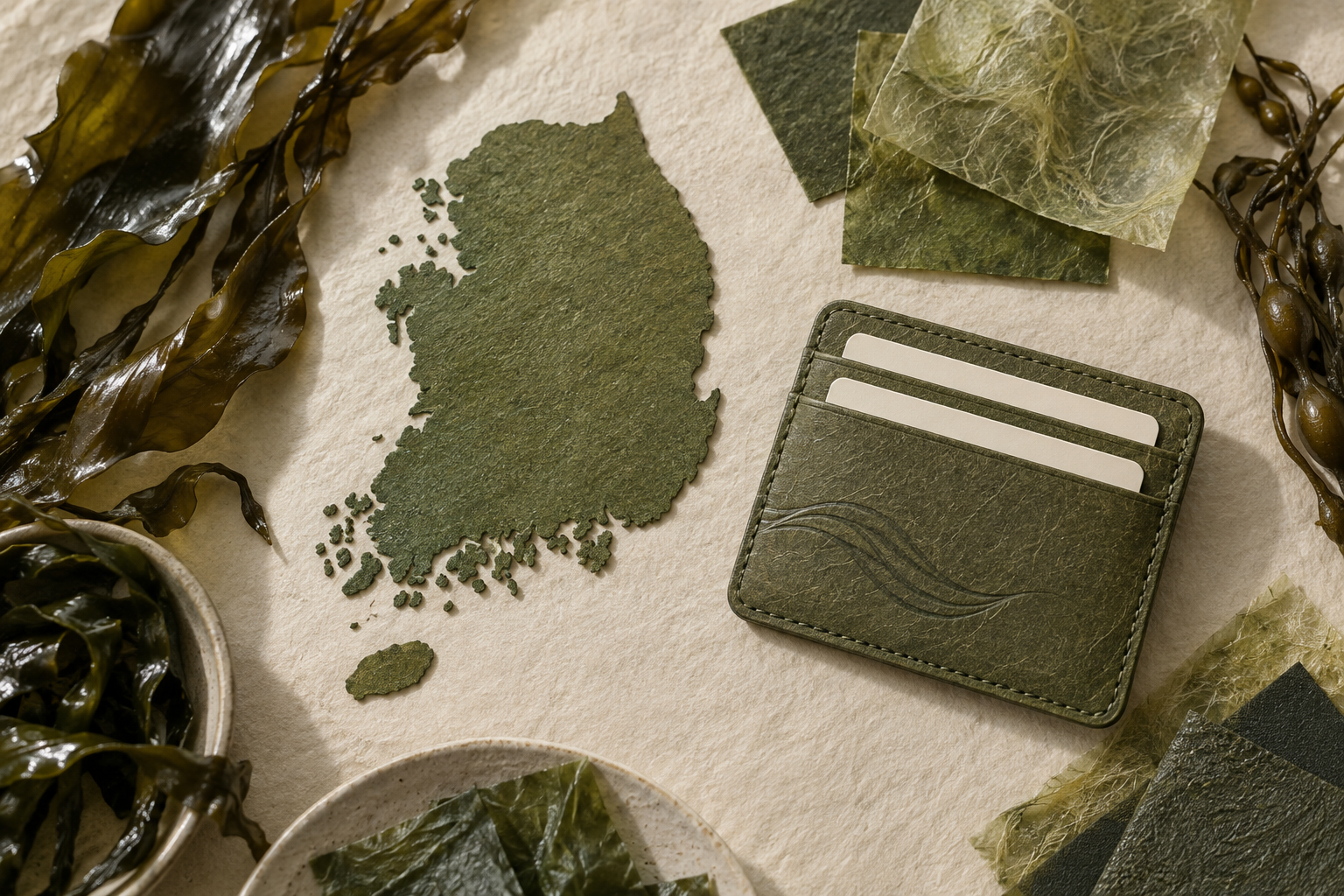
From Seaweed to Seoul or from Seoul to seaweed
For my first HTBAA project, I would like to explore a leather-like material made from seaweed-derived alginate and bacterial cellulose. My initial goal is to manufacture enough material for 10 prototype cardholders.
- What would I like to biomanufacture, and why?
Living and studying in South Korea makes me curious about finding new uses for familiar materials such as seaweed. I want to explore how biology could help produce something that people carry and use every day. My central question is whether biologically produced polymers can become a flexible, attractive, and useful accessory.
The product would be a composite, meaning a material made by combining different components. I would investigate whether bacterial cellulose could provide a fibrous structure while seaweed-derived alginate helps form the surrounding matrix. The combination is a hypothesis; adding alginate would not automatically make the sheet stronger or more flexible.
I imagine a small collection with olive or brown tones and embossed patterns inspired by kelp blades or ocean currents. Color and texture would be design choices requiring suitable finishing methods. I would investigate seaweed-processing offcuts as a future source of alginate, but I have not confirmed a supplier or extraction yield.
My initial users would be students or designers interested in experimental biomaterials.
- What living system would I use?
The project has two biological contributors. Brown seaweed produces alginate, a polymer used for its thickening and gel-forming properties. Cellulose-producing bacteria would manufacture the fibrous component. Published research demonstrates bacterial cellulose production using Gluconacetobacter kombuchae, making it one candidate to investigate [1]. I have not selected a final strain.
For the first prototype, I would use characterized alginate derived from brown seaweed and a separate nutrient source for bacterial cellulose production. I would not assume that the bacteria can directly consume raw seaweed.
The biological manufacturing step is polymer production. Recovery, blending, drying, and assembly are subsequent processing steps. The finished accessory would not be designed to contain living bacteria. Any plasticizer or coating would need to be included when evaluating the finished material’s properties and environmental impact.
- How would I use automation?
I would use automation first to compare formulations. A programmable dispenser would prepare small samples with different cellulose-to-alginate proportions and different amounts of a candidate plasticizer. For example, three proportions and three additive levels would give nine formulations. Three replicates of each would give 27 samples, alongside separate reference materials.
The dispenser would need to handle the viscosity and fibers of the mixtures. An ordinary pipetting robot may be suitable for liquid components but unsuitable for the complete mixture. Equipment selection would follow a compatibility test.
Standardized camera images could help measure sheet area, shrinkage, and visible defects. A controlled drying system could record temperature, humidity, and drying time. Mechanical and moisture testing would still be necessary because an image cannot establish strength or durability.
- How much would I need, and how long would it take?
A. Material area
For this estimate, each cardholder requires two rectangular blanks measuring 10 × 15 cm. These are provisional cutting dimensions, including assembly allowance, rather than a finalized product pattern.
Area for 10 cardholders = 10 × 2 × 0.10 m × 0.15 m = 0.30 m².
Assuming 80% of the finished sheet area is usable after defects and cutting losses:
Required finished sheet area = 0.30 m² ÷ 0.80 = 0.375 m².
B. Dry material requirement
I assume a finished dry thickness of 0.5 mm and an apparent dry density of 800 kg/m³. These are design assumptions that must be checked using a prototype.
Dry composite mass = 0.375 m² × 0.0005 m × 800 kg/m³ = 0.15 kg, or 150 g.
For bookkeeping, I assume the dry composite contains 60% bacterial cellulose, 30% alginate, and 10% other retained additives. This is a starting composition for estimation, not a validated formulation.
C. Production capacity and time
I assume a net recovery of 5 g of dry cellulose per liter of production medium over 14 days. This is an illustrative engineering assumption, not a yield taken from the cited paper or demonstrated for this project. It includes cellulose recovery losses but excludes later composite-forming losses.
Required production medium = 90 g ÷ 5 g/L = 18 L.
If the available system supports 20 L across parallel production units, the cellulose requirement fits within one assumed production round. Culture geometry and oxygen availability must also be adequate; a nominal 20 L vessel alone would not establish this capacity.
Stage- Assumed duration
Preparation- 2 days
Cellulose production-14 days
Composite formation and drying-3 days
Basic evaluation and assembly-2 days
Total-21 days
This roughly three-week estimate assumes that the biological system, material formulation, purchased alginate, and equipment are already available. It excludes initial optimization, seaweed cultivation and alginate extraction, long-term durability studies, and failed batches. I assume adequate downstream capacity and negligible additional material loss during composite formation; those assumptions need testing.
- What do I not know yet?
Will the material withstand everyday use? I would evaluate repeated bending, tearing near joins, surface wear, and changes after moisture exposure. A cardholder must retain its shape and hold cards reliably. I would compare the composite against cellulose-only and alginate-only samples to see whether combining them provides a benefit.
Can I manufacture consistent sheets? I need to measure dry cellulose recovery, final thickness, shrinkage, usable area, and variation between batches. These results would replace the assumptions in my production estimate.
Would the complete product provide an environmental advantage? I would assess the origin of the feedstock, water and energy use, processing inputs, additives, useful lifetime, and disposal options. Biological origin alone does not establish that the finished material is biodegradable or has a lower environmental impact than alternatives.
References
Abdul Rahman, S. S., et al. (2021). “Production of bacterial cellulose using Gluconacetobacter kombuchae immobilized on Luffa aegyptiaca support.” Scientific Reports, 11, 2912. This research demonstrates bacterial cellulose production in a different system; its results do not validate my proposed composite or production assumptions