Week 9 HW: Mammalian Cells and Genetic Circuits
1. How would I recognize uveal melanoma?
Figure 1 shows why one marker alone isn’t enough. At the same TNFSF10 level, a sample with more TRPM1 is more likely to fall on the melanoma side of the line. At the same TRPM1 level, increasing TNFSF10 pushes the prediction in the opposite direction.
I would start with a green fluorescent protein so I could see what the circuit predicts. In my sketch, the TRPM1 input controls how much RNA for the green protein is made. The TNFSF10 input controls CasE, an enzyme that cuts that RNA. I chose CasE_rec_mNeonGreen from the class parts sheet because its RNA has a site that CasE recognizes. One input makes the message, the other helps remove it, and the amount left determines how bright the cell should look.
For a possible treatment, I would consider p21, a protein that can slow cell division. Before studying that effect, I’d want to know how often the green signal turns on in the wrong cells. I didn’t simulate or test this circuit, so the accuracy shown in Figure 1 doesn’t tell me the accuracy of my design.
2. Can two markers distinguish a keloid from an ordinary scar?
I chose keloids because of my interest in burns and reconstruction. If the goal is to slow excessive scarring, the first question I’d ask is: could a cell recognize a keloid without reacting to a wound that healed normally?
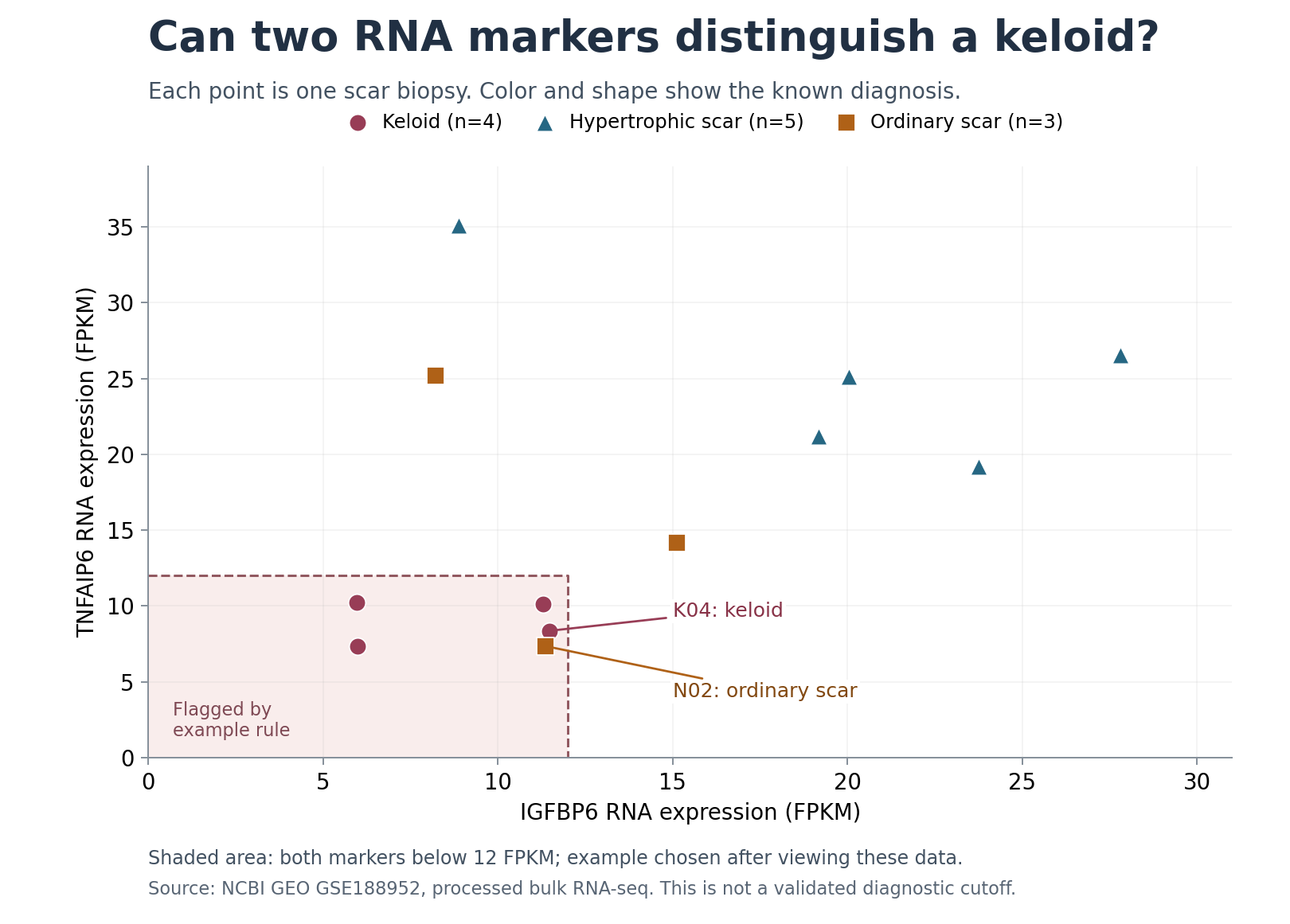
A study of postburn scars found lower levels of two markers, IGFBP6 and TNFAIP6, in keloids than in hypertrophic scars. I wanted to see where ordinary scars fell on the same graph. I used the public dataset GSE188952, which includes four keloids, five hypertrophic scars, and three ordinary scars. Each dot is one biopsy. The axes show RNA expression in the units reported by the researchers (FPKM).
I tried a simple rule: flag a biopsy if both markers are below 12 FPKM. I chose 12 after looking at the graph. It flagged all four keloids, none of the five hypertrophic scars, and one of the three ordinary scars.
These two samples show the problem:
| Biopsy | Actual diagnosis | IGFBP6 (FPKM) | TNFAIP6 (FPKM) |
|---|---|---|---|
| K04 | Keloid | 11.47 | 8.37 |
| N02 | Ordinary scar | 11.36 | 7.36 |
Both would trigger the same response. That’s a meaningful mistake if the tissue receiving treatment is healing normally.
My proposed circuit would give its strongest signal when both markers are low. A rise in either input would increase cutting of the output RNA, leaving less of its message intact. I’d use fluorescence to test that idea first. A possible therapeutic output to study later is decorin: in a lab experiment, it reduced how much keloid fibroblasts contracted a collagen gel after exposure to TGF-β1.
My next step would be to check whether both markers are actually low in the same fibroblast. The graph gives me an average for each biopsy. A cell has to make its decision from the signals it can sense itself.
3. Is my sourdough starter ready to bake with?
I’d make a jar-lid indicator for the moment when I’m deciding whether to mix the dough or give the starter more time. Bubbles tell me that gas was made earlier. What I want to know is how actively the starter is producing gas now. My input would be the amount of CO₂ released by the same amount of starter over a fixed period.
The lid would hold reporter cells separate from the food. In my design, a CO₂-sensitive switch would turn down CasE production as more gas reaches the sensor. CasE normally cuts the RNA for a green fluorescent protein. Less CasE means more of the message survives, so a fresh sensor should give a brighter reading under the same viewing light. The CO₂ switch is a proposed part of the design; CasE itself doesn’t sense gas.
I’d test the idea by taking starter at three points: just after feeding, near its peak rise, and after it has fallen. I’d use an equal amount from each stage in the same dough recipe, keep the temperature the same, and record how long each dough takes to double. If a brighter reading consistently predicts a faster rise, the lid tells me something useful. If the glow appears only after the starter has passed its peak, I’d stick with a rubber band on the jar.
Sources
- HTBAA 2026, Week 9 Homework (Mammalian Lab), Figure 1, and Genetic Circuit Parts, Sheet 1.
- NCBI: p21 (CDKN1A) and cell division.
- Zhong et al., Burns (2024): IGFBP6 and TNFAIP6 in postburn scars. The authors also used GSE188952, so my plot is not an independent validation.
- NCBI GEO: scar biopsy dataset GSE188952 and original RNA expression table.
- Study of decorin and collagen gel contraction by keloid fibroblasts.
- University of Illinois Extension: Sourdough Bread 101.
- King Arthur Baking: How to recognize a ripe starter.