Week 4 LAB: Cell-Free Manufacturing
I focused my experimentation on figuring out which part within the sfGFP designs contributes most to its cost effectiveness. In order to do this, I first averaged every material in most cost efficient designes, and then optimizing it to its max capability. When that is done, I will go over every piece that was optimized and create a dupilcate design, this time changing that part only in order to compare the differences.
A. Designing a batch:
1. My first design submission was centered around being a testing ground. So I designed the first design of sfGFP with the average of all meterials put in, bringing its $/g to $14,011/g. Results bellow:
- Potassium Glutamate 321.41 mM
- HEPES-KOH pH 7.5 72.50 mM
- Ribose 32.47 mM
- Potassium phosphate 1.6:1 monobasic:dibasic (molar ratio) 15.00 mM
- Magnesium Glutamate 8.85 mM
- 17 Amino Acid Mix 4.94 mM
- Nicotinamide 4.00 mM
- GMP 1.88 mM
- UMP 1.88 mM
- CMP 1.63 mM
- AMP 1.38 mM
- Water 1.825 uL
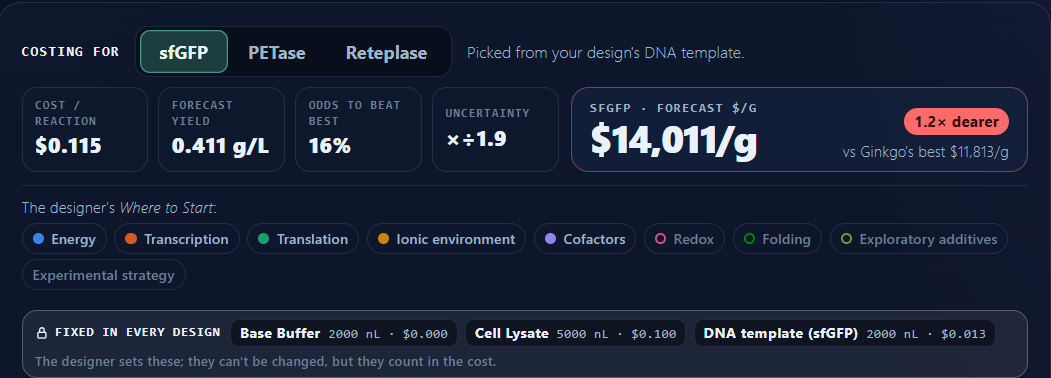
The CFPS Arena results for this design.
2. My second design was optimzied within CFPS Arena, and had its cost efficiently as high as possible. This will be the design which will have its individual changes from the test design used for the next designs. the dollar ber gram was brought to $13,294/g. Results bellow:
- Potassium Glutamate 355.31 mM
- HEPES-KOH pH 7.5 75.00 mM
- Ribose 39.13 mM
- Potassium phosphate 1.6:1 monobasic:dibasic (molar ratio) 11.25 mM
- Magnesium Glutamate 8.85 mM
- 17 Amino Acid Mix 5.00 mM
- Nicotinamide 4.00 mM
- CMP 1.88 mM
- GMP 1.88 mM
- UMP 1.88 mM
- AMP 1.50 mM
- Water 0.850 uL
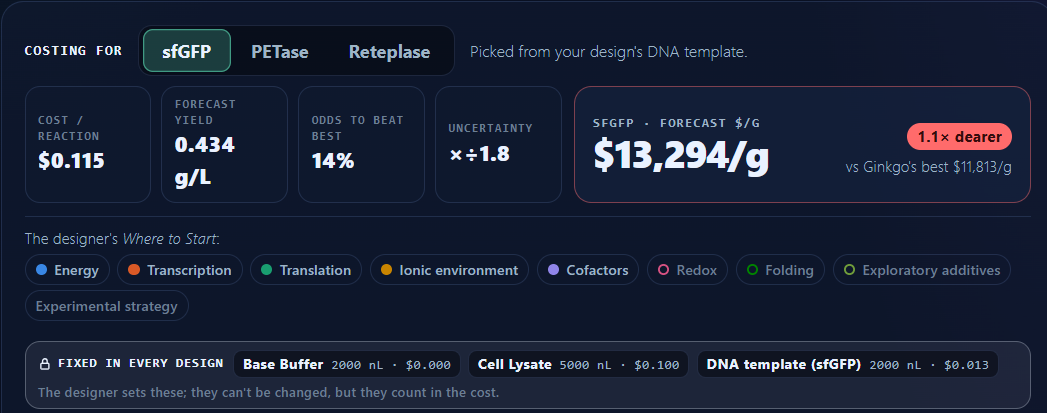
The CFPS Arena results for this design.
3. First comparison design, only changing Postassium Glutamate. Dollar per gram brought to $13,779/g. Results bellow:
- Potassium Glutamate 355.31 mM
- HEPES-KOH pH 7.5 72.50 mM
- Ribose 32.47 mM
- Potassium phosphate 1.6:1 monobasic:dibasic (molar ratio) 15.00 mM
- Magnesium Glutamate 8.85 mM
- 17 Amino Acid Mix 4.94 mM
- Nicotinamide 4.00 mM
- GMP 1.88 mM
- UMP 1.88 mM
- CMP 1.63 mM
- AMP 1.38 mM
- Water 1.050 uL
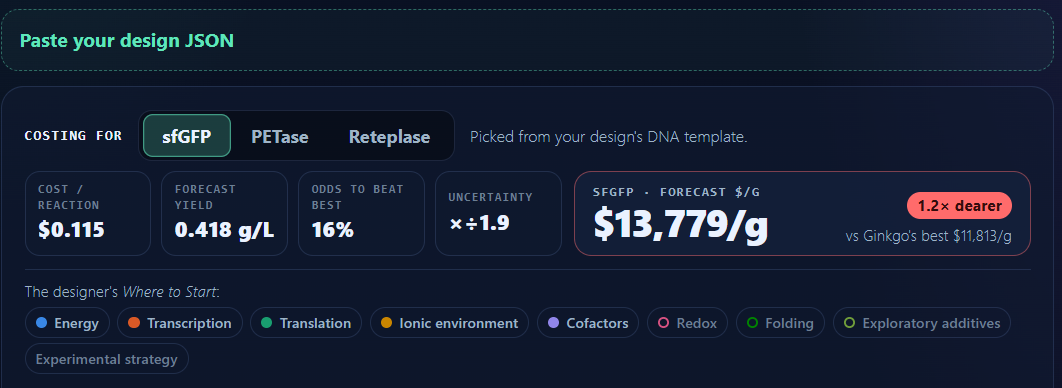
The CFPS Arena results for this design.
4. Second comparison design, only changing 17 Amino Acid Mix and HEPES-KOH pH 7.5. Dollar per gram brought to $13,862/g. Results bellow:
- Potassium Glutamate 321.41 mM
- HEPES-KOH pH 7.5 75.00 mM
- Ribose 32.47 mM
- Potassium phosphate 1.6:1 monobasic:dibasic (molar ratio) 15.00 mM
- Magnesium Glutamate 8.85 mM
- 17 Amino Acid Mix 5.00 mM
- Nicotinamide 4.00 mM
- GMP 1.88 mM
- UMP 1.88 mM
- CMP 1.63 mM
- AMP 1.38 mM
- Water 1.750 uL
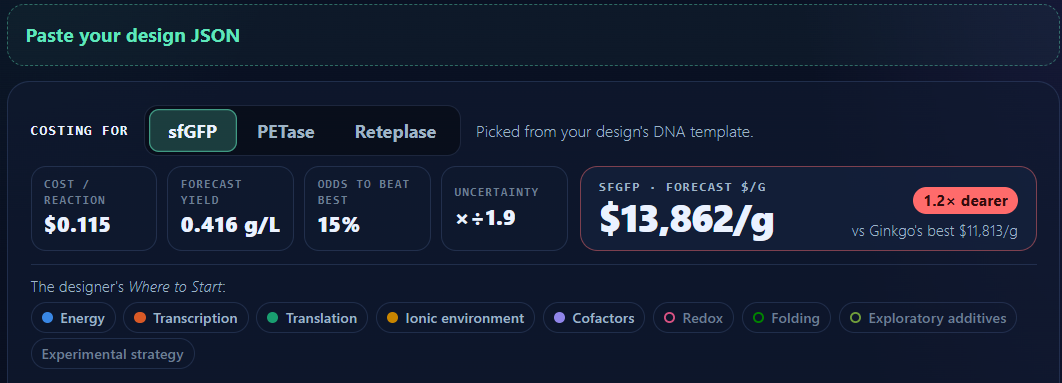
The CFPS Arena results for this design.
5. Third comparison design, only changing Ribose. Dollar per gram brought to $13,936/g. Results bellow:
- Potassium Glutamate 321.41 mM
- HEPES-KOH pH 7.5 72.50 mM
- Ribose 39.13 mM
- Potassium phosphate 1.6:1 monobasic:dibasic (molar ratio) 15.00 mM
- Magnesium Glutamate 8.85 mM
- 17 Amino Acid Mix 4.94 mM
- Nicotinamide 4.00 mM
- GMP 1.88 mM
- UMP 1.88 mM
- CMP 1.63 mM
- AMP 1.38 mM
- Water 1.625 uL
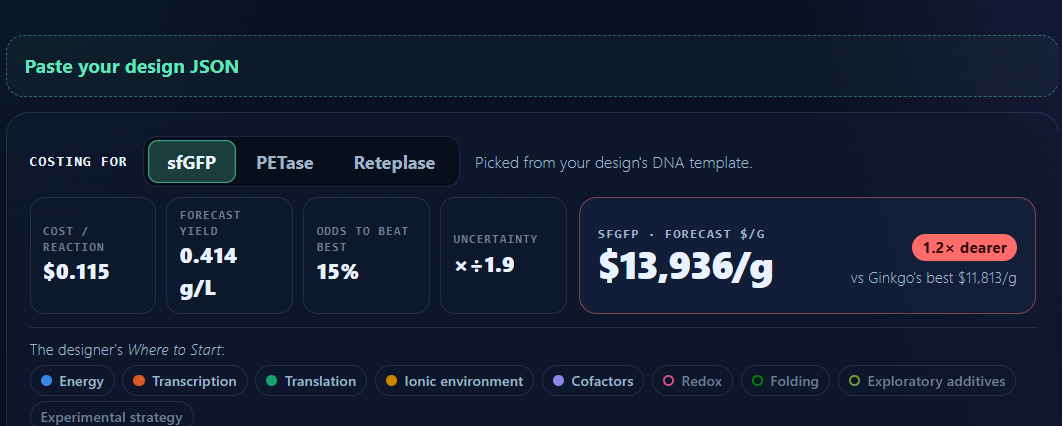
The CFPS Arena results for this design.
Going by these results, the effects of each material are Potassium Glutamate > 17 Amino Acid Mix and HEPES-KOH pH 7.5 > Ribose.
B.Data Analysis and Metascience
Q1. Guess how the same 20 µL sfGFP reaction performs in a 384-well plate versus a 96-well deep-well plate? Can you suggest what might explain some of the differences (for example: oxygen access, evaporation).
1- Oxygen access:
A 96-well deep-well plate generally has a wider well than a 384-well plate. With the same 20 µL of liquid, the reaction spreads into a shallower layer in the wider well, exposing more liquid surface to the air. This could improve oxygen transfer into the reaction. Oxygen availability can influence energy metabolism in cell-free protein synthesis, so I would predict that the 96-well plate might produce more sfGFP if oxygen transfer is limiting.
2- Evaporation:
The larger exposed surface in the 96-well plate could also cause more evaporation if the plates are not adequately sealed. Losing water concentrates the remaining chemicals, potentially changing salt concentrations, pH and protein production. A 384-well plate may lose less water under otherwise comparable conditions.
Q2. Criterion: Expected information gain I would prioritize experiments that are likely to distinguish between competing hypotheses about which reaction components improve functional protein yield. Even if a reaction performs poorly, it can still be valuable if its results help explain why a formulation succeeds or fails and guide the next round of experiments.