I am a researcher, independent developer, and founder/Principal Investigator at Glyxon BioLabs, an independent research laboratory and biomanufacturing node based in Mexico City. My work sits at the intersection of open-source digital microfluidics (EWOD), enzymatic DNA synthesis, frugal laboratory automation, bio-materials, and local Edge AI data governance for ecological monitoring and biological defense.
Academic Trajectory & Institutional Experience
My research background spans international institutions across Mexico, the United States, Germany, and Japan. After finishing my PhD, I have conducted research, held appointments, and collaborated with premier global academic and research centers, including:
Osaka University (Japan) & Waseda University (Japan) — Focus on microfluidics, bio-engineering architectures, and advanced technical systems.
Max Planck Institute (Germany) — Advanced research in molecular mechanisms, physical biology, and structural biophysics.
Arizona State University (ASU) (United States) — Applied biotechnology, bio-automation, and interdisciplinary hardware-wetware integration.
Having lived and worked across these diverse scientific hubs, I advocate for peer-to-peer knowledge transfer, open-hardware standards, and international scientific exchange.
Research Focus at Glyxon BioLabs
At Glyxon BioLabs, we design, prototype, and deploy accessible, modular biotechnology solutions:
Enzymatic DNA Synthesis & EWOD: Engineering open Electrowetting-on-Dielectric (EWOD) digital microfluidic platforms paired with Terminal deoxynucleotidyl transferase (TdT) for template-free, controlled oligonucleotide synthesis.
Frugal Automation & Plant Biomanufacturing: Repurposing Cartesian/CoreXY 3D printer kinematics into low-cost liquid handling and tissue culture robots for somatic embryogenesis, plant genetic transformation, and clonal propagation of endangered ethnobotanicals and recalcitrant forestry taxa.
Bio-Inks & Functional Biomaterials: Developing frugal hydrogel protocols, bio-shields, and structural matrices using Sargassum alginate, nanocellulose, and melanin inks for 3D bioprinting and environmental or radiation contingencies protection.
eDNA Sensing & Edge AI: Integrating embedded microcontrollers, global shutter optical sensors, and microfluidic collectors (eDNA Sniffer) for real-time, pathogen-agnostic environmental bio-surveillance.
Community Nodes, Ecosystem Collaborations & Projects
ReClone Node Distributor: Serving as a regional distribution node for the ReClone (Reagent Collaboration Network) ecosystem, facilitating access to open-access enzymes, diagnostic reagents, and biomanufacturing resources across Latin America.
Community & Global Forums: Active participant, speaker, and contributor across open science communities, including the global Global Community Bio Summit (MIT Media Lab / Community Bio Network) and Maker Faire CDMX (Centro Nacional de las Artes).
Recent Initiatives & Industry Collaborations:
DEFCON 34: Presenting open-hardware biological detection workflows, local Edge AI governance, and biosecurity protocols for decentralized bio-surveillance.
Primordia Biopunk & Open Wetware: Co-developing open-source wetware, bio-punk art-science installations, and distributed community biology tools.
Start-Up & Industry Collaborations: Consulting and collaborating with biotech start-ups and international hardware initiatives on microfluidic design, custom 3D-printed enclosure mechanics, cleanroom setups, and frugal biomanufacturing pipelines.
See the nav bar on the left to look through my work for How To Biomanufacture (Almost) Anything (Fall 2026)!
Subsections of David Jaime Castillo Cornejo — HTBAA Fall 2026
Week 1 HW: Principles and Practices
HTBAA Homework #1: The Electric Cob Project
Decentralized Plant Biomanufacturing via Frugal Automation and Open Wetware
Student: David J. Castillo-Cornejo
Course: How to Biomanufacture (Almost) Anything (HTBAA)
Due Date: Tuesday September 22, by 2:30p ET
Abstract
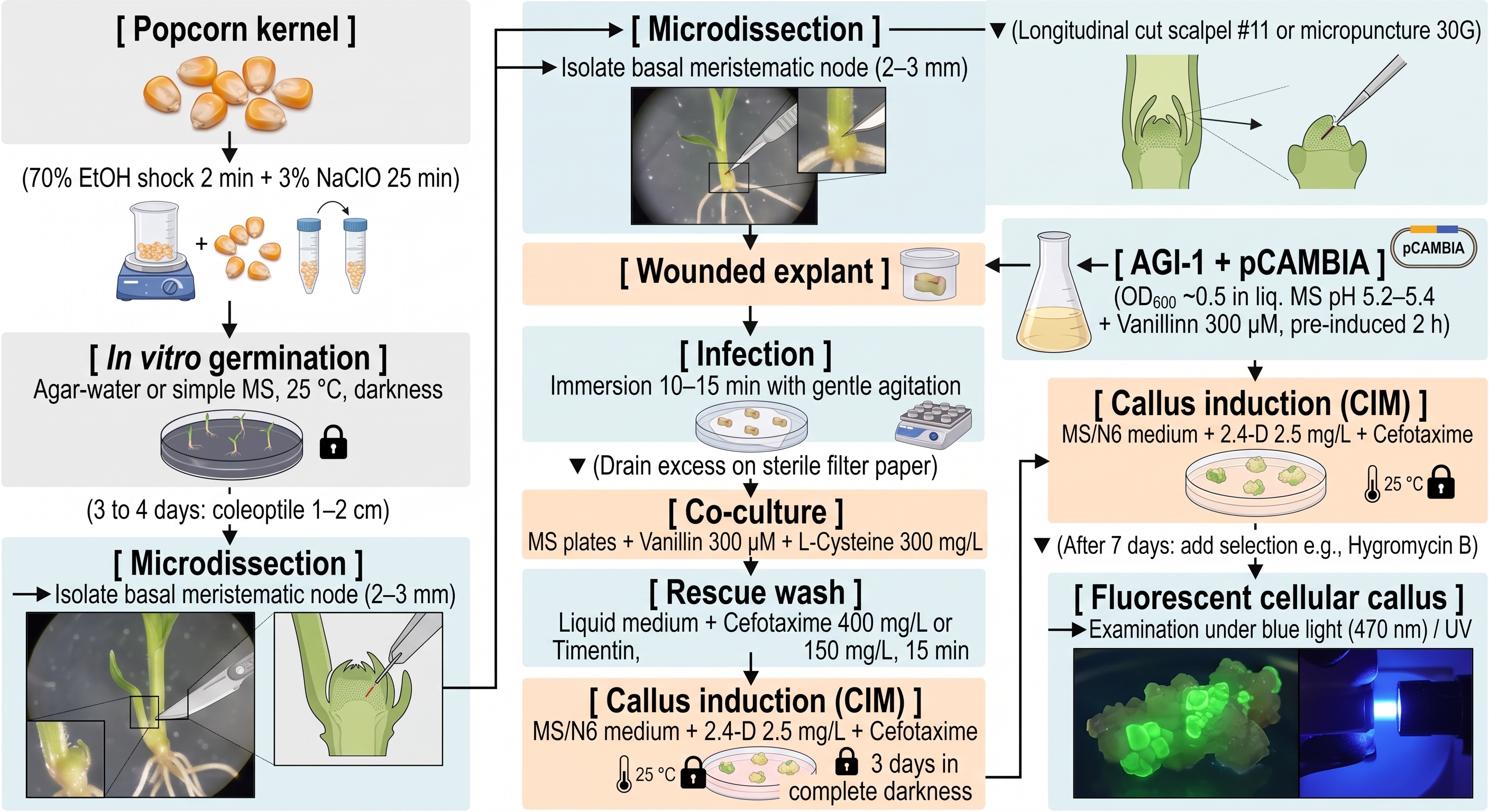
The Electric Cob Project establishes an open-source, decentralized biomanufacturing pipeline for plant genetic transformation and somatic embryogenesis, using heritage popcorn maize (Zea mays everta) as a foundational model chassis. By decoupling advanced botanical engineering from proprietary corporate pipelines, the platform pairs clean-gene vector architecture (pCambia-dLB-kanR-GFP, Addgene #223177) and frugal chemical induction (vanillin) with open-source 3-axis CNC/3D printer gantries.
This approach bypasses multi-year backcrossing cycles, enabling agrarian collectives, regional universities, and community bio-labs to manufacture clonal, climate-resilient germplasm autonomously. Furthermore, this modular automation translates directly to the micropropagation of endangered ethnobotanicals and recalcitrant woody forest taxa, treating biotechnology as open infrastructure for regional sovereignty and living biocultural preservation.
(1) What you would like to biomanufacture and why?
Target Output
Genetically stabilized, transformable embryogenic cell lines (Type II friable callus) and regenerated, fertile clonal plantlets of specialty heritage popcorn maize (Zea mays everta landraces).
Sociotechnical and Utilitarian Motivation
Socio-Agricultural Sovereignty & Farmer Autonomy: Modern agriculture conditions access to elite traits through proprietary seed licensing, intellectual property lock-ins, and mandatory chemical packages. By establishing accessible in vitro micropropagation and somatic embryogenesis, smallholder cooperatives can bypass slow seasonal seed collections and multi-year backcrossing to clonally scale locally adapted germplasm.
Frugal Automation as an Equalizer: Commercial liquid-handling robots (e.g., Hamilton, Tecan) cost tens of thousands of dollars, restricting genetic engineering to elite industrial centers. Repurposing consumer 3D-printer kinematics into automated dispensing and vision-guided subculturing robots democratizes high-precision tissue culture for resource-constrained laboratories in the Global South.
Ecological Conservation & Forest Species Scalability: Heritage landraces hold untapped genetic resilience against drought and marginal soils but face systematic displacement by commercial monocultures. The underlying somatic embryogenesis and micropropagation architecture developed here is cross-applicable: with minor adjustments to mineral formulations and auxin/cytokinin ratios, this exact hardware can clone threatened ethnobotanical species and recalcitrant forest trees for ecological restoration corridors.
Biocultural Heritage: Maize is an ancestral living technology developed through millennia of indigenous co-evolution. Re-engineering its tissue culture pipeline within a peer-to-peer hacker ethos treats biology as living culture rather than industrial extractive capital.
(2) What living system would you use?
Biological Chassis
Chassis: Embryogenic Type II callus cultures derived from the immature zygotic scutellum of Zea mays everta (Pop-corn).
Clean-Gene Segregation: The dLB architecture induces preferential termination at the first Left Border (LB1) for the gene of interest, while read-through to LB2 delivers the nptII marker. This separates the reporter/trait locus from the antibiotic resistance locus, permitting clean-gene isolation in the generation via simple Mendelian segregation.
Monophenolic Induction: To activate the virA/virG regulon without inaccessible acetosyringone, the system uses food-grade vanillin at strict acidic conditions (pH 5.35, MES buffered) and low-temperature coculture (20–22°C).
Inputs, Biological Transformations, and Outputs
Inputs: Basal Chu N6 salts (with ammonium sulfate reduced by 50% to prevent hyper-vitrification), sucrose (30g/L), L-proline (1.4–2.0 g/L to ensure osmotic friability), and 2,4-D (1.5–2.0 mg/L).
Biological Process:
De-differentiation: Dedifferentiation of immature scutellum cells into unorganized proembryogenic masses.
T-DNA Integration: Type IV secretion mediated by AGL1 delivers the T-DNA carrying GFP and nptII.
Selection & Maturation: Bacteriostatic clearance via Timentin (250–300 mg/L) and selection under Geneticin G418 (15–25 mg/L), followed by auxin withdrawal and an ABA/elevated-sucrose pulse to trigger bipolar somatic embryo formation.
Output: Rooted, fertile plantlets expressing GFP, ready for soil hardening and open pollination.
(3) How would you use automation?
Automation Technology
An open-source 3-axis motion platform (repurposed Cartesian/CoreXY CNC gantry retrofitted Ender 3D printer) with a modular, dual-purpose toolhead and positive-pressure laminar-flow enclosure using an adapted Xiaomi HEPA filter recirculator.
Automated Workflow
Precision Micro-Dispensing: A stepper-driven syringe extruder and fine PTFE capillary dispense sub-microliter volumes of liquid media renewals, antibiotic pulses (G418 / Timentin), and hormonal shifts across 24-well and 96-well culture plates without disturbing delicate callus aggregates.
Optical Tracking & Computer Vision: An onboard global shutter camera module coupled with edge-detection scripts screens plates under dual lighting:
Brightfield: Evaluates tissue texture, distinguishing granular, pale-yellow Type II callus from glassy, compact Type I tissue or necrotic zones.
Epifluorescence (470 nm blue LED excitation): Identifies stable GFP micro-colonies between days 7 and 21, automating the mapping of productive sectors for selective feeding.
Hardware Modularity for Forestry: The toolhead accepts interchangeable peristaltic pumps to dispense higher-viscosity media (such as activated charcoal slurries or gellan-dense media required for woody plant cuttings), rendering the physical workstation platform-agnostic across both herbaceous and arboreal plants.
(4) How much would you need to make, and how long would it take?
(a) How Much? (Scale Definition)
Target Scale: A decentralized production target of 1,000 viable, hardened plantlets per operational cycle—sufficient to populate a regional community breeding block, seed conservatory, or field testing trial.
Back-of-the-Envelope Assumptions:
1 immature embryo yields 300–500 mg of Type II callus.
1 gram of healthy Type II callus yields approximately 20–30 mature somatic embryos under ABA/desiccation cues.
Assuming a conservative 15% composite transformation/regeneration survival rate across G418 selection and acclimatization, generating 1,000 plantlets requires:
At 25 proembryos per gram, this requires 267 g of embryogenic callus, managed across approximately 12 to 14 standard multi-well plate stacks within the automated workspace.
Embryo Maturation (ABA / High Sucrose): (2 weeks).
Germination & Shoot Elongation (Hormone-free MS light cycle): (3 weeks).
Acclimatization & Soil Hardening: (2 weeks).
Total Throughput:15 weeks per batch. A single automated gantry servicing multi-tier racks can run 3 overlapping cohorts annually, yielding >3,000 validated plantlets per year in a benchtop footprint.
(5) What don’t you know yet? (Key Technical Unknowns)
Genotype-Specific Recalcitrance: Somatic embryogenesis protocols developed for standard transformable lines (Hi-II, A188) frequently underperform in native landraces. The exact baseline competence of uncharacterized everta accessions to form friable Type II callus rather than non-regenerable Type I tissue remains the primary biological variable.
Vanillin-Mediated Vir-Activation Kinetics: While vanillin contains the critical 4-hydroxy-3-methoxy aromatic structure, its lower binding affinity for VirA compared to acetosyringone may yield lower transformation frequencies. Direct quantitative assays comparing GFP-positive transient foci under vanillin ($350,\mu\text{M}$) versus acetosyringone ($100,\mu\text{M}$) across serial dilutions are required.
Open-Hardware HEPA Integrity Over Long Incubations: Maintaining sterility in a low-cost, 3D-printed positive-pressure enclosure over an 8-week continuous culture schedule presents contamination risks from sporulating fungi and airborne dust. Environmental bioburden and positive-pressure airflow velocity must be empirically validated under routine benchtop operation.
Project Credits & Institutional Acknowledgments
Automation Hardware Funding & Lineage: Initial development and prototyping funds for the 3-axis CNC gantry were provided by Just One Giant Lab (JOGL) under the Proteopresso initiative (automated protein purification platform). The mechanical schematics and kinematics were subsequently forked and customized for the micro-dispensing and plant tissue culture requirements of this project.
Vector Design: The double-Left-Border plasmid pCambia-dLB-kanR-GFP (Addgene #223177) was engineered and kindly donated by Andreas Stürmer and accessed via the Addgene public repository.
Microbiological & Plant Tissue Advisory: Technical consultation and protocols for Agrobacterium tumefaciens strain transformation, bacterial growth kinetics, and plant tissue handling were contributed by Sebastian Cocioba.
Hardware Engineering, Wetware Execution & Analysis: Mechanical component design, kinematic reprogramming, firmware implementation, robotic integration, plant genetic analysis, tissue culture protocol optimization, and epifluorescence optical microscopy were carried out independently at Glyxon BioLabs.
Biosecurity, Biosafety & Risk Assessment Matrix
Evaluated Options:
Option 1: Standard Agrobacterium Transformation (Traditional kanR selection, acetosyringone induction, open bench).
Repository Architecture: The project workspace contains the modular expression cassettes and vector backbone corresponding to the clean-gene binary vector pCambia-dLB-kanR-GFP (physical construct sourced via Addgene #223177, designed by Andreas Stürmer), partitioned into discrete functional parts (Promoter, UTR, CDS, Terminator, Border elements) for verification, codon-bias evaluation, and biosecurity screening.
Part 1: Define Your Expression Target
1. Target Molecule & Functional Role
Primary Target (mGFP5er): An engineered, thermotolerant Green Fluorescent Protein targeted to the endoplasmic reticulum via an N-terminal basic chitinase signal peptide and a C-terminal HDEL retention motif. In the Electric Cob somatic embryogenesis pipeline, mGFP5er serves as a non-destructive optical reporter to quantitatively map early transformation foci (days 7–21) in friable Type II callus cultures without sacrificing proembryogenic masses.
Secondary Target (NPTII): Neomycin phosphotransferase II, an aminoglycoside 3’-phosphotransferase conferring resistance to Geneticin (G418) for selective enrichment.
2. Sequence Provenance & Database Identifiers
Reporter Gene (mGFP5er): Derived from Aequorea victoria GFP, stabilized with S65T and V163A substitutions for dual-wavelength excitation (395 nm / 470 nm) and ER localization.
Final Expression Chassis: Heritage Popcorn Maize (Zea mays everta landraces), specifically friable embryogenic Type II callus and regenerating somatic plantlets.
4. Subcellular Localization & Product Destination
Reporter (mGFP5er) — Lumen of the Endoplasmic Reticulum (ER): Cytoplasmic GFP frequently suffers from cellular aggregation, rapid vacuolar turnover, or mild phytotoxicity in monocot meristematic tissues. Retaining mGFP5er within the ER via the Arabidopsis thaliana basic chitinase signal peptide (cleaved post-translocation) and C-terminal HDEL anchor yields higher steady-state fluorescence intensity and avoids nucleocytoplasmic quenching.
Selection Marker (NPTII) — Cytoplasm: NPTII phosphorylates incoming aminoglycosides (G418) directly in the cytosol prior to ribosomal inactivation.
Part 2: Design Your Genetic Parts
The construct operates as a modular T-DNA bipartite expression cassette framed by an engineered Double Left Border (dLB) architecture. This structure induces mechanical termination at the primary Left Border (LB1) for the clean target gene, while transcriptional read-through into LB2 captures the antibiotic selection marker, allowing Mendelian segregation in subsequent progeny generations.
Layer
Part Name
Type & Source
Length
Justification for Host (Zea mays) & Delivery (A. tumefaciens)
Border 1
Right Border (RB)
Vector Border (A. tumefaciens)
25 bp
Directs high-fidelity 5’-terminal nicking and directional transfer of the T-strand into plant nuclei.
Transcription Start (1)
2x CaMV 35S Promoter
Plant Enhancer/Promoter (Viral)
750 bp
Duplicated enhancer upstream of core Cauliflower Mosaic Virus 35S promoter drives robust constitutive transcription across both monocot calli and dicots.
Translation Start (1)
TEV 5’ UTR Leader
Enhancer / Kozak (Tobacco Etch Virus)
144 bp
Enhances cap-independent ribosomal loading and translation initiation in rapidly dividing embryonic tissues.
Coding Sequence (1)
mGFP5er
CDS + Signal + Retention (Engineered)
783 bp
ER-targeted reporter; permits non-invasive epifluorescence tracking of micro-callus sectors.
Transcription Stop (1)
nos Terminator
Poly(A) Signal (A. tumefaciens)
253 bp
Directs efficient 3’-end polyadenylation and transcript stabilization in plant nuclei.
Internal Border
Left Border 1 (LB1)
T-DNA Terminator Border
25 bp
Acts as a high-affinity cleavage site for VirD2; truncates the T-DNA to produce marker-free primary transgenic integrations.
Transcription Start (2)
CaMV 35S Promoter
Monomeric Promoter
418 bp
Drives moderate constitutive expression of the nptII marker during G418 selective pressure.
Coding Sequence (2)
nptII
CDS (Tn5)
795 bp
Confers Geneticin/G418 resistance for selective metabolic recovery of transformed friable callus.
Transcription Stop (2)
CaMV 35S Terminator
Poly(A) Signal
224 bp
Prevents read-through into the vector plasmid backbone.
Terminal Border
Left Border 2 (LB2)
Fail-Safe T-DNA Border
25 bp
Captures read-through events, ensuring the entire antibiotic marker integrates as an unlinked or segregable secondary locus.
Vector Backbone
pVS1 / ColE1 / KanR (bacterial)
Plasmid Chassis (Addgene #223177)
~11.5 kb
Provides high-copy maintenance in E. coli (ColE1), exceptionally stable low-copy replication in Agrobacterium (pVS1), and bacterial kanamycin selection.
Part 3: Assemble Your Construct
5’→3’ Cassette Architecture
The linear architecture between flanking T-DNA borders decouples the trait reporter locus from the antibiotic resistance cassette:
Reading Frame Integrity: Both open reading frames (mGFP5er and nptII) begin with standard canonical eukaryotic context (Kozak-like ACC ATG G) and terminate with double stop codons (TAA TGA). No premature internal stop codons or frameshifts occur across junction boundaries.
Double Left Border Mechanism: Placing LB1 immediately downstream of the nos terminator decouples the visual reporter from the 35S::nptII::35S-T marker cassette. VirD2 nicking at LB1 releases a truncated “clean” T-DNA fragment (~2.2 kb), while failure to terminate at LB1 permits extension to LB2 (~4.1 kb), generating two separate, segregable Mendelian loci upon integration into the maize genome.
Part 4: Optimize and Quality-Check
1. Codon Optimization & Monocot Bias
Maize GC/Codon Bias Tuning: The wild-type A. victoria GFP CDS has a low GC content (~35%) and heavily utilizes A/T-ending codons, which triggers cryptic splice sites and mRNA degradation in monocots.
Optimization Analysis: The mGFP5er coding sequence was evaluated against the Zea mays codon usage table (optimal codons: GCC for Ala, CUG for Leu, GUG for Val). The optimized construct elevated GC content from 39.2% to 56.4%, abolishing internal pseudo-TATA boxes and premature polyadenylation motifs (AATAAA / ATTAAA) while eliminating recognition sites for common cloning enzymes (BsaI, BsmBI, EcoRI, HindIII).
BLASTn against NCBI GenBank: Querying the assembled T-DNA cassette confirmed 100% identity with the deposited sequence of pCambia-dLB-kanR-GFP (Addgene #223177) and verified alignment with the A. tumefaciens disarmed binary plasmid vector family.
CDS Query: The mGFP5er sequence matched with 99.8% identity to synthetic plant-optimized GFP alleles containing the double mutation S65T/V163A, validating that no unintended point mutations exist in the structural fluorophore barrel.
3. Biosecurity Screening (Kernel / GDM Screen)
Screening Parameters: Evaluated for regulated plant pathogen toxins, viral coat proteins capable of complementation, hazardous select agents, and human/animal pathogenicity factors.
Flagged Sequences & Resolutions:
Flagged: Cauliflower Mosaic Virus (CaMV) 35S promoter sequences. Resolution: CaMV is an endemic plant pararetrovirus; its 35S enhancer element is non-replicative, non-pathogenic, and universally recognized as Biosafety Level 1 (BSL-1) benchmark material for research across plant genetic engineering.
Flagged: Aminoglycoside phosphotransferase (nptII). Resolution: Standard laboratory selectable marker. No biological containment hazards flagged under the Asimov/HTBAA biosecurity checklist.
Part 5: From Design to Build
1. Assembly & Synthesis Strategy
Because binary Ti vectors exceed 11 kb, direct whole-plasmid chemical de novo synthesis is cost-prohibitive (>$1,500 USD) and prone to error propagation across repetitive GC-rich border repeats and duplicated 35S enhancers. We employ a Type IIS Golden Gate / Gibson Modular Assembly approach:
The invariant ~9 kb binary backbone (pVS1-oriV-repA, ColE1, bacterial KanR, and RB/LB2 sites) is maintained as a stable master chassis in E. coli DH5α and Agrobacterium AGL1.
The variable internal cassettes (2x35S-TEV-mGFP5er-nosT and LB1-35S-nptII-35S-T) are ordered as two linear double-stranded gene fragments (gBlocks, ~1.9 kb and ~1.8 kb) from commercial synthesis providers (e.g., Twist Bioscience / IDT) or built via chip-synthesized oligo pools, flanked by unique BsaI/BsmBI overhangs for single-pot hierarchical assembly into the cut destination backbone.
2. Synthesis Constraints, Error Rates, and Hard-to-Synthesize Motifs
T-DNA Border Inverted Repeats: The 25 bp consensus repeat sequences of the Left and Right Borders contain short dyad symmetry that can cause secondary hairpin formation during PCR amplification and solid-phase phosphoramidite oligo extension. Maintaining these repeats pre-integrated in the vector backbone rather than synthesizing them de novo circumvents synthesis aborts.
Duplicated 35S Enhancers: Tandem repeat sequences in the 2x 35S promoter risk recA-mediated homologous recombination and sequence dropouts during bacterial cloning. Propagating the construct in recombination-deficient host strains (E. colirecA1398 or Stbl3 at 30°C) stabilizes these repeats.
3. Prototype vs. Scale Production
Benchtop Prototype: Assembled via Golden Gate cloning into Addgene #223177 backbone, transformed into E. coli for sequence validation via Sanger and Oxford Nanopore whole-plasmid sequencing, and electroporated into competent A. tumefaciens AGL1 cells.
Distributed Scale (Open Wetware Pipeline): Propagating the validated plasmid directly inside bacterial glycerol stocks (-80°C) across regional nodes (such as Glyxon BioLabs) allows biomanufacturing nodes to produce unlimited liters of infectious transformant broth through benchtop bacterial fermentation at minimal cost (<$0.50 USD per batch of LB/YEP broth), bypassing recurring commercial gene synthesis costs for routine micropropagation runs.
(References: Hughes & Ellington, 2017, “Synthetic DNA Synthesis and Assembly”; Kosuri & Church, 2014, “Large-scale de novo DNA synthesis”).
Part 6: What Don’t You Know Yet? (Key Technical Unknowns & Experimental Bets)
1. Maize Monocot Promoter Attenuation
The Bet: While the viral 2x CaMV 35S promoter is ubiquitous in dicots, it frequently suffers from epigenetic gene silencing (cytosine methylation) or weak activity compared to endogenous monocot promoters like Maize Ubiquitin-1 (ZmUbi1) in cereals.
The Validation Experiment: Construct a parallel design variant replacing the 2x 35S promoter with the ZmUbi1 promoter + its first native intron. Quantify transient GFP fluorescence via epifluorescence microscopy at 48 hours post-infection in bombarded/infected scutellar tissue.
2. dLB Cleavage Efficiency & True Clean-Gene Frequency
The Bet: The efficiency of the primary Left Border (LB1) terminating the T-strand transfer varies depending on local VirD2/VirE2 stoichiometry in AGL1. If termination fidelity is low, read-through into nptII will be nearly 100%, defeating the clean-gene segregation goal.
The Validation Experiment: Screen R₁ seedling progeny via multiplex PCR targeting both mGFP5er and nptII loci. Calculate segregation ratios: a true dual-insertion unlinked locus will segregate at 15:1 or 9:3:3:1, whereas a single continuous read-through integration will yield 3:1 linked co-inheritance.
3. Vanillin-Induced Vir Regulon Activation Kinetics
The Bet: Using food-grade vanillin instead of synthetic acetosyringone relies on a weaker binding affinity to the VirA sensory kinase periplasmic loop.
The Validation Experiment: Perform an induction curve testing vanillin concentrations (100 µM to 500 µM) versus acetosyringone (100 µM) in AGL1 broth cultures at pH 5.35. Measure virB operon transcriptional induction via RT-qPCR to establish the threshold concentration required for high-efficiency T-pilus formation.