Week 1 HW: Principles and Practices
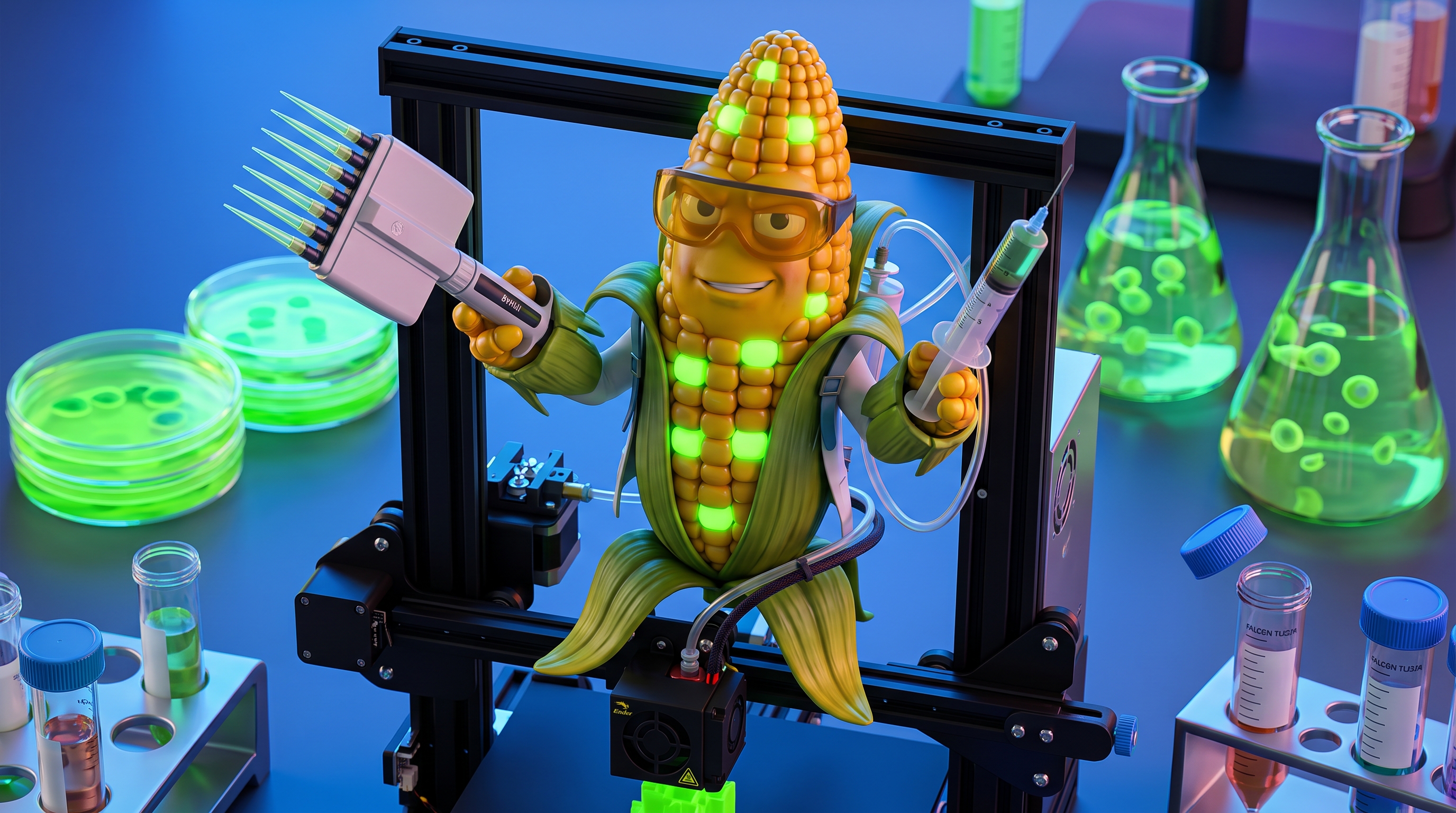
HTBAA Homework #1: The Electric Cob Project
Decentralized Plant Biomanufacturing via Frugal Automation and Open Wetware
- Student: David J. Castillo-Cornejo
- Course: How to Biomanufacture (Almost) Anything (HTBAA)
- Due Date: Tuesday September 22, by 2:30p ET
Abstract
The Electric Cob Project establishes an open-source, decentralized biomanufacturing pipeline for plant genetic transformation and somatic embryogenesis, using heritage popcorn maize (Zea mays everta) as a foundational model chassis. By decoupling advanced botanical engineering from proprietary corporate pipelines, the platform pairs clean-gene vector architecture (pCambia-dLB-kanR-GFP, Addgene #223177) and frugal chemical induction (vanillin) with open-source 3-axis CNC/3D printer gantries.
This approach bypasses multi-year backcrossing cycles, enabling agrarian collectives, regional universities, and community bio-labs to manufacture clonal, climate-resilient germplasm autonomously. Furthermore, this modular automation translates directly to the micropropagation of endangered ethnobotanicals and recalcitrant woody forest taxa, treating biotechnology as open infrastructure for regional sovereignty and living biocultural preservation.
(1) What you would like to biomanufacture and why?
Target Output
Genetically stabilized, transformable embryogenic cell lines (Type II friable callus) and regenerated, fertile clonal plantlets of specialty heritage popcorn maize (Zea mays everta landraces).
Sociotechnical and Utilitarian Motivation
- Socio-Agricultural Sovereignty & Farmer Autonomy: Modern agriculture conditions access to elite traits through proprietary seed licensing, intellectual property lock-ins, and mandatory chemical packages. By establishing accessible in vitro micropropagation and somatic embryogenesis, smallholder cooperatives can bypass slow seasonal seed collections and multi-year backcrossing to clonally scale locally adapted germplasm.
- Frugal Automation as an Equalizer: Commercial liquid-handling robots (e.g., Hamilton, Tecan) cost tens of thousands of dollars, restricting genetic engineering to elite industrial centers. Repurposing consumer 3D-printer kinematics into automated dispensing and vision-guided subculturing robots democratizes high-precision tissue culture for resource-constrained laboratories in the Global South.
- Ecological Conservation & Forest Species Scalability: Heritage landraces hold untapped genetic resilience against drought and marginal soils but face systematic displacement by commercial monocultures. The underlying somatic embryogenesis and micropropagation architecture developed here is cross-applicable: with minor adjustments to mineral formulations and auxin/cytokinin ratios, this exact hardware can clone threatened ethnobotanical species and recalcitrant forest trees for ecological restoration corridors.
- Biocultural Heritage: Maize is an ancestral living technology developed through millennia of indigenous co-evolution. Re-engineering its tissue culture pipeline within a peer-to-peer hacker ethos treats biology as living culture rather than industrial extractive capital.
(2) What living system would you use?
Biological Chassis
- Chassis: Embryogenic Type II callus cultures derived from the immature zygotic scutellum of Zea mays everta (Pop-corn).
- Vector & Delivery System: Agrobacterium tumefaciens strain AGL1 carrying the double-Left-Border vector pCambia-dLB-kanR-GFP (Addgene #223177).
- Clean-Gene Segregation: The dLB architecture induces preferential termination at the first Left Border (LB1) for the gene of interest, while read-through to LB2 delivers the
nptIImarker. This separates the reporter/trait locus from the antibiotic resistance locus, permitting clean-gene isolation in the generation via simple Mendelian segregation. - Monophenolic Induction: To activate the
virA/virGregulon without inaccessible acetosyringone, the system uses food-grade vanillin at strict acidic conditions (pH 5.35, MES buffered) and low-temperature coculture (20–22°C).
Inputs, Biological Transformations, and Outputs
- Inputs: Basal Chu N6 salts (with ammonium sulfate reduced by 50% to prevent hyper-vitrification), sucrose (30g/L), L-proline (1.4–2.0 g/L to ensure osmotic friability), and 2,4-D (1.5–2.0 mg/L).
- Biological Process:
- De-differentiation: Dedifferentiation of immature scutellum cells into unorganized proembryogenic masses.
- T-DNA Integration: Type IV secretion mediated by AGL1 delivers the T-DNA carrying GFP and
nptII. - Selection & Maturation: Bacteriostatic clearance via Timentin (250–300 mg/L) and selection under Geneticin G418 (15–25 mg/L), followed by auxin withdrawal and an ABA/elevated-sucrose pulse to trigger bipolar somatic embryo formation.
- Output: Rooted, fertile plantlets expressing GFP, ready for soil hardening and open pollination.
(3) How would you use automation?
Automation Technology
An open-source 3-axis motion platform (repurposed Cartesian/CoreXY CNC gantry retrofitted Ender 3D printer) with a modular, dual-purpose toolhead and positive-pressure laminar-flow enclosure using an adapted Xiaomi HEPA filter recirculator.
Automated Workflow
- Precision Micro-Dispensing: A stepper-driven syringe extruder and fine PTFE capillary dispense sub-microliter volumes of liquid media renewals, antibiotic pulses (G418 / Timentin), and hormonal shifts across 24-well and 96-well culture plates without disturbing delicate callus aggregates.
- Optical Tracking & Computer Vision: An onboard global shutter camera module coupled with edge-detection scripts screens plates under dual lighting:
- Brightfield: Evaluates tissue texture, distinguishing granular, pale-yellow Type II callus from glassy, compact Type I tissue or necrotic zones.
- Epifluorescence (470 nm blue LED excitation): Identifies stable GFP micro-colonies between days 7 and 21, automating the mapping of productive sectors for selective feeding.
- Hardware Modularity for Forestry: The toolhead accepts interchangeable peristaltic pumps to dispense higher-viscosity media (such as activated charcoal slurries or gellan-dense media required for woody plant cuttings), rendering the physical workstation platform-agnostic across both herbaceous and arboreal plants.
(4) How much would you need to make, and how long would it take?
(a) How Much? (Scale Definition)
Target Scale: A decentralized production target of 1,000 viable, hardened plantlets per operational cycle—sufficient to populate a regional community breeding block, seed conservatory, or field testing trial.
Back-of-the-Envelope Assumptions:
- 1 immature embryo yields 300–500 mg of Type II callus.
- 1 gram of healthy Type II callus yields approximately 20–30 mature somatic embryos under ABA/desiccation cues.
- Assuming a conservative 15% composite transformation/regeneration survival rate across G418 selection and acclimatization, generating 1,000 plantlets requires:
$$\frac{1,000\text{ plantlets}}{0.15} \approx 6,667\text{ somatic proembryos}$$
At 25 proembryos per gram, this requires 267 g of embryogenic callus, managed across approximately 12 to 14 standard multi-well plate stacks within the automated workspace.
(b) How Long? (Process Timeline)
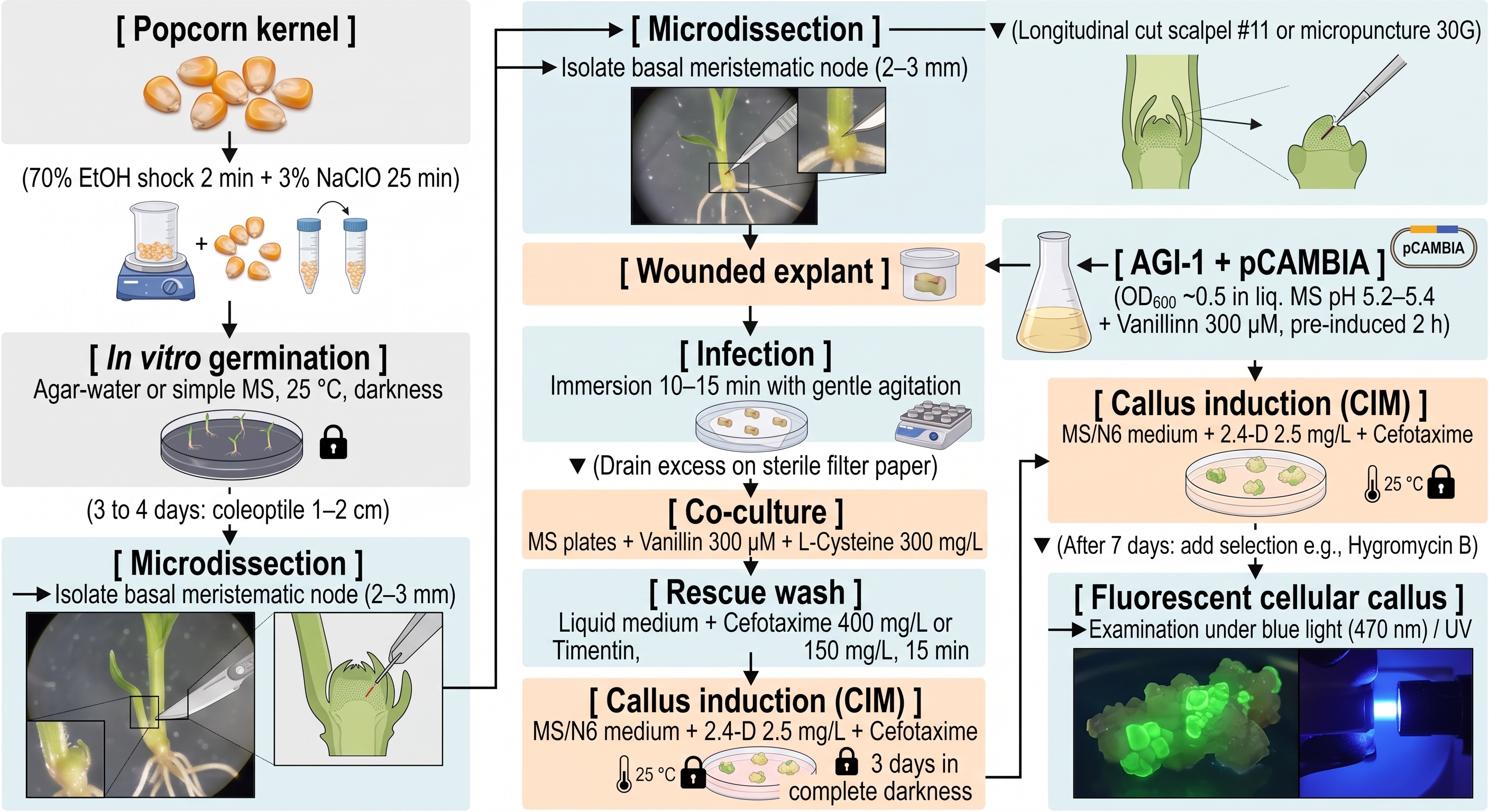
- Immature Embryo Induction & Infection: Isolation, vanillin-mediated AGL1 infection, and coculture (1 week).
- Resting & G418 Selection Rounds:
- 7-day resting phase (Timentin only).
- Three 14-day stepwise G418 rounds ($15 \rightarrow 25 \rightarrow 25\text{ mg/L}$): (7 weeks).
- Embryo Maturation (ABA / High Sucrose): (2 weeks).
- Germination & Shoot Elongation (Hormone-free MS light cycle): (3 weeks).
- Acclimatization & Soil Hardening: (2 weeks).
Total Throughput: 15 weeks per batch. A single automated gantry servicing multi-tier racks can run 3 overlapping cohorts annually, yielding >3,000 validated plantlets per year in a benchtop footprint.
(5) What don’t you know yet? (Key Technical Unknowns)
- Genotype-Specific Recalcitrance: Somatic embryogenesis protocols developed for standard transformable lines (Hi-II, A188) frequently underperform in native landraces. The exact baseline competence of uncharacterized everta accessions to form friable Type II callus rather than non-regenerable Type I tissue remains the primary biological variable.
- Vanillin-Mediated Vir-Activation Kinetics: While vanillin contains the critical 4-hydroxy-3-methoxy aromatic structure, its lower binding affinity for VirA compared to acetosyringone may yield lower transformation frequencies. Direct quantitative assays comparing GFP-positive transient foci under vanillin ($350,\mu\text{M}$) versus acetosyringone ($100,\mu\text{M}$) across serial dilutions are required.
- Open-Hardware HEPA Integrity Over Long Incubations: Maintaining sterility in a low-cost, 3D-printed positive-pressure enclosure over an 8-week continuous culture schedule presents contamination risks from sporulating fungi and airborne dust. Environmental bioburden and positive-pressure airflow velocity must be empirically validated under routine benchtop operation.
Project Credits & Institutional Acknowledgments
- Automation Hardware Funding & Lineage: Initial development and prototyping funds for the 3-axis CNC gantry were provided by Just One Giant Lab (JOGL) under the Proteopresso initiative (automated protein purification platform). The mechanical schematics and kinematics were subsequently forked and customized for the micro-dispensing and plant tissue culture requirements of this project.
- Vector Design: The double-Left-Border plasmid
pCambia-dLB-kanR-GFP(Addgene #223177) was engineered and kindly donated by Andreas Stürmer and accessed via the Addgene public repository. - Microbiological & Plant Tissue Advisory: Technical consultation and protocols for Agrobacterium tumefaciens strain transformation, bacterial growth kinetics, and plant tissue handling were contributed by Sebastian Cocioba.
- Hardware Engineering, Wetware Execution & Analysis: Mechanical component design, kinematic reprogramming, firmware implementation, robotic integration, plant genetic analysis, tissue culture protocol optimization, and epifluorescence optical microscopy were carried out independently at Glyxon BioLabs.
Biosecurity, Biosafety & Risk Assessment Matrix
Evaluated Options:
- Option 1: Standard Agrobacterium Transformation (Traditional
kanRselection, acetosyringone induction, open bench). - Option 2 (Proposed Electric Cob Pipeline): Clean-Gene Segregation (
pCambia-dLB), Frugal Vanillin Induction, 3D-Printed Positive-Pressure HEPA Enclosure. - Option 3: Auxotrophic / Marker-Free Chassis in Automated Sealed Biocontainment Unit.
| Does the option: | Option 1 | Option 2 (Electric Cob) | Option 3 |
|---|---|---|---|
| Enhance Biosecurity | |||
| • By preventing incidents | No (uses active antibiotic selection markers) | Yes (dLB separates trait from antibiotic resistance locus) | Yes (auxotrophic containment prevents wild survival) |
| • By helping respond | Low | Moderate (open-source telemetry logs run history) | High (fully tracked automated closed loop) |
| Foster Lab Safety | |||
| • By preventing incident | Standard | Yes (positive-pressure HEPA enclosure reduces aerosol risk) | High (hermetic containment) |
| • By helping respond | Manual protocol | Moderate (automated micro-dispensing minimizes handling) | High (fully automated isolation) |
| Protect the environment | |||
| • By preventing incidents | Low risk in plants, but persistent marker genes | Yes (clean-gene segregation prevents transgenes in progeny) | High (impossible to survive outside specialized media) |
| • By helping respond | Standard containment | Yes (frugal HEPA containment is easily deployable) | High |
| Other considerations | |||
| • Minimizing costs and burdens to stakeholders | High cost (expensive reagents & commercial robots) | Optimal (uses vanillin & repurposed Ender 3 gantries) | Low (high hardware & engineering costs) |
| • Feasibility? | High (established protocols) | High (validated open-hardware & frugal chemistry) | Moderate (requires genetic rewiring of chassis) |
| • Not impede research | Yes | Yes (fully open hardware and accessible wetware) | No (strict access and costly maintenance) |
| • Promote constructive applications | Yes | Yes (democratizes plant tissue culture for Global South & forestry) | Yes |