Week 1 HW: Final Project Ideas
1. What do you want to make?
I want to biomanufacture a pair of orthogonal synthetic cell-adhesion proteins designed for directed synaptogenesis:1SZ-Nrxn1β (presynaptic): β-neurexin scaffold fused to a synthetic SynZip coiled-coil domain.
2SZ-Nlgn1 (postsynaptic): neuroligin-1 scaffold fused to the complementary SynZip domain.
These proteins act as a programmable “molecular Velcro” that preferentially drives the formation of specific synapses between neurons expressing the matching pair, overcoming the random connectivity of native neurexin–neuroligin interactions.
Why?
Directed (orthogonal) synaptogenesis is a frontier tool for:
Precise rewiring of neural circuits for regenerative medicine (epilepsy, Parkinson’s, spinal injuries).
Building better brain–computer interfaces and neuroprosthetics.
Creating controlled multicellular neural architectures for basic research and biological computing.
My long-term motivation is to contribute tools that let us treat neurological disease by reprogramming connectivity rather than just modulating activity. In the shorter term, the immediate product is a research-grade toolkit (DNA constructs + purified proteins + engineered cell lines) that neurobiology and synbio labs can use.
2. What living system could make it?
Primary chassis: Mammalian cells (HEK293 or CHO)
Input: Optimized DNA constructs (codon-optimized, under hSyn or constitutive promoters, with fluorescent tags mCherry/GFP) delivered by lentiviral vectors or transient transfection.
Biological process: Transcription → translation → trafficking to the plasma membrane → secretion or surface display of the chimeric adhesion proteins.
Output: Membrane-bound or purified soluble versions of the two complementary proteins.
Alternative / complementary systems:
Cell-free systems (e.g., PURExpress or mammalian cell-free lysates) for rapid prototyping and small-scale pure protein production without the complexity of living cells.
Microbial (E. coli) for high-yield production of the DNA parts and possibly truncated soluble domains.
Assumption: Full-length transmembrane versions will require eukaryotic post-translational processing, so mammalian or cell-free eukaryotic systems are preferred for the final functional product.
3. How could automation help you make it?
Automation would be used at three critical stages:DNA design & assembly – Desktop liquid-handling robot (Opentrons OT-2) or cloud lab for high-throughput Golden Gate / Gibson assembly of many SynZip linker variants and promoter combinations.
Screening & characterization – Automated transfection, culture, and imaging (cloud lab or microfluidics platform such as Nuclera) to quantify cell–cell aggregation and colocalization of fluorescent tags in 96- or 384-well format.
Protein production & purification – Automated bioreactor sampling, affinity purification (His/Strep tags), and quality control (SDS-PAGE, Western, binding assays) so that successful variants can be rapidly scaled from µg to mg quantities.
Why automation? The design space of linkers, SynZip pairs, and expression conditions is combinatorial. Manual screening would be too slow; automation turns the DBTL cycle into a high-throughput process.
4. What would it take to make it at a meaningful scale?
(a) How much?Meaningful research scale = enough material for 50 independent research groups to run pilot experiments for one year.
Assumption: each lab needs ~2 mg of each purified protein + 10 µg of high-quality plasmid DNA per year.
→ Total target: 100 mg of each protein + 500 µg of each plasmid.
(b) How long?
DNA: With automated assembly + Twist Bioscience synthesis of the initial constructs → 2–3 weeks.
Small-scale protein (µg–mg) in HEK293 suspension culture (1–5 L bioreactors) with automated purification: ~4–6 weeks per batch (including transfection, expression, harvest).
Parallel production of both proteins in two bioreactors + automation → first research-grade batch in ~8–10 weeks.
For larger future therapeutic scale (grams), we would switch to stable CHO cell lines in 50–200 L bioreactors and continuous perfusion culture — a completely different manufacturing setup from the prototyping phase.
5. What don’t you know yet? (biggest unknowns)
Functional orthogonality in a real neural context – Will the SynZip pair actually drive preferential synapse formation in primary neurons or organoids, or will native interactions still dominate?
Expression level, trafficking and toxicity – Do the chimeric proteins reach the membrane at sufficient density without triggering ER stress or altered cell physiology?
Binding kinetics and mechanical strength – We can predict affinity in silico (HADDOCK), but we do not yet know the on/off rates or the force the synthetic synapse can withstand under physiological conditions.
These are the key experimental questions that must be answered before the system can move from a research tool to a reliable biomanufactured product.
Assisted by Grok (xAI). Prompt: “Help me frame my undergraduate thesis on synthetic synaptic adhesion proteins (SynZip-neurexin/neuroligin) as a biomanufacturing project answering the four HTBAA questions: what to make, living system, automation, and scale.”
References
Stevens, A.J., Harris, A.R., Gerdts, J. et al. Programming multicellular assembly with synthetic cell adhesion molecules. Nature 614, 144–152 (2023). https://doi.org/10.1038/s41586-022-05622-zWeek 2 HW: DNA Design
Part 1: Defining the expression target
Target molecule
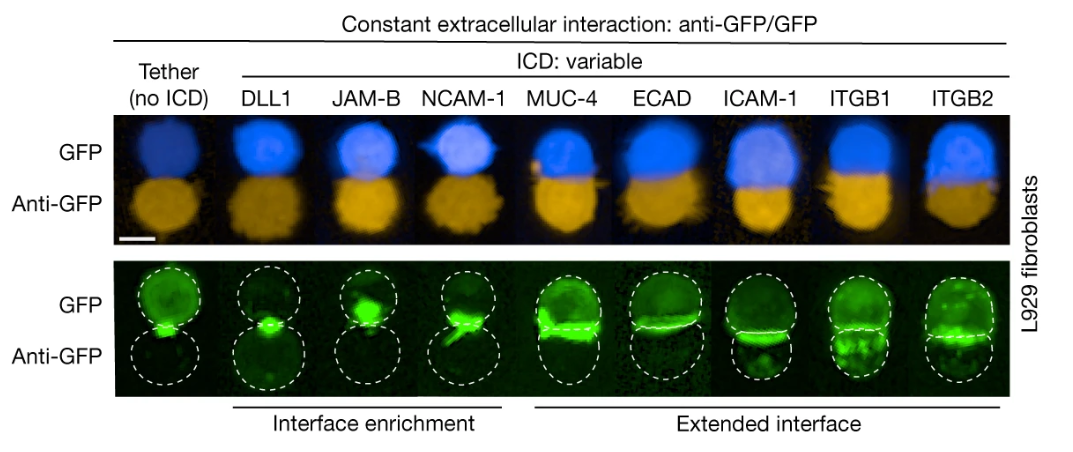
I'm expressing a pair of orthogonal adhesion proteins. For this project I'm using GFP and a anti-GFP binding protein described by Stevens et al. (Nature 2022). Each synCAM consists of:- An extracellular interaction domain: one partner carries superfolder GFP (sfGFP) and the complementary partner carries the high-affinity anti-GFP nanobody LaG16.
- A transmembrane domain.
- An intracellular domain derived from ICAM-1, which links the adhesion complex to the cytoskeleton and determines the mechanical properties of the cell–cell interface.
This pair enables heterophilic, orthogonal adhesion: cells expressing the GFP-version preferentially adhere only to cells expressing the LaG16-version, allowing directed multicellular assembly and, in the longer term, programmable synaptogenesis or tissue reorganization.
Sequence sources
Superfolder GFP (sfGFP): engineered GFP variant optimized for folding and solubility (Pédelacq et al., 2006; commonly used sequences available in Addgene and UniProt).
LaG16 anti-GFP nanobody: high-affinity llama nanobody against GFP (Fridy et al., 2014; used extensively in the Stevens et al. toolkit and available as Addgene plasmids, e.g. #205195–205196).
ICAM-1 intracellular domain + transmembrane segment: taken from human ICAM-1 (UniProt P05362) as used in the original synCAM constructs.
I will codon-optimize both full-length coding sequences for human expression.
Host / chassis
HEK293 cells (Human Embryonic Kidney 293), a well-characterized mammalian cell line that I have already used successfully in my undergraduate thesis work. HEK293 supports proper folding, glycosylation, and membrane trafficking of mammalian transmembrane proteins and is standard for transient transfection studies of adhesion molecules.
Subcellular localization
Both proteins must be displayed on the plasma membrane as type-I transmembrane proteins. Therefore each construct will include:
- An N-terminal signal peptide (to enter the secretory pathway),
- The extracellular domain (sfGFP or LaG16),
- The transmembrane helix,
- The ICAM-1 intracellular domain.
This topology ensures the interaction domains face the extracellular space while the ICAM-1 tail engages the cytoskeleton.
Part 5: How would you build it?
For the prototype stage I will order the two full coding sequences as synthetic DNA fragments (gBlocks or equivalent) from a commercial provider such as Twist Bioscience or IDT, then clone them into a mammalian expression vector (e.g., a lentiviral or transient transfection backbone such as pHR or pcDNA) using Gibson assembly or restriction–ligation.
Given the moderate length of each construct (~1.5–2.5 kb for the full synCAM CDS) and the need for precise fusion junctions (signal peptide – ECD – TM – ICD), gene synthesis of the entire CDS followed by cloning into a validated backbone is the most reliable and fastest route. Gibson assembly is preferred because it is scarless and tolerant of the flexible glycine-serine linkers I will insert between domains.
What does synthesis constrain?
Commercial gene synthesis can struggle with:
- Extreme GC content or long homopolymeric runs,
- Highly repetitive sequences (e.g., multiple GGGGS linkers),
- Secondary-structure-prone regions.
I chose superfolder GFP precisely because it is known to be well-behaved in synthesis and expression. The LaG16 nanobody is short and has been synthesized successfully many times. If any difficult regions appear after codon optimization, I will break the construct into two overlapping fragments and assemble them by Gibson, or use error-correction methods (e.g., those described by Carr et al., 2004) if ordering from a lower-fidelity pool.
Prototype vs. scale
- Prototype (one or a few constructs for functional testing): order two synthetic DNA fragments, clone into a transient-expression or lentiviral vector, and transfect HEK293 cells. This is fast (2–3 weeks from order to first transfection) and low-cost.
- Scale (producing DNA or cells for many experiments or future tissue-engineering applications): once the optimal pair is identified, I would move to a stable mammalian expression system (e.g., lentiviral integration or Flp-In) and scale plasmid production in E. coli (midi/maxi preps or industrial plasmid manufacturing). For therapeutic-scale cell production the DNA itself would be produced under GMP conditions, but that is far beyond the current research prototype.
In short, gene synthesis + Gibson cloning is ideal for rapid iteration of the adhesion pair; once validated, the same sequence can be moved into higher-throughput or higher-volume DNA production pipelines.
AI use statement
I asked Grok to help draft Part 1 and Part 5 of HTBAA Homework #2 based on my undergraduate thesis on directed synaptogenesis and the Stevens et al. (Nature 2022) synthetic cell adhesion molecule (synCAM) toolkit. Specifically, I requested help defining the expression target as a pair of orthogonal adhesion proteins using superfolder GFP + LaG16 anti-GFP nanobody as the extracellular domains and the ICAM-1 intracellular domain, expressed in HEK293 cells and localized to the plasma membrane. I also asked for guidance on DNA synthesis strategy, constraints of gene synthesis, and the difference between prototype-scale and larger-scale DNA production for the constructs.All scientific decisions, sequence choices, and justifications were reviewed and finalized by me.
References
Stevens, A.J., Harris, A.R., Gerdts, J. et al. Programming multicellular assembly with synthetic cell adhesion molecules. Nature 614, 144–152 (2023). https://doi.org/10.1038/s41586-022-05622-z