Week 2 HW: DNA Design
Part 1: Defining the expression target
Target molecule
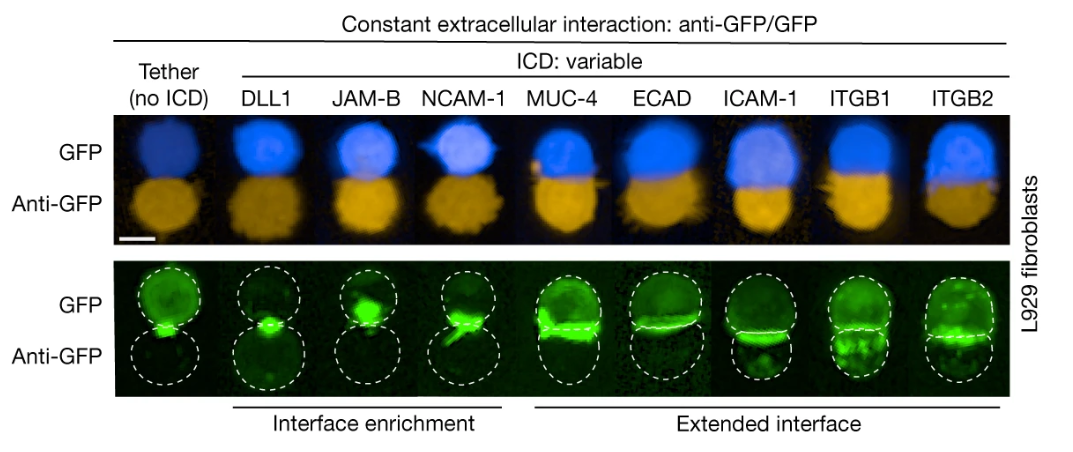
I'm expressing a pair of orthogonal adhesion proteins. For this project I'm using GFP and a anti-GFP binding protein described by Stevens et al. (Nature 2022). Each synCAM consists of:- An extracellular interaction domain: one partner carries superfolder GFP (sfGFP) and the complementary partner carries the high-affinity anti-GFP nanobody LaG16.
- A transmembrane domain.
- An intracellular domain derived from ICAM-1, which links the adhesion complex to the cytoskeleton and determines the mechanical properties of the cell–cell interface.
This pair enables heterophilic, orthogonal adhesion: cells expressing the GFP-version preferentially adhere only to cells expressing the LaG16-version, allowing directed multicellular assembly and, in the longer term, programmable synaptogenesis or tissue reorganization.
Sequence sources
Superfolder GFP (sfGFP): engineered GFP variant optimized for folding and solubility (Pédelacq et al., 2006; commonly used sequences available in Addgene and UniProt). LaG16 anti-GFP nanobody: high-affinity llama nanobody against GFP (Fridy et al., 2014; used extensively in the Stevens et al. toolkit and available as Addgene plasmids, e.g. #205195–205196). ICAM-1 intracellular domain + transmembrane segment: taken from human ICAM-1 (UniProt P05362) as used in the original synCAM constructs.
I will codon-optimize both full-length coding sequences for human expression.
Host / chassis
HEK293 cells (Human Embryonic Kidney 293), a well-characterized mammalian cell line that I have already used successfully in my undergraduate thesis work. HEK293 supports proper folding, glycosylation, and membrane trafficking of mammalian transmembrane proteins and is standard for transient transfection studies of adhesion molecules. Subcellular localization
Both proteins must be displayed on the plasma membrane as type-I transmembrane proteins. Therefore each construct will include:
- An N-terminal signal peptide (to enter the secretory pathway),
- The extracellular domain (sfGFP or LaG16),
- The transmembrane helix,
- The ICAM-1 intracellular domain.
This topology ensures the interaction domains face the extracellular space while the ICAM-1 tail engages the cytoskeleton.
Part 5: How would you build it?
For the prototype stage I will order the two full coding sequences as synthetic DNA fragments (gBlocks or equivalent) from a commercial provider such as Twist Bioscience or IDT, then clone them into a mammalian expression vector (e.g., a lentiviral or transient transfection backbone such as pHR or pcDNA) using Gibson assembly or restriction–ligation. Given the moderate length of each construct (~1.5–2.5 kb for the full synCAM CDS) and the need for precise fusion junctions (signal peptide – ECD – TM – ICD), gene synthesis of the entire CDS followed by cloning into a validated backbone is the most reliable and fastest route. Gibson assembly is preferred because it is scarless and tolerant of the flexible glycine-serine linkers I will insert between domains.
What does synthesis constrain?
Commercial gene synthesis can struggle with:
- Extreme GC content or long homopolymeric runs,
- Highly repetitive sequences (e.g., multiple GGGGS linkers),
- Secondary-structure-prone regions.
I chose superfolder GFP precisely because it is known to be well-behaved in synthesis and expression. The LaG16 nanobody is short and has been synthesized successfully many times. If any difficult regions appear after codon optimization, I will break the construct into two overlapping fragments and assemble them by Gibson, or use error-correction methods (e.g., those described by Carr et al., 2004) if ordering from a lower-fidelity pool.
Prototype vs. scale
- Prototype (one or a few constructs for functional testing): order two synthetic DNA fragments, clone into a transient-expression or lentiviral vector, and transfect HEK293 cells. This is fast (2–3 weeks from order to first transfection) and low-cost.
- Scale (producing DNA or cells for many experiments or future tissue-engineering applications): once the optimal pair is identified, I would move to a stable mammalian expression system (e.g., lentiviral integration or Flp-In) and scale plasmid production in E. coli (midi/maxi preps or industrial plasmid manufacturing). For therapeutic-scale cell production the DNA itself would be produced under GMP conditions, but that is far beyond the current research prototype.
In short, gene synthesis + Gibson cloning is ideal for rapid iteration of the adhesion pair; once validated, the same sequence can be moved into higher-throughput or higher-volume DNA production pipelines.
AI use statement
I asked Grok to help draft Part 1 and Part 5 of HTBAA Homework #2 based on my undergraduate thesis on directed synaptogenesis and the Stevens et al. (Nature 2022) synthetic cell adhesion molecule (synCAM) toolkit. Specifically, I requested help defining the expression target as a pair of orthogonal adhesion proteins using superfolder GFP + LaG16 anti-GFP nanobody as the extracellular domains and the ICAM-1 intracellular domain, expressed in HEK293 cells and localized to the plasma membrane. I also asked for guidance on DNA synthesis strategy, constraints of gene synthesis, and the difference between prototype-scale and larger-scale DNA production for the constructs.All scientific decisions, sequence choices, and justifications were reviewed and finalized by me.