My name is Dmitrii Chernushkin. I work in biotechnology and industrial biomanufacturing, with a focus on microbial cultivation, gas-fed bioreactors and process scale-up. I am interested in how microorganisms can turn simple raw materials into useful products.
In our project, we have already produced crude microbial protein and used biomass lysis to obtain peptides. I would like to build on this experience and explore other products that can be made through fermentation.
Why I joined HTBAA
I want to understand better how genetic engineering, process control and laboratory measurements work together. I also want to develop our in-house automation and use data from experiments to make better decisions about the next run.
This website will be my record of course assignments, experiments and project progress.
My project idea
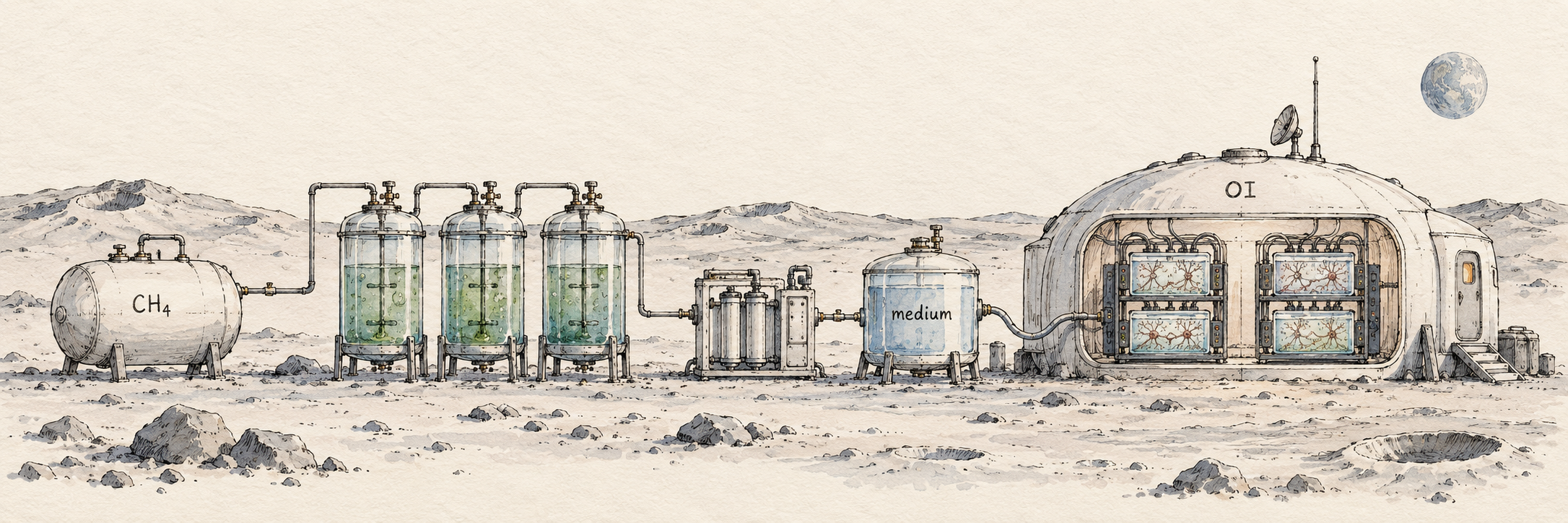
My long-term idea is to produce neuronal culture media from C1 feedstocks, such as methane and carbon dioxide. Eventually, this could help support biological computing systems in space, where supplies from Earth would be limited.
For this course, I am starting with glucose. I plan to study glycogen production in Methylococcus capsulatus MIR, recover the glycogen and convert it into glucose. I would then test whether the purified glucose is suitable for neuronal culture. Other medium ingredients would come later.
See the nav bar on the left to look through my work for How To
Biomanufacture Almost Anything (Fall 2026)!
Subsections of Dmitrii Chernushkin — HTBAA Fall 2026
Week 1 HW: Final Project Ideas
C1 biomanufacturing for neuronal media in space
HTBAA Homework #1 | Dmitrii Chernushkin
1 What I would like to make and why
My long-term idea is to make complete culture media for living neuronal computers away from Earth. I am interested in OI, or organoid intelligence, and related neuron-based computing systems. Cortical Labs’ CL1 is a practical reference: it combines cultured neurons with a silicon chip and life support [5]. I would like to supply such systems with nutrients made locally, reducing their dependence on shipments from Earth.
The manufacturing platform would use C1 feedstocks, meaning molecules with one carbon atom, such as methane and carbon dioxide. In our project, we have already successfully produced crude microbial protein and lysed biomass to obtain peptides. This gives us a starting point. We still need to show whether purified ingredients from this material are suitable for neurons.
The complete medium would need carbohydrates such as glucose, amino acids, suitable lipids, vitamins and specific proteins or growth factors required by the chosen culture. Salts, trace elements, buffers and clean water are also needed [3, 3a]. I would use several production and purification steps.
At a Mars base, methane made on site from carbon dioxide and hydrogen could feed the system. At a lunar base, carbon dioxide exhaled by the crew could become a carbon source. These routes would need energy and other resources [6]. I would not base the Mars design on an assumed supply of naturally occurring methane.
For this homework, I would start with purified D-glucose from methane-grown bacteria. My research proposal is to engineer Methylococcus capsulatus MIR or VS-1 (depends on first check points) to store more glycogen, then recover glucose from this material. I can measure production, recovery and the effect on neurons before trying to make the whole medium.
2 What living system I would use
I would use Methylococcus capsulatus MIR as the experimental strain (or VS-1 as reserve option). The earlier Concept8 programme gave me the idea of recovering glucose from microbial glycogen [1]. MIR has a useful published starting point: But et al. reported about 20% glycogen in dry biomass under nitrogen limitation, including 18.75% in a batch bioreactor [2]. These are reported results, not a known upper limit. Oxygen supply may also affect storage, but I would measure its effect separately rather than assume oxygen limitation improves MIR production.
The inputs would be methane, oxygen, water and mineral nutrients, including nitrogen. The cells turn methane carbon into biomass and glycogen. After harvesting, I would extract glycogen, hydrolyse it to free glucose and purify the glucose. Carbon dioxide, heat and leftover biomass would also come out of the process. My hypothesis is that reducing glycogen breakdown while increasing synthesis will leave more recoverable glycogen at harvest.
Research proposal
Genetic Engineering of Methylococcus capsulatus MIR for Enhanced Glycogen Overproduction
My objective is to obtain an engineered MIR strain that outperforms wild type in both glycogen percentage of dry cell weight and glycogen titer in g/L during methane-fed cultivation. I would also compare productivity over the whole batch and the glucose actually recovered. A higher percentage alone would not be enough.
Aim 1 Disrupt glycogen catabolism
I would first verify the proposed targets in the MIR genome. The initial candidates are glgP-1 and glgP-2 for phosphorolytic glycogen breakdown. If both copies are confirmed, I would compare the two single deletions and the double deletion with wild type. This would test whether they compensate for each other. Loss of glgP caused a several-fold glycogen increase in E. coli [7], which supports the idea but does not predict the size of the effect in MIR.
The next candidates are glgX, amy and malQ, associated with debranching, amylolytic breakdown and maltodextrin metabolism. I would add these deletions sequentially and keep the combinations that improve net production. MalQ also rearranges glucan chains, so deleting it may affect more than degradation. I would verify the edits and use restored-gene controls for key effects before assigning a function.
For construction, I would investigate markerless allelic exchange with pheS* or sacB counterselection. The published MIR work used homologous recombination with antibiotic-resistance cassettes [2]. Mutated pheS has been demonstrated in the Bath strain, where sacB performed poorly [8]. CRISPR/Cas9 is another option with Bath precedent [10]. These methods would need validation in MIR; I would not assume they transfer directly.
Aim 2 Reinforce glycogen biosynthesis
In the best strain from Aim 1, I would moderately increase expression of glgC, glgA and glgB, which contribute to precursor formation, chain synthesis and branching. MIR has two glycogen synthase genes, glgA1 and glgA2, with functional redundancy reported by But et al. [2]. I would compare modest expression changes and follow growth as well as storage, because stronger expression could consume resources without improving output.
Aim 3 Optimize production conditions
I would test a two-phase process: first balanced growth to build biomass, then nitrogen-limited glycogen accumulation with methane available. But et al. provide the MIR baseline [2]. I would compare the length of this accumulation phase, including a stationary-phase hold, while monitoring oxygen and methane transfer. Engel et al. studied gas-transfer monitoring and nitrogen fixation in Bath [9]. Their work is useful for monitoring, but does not establish a MIR glycogen recipe. Actual nitrogen limitation would need checking rather than assuming it follows from stopping nitrogen addition.
Aim 4 Check glycogen turnover and quantify yield
I would use anthrone as a first carbohydrate screen, then confirm promising samples by glycogen extraction and an amyloglucosidase/glucose oxidase assay. Anthrone is not specific for glycogen. The enzyme assay would include untreated sample controls to subtract free glucose, enzyme blanks and a glycogen standard. I would also check the polymer identity in the best samples. To test whether catabolism is really blocked, I would measure glycogen loss during a matched holding period and follow viability. The deletion list by itself would not prove pathway closure.
For each strain I would report glycogen as % dry cell weight, glycogen titer in g/L, whole-batch productivity in g/L/h and purified glucose recovered. Growth and viability would show whether extra storage has a cost. I would look for carbon moving into trehalose or extracellular polysaccharides. PHB would be an exploratory check only if MIR genomic or chemical evidence supports that pathway. I would call a strain catabolism-null only after confirming that glycogen turnover is effectively absent under the tested conditions.
On this stage I would establish the wild-type baseline before building the mutants. Later, other medium ingredients may need different organisms, with separate production of specific proteins and lipids. A CO2-fed version would need organisms that fix CO2, using light or an energy source such as hydrogen, or an upstream step that converts CO2 into methane [6]. I cannot simply replace methane with CO2 in the MIR reactor. Fermentation and neuronal culture would stay separate.
3 How I would use automation
I would use our in-house automation for a gas-fed bioreactor. In continuous operation, fresh medium would be added and culture removed at a controlled rate. The reactor controller would manage gas flow, feeding, temperature, pH and mixing, using sensor readings including dissolved oxygen.
Following our laboratory data concept, I would save sensor data, biomass and glycogen measurements, and short operator notes together for each run. Original files would be kept so we can check the results. A simple dashboard would show trends and help us spot changes in growth or production.
AI could summarize the runs and suggest what to test next. An operator would review suggestions, while the reactor controller would handle equipment settings and alarms. I would first test the data system during the two-phase glycogen experiment described above, then use it to support longer continuous runs.
4 How much I would need and how long it would take
For the glucose part, I chose ten neuronal culture chambers running for 30 days as a useful first scale. I assume each chamber needs 10 mL of fresh medium per day, plus a 10 mL initial fill. These are example volumes, not a verified CL1 specification. This calculation covers glucose production on Earth, not the full medium or the equipment needed in space.
For glucose concentration, I use 2.5 mmol/L, approximately the concentration in the original BrainPhys formulation [3, 3a]. With a glucose molecular weight of 180.16 g/mol:
This is a reference for the estimate. The actual neuronal culture would determine the required medium. Using the rounded value:
Medium over 30 days: 10 × 0.010 L/day × 30 days = 3.0 L
Initial fills: 10 × 0.010 L = 0.10 L
Glucose needed: (3.0 + 0.10) L × 0.45 g/L = 1.395 g
With a 30% reserve: 1.395 g × 1.30 = 1.81 g
I count fresh medium added, not liquid recirculating through a chamber. I also do not add neuronal glucose consumption again, because the calculation already counts glucose supplied in that medium.
For the baseline calculation, I assume a 5 L working volume, 4 g dry cells/L and 20% glycogen. The MIR study reported 4.12 g dry cells/L and 18.75% glycogen in its bioreactor experiment [2]. My rounded values are planning assumptions based on that result. They are not measurements from the proposed engineered strain.
Glycogen in the batch: 5 L × 4 g/L × 0.20 = 4.0 g
Hydrolysis adds water, so 1 g of glycogen can theoretically give about 1.11 g of glucose. Following the project estimate [1], I assume 70% extraction recovery, 98% conversion and 80% recovery during final purification:
Recovered glucose: 4.0 g × 1.11 × 0.70 × 0.98 × 0.80 = 2.44 g
The baseline glycogen titer is 4 g dry cells/L × 0.20 = 0.8 g/L. As an illustration only, reaching 40% glycogen at the same biomass concentration would give 1.6 g/L, or 8 g in the reactor, and about 4.88 g recovered glucose with the same recovery factors. This is not a predicted mutant result. If biomass fell to 2 g/L, the benefit would disappear: 40% glycogen would again give only 0.8 g/L.
One successful baseline batch would therefore cover the 1.81 g glucose target. For scheduling, I allow four days for cultivation and glycogen accumulation, one day for recovery and cleaning, and two days for testing: seven days altogether, assuming a starter culture is ready.
This seven-day estimate describes an operating batch after development. It does not include constructing mutants, confirming their effects or qualifying the glucose for neuronal culture. If glycogen were only 5% of dry cells, output would fall to about 0.61 g per batch. Three successful batches would just cover the target and take about 21 days in this simple sequential schedule.
5 What I do not know yet
First, I do not know which deletions will increase net glycogen production in MIR. The proposed glgP copies and their functions need checking. Removing storage breakdown may reduce survival during starvation, and extra synthesis may slow growth. I would compare engineered strains with wild type under the same conditions and follow total batch time. The decision would depend on recovered glucose per batch and per day, not just the largest glycogen percentage.
Second, I do not know whether the recovered glucose can be cleaned enough for neurons. Bacterial material and process chemicals may remain after purification. I would measure glucose identity and concentration, residual proteins and endotoxin. Then I would compare it with commercial glucose in otherwise identical neuronal medium, checking both cell survival and electrical activity. A sterile solution alone would not answer this question.
Third, I need the actual medium recipe and consumption of the neuronal system. The public CL1 product description does not give a complete formulation [5]. I need more informations from the receiving laboratory before deciding which amino acids, lipids and growth factors to make. Later I would measure the energy, water and mineral inputs for the whole C1 system. My first practical goal remains one glucose batch that works as well as commercial glucose in an otherwise identical medium.
References
[1] Concept8 glycogen to neuronal glucose. Project programme supplied with this assignment, September 2026. Source of the idea, genome interpretation and assumed recovery factors. Link
[2] But et al. (2024). New Solutions in Single-Cell Protein Production from Methane: Construction of Glycogen-Deficient Mutants of Methylococcus capsulatus MIR. Fermentation 10, 265. Table 2 and the bioreactor experiment. Link
[3] Bardy et al. (2015). Neuronal medium that supports basic synaptic functions and activity of human neurons in vitro. PNAS 112, E2725–E2734. Link
[3a] Original BrainPhys formulation, patent WO2014172580A1. D-glucose approximately 2.5 mM. Link
[5] Cortical Labs. CL1 product information. Neurons, nutrient solution and integrated life support. Link
[6] Averesch, N. J. H. (2021). Choice of Microbial System for In-Situ Resource Utilization on Mars. Frontiers in Astronomy and Space Sciences 8, 700370. Link
[7] Alonso-Casajús et al. (2006). Glycogen phosphorylase, the product of the glgP gene, catalyzes glycogen breakdown by removing glucose units from the nonreducing ends in Escherichia coli. Journal of Bacteriology 188, 5266–5272. Link
[8] Ishikawa et al. (2018). Efficient Counterselection for Methylococcus capsulatus (Bath) by Using a Mutated pheS Gene. Applied and Environmental Microbiology 84, e01875-18. Link
[9] Engel et al. (2025; first published online in 2024). Online monitoring of methane transfer rates unveils nitrogen fixation dynamics in Methylococcus capsulatus. Biotechnology and Bioengineering 122, 110–122. Link
[10] Rumah et al. (2023). In Vivo Genome Editing in Type I and II Methanotrophs Using a CRISPR/Cas9 System. ACS Synthetic Biology 12, 544–554. Link
AI acknowledgement
I used ChatGPT by OpenAI, through Codex in ChatGPT Work, to help draft the text, find references and check the calculation. The initial prompt was as follows, with the Google Doc link shown as [1]:
“Use this homework frame and this idea [1]. Create homework accordingly to uploaded rules and structure”
Follow-up prompt: “Explain idea - to run extraterrestrial OI we should establish C1-based bio manufacturing of full neuronal media but right now I would start from glucose. Crude protein production and biomass lysis to obtain peptide has been successfully done. So we must produce proteins, fats, hydrocarbons, vitamins, growth factors etc. All that we need to feed neuronal cells like CL1 cortical lab system requirement. This complex system may utilize methane on Mars or CO2 from crew in the moon base.”
Further prompt (summary): Update the homework with the supplied research proposal on engineering Methylococcus capsulatus MIR for enhanced glycogen overproduction. Include sequential disruption of glycogen catabolism, moderate reinforcement of biosynthesis, a two-phase methane-fed production process, and assays for glycogen yield, alternative carbon sinks and viability.