Week 2 HW: DNA Design
A glgA1 expression vector for Methylococcus capsulatus MIR
Dmitrii Chernushkin · HTBAA Homework 2
Status: A sequence-defined computational candidate has been prepared and imported into Asimov Kernel according to the project record. Biological performance is untested. The remaining course deliverables are identified below; no unperformed analysis is presented as completed.
From Homework 1 to a defined DNA design
My Homework 1 concept was to use methane-grown Methylococcus capsulatus MIR biomass as a source of intracellular glycogen, recover that glycogen, and hydrolyse it to glucose for subsequent purification and assessment in neuronal culture media.
For Homework 2, I narrowed the question to one intervention: can an additional native glgA1 copy increase glycogen accumulation? GlgA1 is the enzyme expressed by the construct. Glycogen is the intracellular pathway product; glucose is a downstream recovery product. The DNA does not directly encode glucose or establish glucose secretion.
The first candidate retains the native chromosomal genes. It does not include the glycogen-catabolism deletions considered in the broader project. This keeps the expression hypothesis separate from changes to glycogen breakdown.
Part 0 — Kernel setup and project record
The sequence was assembled and checked externally with Python and Biopython, then imported into Asimov Kernel. The expression cassette was subsequently confirmed as visible in the working project. Kernel was used for import and visualization; its compiler did not generate this sequence.
Part 1 — Expression target
| Question | Design decision |
|---|---|
| Protein | Native GlgA1 glycogen synthase |
| Host | Methylococcus capsulatus MIR |
| Gene identity | Locus M3M30_03055; annotated as glgA in the genome and designated glgA1 in this project |
| Chromosome | NCBI accession CP097161.1 |
| Genomic feature | complement(691148..692629) |
| CDS | 1,482 bp, including ATG start and TAG stop |
| Protein reference | UQN12847.1, 493 amino acids |
| Destination | Intracellular; no secretion signal or fusion tag |
The reverse-strand genomic feature was extracted in its coding orientation. The archived audit reports that the CDS matches the native reference and translates to the expected protein without internal stops.
The MIR deletion study supports a role for its two glycogen synthases in glycogen formation. It does not show that additional glgA1 expression increases yield; that remains the hypothesis of this design. [1, 2]
Part 2 — Genetic parts and their rationale
The final candidate retains the complete 4,979-bp pAWP78 backbone and adds a 1,697-bp expression cassette, giving a 6,676-bp circular plasmid.
| Part | Length | Final coordinates, 1-based inclusive | Rationale and limitation |
|---|---|---|---|
| J23104 promoter | 35 bp | 1913–1947 | Traceable constitutive promoter with published activity in M. capsulatus Bath; strength in MIR/pAWP78 is unmeasured |
| Leader/RBS | 27 bp | 1948–1974 | Translation-initiation context copied from a published methanotroph reporter; not optimized for this new CDS |
| Native glgA1 CDS | 1,482 bp | 1975–3456 | Preserves the native MIR protein and provides a baseline without recoding |
| Downstream linker | 24 bp | 3457–3480 | Retained reporter context; its necessity has not been established |
| B0015-labelled terminator | 129 bp | 3481–3609 | Intended transcription termination; efficiency in this candidate is untested |
| pAWP78 backbone | 4,979 bp | Flanks the cassette | Retains replication and kanamycin-selection features from the supplied backbone |
The regulatory and context sequences are:
J23104 promoter
Leader/RBS
Downstream linker
Terminator
The native CDS is identified by the accession, locus and coordinates above. The complete annotated design record is named pAWP78_J23104_glgA1_candidate_v1.gb in the project archive; the file still needs to be attached to this page.
The original proposal considered pCAH01/TetR/Ptet. The final choice was to retain the supplied pAWP78 and add independent expression control. An unverified native promoter sequence was not inferred from arbitrary upstream DNA. The local genome contains an overlap with glgB, so upstream sequence cannot automatically be called the glgA1 promoter.
J23104 and the reporter-derived leader/terminator have traceable sources, but their combination with MIR glgA1 is a new composite design. Published promoter activity in another strain and vector does not establish expression strength here. [3–6]
Archived backbone views
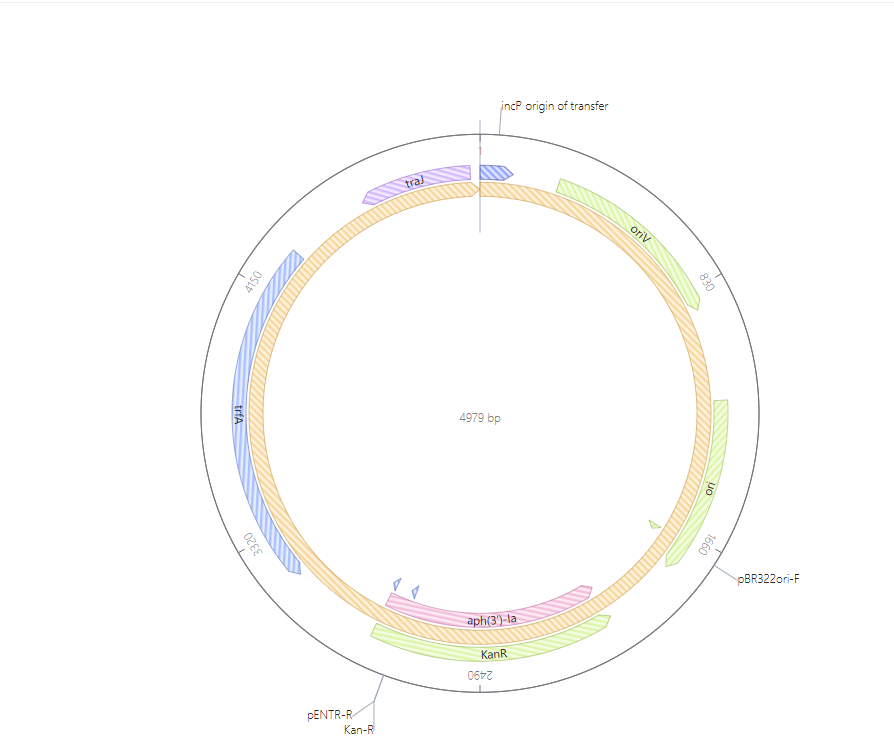
Figure 1. Archived circular map of the supplied 4,979-bp pAWP78 backbone, showing its annotated replication, transfer and selection features.

Figure 2. The same backbone in a linear view. These are sequence annotations, not experimental evidence of feature activity.
Part 3 — Assembly and sequence verification
The intended cassette order is J23104 → leader/RBS → native glgA1 → linker → terminator, with all cassette components in the forward orientation.
The cassette was inserted at the parent-backbone boundary 1912^1913. The archived construction logic is:
These are zero-based Python slices: parent bases 1–1912 are followed by the cassette, then parent bases 1913–4979. No original backbone bases are deleted.
The archived audit reports:
- The final molecule is 6,676 bp and the cassette is 1,697 bp.
- Removing final bases 1913–3609 restores the complete 4,979-bp parent sequence.
- The CDS is an exact native reference match and translates to 493 amino acids without internal stops.
- Original non-source feature sequences and strand directions were retained.
- The GenBank write/read round trip preserved sequence and feature locations.
These checks establish consistency of the computational sequence.
Archived candidate maps and sequence view
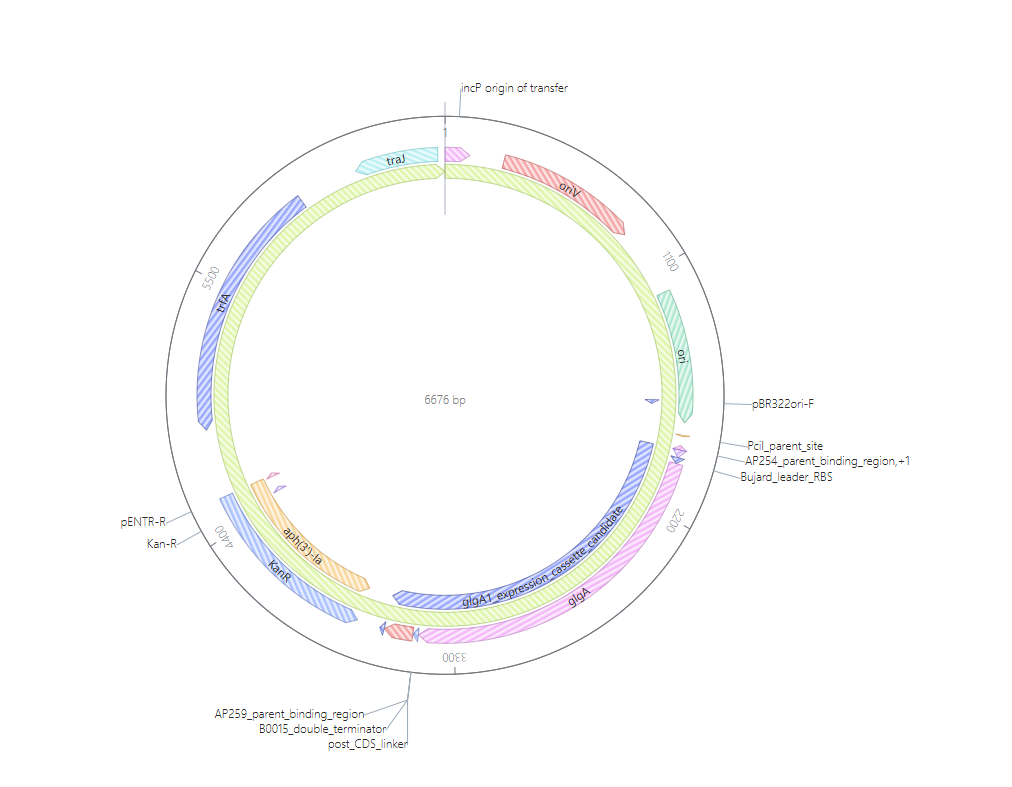
Figure 3. Archived circular map of the 6,676-bp pAWP78-derived candidate, including the added glgA1 expression cassette.
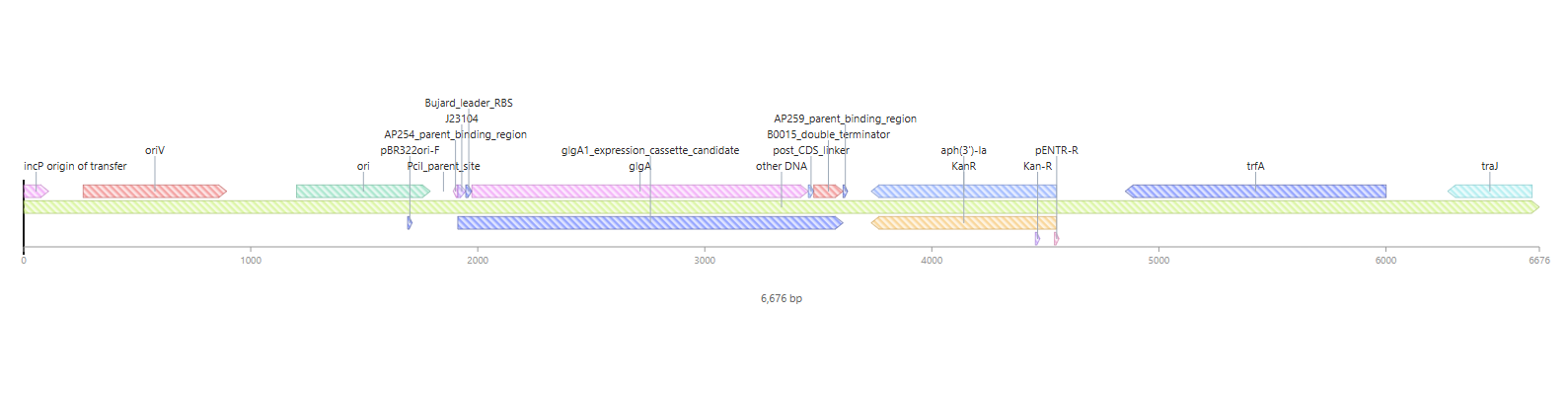
Figure 4. Linear map showing the expression cassette within the complete vector. The image retains its original annotation labels; the part-provenance discussion above describes the actual sequence sources.
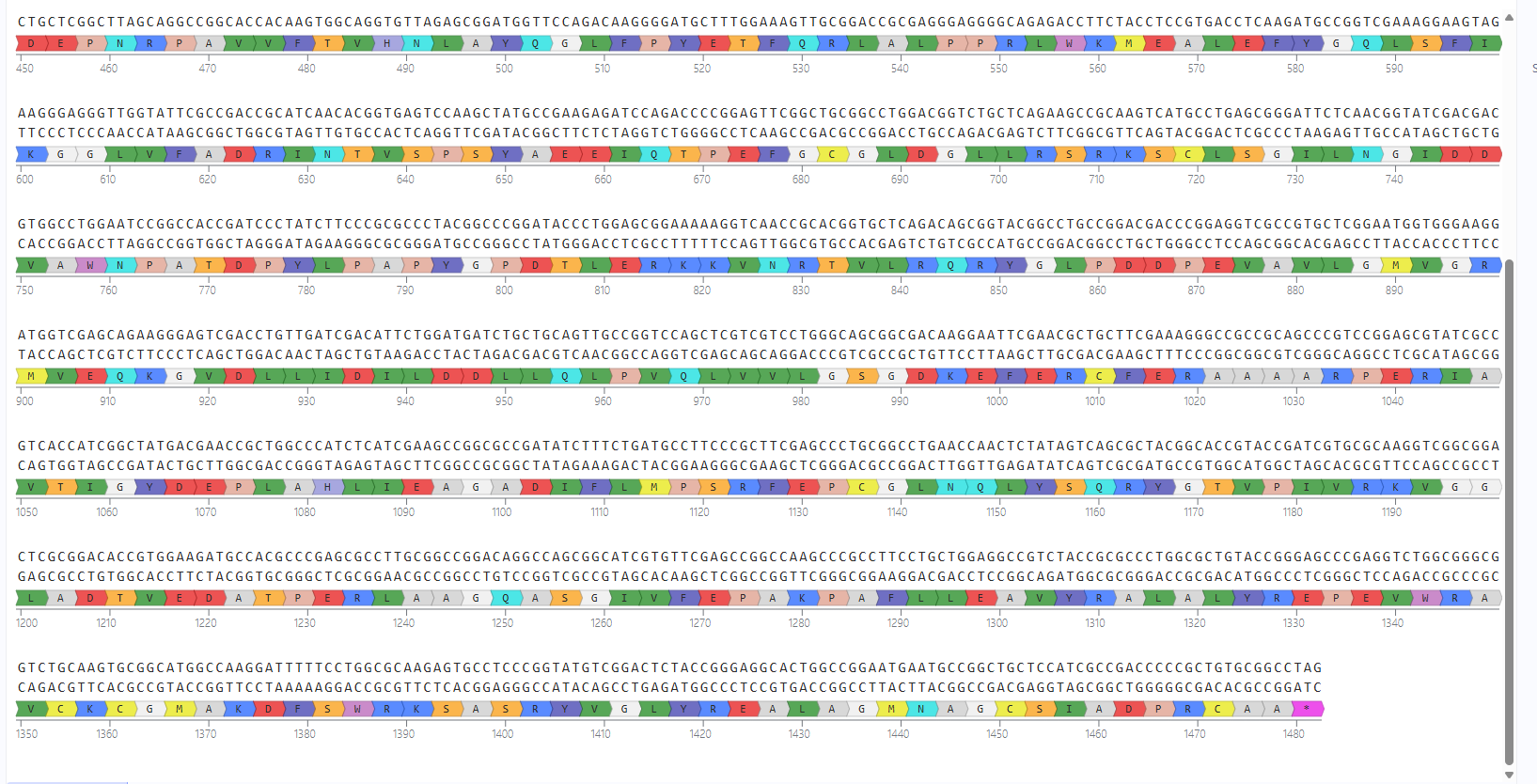
Figure 5. Archived sequence-editor view showing nucleotides, translated residues and the terminal stop marker in the displayed region. This partial screenshot is not a BLAST result, a codon-optimization comparison or a safety-screen result.
Part 4 — Optimization and quality checks
Codon optimization
A codon-optimization comparison was not run. The current candidate retains the native MIR CDS. This is a baseline choice, not evidence that optimization would be unnecessary or beneficial. Any later recoding comparison must document the host/model, constraints and actual sequence changes.
BLAST or database sequence search
A BLAST/database sequence search was not run. Exact matching to the supplied annotated MIR genome and its reference translation was performed in the archived local audit. That check supports consistency with the chosen source but is not a substitute for the requested database search and closest-match result.
Safety screening
A construct safety screen was not run. There is no pass/fail result to report. The relevant screening output, service and interpretation must be recorded when the analysis is completed.
Part 5 — From design to build
Prototype strategy
For one prototype, my proposed route is to retain the existing pAWP78 backbone and obtain the approximately 1.7-kb cassette as sequence-verified DNA for overlap-based assembly. The depositor’s backbone primers motivated the selected junction. Gibson et al. provide the assembly principle; the computational concatenation above is not a completed Gibson reaction. Final fragment boundaries and a complete oligonucleotide set remain to be designed. [3, 7]
A possible single-site PciI restriction/ligation alternative was identified also. The current GenBank record is specifically the 1912^1913 design and must not be labelled a PciI-ligation product.
Synthesis constraints and error handling
A formal synthesis review remains outstanding. Before ordering, I would check local GC composition, repeats, secondary-structure-prone regions and the assembly boundaries.
Carr et al. demonstrate that mismatch-binding-based error depletion can reduce errors in synthetic DNA. My implication for this project is to separate assembly success from sequence accuracy: recovery of a product of the expected size would still require sequence verification. I have not performed the paper’s error-correction method. [8]
Prototype versus a larger design programme
For one construct, ordering the defined cassette and reusing the backbone is the proposed starting point. If the project later compares many promoter/RBS variants, pooled synthesis and selective recovery could become relevant. Kosuri et al. demonstrate a scalable approach using microchip-derived oligonucleotide pools, selective amplification, assembly and error correction. Applying that approach to a variant library would be a future design decision. [9]
Scaling the biological production process is a separate question from scaling DNA synthesis. This homework has not demonstrated strain stability or production-scale performance.
Part 6 — Three major unknowns
| Unknown | How I would assess it |
|---|---|
| Will the promoter/leader/CDS combination produce the intended GlgA1 level in MIR? | Compare transcript and protein or enzyme activity with an empty-vector control; evaluate regulatory variants if needed |
| Will more GlgA1 improve glycogen productivity without an unacceptable growth cost? | Compare wild-type, empty-vector and expression-strain cultures using glycogen per biomass, per culture volume and per unit time, together with growth |
| Will the supplied backbone support the intended use reliably? | Verify the physical backbone and complete construct sequence, resolve the retained traJ annotation issue, and assess maintenance in the host |
The supplied reverse-strand traJ annotation contains an internal stop in the archived audit. This was retained for review rather than silently repaired. It does not by itself prove that transfer will fail.
The central result is a defined DNA candidate with documented assumptions. Increased expression, increased glycogen and suitability of recovered glucose for neuronal media remain separate experimental questions.
Remaining deliverables
- Exact Kernel repository and folder names.
- Exported Kernel schematic and comparison with the audited reference.
- The complete annotated GenBank file attached to this page.
- Recorded codon-optimization comparison, sequence-search output and safety-screen output.
- Final physical assembly design and synthesis review.
References
- Oshkin IY et al. (2022). Complete Genome Sequence of Methylococcus capsulatus MIR, a Methanotroph Capable of Growth on Methanol. DOI: 10.1128/mra.00542-22. Chromosome CP097161.1.
- But et al. (2024). New Solutions in Single-Cell Protein Production from Methane: Construction of Glycogen-Deficient Mutants of Methylococcus capsulatus MIR. Fermentation 10, 265. DOI: 10.3390/fermentation10050265.
- Addgene. pAWP78, plasmid 61263, sequence record 203152. Plasmid record.
- Puri AW et al. (2015). Genetic Tools for the Industrially Promising Methanotroph Methylomicrobium buryatense. Applied and Environmental Microbiology 81, 1775–1781. DOI: 10.1128/AEM.03795-14.
- Bhat et al. (2024). Construction of a broad-host-range Anderson promoter series and particulate methane monooxygenase promoter variants expand the methanotroph genetic toolbox. Synthetic and Systems Biotechnology 9, 250–258. DOI: 10.1016/j.synbio.2024.02.003.
- The pGinger Family of Expression Plasmids (2023). Microbiology Spectrum. DOI: 10.1128/spectrum.00373-23.
- Gibson DG et al. (2009). Enzymatic assembly of DNA molecules up to several hundred kilobases. Nature Methods 6, 343–345. DOI: 10.1038/nmeth.1318.
- Carr PA et al. (2004). Protein-mediated error correction for de novo DNA synthesis. Nucleic Acids Research 32, e162. Full text.
- Kosuri S et al. (2010). Scalable gene synthesis by selective amplification of DNA pools from high-fidelity microchips. Nature Biotechnology 28, 1295–1299. Primary paper.
AI acknowledgement
ChatGPT by OpenAI, through Codex in ChatGPT Work, assisted with literature retrieval, design reasoning, Python/Biopython scripting, sequence audits and report preparation. I directed the project goal and selected pAWP78 as the backbone.
Representative earlier tasks were to create a glgA1 expression cassette, explain its assembly, identify the source of the RBS and check the design. These are summaries of the earlier prompts, not a complete verbatim log.
The website text was adapted from the existing design report. The Carr and Kosuri reading discussion was added during this preparation. Kernel AI or its compiler is not credited with generating the final sequence, and no new experimental or screening result is claimed.