Week 4 HW: Cell-Free Reaction Design
Dmitrii Chernushkin | HTBAA Fall 2026 | BUGSS node
17 November 2026 | Edited 18 November 2026
I want to reduce the cost of active protein, starting from my HW3 recipes: ribose/NMP for sfGFP and PEP/NTP for TfCut2 and Reteplase. I prepared 12 compositions in three batches, each with the original recipe for comparison. These are proposed tests; the results below come from the course dataset. [1, 2]
A Batch design
Each 20,000 nL reaction contains 5,000 nL lysate, 2,000 nL matching DNA and 2,000 nL base buffer. I use approved reagents in 25 nL steps, with water to make up the volume. [1, 3]
Batch 1 Magnesium for sfGFP
The ribose recipe uses less nucleotide, so I want to check which magnesium level works better. I change only magnesium glutamate and water.
| Condition | Mg stock nL | Nominal Mg mM | Water nL |
|---|---|---|---|
| Mg175 | 175 | 6.975 | 1675 |
| Mg225 HW3 | 225 | 8.225 | 1625 |
| Mg275 | 275 | 9.475 | 1575 |
Mg stock is 0.5 M. Values include 2.6 mM from the buffer; they are nominal supplied Mg, not measured free Mg. [3]
Batch 2 DsbC for PETase TfCut2
DsbC is expensive. TfCut2 has one disulfide bond, so I want to see if less DsbC still gives enough activity. The PEP recipe and standard lysate stay unchanged. [1]
| Condition | DsbC stock nL | Added DsbC µM | Water nL |
|---|---|---|---|
| DsbC250 | 250 | 1.25 | 1650 |
| DsbC500 HW3 | 500 | 2.5 | 1400 |
| DsbC1000 | 1000 | 5 | 900 |
DsbC stock is 100 µM. Mg stock stays at 300 nL, giving 10.1 mM nominal Mg including the buffer.
Batch 3 Magnesium and DsbC for Reteplase
I test all six combinations to see whether the effect of DsbC depends on magnesium.
| Condition | Mg stock nL | Nominal Mg mM | DsbC stock nL | Added DsbC µM | Water nL |
|---|---|---|---|---|---|
| Mg175 D500 | 175 | 6.975 | 500 | 2.5 | 850 |
| Mg175 D1000 | 175 | 6.975 | 1000 | 5 | 350 |
| Mg225 D500 | 225 | 8.225 | 500 | 2.5 | 800 |
| Mg225 D1000 HW3 | 225 | 8.225 | 1000 | 5 | 300 |
| Mg275 D500 | 275 | 9.475 | 500 | 2.5 | 750 |
| Mg275 D1000 | 275 | 9.475 | 1000 | 5 | 250 |
GSSG stays at 4.0375 mM and GSH at 1 mM. The DSB lysate is made without DTT and treated beforehand with IAM, then quenched with cysteine. IAM is not added to the reactions. This lysate is not from a Δgor strain. [1, 3]
Comparing the batches
I would use four technical wells per composition: 12 for sfGFP, 12 for TfCut2 and 24 for Reteplase. This gives 48 wells, or 0.96 mL, plus standards and positive and no-template controls. I would keep each batch on the appropriate plate with one lysate lot, and spread replicate wells across positions where possible.
For sfGFP, I would measure calibrated fluorescence. For TfCut2, I would use the initial p-nitrophenyl substrate hydrolysis rate; PET breakdown needs a separate test. For Reteplase, I would measure initial IPR-AMC cleavage; this does not establish clot lysis or correct pairing of every disulfide bond.
I would compare the mean, variation between wells and cost per useful output. A promising recipe needs an independent repeat and another plate or tube format. Four wells from one preparation are not enough.
Reagent costs
The course catalogue gives about $0.115 per sfGFP reaction. TfCut2 costs $1.57, $2.98 and $5.79 at 1.25, 2.5 and 5 µM DsbC. Reteplase costs $2.98 or $5.79 at 2.5 or 5 µM DsbC. Mg changes the cost very little. [3]
For TfCut2, 2.5 µM DsbC must retain more than 51.4% of the activity at 5 µM to lower reagent cost per activity unit. This is a break-even calculation; activity still needs measuring. A product standard curve alone cannot convert activity into grams of active enzyme.
Prices checked 17 November 2026 include lysate, DNA, buffer and water. They exclude assays, controls, labour, equipment, consumables and purification.
B The sfGFP reference data
The deep-well run gave higher fluorescent sfGFP titer and lower variation between wells. CV means coefficient of variation. [4]
| Measure | 384-well reference | 96-well deep-well run |
|---|---|---|
| Reaction volume stated in report | 20 µL | 40 µL |
| Median retained design-well titer | 0.356 g/L | 2.714 g/L |
| Median replicate CV | 14.6% | 7.2% |
| Designs with CV above 20% | 32 of 80 | 4 of 80 |
| Retained design wells | 315 | 318 |
For 77 matched designs with a 384-well mean ≥0.05 g/L, the median paired increase was 7.3-fold. This is the median of individual fold changes. Across all 80 designs, rank correlation was −0.12; the top-ten lists had no recipe in common. [4]
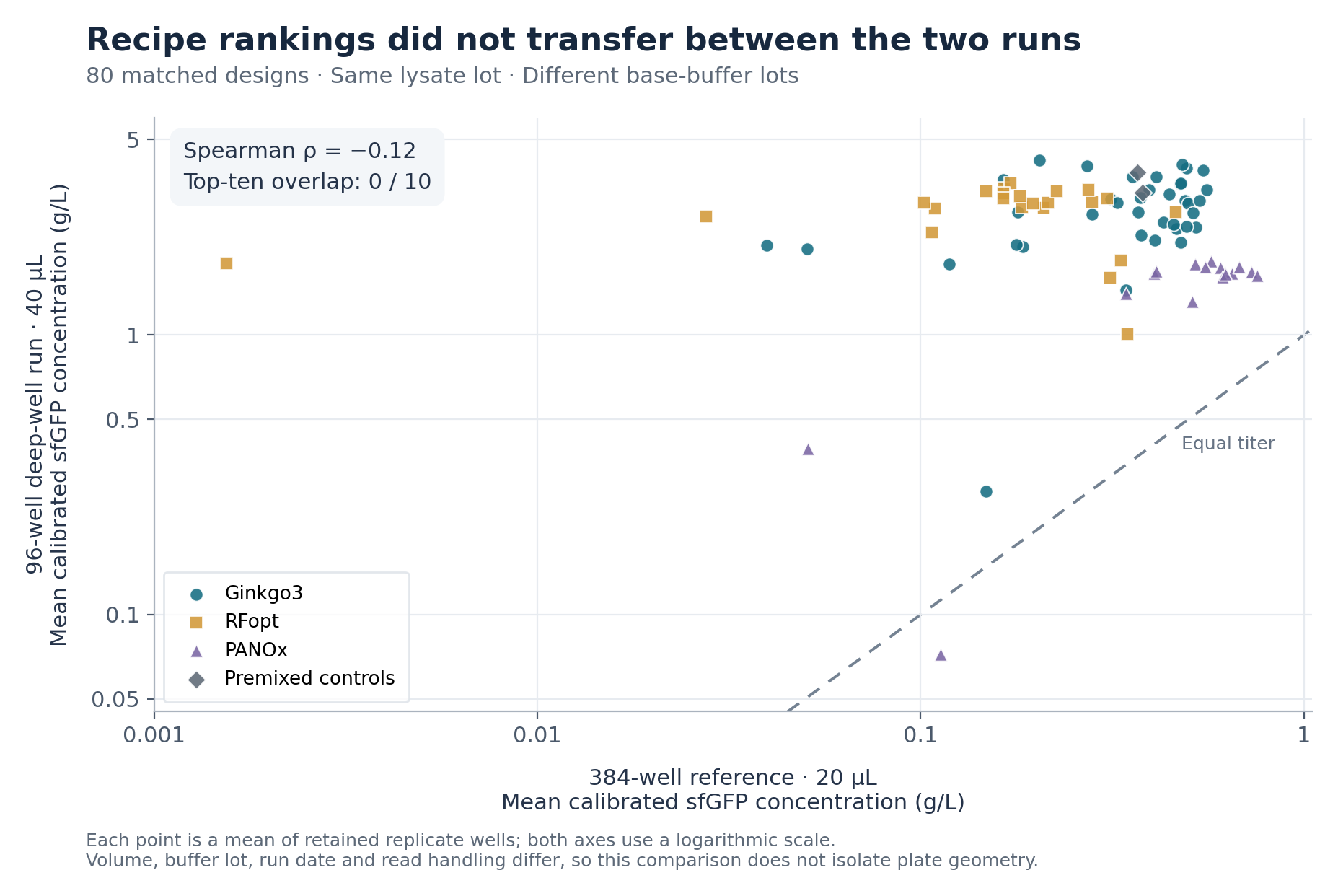
Figure 1. Mean retained-well titer for each matched design; both axes are logarithmic. Course reference data, using the report’s exclusions. [4]
What I would check next
For me, main point is that the best recipes changed between plates. For next test, I would keep several good recipes and compare them again.
The question says “the same 20 µL”, but the report gives 40 µL for deep wells and 20 µL for the 384-well plate. The lysate lot was the same; buffer lots and dates differed. Deep-well samples were transferred, diluted twofold and later re-read. The report corrects for dilution. [1, 4]
Better oxygen access could help energy regeneration and sfGFP maturation. Evaporation could change salt levels and raise g/L by reducing water volume. Buffer lots and reading methods may also matter. These data cannot separate the causes, and lower CV at a stronger signal does not prove better dispensing.
I would compare the formats using the same reagent lots, starting volume, incubation time and calibration. I would measure remaining liquid and total recovered fluorescent protein as well as g/L, then test volume separately within each format.
My next designs focus on Mg and DsbC. Skp remains a later option if it enters the approved inventory.
Choosing experiments
I would choose experiments that answer a clear question with few wells. A complete comparison with a reference recipe, such as the six Reteplase mixtures, should help us choose the next step even if activity does not improve.
References
[1] Donovan R and Yue M. HTBAA Homework 3 and 4, Sections 2 and 4. Accessed 17 November 2026.
[2] Chernushkin D. Homework 3. Starting recipes: sfGFP, TfCut2, Reteplase.
[3] HTBAA course designer, reagent catalogue and validation code. Checked 17 November 2026.
[4] Course data archive: sfGFP_control_20260722-39-L_96w_report.pdf, 9 October 2026, pp. 1–2 and 9, and associated results JSON. Recalculated with two quad and five reference dropout exclusions.
Batch files
The submission pack contains three JSON batches: sfGFP (3 recipes), TfCut2 (3) and Reteplase (6). Each has a hypothesis, unique sample IDs and comments. TfCut2 uses the target name PETase. All 12 total 20,000 nL and use the fixed components and 25 nL steps.
I submitted all 12 compositions on 18 November 2026: 3 sfGFP, 3 PETase/TfCut2 and 6 Reteplase. The three unchanged HW3 recipes are reference controls. These are submitted proposals, with no new experimental results.
Submitted batches: sfGFP, PETase TfCut2, Reteplase.
Appendix Starting recipes
These are the saved HW3 recipes. Apply the changes in the batch tables; the JSON files contain all complete HW4 compositions. “Each” means a separate addition for every listed reagent. [2, 3]
| Component | Stock | sfGFP nL | TfCut2 nL | Reteplase nL |
|---|---|---|---|---|
| Lysate | Course stock | 5000 | 5000 | 5000 |
| Matching DNA template | 50 nM | 2000 | 2000 | 2000 |
| Base buffer | 10× | 2000 | 2000 | 2000 |
| Potassium glutamate | 875 mM | 2000 | 0 | 0 |
| Magnesium glutamate | 500 mM | 225 | 300 | 225 |
| HEPES KOH | 1000 mM | 900 | 900 | 900 |
| Amino acid mix 17 | Nominal 50 mM | 1200 | 400 | 400 |
| Tyrosine | 50 mM | 400 | 0 | 0 |
| Cysteine | 200 mM | 200 | 0 | 0 |
| PEP | 100 mM | 0 | 6000 | 6000 |
| Ribose | 100 g/L | 1500 | 0 | 0 |
| Glucose | 200 g/L | 150 | 0 | 0 |
| Phosphate mono to di mix | 500 mM | 600 | 0 | 0 |
| AMP | 100 mM | 400 | 0 | 0 |
| CMP GMP UMP each | 100 mM | 300 each | 0 | 0 |
| ATP | 100 mM | 0 | 250 | 250 |
| CTP GTP UTP each | 100 mM | 0 | 175 each | 175 each |
| Ammonium glutamate | 1000 mM | 0 | 200 | 200 |
| Nicotinamide | 100 mM | 800 | 0 | 0 |
| Spermidine | 250 mM | 100 | 100 | 100 |
| Putrescine | 500 mM | 0 | 50 | 50 |
| Folinic acid | 10 mg/mL | 0 | 50 | 50 |
| NAD | 100 mM | 0 | 75 | 75 |
| Coenzyme A | 50 mM | 0 | 100 | 100 |
| Oxalate | 500 mM | 0 | 150 | 150 |
| DsbC | 100 µM | 0 | 500 | 1000 |
| GSSG | 170 mM | 0 | 0 | 475 |
| GSH | 100 mM | 0 | 0 | 200 |
| Nuclease free water | 1625 | 1400 | 300 | |
| Total reaction volume | 20000 | 20000 | 20000 |
The fixed buffer adds nominal 200 mM potassium glutamate, 2.6 mM magnesium glutamate, 30 mM HEPES and 1 mM amino-acid-mixture, tyrosine and cysteine baselines. The amino acid mix is not equimolar for all amino acids. These contributions are included in final concentrations. [3]
Assignment prompts
The responses above follow Section 4 of the official assignment. The original mandatory questions are retained below for reference.
A. DESIGN A BATCH OF CELL-FREE REACTION COMPOSITIONS
When designing experiments, you’ll often want to compare several conditions that differ only slightly, such as one reagent at a few different concentrations, and batches let you submit those together.
Even if you do not wish to sign up to share publicly, please document on your homework page the current status of your CFPS optimization ideas!
Data Analysis: Familiarize yourself with the autonomous-cfps repository. Experimental results are stored in autonomous_cfps/data/reference_set and data analysis files are in the reference_results folder. Review the sfGFP_control_20260722-39-L_96w_report.pdf. What does it show about how the same 20 µL sfGFP reaction performs in a 384-well plate versus a 96-well deep-well plate? Can you suggest what might explain some of the differences (for example: oxygen access, evaporation).
Metascience: With hundreds of proposed reactions and a limited number of experimental wells during round 1 of the coopetition, deciding which experiments to run is itself a scientific question. A shared rubric, a set of criteria we score every proposal against, can make that choice transparent and fair. Propose one rubric criterion you think we should use to decide which experiments make it onto the plate, and explain in a sentence or two why it matters.