Week 1 HW: Final Project Ideas
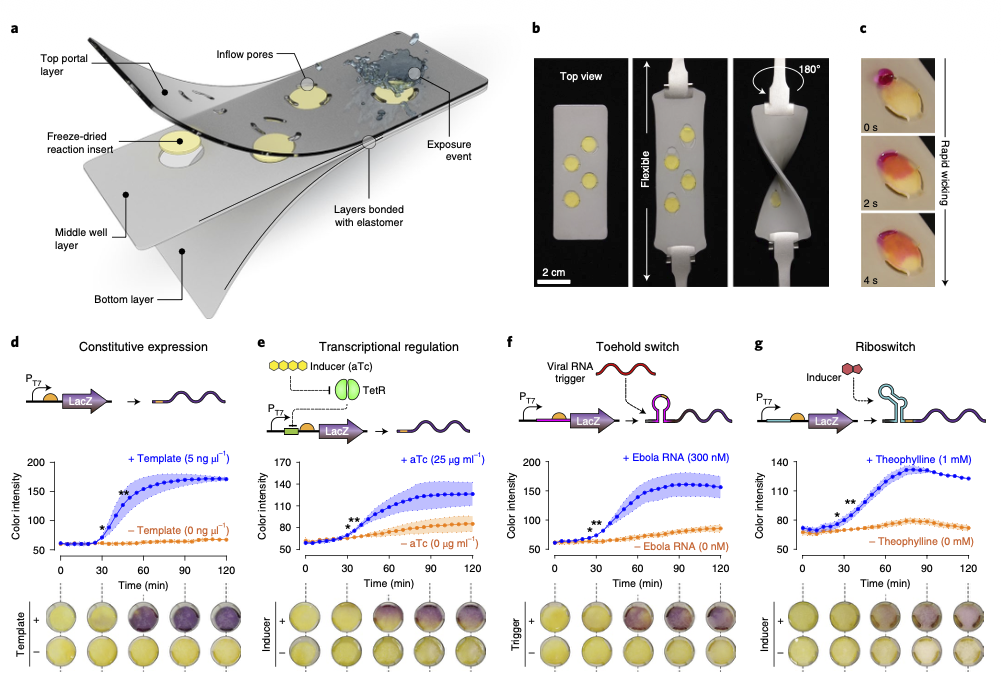
Figure adapted from Nguyen et al. (2021): the wearable freeze-dried cell-free (wFDCF) sensor platform. (a–c) Sensor architecture — a flexible, multi-layer textile insert containing freeze-dried reaction wells that activate on liquid exposure. (d–g) Four genetic-circuit designs (constitutive expression, transcriptional regulation, a toehold switch, and a riboswitch) with their colorimetric readouts over time. Source: Nguyen, P. Q., Soenksen, L. R., Donghia, N. M., Angenent-Mari, N. M., de Puig, H., Huang, A., Lee, R., Slomovic, S., Galbersanini, T., Lansberry, G., Sallum, H. M., Zhao, E. M., Niemi, J. B., & Collins, J. J. (2021). Wearable materials with embedded synthetic biology sensors for biomolecule detection. Nature Biotechnology, 39(11), 1366–1374. https://doi.org/10.1038/s41587-021-00950-3. Reproduced here for educational, non-commercial coursework use — confirm the journal’s reuse terms before publishing this repository publicly.
1. What I would like to biomanufacture and why
I want to biomanufacture an electrospun nanofiber patch that changes color when exposed to gaseous formaldehyde, giving an immediate, electronics-free visual warning of hazardous exposure. The target users are workers with occupational formaldehyde exposure — for example, in leather tanning, footwear and furniture manufacturing, and histology/anatomy labs — industries that are prominent in the region where I live and work, and that rarely have access to continuous, affordable gas monitoring.
Formaldehyde is a recognized human carcinogen with strict occupational exposure limits (e.g., OSHA’s 0.75 ppm time-weighted-average permissible exposure limit). Continuous monitoring today typically relies on electrochemical or photometric instruments that are expensive, need power, and require periodic calibration. A disposable, fiber-based badge — activated only by ambient humidity, needing no battery, and readable by eye — could close a real gap between biomanufacturing and occupational health, especially for small and medium manufacturers that cannot afford commercial gas-detection instrumentation.
This project also lets me combine electrospinning equipment and physical-characterization tools I already have access to with a synthetic-biology sensing layer, connecting directly to my broader undergraduate thesis work on functionalized electrospun fibers.
2. What living system would I use
I would use a cell-free (not cell-based) biomanufacturing chassis: a freeze-dried E. coli transcription–translation (TX-TL) extract carrying a DNA-encoded genetic circuit, embedded in or on the electrospun fiber. This approach has direct precedent: Nguyen et al. (2021) showed that freeze-dried, cell-free synthetic circuits embedded in textiles and other flexible substrates activate by rehydration from an aqueous exposure event and report a target molecule through a colorimetric, fluorescent, or luminescent signal (see figure above) — including circuits for detecting toxic chemical agents. That platform builds on the original paper-based cell-free sensor work of Pardee et al. (2014), which achieved detectable colorimetric outputs in 20–40 minutes at roughly $0.02–0.04 per sensor.
For the specific genetic circuit, I would repurpose E. coli’s native formaldehyde-sensing system, the frmRA(B) operon. The FrmR protein normally represses the Pfrm promoter; in the presence of formaldehyde, FrmR is covalently modified and releases the promoter, allowing transcription of downstream genes (Denby et al., 2016). Concretely:
- Input: a TX-TL extract + a DNA template placing Pfrm upstream of a chromoprotein reporter gene (visible by eye, no UV lamp required) + co-expressed FrmR, all freeze-dried onto the fiber.
- Process: ambient humidity rehydrates the reaction; gaseous formaldehyde dissolves into that thin aqueous film, modifies FrmR, and derepresses Pfrm.
- Output: a visible color change on the fiber once formaldehyde exceeds the design threshold.
As a fallback design (trading the “no living cells” simplicity for stronger signal amplification and longer field stability), whole living bacteria can also be encapsulated directly into electrospun fibers and remain viable for months (Diep & Schiffman, 2023; Liu et al., 2009), including in conductive-biofilm and biomineralized “living ceramic” fiber formats (Massaglia et al., 2021; Schulte-Hermann et al., 2024).
3. How would I use automation
Prototyping and characterization: A desktop liquid-handling robot (e.g., an Opentrons OT-2) would automate DNA assembly (Golden Gate cloning), screening of promoter–reporter combinations, and precise microliter dispensing of the extract + DNA + lyoprotectant mixture onto pre-spun fiber mats — generating reproducible dose–response curves against known formaldehyde concentrations in a controlled gas chamber.
Manufacturing at scale: Single-needle electrospinning (my current setup) suits prototyping but has low throughput (fractions of a gram of fiber per hour). Scaling to production volumes would require transitioning to needle-free or multi-nozzle electrospinning (e.g., Nanospider-type systems), which reach substantially higher throughput — the prototyping and scale-up automation are, deliberately, not the same technology (Petzold & Mukhopadhyay, 2025).
4. How much would I need to make, and how long would it take?
(a) How much?
As a reference scale: supply 1,000 workers with one new patch per week (a reasonable starting scale for one or several small-to-medium tanneries, footwear, or furniture manufacturers). Assumptions:
- Each patch is ~4 cm² of functionalized fiber.
- Each patch needs ~5 µL of reaction mixture (extract + DNA + lyoprotectant), based on the reaction volumes used in paper-based cell-free sensors (Pardee et al., 2014).
That gives 4,000 cm² of fiber/week and 5 mL of reaction mixture/week. The reaction-mixture volume is trivial to supply — a single cell-free extract batch from 1 L of bacterial culture typically yields hundreds of milliliters of extract, enough for thousands of reactions once diluted.
(b) How long?
A single-needle lab electrospinning setup produces on the order of ~200 cm² of usable mat per 2–4 hour session. Covering 4,000 cm²/week would need roughly 20 sessions/week (~3/day) on one machine — tight but workable at this initial scale. Scaling to, say, 10,000 workers would require the needle-free/industrial electrospinning route described above. Once rehydrated, the sensor’s response time is estimated at 20 minutes to 3 hours, by analogy with the paper- and textile-based cell-free systems reported in the literature (Pardee et al., 2014; Nguyen et al., 2021).
5. What don’t I know yet?
- Whether the cell-free components survive electrospinning itself (10–20 kV voltages, organic solvents). Whole living bacteria have been shown to survive electrospinning with specialized protocols and remain viable for months (Diep & Schiffman, 2021, 2023), but a cell-free enzymatic system may be more solvent-sensitive; a safer design might functionalize the fiber after spinning rather than co-spinning the reaction into it.
- Real sensitivity and response kinetics on a solid fiber matrix versus in free solution or on flat paper — how gas diffusion into a thin, fiber-supported aqueous film differs, and how much ambient humidity and temperature affect performance.
- Shelf life of the freeze-dried reagents once embedded in the fiber at room temperature — this determines whether the weekly production cadence estimated above is realistic, or whether refrigeration/specialized packaging is required.
References
Asin-Garcia, E., Fawcett, J. D., Batianis, C., & Martins dos Santos, V. A. P. (2025). A snapshot of biomanufacturing and the need for enabling research infrastructure. Trends in Biotechnology, 43(5), 1000–1014. https://doi.org/10.1016/j.tibtech.2024.10.014
Denby, K. J., Iwig, J., Bisson, C., Westwood, J., Rolfe, M. D., Sedelnikova, S. E., Higgins, K., Maroney, M. J., Baker, P. J., Chivers, P. T., & Green, J. (2016). The mechanism of a formaldehyde-sensing transcriptional regulator. Scientific Reports, 6, 38879. https://doi.org/10.1038/srep38879
Diep, E., & Schiffman, J. D. (2021). Encapsulating bacteria in alginate-based electrospun nanofibers. Biomaterials Science, 9(12), 4364–4373. https://doi.org/10.1039/D0BM02205E
Diep, E., & Schiffman, J. D. (2023). Electrospinning living bacteria: A review of applications from agriculture to health care. ACS Applied Bio Materials, 6(3), 951–964. https://doi.org/10.1021/acsabm.2c00976
Karim, A. S., & Jewett, M. C. (2021). Toward sustainable, cell-free biomanufacturing. Current Opinion in Biotechnology, 69, 136–144. https://doi.org/10.1016/j.copbio.2020.12.012
Liu, Y., Rafailovich, M. H., Malal, R., Cohn, D., & Chidambaram, D. (2009). Engineering of bio-hybrid materials by electrospinning polymer-microbe fibers. Proceedings of the National Academy of Sciences, 106(34), 14201–14206. https://doi.org/10.1073/pnas.0903238106
Massaglia, G., Sacco, A., Chiodoni, A., Pirri, C. F., & Quaglio, M. (2021). Living bacteria directly embedded into electrospun nanofibers: Design of new anode for bio-electrochemical systems. Nanomaterials, 11(11), 3088. https://doi.org/10.3390/nano11113088
Nguyen, P. Q., Soenksen, L. R., Donghia, N. M., Angenent-Mari, N. M., de Puig, H., Huang, A., Lee, R., Slomovic, S., Galbersanini, T., Lansberry, G., Sallum, H. M., Zhao, E. M., Niemi, J. B., & Collins, J. J. (2021). Wearable materials with embedded synthetic biology sensors for biomolecule detection. Nature Biotechnology, 39(11), 1366–1374. https://doi.org/10.1038/s41587-021-00950-3
Pardee, K., Green, A. A., Ferrante, T., Cameron, D. E., DaleyKeyser, A., Yin, P., & Collins, J. J. (2014). Paper-based synthetic gene networks. Cell, 159(4), 940–954. https://doi.org/10.1016/j.cell.2014.10.004
Petzold, C. J., & Mukhopadhyay, A. (2025). From bench to biofactory: High-throughput technologies and automated workflows to accelerate biomanufacturing. Current Opinion in Biotechnology, 94, 103320. https://doi.org/10.1016/j.copbio.2025.103320
Schulte-Hermann, J., Rießland, H., MacKinnon, N., Korvink, J. G., & Islam, M. (2024). Biomineralization of electrospun bacteria-encapsulated fibers: A relevant step toward living ceramic fibers. ACS Applied Bio Materials, 7(12), 7936–7943. https://doi.org/10.1021/acsabm.4c01046
AI use disclosure
Tool: Claude (Anthropic, Sonnet 5), used through the chat interface.
Prompts (summarized; originally written in Spanish):
- Explored possible undergraduate thesis directions related to electrospinning.
- Explained that I also needed to complete this MIT course assignment (HTBAA Homework #1) and wanted to combine both, proposing electrospun fibers with added functional properties reactive to specific environmental agents (harmful gases, drink-spiking agents, or damaging UV levels).
- Asked to narrow the direction to harmful-gas detection using a cell-free (non-living) biological chassis.
- Asked for a report on this idea with credible, foundational supporting literature.
- Asked to reformat the material into Markdown for this course repository, following the required front-matter template, and to include the wFDCF figure from Nguyen et al. (2021).
I used the AI’s suggestions to select formaldehyde detection via E. coli’s native FrmR regulator as the specific target, and to identify and verify the literature cited above. The scale assumptions, final structure, and prose were reviewed and adapted by me.