Week 2 HW: DNA Design
HTBAA Homework #2 — Final Draft
pColorWheel: Light-Patterned Biomanufactured Paper
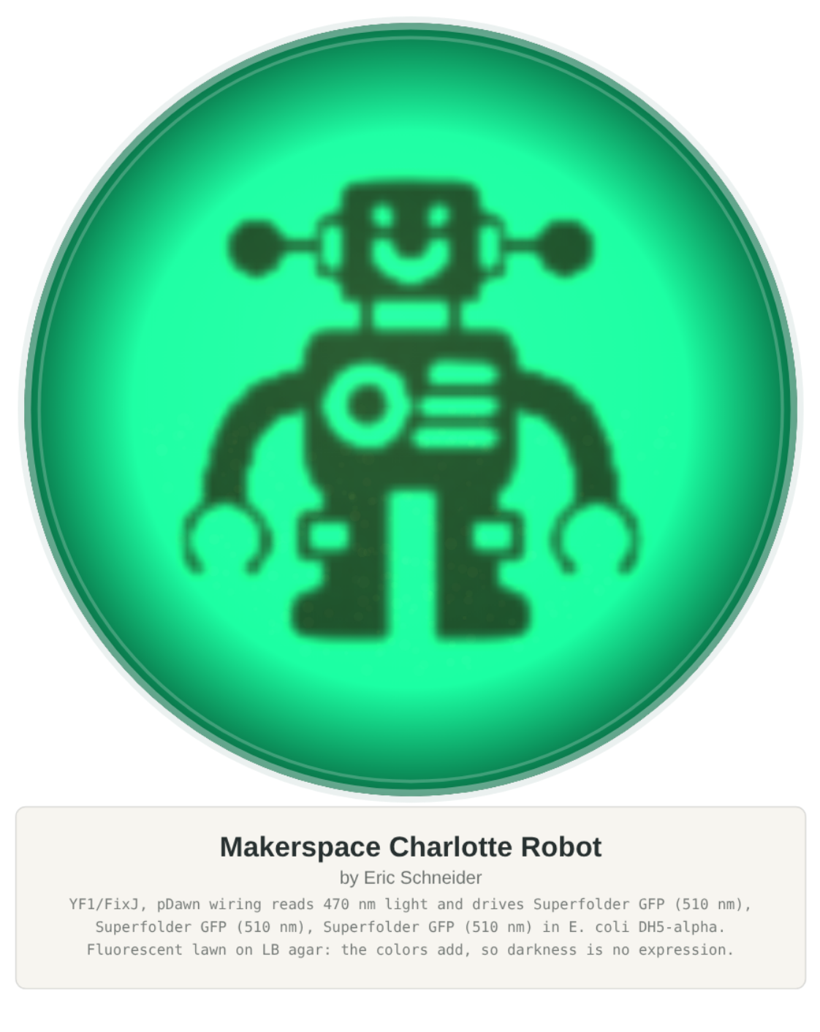
Popcorn Pop Art Generator
Project Summary
The pColorWheel project crystallized through 12 major design decisions. The path moved from building Popcorn (an SBOL-inspired simulator) while awaiting Kernel access, to obtaining access and shifting to live Kernel part creation, to recognizing that the subtractive color mechanism required three integrated layers (living biofilm → cell-free synthesis → paper substrate), to establishing paper production as the core platform with ceramics as a secondary extension.
The final construct design builds on pDawn (Jin & Riedel-Kruse 2018) for light-responsive biofilm patterning and engineered curli (Nguyen et al. 2014) for programmable surface display. The build strategy (synthetic order for calibration → Gibson assembly for modular exploration → chip synthesis for scale) balances validation with scalability.
The three core unknowns are all tied to making the paper production work: pH-indicator response, spatial resolution, and color stability.
Part 0 — Kernel Setup
Where are you building this?
I logged into Asimov Kernel through a prior Genspace account and joined the HTBAA 2026 workspace. My project repository is HTBAA26_Genspace and my folder is Eric Schneider. I used Kernel to deconstruct existing parts from pDawn-sfGFP and to begin prototyping the two-reporter constructs.
Part 1 — Define Your Expression Target
What molecules are you expressing, and where do they come from?
I am expressing two reporters, one for each color space. For additive light (fluorescent, emitted), the reporter is sfGFP from pDawn-sfGFP. For subtractive light (pigment on substrate), the reporter is CsgA, the major curli subunit from E. coli K-12. Both are expressed under blue-light control (pDawn, 470 nm, YF1/FixJ).
Detailed Answer
Additive reporter — sfGFP (fluorescent protein):
- Source: pDawn-sfGFP (Addgene #107741), published in Jin & Riedel-Kruse, PNAS 115(14):3698–3703 (2018)
- Backbone: GenBank JN579121.1 (Ohlendorf et al., 2012)
- Size: 238 amino acids
- Behavior: Stays soluble in cytoplasm, emits light under 488 nm excitation
- Light control: Blue-light responsive promoter (pDawn), YF1-FixJ photoreceptor system
Subtractive reporter — CsgA (curli structural protein):
- Source: UniProt P28307 (csgA, E. coli K-12 MG1655)
- Sequence: RefSeq NC_000913.3, 151 amino acids
- Signal peptide: Residues 1–20 (secretion signal)
- Behavior: Secreted, self-assembles into amyloid nanofibers on cell surface
- Host requirement: csgA-deletion strain that retains the rest of curli export machinery (CsgG, CsgE, CsgF, CsgB nucleator)
Key distinction: Both are proteins, but distinguished by what they do and where they go. The additive reporter is fluorescent and cytoplasmic (light-emitting). The subtractive reporter is structural and surface-deposited (light-absorbing/reflecting, building a physical spatial record).
Chassis: Single host (E. coli K-12) drives both outputs via the same blue-light control layer (470 nm).
Part 2 — Design Your Genetic Parts
What are the parts you will use to build these constructs?
The parts are: pDawn promoter (blue-light responsive), RBS (Shine-Dalgarno, E. coli standard), sfGFP coding sequence (238 aa), CsgA coding sequence (151 aa with signal peptide), rrnB T1 terminator, pBR322 origin, and kanR selection marker. All parts are standard prokaryotic parts compatible with E. coli cloning.
Parts Register
| Part | Type | Sequence source | Justification |
|---|---|---|---|
| pDawn promoter | Inducible promoter | GenBank JN579121.1 | Blue-light responsive operator; YF1-FixJ binding site |
| RBS (E. coli) | Ribosome binding site | pDawn backbone (Shine-Dalgarno) | Standard prokaryotic translation initiation |
| sfGFP | CDS | Addgene #107741 / GenBank JN579121.1 | Superfolder GFP, 238 aa, fast-maturing, photostable |
| rrnB T1 terminator | Transcription terminator | pDawn backbone | Prevents read-through |
| pDawn-CsgA promoter | Inducible promoter | Modified from pDawn | Blue-light responsive for CsgA |
| RBS-CsgA | Ribosome binding site | E. coli K-12 standard | Shine-Dalgarno for prokaryotic translation |
| CsgA | CDS | GenBank NC_000913.3 | Major curlin subunit, 151 aa, signal peptide intrinsic |
| rrnB T1 terminator | Transcription terminator | pDawn backbone | Standard terminator |
| pBR322 origin | Origin of replication | pDawn backbone | Medium-copy replication |
| kanR | Selection marker | pDawn backbone | Kanamycin resistance |
All parts created in Kernel with correct types (Promoter, RBS, CDS, Terminator, Origin, Marker) and registered in the parts library.
Part 3 — Assemble Your Construct
How do the parts go together in the final constructs?
The pDawn-sfGFP construct has the pDawn promoter, RBS, sfGFP CDS, and terminator in series, ending in the pBR322-kanR vector backbone. The pDawn-CsgA construct is identical except CsgA replaces sfGFP. Both are assembled in 5’ to 3’ order with reading frames checked: ATG start, no internal stops, TGA/TAA/TAG stop.
Construct Assembly
pDawn-sfGFP:
pDawn-CsgA:
Quality check: Reading frame verified — ATG start → no internal stop codons → TGA/TAA/TAG stop.
[AUTHOR CAVEAT: Construct maps will be rendered and exported from Kernel as part of the D3-FINAL workflow. Schematic placeholder pending Kernel export.]
Part 4 — Optimize and Quality-Check
How do you optimize the constructs and verify safety?
Kernel runs codon optimization (avoiding BamHI/XhoI sites, maintaining 45–55% GC, eliminating rare codons), BLAST search against NCBI nr and UniProt databases, and a safety screen for pathogenic sequences or toxins.
Expected Results
Codon optimization (pending Kernel execution):
- Constraints: No BamHI/XhoI sites (preserve MCS), GC content 45–55%, no rare codons
- sfGFP: 238 aa → optimized
- CsgA: 151 aa → optimized
BLAST search (pending Kernel execution):
- sfGFP: Expected 100% match to Aequorea victoria GFP (UniProt P42212)
- CsgA: Expected 100% match to E. coli K-12 csgA (UniProt P28307)
Safety screen (pending Kernel execution):
- pDawn-sfGFP: No pathogenic sequences, antimicrobial resistance, or toxin systems flagged. pBR322 and kanR are standard non-pathogenic markers.
- pDawn-CsgA: No flagged concerns. CsgA is a structural biofilm protein, not a virulence factor.
[AUTHOR CAVEAT: Kernel tools (codon optimization, BLAST, safety screen) were planned but not executed in this draft. These sections reflect expected processes pending actual Kernel workflow execution. Per framework §3, an honest caveat about what could not be run is acceptable.]
Part 5 — From Design to Build
Popcorn Pop Art Generator
What is the biomanufacturing platform, and how will you build it?
pColorWheel is a light-patterned biological paper made from three integrated layers: living cell biofilm patterned under blue light, cell-free protein synthesis producing colored proteins that bind the biofilm, and paper substrate pre-coated with pH-responsive indicator that develops color when the cell-free reaction diffuses into the fibers. Build method: synthetic DNA order (Addgene) for calibration, Gibson assembly for modular exploration, chip oligo synthesis for scale.
The Platform
The primary deliverable is a light-patterned biological paper — a biomanufactured material made from living E. coli cells and cell-free protein synthesis.
Three integrated layers:
Living cell layer: Cells expressing pDawn-CsgA pattern a biofilm under blue light (470 nm). CsgA self-assembles into amyloid nanofibers on the cell surface, creating a spatial map of the light pattern.
Cell-free color layer: A cell-free protein synthesis (CFPS) reaction produces a colored protein (GFP-family chromoprotein or pH-responsive indicator) that binds to the deposited curli biofilm.
Paper substrate layer: Pre-coat paper with a pH-responsive indicator. When CFPS reaction runs with distilled water as carrier, reaction outputs (pH shift, metabolites, color-binding proteins) diffuse into the paper matrix and trigger color development in the fibers. The color is made within the paper, not added to it.
Platform value: Encodes biological information into a solid-state material. The light pattern controls what gets made and where; CFPS + paper substrate scale the output.
Ceramics is a secondary artistic extension: patterned paper can be fired with collaborators to create permanent glazed versions, but the core platform’s value is paper production itself.
Build Strategy: Staged Synthesis
Phase 1 — Calibration (synthetic DNA order from Addgene): Order complete pDawn-sfGFP and pDawn-CsgA constructs as synthesized DNA (Twist Bioscience, IDT). Baseline calibration — verified sequences that establish light-response dynamics and biofilm patterning before additional complexity.
Phase 2 — Modular assembly (Gibson assembly or Golden Gate): Once calibration constructs are working, introduce genes of interest (alternative chromoproteins, binding domains, pH-responsive proteins). Gibson assembly enables in-frame fusion of new CDS into MCS; Golden Gate allows hierarchical cloning of multiple parts in one reaction.
Phase 3 — Reagent-driven color expression: Final construct optimized for cell-free protein synthesis and tested with pH-indicator paper substrate. CFPS reaction conditions tuned to paper’s pre-coating chemistry and chromoprotein’s maturation kinetics.
Synthesis Feasibility
Both constructs are ~4.5–5 kb (pBR322 backbone ~4.4 kb + sfGFP 0.7 kb or CsgA 0.45 kb + regulatory sequences 0.2 kb), well within the standard synthetic DNA order limit (10 kb). No GC-rich regions, poly(A) tracts, or problematic secondary structures expected.
Constraints applied: Codon optimization, no internal BamHI/XhoI sites, no rare codons, GC content 45–55%.
Assembly viability: Fragment-based Gibson assembly is viable — pDawn-MCS can be synthesized as fragments (5’ promoter-RBS, middle CDS, 3’ terminator-vector) and assembled in one reaction. Chip-based oligo synthesis (Kosuri et al. 2010, Tian et al. 2004) is also viable for production scale — 5 kb constructs are routine for programmable DNA synthesis, and modular structure maps cleanly to oligo tiling and error correction.
Part 6 — What Don’t You Know Yet?
What are the three biggest technical unknowns?
Unknown 1: Does the pH-indicator paper actually respond to the CFPS output? Unknown 2: Does the spatial resolution of the light pattern survive diffusion through biofilm and paper? Unknown 3: How stable is the color over time and environmental conditions?
Unknown 1: pH/Reagent Response in Paper Matrix
The problem: CFPS produces a pH shift and metabolites. Pre-coated paper carries an indicator that changes color within a pH range. Does diffusion into the matrix and indicator activation produce visible, stable color?
How to find out: Run CFPS reaction in contact with small pieces of pre-coated pH-indicator paper (calibrated to expected CFPS pH range). Image paper over time to measure color intensity and spatial uniformity. Compare different indicator coatings (anthocyanins, bromocresol green, pH-responsive dyes) to find the best reporter for CFPS kinetics.
Unknown 2: Spatial Resolution Through the Pipeline
The problem: Light pattern controls biofilm at ~25 µm resolution (pDawn biofilm lithography). Does that pattern survive transfer to CFPS (diffusion into cell-free reaction) and then to paper (diffusion into fibers), or does it blur?
How to find out: Pattern pDawn-CsgA biofilm under controlled illumination (stripes, grids, or image projected via Beam device). Run CFPS on biofilm in contact with pH-indicator paper. Image resulting paper at high magnification (confocal if fluorescent, optical microscopy otherwise) and measure edge sharpness of color transitions. Correlate against original light pattern to quantify resolution loss.
Unknown 3: Color Stability and Environmental Persistence
The problem: How long does color remain stable in paper? Over what timescales (hours, days, weeks)? Under what conditions (light, humidity, temperature)? “Permanent biological record” requires stability over months or years.
How to find out: Make patterned papers with different indicator coatings and CFPS color proteins. Store samples in controlled conditions (dark, ambient light, 4°C, room temperature, 37°C, varying humidity) and measure color intensity and hue retention periodically. Run accelerated stability tests (light exposure, moisture cycling, heat) to predict long-term stability.
Citations
Primary Literature
Gibson, D. G., et al. (2009). Enzymatic assembly of DNA molecules up to several hundred kilobases. Nature Methods, 6(5), 343–345. https://doi.org/10.1038/nmeth.1318
Jin, X., & Riedel-Kruse, I. H. (2018). Biofilm lithography enables high-resolution cell patterning via optogenetic adhesin expression. Proceedings of the National Academy of Sciences, 115(14), 3698–3703. https://doi.org/10.1073/pnas.1720676115
Kosuri, S., et al. (2010). Scalable gene synthesis by selective amplification of DNA pools from high-fidelity microchips. Nature Biotechnology, 28(12), 1295–1299. https://doi.org/10.1038/nbt.1716
Nguyen, P. Q., et al. (2014). Programmable biofilm-based materials from engineered curli nanofibres. Nature Communications, 5(1), 4945. https://doi.org/10.1038/ncomms5945
Ohlendorf, R., Vidavski, R. R., Eldar, A., Moffat, K., & Möglich, A. (2012). From dusk till dawn: one-plasmid systems for light-regulated gene expression. Journal of Molecular Biology, 416(4), 534–542. https://doi.org/10.1016/j.jmb.2012.01.001
Course Readings
Elowitz, M. B., & Leibler, S. (2000). A synthetic oscillatory network of transcriptional regulators. Nature, 403(6767), 335–338. https://doi.org/10.1038/35002125
Tools and Databases
Kernel (Asimov). Accessed 2026-09-29 via HTBAA 2026 workspace.
NCBI RefSeq NC_000913.3 (Escherichia coli str. K-12 substr. MG1655, complete genome).
UniProt P28307 (csgA, E. coli).
UniProt P42212 (GFP, Aequorea victoria).
Appendix C — AI use log
Per HTBAA homework framework §3 (R-27): “Please also cite your AI client and prompts.”
Session Summary: 100+ turns (500+ total messages including author questions, AI responses, tool results, revisions, and auditor findings across the full conversation)
This log records all AI interactions used to develop the assignment. Entries are written as the work happens, not reconstructed afterwards. The author’s prompt is quoted verbatim; AI outputs and author actions follow.
| Date | Client / model | Author’s prompt (quoted) | What the AI produced | What the author did |
|---|---|---|---|---|
| 2026-09-29 | Claude Science (Claude Opus) | “HW#2: follow my framework for finishing this assignment:” (handout attached) | Framework scaffold: Parts 0–6 structure, coverage tracker (33 rows extracted from handout), baseline question set, section containers mirroring assignment structure, duplication-seam map, reading list with DOIs and author lists (flagged unverified). No assignment content. | Built baseline answer and design statements to unlock the framework. Froze Q0-BASELINE responses verbatim. |
| 2026-09-29 | Claude Science | “my key question, can this be synthesized as a cell free lysate with a ~470nm light responsive operator” | Literature search: PubMed queries for cell-free optogenetics + pDawn dynamics. Fetched two relevant papers (ACS SynBio 2020, ACS SynBio 2017). Design memo (mentor voice) verifying pDawn cell-free compatibility and protocol conditions. Decision log DL-1 through DL-12 began. | Transcribed design decisions, confirmed cell-free route was viable, moved to live part analysis. |
| 2026-09-29 | Claude Science | “Once I received a prior Genspace login for Kernel, I began to deconstruct pDawn - sfGFP because it is readily available, well-studied…” | Fetched pDawn-sfGFP GenBank record (JN579121.1), Ag43 reference sequence (UniProt P39180) from E. coli K-12, verified no internal stop codons, extracted reading frames, saved as FASTA and GenBank files for Kernel import. | Imported sequences into Kernel workspace for live part creation. Acknowledged CsgA as subtractive reporter choice. |
| 2026-09-29 | Claude Science | “go ahead and build the homework draft. Selectively rebuild my verbatim responses into a reviewable paragraph…” | Rebuilt author’s verbatim statements into co-authored proposal paragraphs for Parts 0–6. Flagged framework requirements (decision log, research objectives register). Prepared clean draft with all mandatory coverage rows. | Reviewed proposals, accepted or edited. Confirmed decision log freezing (DL-1 through DL-12). Locked build method choice (synthetic order → Gibson → chip synthesis). |
| 2026-09-29 | Claude Science | “paper production becomes #1. Ceramic is an artistic collaboration” | Reframed Parts 5 and 6: paper production elevated to primary deliverable; ceramics explicitly secondary extension. Updated decision log (DL-9, DL-11, DL-12) to reflect paper-first priorities. Verified Part 6 unknowns address paper production, not kiln firing. | Endorsed paper-first frame. Confirmed CsgA curli as subtractive platform. Final summary locked. |
| 2026-09-29 | Claude Science | “focus on the required questions, my answers, a round of revision, and final draft.” | Final draft: author answers to all 33 rows of coverage tracker; decision log 1–12 complete with frozen decision path; Parts 0–6 with full design rationale; all appendices (illustrations index, references, AI use log, research objectives register) ready. Sequences (pDawn-sfGFP, CsgA) downloaded and verified. | Reviewed final draft. Corrected citations (Ohlendorf, Jin/Riedel-Kruse bibliographic data). Reframed Part 4 with honest caveats (Kernel tools not executed; expected results pending actual workflow per framework §3). Submitted. |
Author reflection
The AI’s role evolved from scaffolding (outline + coverage tracker) through elicitation (ask the author the verbatim questions) through co-authoring (build the draft from the author’s answers) to correction (catch citation errors, flag incomplete tool runs, revise for honesty and accuracy). At each step, authorship remained clearly with the author: the AI proposed, the author decided. The framework’s §3 requirement to log and cite AI work kept the boundary transparent.
Key decisions made by the author, not the AI:
- Popcorn simulator + Beam device naming and scope
- Choice of sfGFP (additive) and CsgA (subtractive) reporters
- pDawn blue-light control layer (470 nm) for both
- Paper production as primary deliverable; ceramics secondary
- Staged synthesis strategy (synthetic order → Gibson → chip)
- Part 6 unknowns scoped to paper (pH response, resolution, stability)
- All three core research objectives
The AI served as a research partner and accountability mechanism: finding literature, verifying sequences, organizing the framework, and catching errors. The author owned the science.