Week 1 HW: Final Project DRAFT
Biomanufactured Structural White: A TiO2 Replacement
1. What I want to biomanufacture, and why
I want to explore a biomanufactured, particle-free white colorant and opacifier, something that could replace titanium dioxide (TiO2, listed as E171 in food) in food coatings, tablet/supplement coatings, and cosmetics.
This isn’t a hypothetical problem. TiO2 was banned as a food additive in the EU in August 2022, on genotoxicity concerns tied to its nanoparticle form [1]. It’s still permitted in the US and several other markets, but that kind of ruling tends to spread. A petition asking the FDA to revoke its color additive listing is already pending, US states are moving on food additive bills, and manufacturers are reformulating around it [2]. So the premise here isn’t “can something beat TiO2 on price”, TiO2 is being pulled off the table on health grounds regardless of cost. The premise is: something has to fill that slot, and the market hasn’t settled on what.
That’s what makes white the interesting color to work on. Natural-colorant companies (including the biocolor work I’m involved in) have technically cracked red, blue, and yellow, including with fermentation-derived pigments, though these remain expensive in use. Nobody has cracked a fermentation-derived white that matches TiO2. It’s the unsolved color, both technically and commercially, which is why it’s talked about as a kind of holy grail in the natural-colorant industry.
Who it’s for: food and supplement manufacturers currently scrambling for a TiO2 replacement (especially ones selling into the EU, or ones that want to get ahead of a similar US ruling), and by extension, consumers who’d rather not have a nanoparticle mineral pigment in their food or pills.
2. What living system would I use?
Rather than trying to biosynthesize a white pigment molecule (there isn’t really such a thing, white pigments work by scattering light broadly, not absorbing specific wavelengths), I’d take a structural-color approach, copying how some organisms are white with no pigment at all.
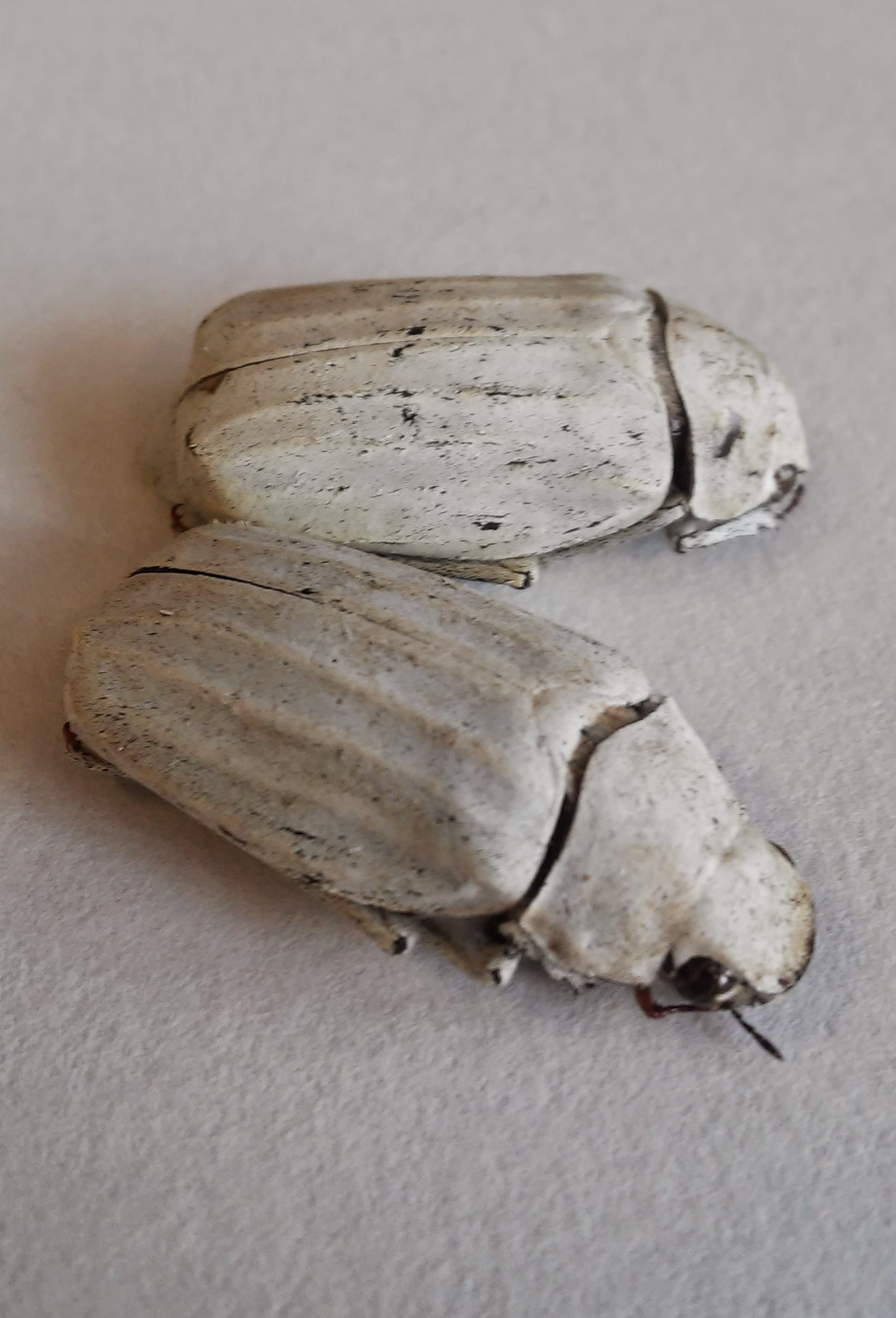
The best natural example is the Cyphochilus beetle. Its scales are a disordered, randomly-oriented network of chitin nanofibers, refractive index around 1.5. That randomness is the key: it scatters light broadly across the visible spectrum instead of absorbing any of it, which reads as bright white using a fraction of the material a solid pigment would need. Researchers have built synthetic mimics, such as a PMMA foam version that hit 90% reflectance at just 60 microns thick, comparable to TiO2 films [3], but that’s a synthetic polymer process, not a biomanufacturing one.
My proposed organism is Komagataeibacter (formerly Gluconacetobacter), the bacterium behind kombucha SCOBY and nata de coco. It’s food-safe and already used industrially. Fed glucose or sucrose, it secretes a nanofibril cellulose network. Cellulose and chitin are close chemical cousins with similar refractive index (about 1.55 for cellulose) and similar fibrous architecture.
The reframe: I’m fermenting a structure, not a molecule. Cellulose itself is a commodity. What the organism provides is a self-assembled nanofibril network that the synthetic mimic needed PMMA and supercritical CO2 drying to fake. The organism does the nanofabrication, fermentation sets the dimensions, and drying preserves them.
What the structure has to look like. A natural assumption is that Komagataeibacter’s fibrils are already close to what the beetle uses. The best-documented benchmark says otherwise. The Cyphochilus scale is a network of chitin filaments about 244 nm in diameter ([4], as used in [5]), packed into a layer only about 8 µm thick [5]. Bacterial cellulose nanofibers are typically 25 to 100 nm in diameter [6], so even at the top of that range they are smaller than the beetle’s filaments, and at the bottom they are about a tenth the size. I’m using the beetle as a benchmark, not as proof that 244 nm is the optimum for cellulose in air. The failure mode of undersized features is a blue-grey cast, because thin fibrils scatter short wavelengths preferentially, which fails a whiteness specification even when total reflectance looks acceptable. That is my physical expectation, not a measurement, and the optical testing in Section 5 is what would confirm it. The direction is what matters: I need larger, better-organized scattering features, not finer ones.
Production organism versus testbed. In my opinion, native K. xylinus is the most plausible production organism for a food ingredient: it has documented food use (nata de coco) and no host-derived contaminants. In Homework 2 I design an E. coli construct, not as the production strain but as a genetic testbed for one hypothesis, that expression level of the BcsD subunit moves fibril diameter. What that dose-response teaches would feed back into strain and media work in the native organism.
A cell-free path, parked as an open question. In 2015, researchers used crude lysate from Gluconacetobacter hansenii (now classified as Komagataeibacter hansenii), a close relative, and converted glucose to cellulose more efficiently than live cells (57.68% versus 39.62% yield on consumed glucose), while producing about the same amount of cellulose, 3.72 versus 3.78 g/L over 15 days [7]. But the figures I have are yield and conversion efficiency, not fibril structure. Since structure is the product, a lysate route only matters if it can assemble organized fibrils, which I don’t know. I’m keeping it as a question to test, not a recommended path.
3. How would I use automation?
Prototyping and screening. Testing strain variants and culture conditions in parallel is well suited to a desktop liquid handler like an Opentrons or a shared Cloud Lab: automated media prep and inoculation across many small cultures. This works well for screening cellulose yield. It does not work for the property I actually care about. Whiteness is a property of a dried solid, and cloud labs and plate readers measure liquids. Fibril architecture needs SEM or AFM, and whiteness needs reflectance spectroscopy on dried films. So I’d split the workflow deliberately: automated parallel culture for yield, and a core facility or collaborator with the right instruments for architecture and optics. A handheld colorimeter giving Lab* values and a whiteness index is a cheap first-pass proxy that would catch the blue-cast failure mode.
Production. Once a recipe is chosen, the need shifts to bioreactor process control (feed rate, pH, dissolved oxygen) and a harvest, wash and dry line. The drying step matters most, because it’s where the structure is preserved or lost. The tools I’d prototype with are not what I’d scale production with.
4. How much would I need to make, and how long would it take?
(a) How much.I’m using tablet/supplement coating as my scale example, since it’s a real, near-term target (a plant-based cellulose TiO2 alternative called SilvaAlba, from BIOGRUND and Seprify, launched into exactly this market in 2026 [8]).
- Assume a mid-size nutraceutical manufacturer producing 100 million tablets/year.
- Assume 500 mg tablet cores, a 5% coating weight gain (25 mg of coating per tablet), and a coating formulation that is 40% opacifier. That gives about 10 mg of opacifier per tablet. These figures come from a published titanium dioxide versus calcium carbonate coating study [9] on strongly colored cores, so I’m treating them as a realistic high-coverage case rather than a minimum, and I’d want to verify against real formulation data.
- 100,000,000 tablets × 10 mg = 1,000,000,000 mg = 1,000 kg of dry white material per year.
- The mass needed also depends on how well the structure scatters light. Better fibril architecture means less material per tablet, which links the genetic design in Homework 2 directly to scale. One caveat on the 10 mg anchor: TiO2 is far denser than cellulose, so 10 mg of a low-density cellulose network takes up much more coating volume than 10 mg of TiO2. Equal mass will not mean equal coverage, so the true mass could land well above or below 10 mg. I haven’t measured this, so I treat 10 mg as a placeholder anchor, not a result.
(b) How long. Reported bacterial cellulose yields vary widely. One review describes pellicles forming in 3 to 14 days at up to about 10 g dry weight per liter [6], while one optimized strain reports more than 23 g/L in 10 days of static culture [10] (I haven’t confirmed whether that is dry weight). I don’t have a verified yield for the strain and medium I’d use, so I’m bracketing it with scenarios of 1, 3 and 10 g/L and treating yield as the first thing to measure. Productivity matters more than titer, because reactor cost scales with volume multiplied by time occupied. At 3 g/L over a 10 day cycle that’s about 0.3 g/L/day (10 days of growth inside a 14-day cycle, about 0.2 g/L/day over the full cycle).
Not every gram in the vessel becomes finished white material after harvest, purification, washing, drying and milling. I’m assuming roughly 70% recovery as a placeholder to verify. Culture needed per year is the 1,000 kg of dry material divided by yield times recovery. The table assumes a 14-day cycle (growth plus turnaround):
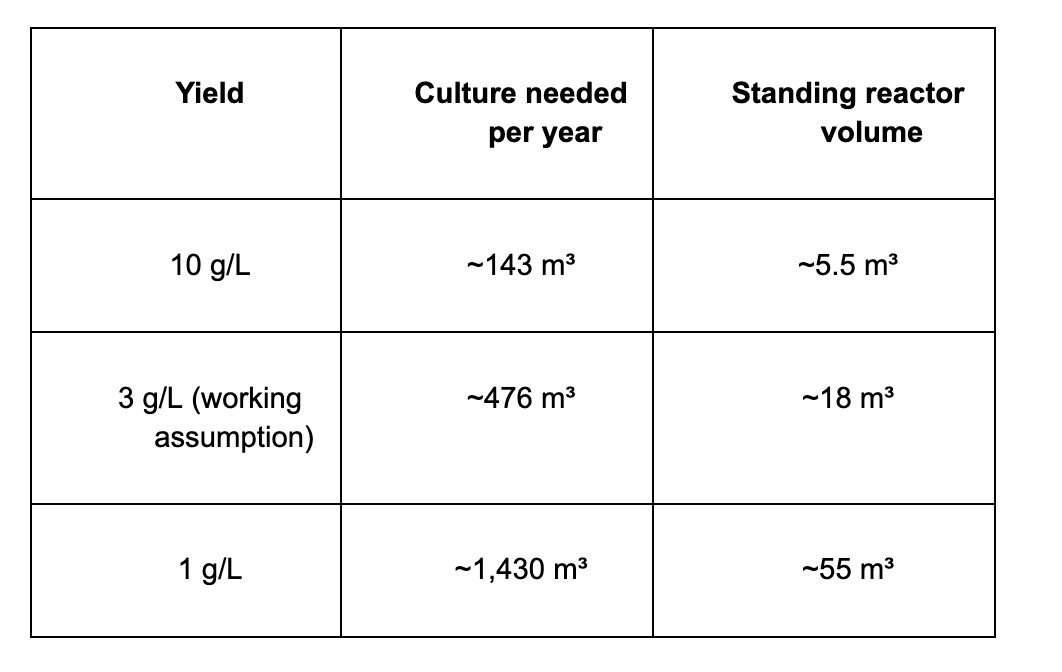
Yield moves the answer by an order of magnitude, from roughly 140 to 1,430 m³ of culture a year, or about 5 to 55 m³ of reactor running continuously. Yield is therefore the number I would verify first.
Scale also depends on culture mode. Static culture is surface-area limited, so it doesn’t scale linearly with vessel volume. Agitated culture scales better, but it changes pellicle morphology, and morphology is the thing being sold.
The gap between the prototyping scale (small parallel cultures on a liquid handler) and the production scale (thousands of liters) is itself one of the more interesting engineering problems, this is a case where the automation used to develop the idea is nothing like the automation used to make it at volume.
5. What I don’t know yet
These are ordered by how much each would change the project. The first two decide whether the product can be white at all. The last two decide whether it can be sold.
Can the fibrils reach a useful feature size, and does genetics or process move it? Whiteness depends on fibril dimensions and packing. The beetle’s network uses filaments of about 244 nm ([4], as used in [5]), while bacterial cellulose nanofibers are typically 25 to 100 nm in diameter [6]. Thin fibrils scatter short wavelengths preferentially, so an undersized network risks a blue-grey cast instead of white. The open question is whether anything I can control moves fibril diameter toward the beetle’s range. One candidate is the level of the BcsD subunit, which bundles glucan chains into ribbons and is the hypothesis I test in Homework 2. Culture and process conditions are the other. How I’d find out: SEM or AFM for fibril diameter and reflectance on dried films, starting from a wild-type baseline. If nothing moves, this becomes a process invention running on a fermentation feedstock, which is still biomanufacturing, but a different project.
Does the structure survive drying and formulation? The organism builds the structure, but drying and coating decide whether it survives into the finished product. Drying sets the pore and aggregate size distribution, and scattering depends on that distribution and on packing, not on primary fibril size alone. Scattering strength does not increase linearly with filling fraction [5], so packing and drying matter as much as fibril size. I expect drying to be a dominant variable, which makes it something to characterize rather than assume. And because whiteness depends on air in the pores, embedding the material in a coating binder of similar refractive index collapses the contrast the structure relies on. Neither of these is a genetics problem. How I’d find out: a drying and formulation sweep on wild-type pellicles, which are cheap and food-safe, run in parallel with the strain work so the two levers get characterized against each other.
What’s the regulatory pathway, and how long is it? A fermented nanocellulose whitener would likely need a novel food filing (EU) or a GRAS determination (US), which could take longer than the technical work. Native K. xylinus has a documented food-use history through nata de coco, which should help. A recombinant E. coli route would add endotoxin (LPS) removal, antibiotic-marker concerns and host-modified cellulose to the filing. I don’t yet know realistic timelines or precedent for a fermented, rather than extracted, cellulose ingredient.
Can it beat the stopgap alternatives on cost and performance? TiO2 is banned in the EU and under growing pressure elsewhere, so it can’t be the long-term benchmark. The competition is the replacements already on the market (calcium carbonate, calcium phosphate, silica, rice starch, [2] and a plant-based cellulose like SilvaAlba [8]). They are cheaper than a new bioprocess would likely be, but optically weaker than TiO2 ever was. How I’d find out: compute cost per kg on a g/L/day basis, including drying and formulation, and compare against those incumbents. The cell-free route from Section 2 only enters this comparison if it can assemble the right fibril structure.
AI use disclosure
Developed with Claude (Anthropic), used for background research (regulatory status of TiO2/E171, structural-white biomimicry literature, bacterial cellulose fermentation characteristics, existing commercial TiO2 alternatives, cell-free bio-cellulose production precedent) and for structuring/drafting this write-up around the four core questions. All claims below are ones I’ve reviewed and can defend; estimates I haven’t independently verified are flagged inline as assumptions.
I also used Claude Science (Anthropic) as a second AI tool for adversarial review of my drafts and for checking calculations and checking citations. Where its output included figures I could not trace to a source, I removed them or replaced them with sourced values. The volume estimates in Section 4 are stated as scenarios with assumptions flagged inline, and I checked the arithmetic myself.
Prompts for Used for Claude:
- Here are notes from the intro class. (added notes summary). Here is homework 1 in detail (shared the homework google doc)
- “yeah, let’s ground the project on biocolors. and specifically white. that is the holy grail in the industry and would love to take a stab at it if possible.”
- I’d like to refine. So if TiO2 has serious health risks and will be banned, it needs to be removed or replaced. Therefore, whether the biomanufactured or plant extracted versions of white are more expensive than TiO2 isn’t the challenge to solve because it’s gone, it’s what is going to replace it and how much cheaper are the alternatives. So don’t think that’s the unknown
Sources referenced
[1] Mérieux NutriSciences. The European Commission banned titanium dioxide as a food additive. https://www.merieuxnutrisciences.com/the-european-commission-banned-titanium-dioxide-as-a-food-additive/ [2] Kanegrade. EU titanium dioxide ban: alternative white food colours. https://kanegrade.com/eu-titanium-dioxide-ban-alternative-white-food-colours/ [3] Syurik, J., Siddique, R. H., Dollmann, A., Gomard, G., Schneider, M., Worgull, M., Wiegand, G., & Hölscher, H. (2017). Bio-inspired, large scale, highly-scattering films for nanoparticle-alternative white surfaces. Scientific Reports, 7, 46637. https://doi.org/10.1038/srep46637 [4] Luke, S. M., Hallam, B. T., & Vukusic, P. (2010). Structural optimization for broadband scattering in several ultra-thin white beetle scales. Applied Optics, 49(22), 4246-4254. https://pubmed.ncbi.nlm.nih.gov/20676179/ [5] Burresi, M., Cortese, L., Pattelli, L., Kolle, M., Vukusic, P., Wiersma, D. S., Steiner, U., & Vignolini, S. (2014). Bright-white beetle scales optimise multiple scattering of light. Scientific Reports, 4, 6075. https://doi.org/10.1038/srep06075 [6] Potočnik, V., Gorgieva, S., & Trček, J. (2023). From nature to lab: Sustainable bacterial cellulose production and modification with synthetic biology. Polymers, 15(16), 3466. https://doi.org/10.3390/polym15163466 [7] Ullah, M. W., Ul-Islam, M., Khan, S., Kim, Y., & Park, J. K. (2015). Innovative production of bio-cellulose using a cell-free system derived from a single cell line. Carbohydrate Polymers. https://doi.org/10.1016/j.carbpol.2015.06.037 [8] World Bio Market Insights. BIOGRUND and Seprify launch plant-based alternative to titanium dioxide. https://worldbiomarketinsights.com/biogrund-and-seprify-launch-plant-based-alternative-to-titanium-dioxide/ [9] Elia, A. G., Di Gallo, N., Knüttel, A.-N., Kipping, T., & von der Brelie, A. (2023). Calcium carbonate as a replacement for titanium dioxide in coating: the importance of particle engineering. MilliporeSigma white paper MS_WP12274EN. https://www.sigmaaldrich.com/deepweb/assets/sigmaaldrich/product/documents/128/709/parteck-ta-whitepaper-wp12274en-ms.pdf [10] Gullo, M., Sola, A., Zanichelli, G., Montorsi, M., Messori, M., & Giudici, P. (2017). Increased production of bacterial cellulose as starting point for scaled-up applications. Applied Microbiology and Biotechnology, 101(22), 8115-8127. https://doi.org/10.1007/s00253-017-8539-3