Week 4 HW: CFPS Batch Design, Data Analysis, Metascience
Part A · Part B · Part C · AI use · Reflection · Appendix · Glossary · Sources
Batch hypothesis. My Week 3 sfGFP composition changed three things at once, so nothing it measures can be attributed. This batch holds that composition fixed and varies catalase alone, with twelve wells on the zero arm and twelve on the published dose.
| Contents | The assignment |
|---|---|
| Part A: Batch design What Week 3 left unresolved What the evidence for catalase actually is The batch Why this earns wells Part B B1. Where my thinking stands B2. 384-well against 96-well deep well B3. Metascience, one rubric criterion Part C: Agentic contribution AI use disclosure Reflection Appendix A: Full batch composition Appendix B: Calculations Appendix C: The lysate answer Glossary Sources References | A. Design a batch of reaction compositions meant to be compared with each other, with one overall hypothesis and a rationale per mix. → Nine sfGFP mixes on one batch ID: a catalase titration at five levels, replicated on the two arms that carry the question. B1. Document the current status of my CFPS optimization ideas. → Five threads, one of which is now resolved by arithmetic. B2. Review the sfGFP control report and explain how the same reaction performs in a 384-well plate against a 96-well deep well. → The report’s findings, a discrepancy I had to flag, and an analysis of the underlying results that the report does not do. B3. Propose one rubric criterion for deciding which experiments make it onto the plate. → Prefer within-plate contrasts over cross-plate ranks, argued from B2. C. Optionally use the agent API and document the experience. → Attempted, blocked twice by safety classifiers, completed by hand. |
Part A: Batch design
What Week 3 left unresolved
The Week 3 sfGFP composition made three changes to the sfGFP Ribose reference at once: spermidine added at 1.25 mM, catalase added at 187.5 U/mL, and all four NMPs cut to 1.0 mM. The submission said so itself. No result from it can be attributed to any one change.
Catalase is the change worth isolating, because of oxygen. sfGFP does not fluoresce on synthesis; the chromophore forms by cyclization and dehydration followed by an oxygen-dependent oxidation (chromophore maturation). A reaction can make correctly folded protein and still read dark. The reagent table classifies catalase under “oxygen-related components: influence oxygen availability and metabolism,” which is the mechanism under test here: not peroxide clean-up, but two H₂O₂ becoming two water and one O₂ inside a sealed well.
What the evidence for catalase actually is
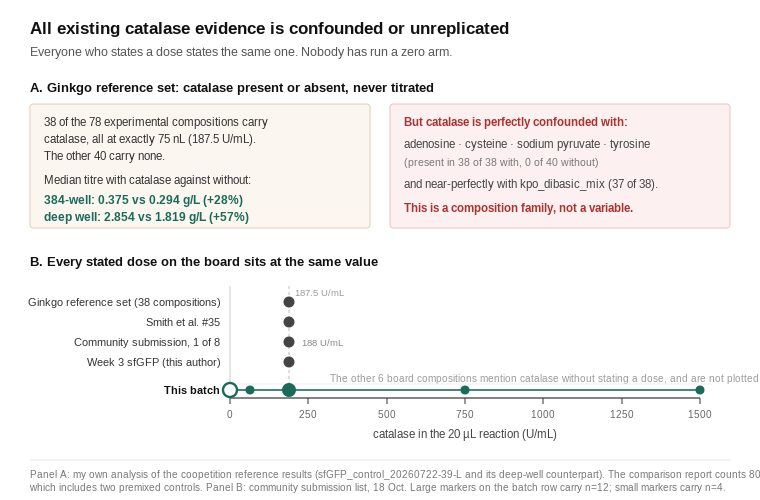
Figure 1.
The reference results contain a catalase contrast nobody has reported. Of the 78 experimental compositions on the sfGFP reference plate, 38 carry catalase at exactly 75 nL (187.5 U/mL) and 40 carry none. The catalase-bearing group runs +28% in 384-well and +57% in deep well on median titre. (The comparison report counts 80 designs rather than 78, because it includes two premixed controls.)
That is the right direction and it cannot be attributed. Catalase is perfectly confounded with adenosine, cysteine, sodium pyruvate and tyrosine (present in 38 of 38, absent from 40 of 40) and near-perfectly with kpo_dibasic_mix. It is a marker of one composition family, not a variable.
On the community board, catalase appears in 8 of 431 compositions, from 7 participants. Only one states a dose, at 188 U/mL. None carries an otherwise-identical zero arm. Two expert groups named it and moved on: Evan (Adamala lab) raised oxygenation as critical and noted catalase can provide ancillary oxygenation; Georgia Tech listed catalase as a live variable while calling pyruvate oxidase unhelpful. Neither proposed titrating it.
Where the board does give a reason, it is the conventional one. Two submissions pair catalase with pyruvate or acetyl phosphate and describe it as peroxide clearance, which is catalase in its usual role of cleaning up after an oxidase. My batch contains no oxidase, which is what makes the net-oxygen-source framing a different claim rather than a restatement.
So the position is not “nobody has thought about catalase.” It is that the only quantitative evidence is a five-reagent family contrast, and the comparison report names “better aeration” as one of three untested explanations for a 7.3× format effect. This batch tests that limb at 384-well scale with the cheapest in-well oxygen source available.
The batch
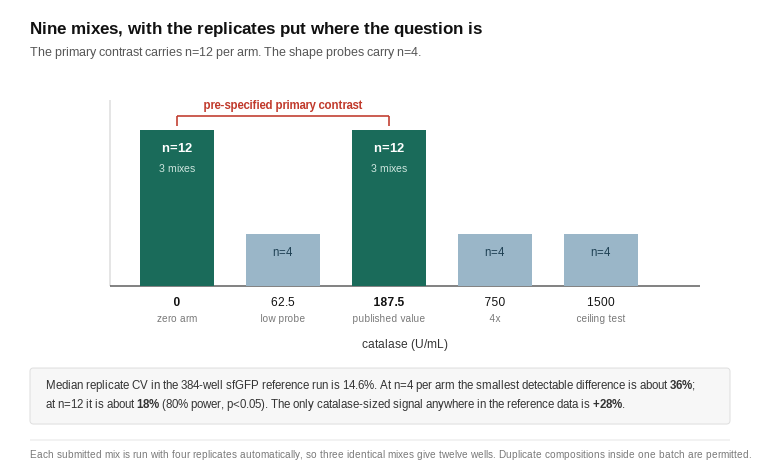
Figure 2.
| Catalase (U/mL) | Mixes | Wells | catalase nL | nuclease_free_water nL |
|---|---|---|---|---|
| 0 | 3 | 12 | 0 | 1,150 |
| 62.5 | 1 | 4 | 25 | 1,125 |
| 187.5 | 3 | 12 | 75 | 1,075 |
| 750 | 1 | 4 | 300 | 850 |
| 1,500 | 1 | 4 | 600 | 550 |
Backbone identical in all nine; full volumes in Appendix A.
Why the replication. Median replicate CV in the 384-well sfGFP reference run is 14.6%; my own calculation over wells above 0.05 g/L gives 15.4%. At n=4 per arm the smallest difference detectable at 80% power and p<0.05 is about 36%. The only catalase-sized signal anywhere in the reference data is +28%. A six-arm, n=4 sweep would have been underpowered against the effect it was looking for. Putting three mixes on each of the two arms that carry the question brings that to about 18%.
The standard error of a difference scales with the square root of (1/n₁ + 1/n₂), so it is the smaller arm that sets the limit. Splitting 24 wells as 12 and 12 beats 16 and 8, and beats 20 and 4 by a wide margin. The zero arm is also the shared reference for all four dose levels, so it is the last place to economise.
This is a deliberate power allocation, not redundancy, and the submitted hypothesis says so explicitly so that a selector does not cut the duplicate arms as near-duplicates.
Why this earns wells
| Claim | Evidence |
|---|---|
| Cost is flat across the sweep | All arms price at $0.12 per 20 µL, spanning $5.75 to $5.90 per mL. No arm is penalised on the scoring metric by its catalase level. |
| Every outcome is interpretable | Figure 3. Rising, flat and falling each answer the question. |
| It is powered for the effect size in the data | 18% detectable against a 28% prior signal. |
| It resolves something already on the board | The 187.5 arms reproduce the Week 3 composition; the zero arms are that composition minus catalase. |
| It is unoccupied | No zero arm and no titration exists among the 431 board compositions. |
| It survives the B2 failure mode | It is a within-plate contrast, not a cross-plate ranking. See B3. |
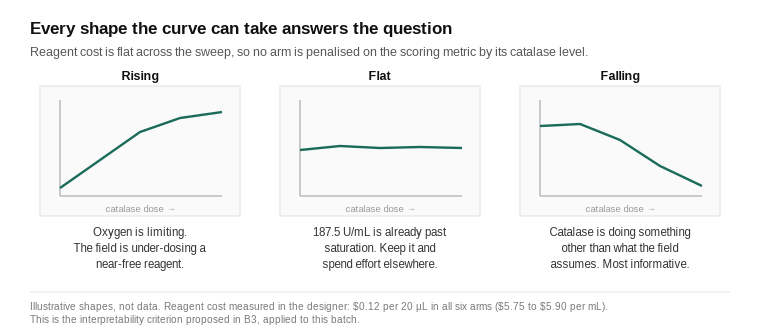
Figure 3.
Stated limitations. Spermidine is held at 1.25 mM throughout, so this isolates catalase and does not re-test the spermidine half of the Week 3 design. The catalase stock is buffered in potassium phosphate, so the top arm carries a small uncontrolled phosphate increment against the designed 15 mM; negligible at the lower arms. The stock is specified as “>50,000 U/mL”, a floor, so all U/mL figures here are nominal.
On cost and sustainability. The metric is dollars per gram, and cheaper is not the same as greener. Several reagents in these low-cost formulations, nicotinamide among them, have petrochemical upstream steps. Nothing in the current scoring captures embodied carbon.
Part B
B1. Where my thinking stands
| Thread | Status |
|---|---|
| 1. Oxygen as the untested variable | Active. This is the batch. |
| 2. Reducing load against added oxidant on PETase | Resolved by arithmetic, once the lysate numbers were published. |
| 3. PETase folding-helper dose-response | Dropped. Heavily covered on the board. |
| 4. The existing 60 °C assay step as a variable | Parked for round 2. |
| 5. Calcium as a community reagent | Not proposed. Absent from the palette and the board. |
Thread 2, resolved. Eighteen PETase compositions from thirteen participants add a GSSG/GSH couple to the reducing formulation, at stated concentrations of 0.425 to 1.25 mM. The reasoning is that TfCut2’s single disulfide needs an oxidant and glutathione is far cheaper than DsbC, and it rests on a real distinction: DsbC is an isomerase, not an oxidase. Both Karash and Georgia Tech proposed the same move at the group meeting.
What nobody had was the DTT concentration in the standard lysate, which the specification did not state. It was asked on the forum and Ronan answered on 20 October: 3 mM DTT, and the lysate is BL21 Star (DE3) with both gor and trxB intact, not a Δgor strain. The specification has been updated to match. With that number the question becomes arithmetic, and nobody appears to have run it.
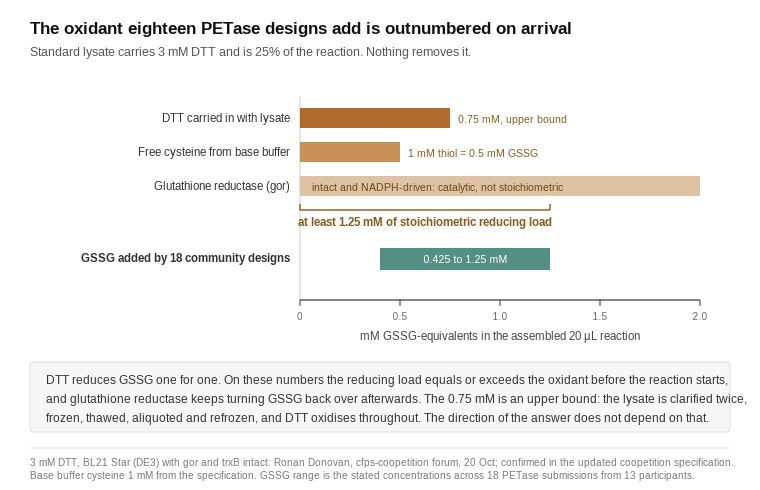
Figure 4.
Lysate is 25% of the reaction by volume, so 3 mM in the lysis buffer is an upper bound of 0.75 mM DTT in the assembled reaction. The base buffer contributes 1 mM free cysteine, worth another 0.5 mM of GSSG-equivalents by thiol-disulfide exchange. DTT reduces GSSG one for one. That is at least 1.25 mM of stoichiometric reducing load against additions of 0.425 to 1.25 mM, with glutathione reductase intact and turning GSSG back over catalytically on top.
0.75 mM is an upper bound: the lysate is clarified twice, frozen, thawed, aliquoted and refrozen, and DTT oxidises throughout. The direction of the answer does not depend on that.
So the honest conclusion is that the added oxidant is probably consumed, and the cheapest correct PETase design may be zero DsbC and zero glutathione. I am not submitting that. The DsbC lane is the most crowded question in the competition and a zero arm would land inside other people’s zero arms. The arithmetic is more useful to the people spending wells on it than another composition would be.
Thread 3, dropped. Forty-five PETase compositions from twenty-five participants engage with DsbC, and nineteen of them explicitly drop or zero it. Three are multi-mix series of 8, 5 and 3 mixes. My Week 3 PETase design at 1 µM already sits inside a curve others have covered with more points.
Thread 4, parked. TfCut2 has an apparent melting temperature near 70 °C by CD spectroscopy (Roth et al. 2014) and best activity near 50 °C, but the reaction runs at 30 °C for 20 hours because that is what E. coli ribosomes want. The PETase assay already opens with a 60 °C, ten-minute incubation to kill background lysate esterases. That is also a window at a temperature where a thermostable protein’s folded state is strongly favoured, and it is applied as a fixed operation rather than a variable. Sweeping it would cost nothing in reagents, which matters when the score is dollars per unit activity. Counterweight: work from the Swartz group on cell-free vtPA folding found that lowering the synthesis temperature improved both solubility and activity. That concerns synthesis rather than a post-synthesis anneal, but the burden of proof is mine.
B2. 384-well against 96-well deep well
First, a discrepancy to flag. The assignment describes this as “the same 20 µL sfGFP reaction” in both formats. The comparison report describes the deep-well reactions as 40 µL and lists the volume difference among its caveats: “different reaction volumes (40 µL quad, 20 µL in 384).” I am flagging that rather than resolving it, because it changes what the comparison is.
What the report found. Same 80 designs, same lysate lot 20260722-39-L, identical recipes.
| Metric | 384-well | 96-well deep |
|---|---|---|
| Median design titre | 0.36 g/L | 2.71 g/L |
| Median per-design fold | — | 7.3× (IQR 4.5–13.6) |
| Median replicate CV | 14.6% | 7.2% |
| Designs above 20% CV | 32 of 80 | 4 of 80 |
| Spearman ρ between formats | −0.12 | |
| Top-10 overlap | 0 of 10 |
The format effect is reproducible: an earlier deep-well run gave 5.8× against the same reference, also with no shared top-10 designs.
What explains it. The report lists three candidates and tests none:
- Evaporative concentration in the deep well. Losing volume during a 30 °C incubation raises every salt concentration, which would lower the apparent Mg and K(Glu) optima and lift low-Mg recipes into the working range.
- Better aeration. A thin reaction film under a large headspace would support oxidative energy regeneration.
- Base buffer lot. 20260512-2-BB in the deep well against 20260721-4-BB in 384, a confound that cannot be separated from the format without a same-buffer side-by-side.
Candidate 1 has the most direct support. The Ginkgo3 Mg optimum shifts from 9.8 mM in 384 down to 5.6 mM in deep well, and RFopt recipes that collapse 65-fold at low Mg in 384 make 1.8 to 2.0 g/L in deep well. That is a specific mechanistic prediction the data confirms.
What I add, from the results JSON.
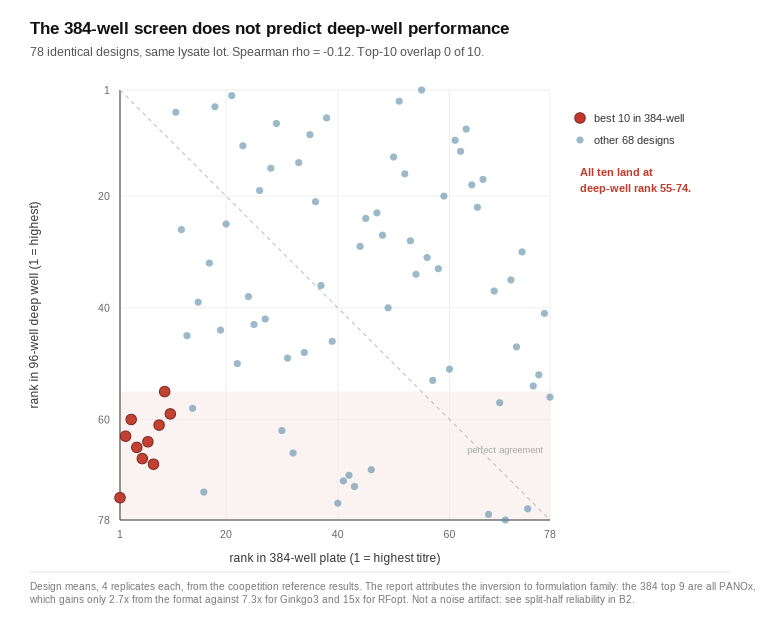
Figure 5.
The report shows the rankings disagree. It does not establish that either plate can rank in the first place, which is the obvious objection: a near-zero correlation is what you would also see if the 384-well measurement were simply too noisy to order anything.
It is not. Splitting each design’s four replicates into halves and correlating the two halves gives a within-plate rank reliability of +0.854 for the 384-well plate. That is the half-length figure; the Spearman-Brown correction puts the full four-replicate mean near 0.92, so if anything it understates. And the replicate positions make it trustworthy: none of the 78 designs has its four replicates in a single column (median four distinct columns and four distinct rows), so the agreement is not shared local noise.
The 384-well plate ranks its own compositions reliably. It simply disagrees with the deep well.
I would not quote the deep-well reliability figure. All 78 designs there have their four replicates in one column, which is exactly the artifact the PETase report warns about: “shared local noise inflates their agreement within a read.” The argument only needs the 384 side, and that is the randomised one.
The sharpest version of the result: the ten best designs in 384-well land at deep-well ranks 55 to 74 out of 78. The report explains why. The 384 top nine are all PANOx, and PANOx gains only 2.7× from the format against 7.3× for Ginkgo3 and 15.1× for RFopt. The screen systematically promotes the family that benefits least from the next stage.
A cross-target check. sfGFP gains 7.3× from the format. PETase gains about 2.5 to 2.7× once corrected for activity lost between reads. Evaporative concentration should hit both targets equally, since both see the same salts in the same deep wells. A roughly threefold difference in format sensitivity suggests a target-specific component, and sfGFP’s distinguishing feature is the oxygen-dependent chromophore. I would hold this loosely: the PETase deep-well data has design reliability of 0.52/0.39 and the report says plainly that “replicate noise is the limit now.”
One more pattern. In the 384-well plate, edge wells read 24% higher than interior wells; in the deep well the sign reverses to 0.74; PETase shows no edge effect in either format (0.98, 0.98). Consistent with evaporative concentration acting on the sfGFP readout. The deep-well figure is computed on the 384 read plate rather than the incubation plates, which is legitimate only because quadrant interleaving maps the read plate’s perimeter onto the perimeters of the four 96-well plates; the 384 figure needs no such caveat.
What would distinguish the candidates. A post-incubation volume or weight check on the deep-well plates would settle evaporation, and the report says so. For aeration, an in-well oxygen source should narrow the gap at 384-well scale without changing the format. That is what the Part A batch tests.
B3. Metascience: one rubric criterion
Proposed criterion: prefer proposals whose readout is a within-plate contrast over proposals whose readout is a cross-plate rank.
I came to this from B2 rather than from first principles, and it is the stronger version of the interpretability argument I would otherwise have made.
The staged design promotes top 384-well performers into deep well. In the one reference case where that transfer can be checked, the top ten 384-well designs land at deep-well ranks 55 to 74, and the failure is not attributable to measurement noise. So a proposal whose value depends on winning the 384-well ranking is resting on a step that demonstrably did not hold.
A proposal whose value is a difference between arms inside one plate does not depend on that step at all. The 384-well plate’s within-plate rank reliability is 0.854. It is good at exactly the thing a sweep asks of it.
In practice I would score for four things: a named variable swept; at least three levels, or two plus a matched control; everything else held identical; and a prediction specific enough to be wrong. All four are cheap to check by eye.
Why not novelty or hypothesis strength. Both are already implicitly in play and both are hard to score consistently across a cohort with very mixed backgrounds. This one is close to mechanical.
It also sidesteps the two community signals, neither of which is usable. Of 431 compositions, 82 carry a star, and all 82 stars come from a single participant, 78 of them on Reteplase entries. That is one person’s browsing pattern, not a quality ranking. On the reagent board, the top-voted suggestion leads by a wide margin on a rationale describing it as something that “could be an additional folding support,” while the one proposal that would generate disulfide bonds rather than rearrange them sits near the bottom at two votes. I should disclose that I am one of those two votes, which is part of why I would not want a rubric weighting upvotes either.
Applied honestly the criterion scores my own Week 3 Reteplase design poorly, where I coupled two redox changes and said in the submission that a drop could not be attributed to either. That is the right verdict.
Known weakness. The criterion favours sweeps over bold single compositions, and new ideas usually arrive as single compositions. Olsen’s own finding, that single-reagent additions rarely improved yield and that real gains required simultaneous change, argues against applying it hard. I would use it as one weighted criterion rather than a gate, and reserve a fixed share of wells for exploratory designs scored on other grounds, close to the roughly 10% proposed at the group meeting.
Part C: Agentic contribution
I generated an agent token and attempted to have Claude (Opus 5) read the coopetition API and submit the batch programmatically. Both attempts were blocked by a safety classifier on the AI side, before any request reached the site.
The first passed the token in an authorization header, as the agent instructions specify. It was refused because the credential had arrived as pasted text rather than through a verified channel, so the system could not establish that I had legitimately delegated it. The second used my own signed-in browser session instead, and was refused more firmly, as routing the same access through a different method rather than stopping to ask.
The second refusal was correct and Claude said so. The intended behaviour after the first block was to stop and surface it; instead it tried a second path, and escalation only won once a second refusal forced it. Under safety constraints, the drive to complete competed with the instruction to escalate.
This is the second time classifier behaviour has interrupted this coursework. In Week 3 a question about glutathione redox potential was flagged mid-session, costing minutes and changing no conclusion. This time it stopped the task.
The workaround, and the division of labour it produced. I opened the endpoints in my own browser and pasted the data in. Claude analysed it. I entered the batch in the designer myself. Later I gave Claude direct access to the reference results folder, and that is where B2 came from.
That split is defensible on its own terms. The authenticated, consequential action stayed with me. The part that needed a machine was reading 431 community submissions to find what was saturated, and then computing split-half reliabilities and replicate positions across 624 wells. Neither is something I would have done by hand in the time available, and both changed what I submitted.
Automating the submit button would have saved ninety seconds. Automating the reading and the arithmetic changed the design twice.
What the board shows about agent use. Four participants have submitted via agent, and between them they account for 128 of the 431 compositions, against 95 explicitly tagged as user-submitted and 208 predating the field. Agents are not a fringe on this board. Agent work skews large and systematic: the two biggest batches are 40 mixes each, both from one participant. Human work skews toward single compositions with narrative rationale.
Neither is obviously ahead on cost per gram, but they fail differently: agent batches are internally rigorous and occasionally redundant with each other, because nothing in an agent’s context tells it what the cohort already submitted. For round 2 I would give the agent read access to the community set before it designs, which is exactly the step my blocked attempt was trying to perform.
AI use disclosure
Claude (Opus 5) was used as a research and reasoning partner, continuing the Week 3 practice. I am listing every error I caught, not a representative sample, because the count is the point.
| What it claimed | What was true | How it was caught |
|---|---|---|
| A catalase sweep was open whitespace | I had already submitted catalase in Week 3 | I gave it my published Week 3 page |
| Nobody had submitted zero-DsbC PETase, so I should | Nineteen compositions already drop DsbC, three of them in multi-mix series | I pasted the actual submission data |
| One of my Week 3 reagent votes had not registered | It had; an identifier was misread | Screenshot of the live page |
| The two format runs were “the same 20 µL reaction” | The deep-well reactions were 40 µL | Reading the report PDF |
| A six-arm n=4 sweep was adequate | Underpowered against the only effect size in the data | Computing the CV from the results JSON |
| A named participant held catalase at “100 nL” | The board data contains no reagent volumes at all. The number had no source | Re-querying the board on the last pass |
| “Roughly six” board submissions mention catalase | Eight, from seven participants | Same pass |
| One participant ran an 80-composition three-axis sweep | Two separate 40-mix batches | Same pass |
| A named participant posted a four-point DsbC series | No such batch exists | Same pass |
| “Six single zero-DsbC compositions” | Nineteen, from six participants | Same pass |
| The Roth et al. DOI | The paper is real (PMID 24728714); that DOI does not verify | Looking it up |
| Swartz temperature figures cited to Yin & Swartz 2004 | They come from patent US 7041479, which is what was actually read | Looking it up |
| (Behavioural) Tried a second route after a safety block | Should have stopped and asked | The second refusal |
Three things are worth separating out.
The fourth row is interesting because the assignment itself says “the same 20 µL sfGFP reaction” and the report contradicts it. The error was repeating a framing from the brief without opening the source that would check it.
The sixth is the worst of them. A specific reagent volume was attributed to a named person, from a dataset that contains no reagent volumes. That is not a misreading; it is a number that did not exist. It had reached a figure and an appendix table before the last verification pass caught it.
Rows six through ten were all caught on a third pass over the same data, after two earlier passes had already been called complete. Verification is not a step you do once.
The pattern. Nearly all of these are one failure: asserting against data that existed but had not been opened. Week 3’s rule was to compute the order of magnitude before accepting a mechanism, and to prefer platform readouts over inference. Week 4 extends it: before accepting a claim about what has or has not already been done, open the source that would settle it, and then open it again. Every one of these was caught by going to the data. None by reasoning harder.
The same rule produced the good outcomes. Giving Claude direct access to the reference results folder, rather than asking it to reason about the reference results, is what turned B2 from a plausible story about headspace into a measured result about rank transfer.
Tools. Claude (Opus 5). Google Drive connector for the syllabus, assignment, specification and notes. Web search for TfCut2 thermostability and catalase prior art. Browser reads of the coopetition endpoints, performed by me. Direct analysis of the reference_results/ folder and of the board data for every figure and number attributed to my own analysis below.
Reflection
Week 3 ended by arguing the opposite of what I did this week: that given a second round I would spend it on one composition far enough out that failure would teach me little, rather than several close enough that success teaches me little.
I went the other way, and B2 is why. If the 384-well ranking does not transfer, then a bold single composition that wins round 1 may not survive the next stage, and I would not know whether it was the composition or the format. A within-plate contrast answers a question the format cannot take away from me. That is a better use of 36 wells than a flyer.
What I would do differently: read the reference data before designing, not after. The board changed my plan once and the reference results changed it twice more, and every correction came late enough to waste work. Opening the data is the cheapest step available and I kept treating it as the last one.
What I still do not know: whether the zero arms survive downselection. They are the most valuable wells in the batch and the easiest to mistake for redundancy.
Appendix A: Full batch composition
Fixed in all nine (nL): lysate 5,000 · template_sfgfp 2,000 · base_buffer 2,000 · potassium_glutamate 3,325 · magnesium_glutamate 225 · amino_acid_mix_17 1,600 · hepes_koh 900 · kpo_monobasic_mix 600 · ribose 1,500 · nicotinamide 800 · spermidine 100 · amp 200 · cmp 200 · gmp 200 · ump 200
Fixed platform components 9,000 nL; held-constant backbone 9,850 nL; remainder 1,150 nL traded between catalase and water. Every reaction totals exactly 20,000 nL. Measured in the designer: $0.12 per 20 µL in every arm, $5.75 to $5.90 per mL.
Batch hypothesis, as submitted:
Catalase appears in the best published 384-well composition (Smith et al. #35), in 8 of 431 community compositions, and in 38 of the 78 experimental compositions on the Ginkgo sfGFP reference plate – always at the same 187.5 U/mL. It has never been varied as a single factor. In that reference set the catalase-bearing group runs +28% in 384-well and +57% in deep well, but catalase there is perfectly confounded with adenosine, cysteine, sodium pyruvate and tyrosine, so that contrast is a composition family, not a variable. My own earlier sfGFP design added catalase and spermidine and trimmed all four NMPs at once, so it cannot attribute anything either.
This batch holds that composition fixed and varies catalase alone across 0, 62.5, 187.5, 750 and 1500 U/mL. No oxidase is present, so the mechanism under test is catalase as a net oxygen source, not peroxide clean-up: two H2O2 become two water and one O2, in a sealed well where the format comparison report names better aeration as one of three untested explanations for the 7.3x deep-well gain, and where sfGFP chromophore maturation needs an oxygen-dependent oxidation step.
Replication is deliberate. Median replicate CV in the 384-well sfGFP reference run is 14.6%, so n=4 detects only a ~36% difference while the only catalase-sized signal in the data is +28%. Three mixes sit on 0 and three on 187.5, bringing the primary contrast to n=12 and ~18% detectable; the rest are n=4 shape probes. All arms price at $0.12 per 20 uL.
Appendix B: Calculations
Catalase volume. Stock 50,000 U/mL; reagent absent from base buffer:
Each 25 nL of stock adds 62.5 U/mL, which sets the resolution of the sweep.
Volume closure. V_water = 1,150 − V_catalase in every arm. Checked against all nine.
Catalase cost at the top arm. $5.00/mL × 600 nL × 10⁻⁶ = $0.003, against a whole-well reagent cost of $0.12.
Detectable difference. Two-sample t, 80% power, p<0.05, CV 14.6%:
Allocation of the primary contrast. The standard error of a difference scales with √(1/n₁ + 1/n₂), so for a fixed 24 wells:
Reducing load on added GSSG (Thread 2).
Plus glutathione reductase, intact and NADPH-driven, turning GSSG over catalytically.
Appendix C: The lysate answer
The specification did not state the DTT concentration in the standard lysate, and it is the number the whole PETase redox argument turns on. The question was raised on the cfps-coopetition forum and Ronan Donovan answered it on 20 October:
Is the DSB (Reteplase) lysate made from a Δgor strain? No. The lysate is BL21 Star (DE3), and both gor (glutathione reductase) and trxB (thioredoxin reductase) are intact.
What is the DTT concentration in the standard (sfGFP and PETase) lysate? 3 mM. The coopetition document has been updated.
What are the IAM and cysteine-quench conditions? Details not being shared with the teams at this time.
Two additional details: the cells were cultured with glucose, and the counterion in the lysis buffer is acetate.
Two things follow. The Δgor correction matters beyond Reteplase: if the reductases are intact in the DSB lysate, they are certainly intact in the standard one, so added GSSG is being turned over catalytically as well as consumed stoichiometrically. And 3 mM is the number that makes Appendix B and Figure 4 possible.
Glossary
Sweep
A set of reactions identical except for one ingredient, varied across several levels. The point is attribution: if the arms differ in one way and the results differ, the difference belongs to that one thing.
Zero arm
The level of a sweep where the ingredient under test is absent and everything else is unchanged. Different from a reference plate, which differs in many ways at once.
Within-plate contrast
A comparison between arms sitting on the same plate under the same conditions. Its opposite is a cross-plate rank, which compares a design’s position on one plate with its position on another. B2 shows the second does not transfer here; the first does.
Split-half reliability
Splitting each design’s replicates into two halves and correlating the halves. It measures whether a plate can rank its own compositions, which is different from precision (CV). The Spearman-Brown correction converts the half-length figure to the full-length one.
Catalase
An enzyme that breaks down hydrogen peroxide: two H₂O₂ become two water and one O₂. Usually added to clear peroxide after an oxidase. This batch contains no oxidase and tests the oxygen it releases.
Chromophore maturation
The rearrangement inside folded GFP that makes it fluoresce, ending in an oxygen-dependent oxidation. Protein can be present and correctly folded while the well still reads dark.
DTT
Dithiothreitol, a reducing agent. Keeps cysteines free and stops disulfide bonds forming. Supplemented at 3 mM into the harvest and lysis buffer for the standard lysate, and not removed.
Glutathione couple
Oxidized (GSSG) and reduced (GSH) glutathione together; their ratio sets how oxidizing the reaction is, which decides whether disulfide bonds can form.
Isomerase and oxidase
An isomerase such as DsbC reshuffles disulfide bonds that have already formed. An oxidase creates them. An isomerase with no oxidant present has little to do.
gor and trxB
Glutathione reductase and thioredoxin reductase. Both intact in both lysates, so added GSSG is reduced catalytically as well as stoichiometrically.
TfCut2
Cutinase 2 from Thermobifida fusca, the enzyme the coopetition calls PETase. Not the Ideonella sakaiensis PETase but a thermostable relative: apparent melting temperature near 70 °C, best activity near 50 °C, one disulfide bond.
Deep-well run
The _96w reference: four 96-well deep-well plates used for incubation, then compressed into one 384-well read plate. The results JSON keeps the 384-well read layout, not four separate plates.
Lysate
The broken-open E. coli contents that run transcription and translation. 5,000 nL of every 20,000 nL reaction, a quarter by volume.
Sources
Where the numbers on this page come from, so each claim can be traced without tagging every sentence.
| Source | What it supports |
|---|---|
| CFPS coopetition specification (updated 20 Oct) | Reaction format and volumes, the 25 nL grid, four automatic replicates, reagent stocks and prices, lysate preparation including 3 mM DTT, base buffer composition, assay protocols, scoring |
| Week 3/4 assignment brief | Protein targets, the oxygen-dependent chromophore step, the 60 °C PETase assay step, the B2 question wording |
sfGFP_control_20260722-39-L_96w comparison report | 7.3× median fold, Spearman ρ −0.12, top-10 overlap, replicate CVs, the three candidate explanations, Mg optimum shifts, family folds, the 40 µL deep-well volume and the base buffer lot confound |
PETase_control_20260722-39-L_96w comparison report | PETase format gain of 2.5 to 2.7× corrected, design reliability 0.52/0.39, the warning about replicates sharing a column |
My own analysis of reference_results/ | The 38-against-40 catalase contrast and its confounds; split-half reliabilities; replicate position checks; the 384 top-10 landing at deep-well ranks 55 to 74; edge-against-interior ratios; the CV used in the power calculation |
Community submission list (/cfps/stars, 18 Oct, 431 compositions) | Catalase prior art and its stated doses; the 18-composition PETase glutathione cluster and its concentrations; DsbC coverage; the star distribution; agent-against-human submission patterns and batch sizes |
Community reagent board (/cfps/suggestions, 18 Oct) | Reagent upvote ranking, absence of calcium |
| Reaction designer | Per-well and per-mL costs, closest-match scores |
| Group meeting, 15 Oct | Expert group positions on catalase, DsbC and redox; the ~10% exploratory allocation proposal |
| Genspace node review, 19 Oct | Node discussion of this batch; the sustainability point |
| cfps-coopetition forum, 20 Oct | Ronan Donovan’s answer on DTT, gor/trxB, culture glucose and lysis buffer counterion |
References
- Olsen, M. L., Copeland, C. E., Sundberg, C. A., Aw, R., Shaver, Z. M., Rao, G., Swartz, J. R., Karim, A. S., & Jewett, M. C. (2026). Design-driven optimization of low-cost reagent formulations for reproducible and high-yielding cell-free gene expression. Nature Communications, 17, 3478. https://doi.org/10.1038/s41467-026-69605-8
- Smith, A. A., et al. (2026). Using a GPT-5-driven autonomous lab to optimize the cost and titer of cell-free protein synthesis. bioRxiv. https://doi.org/10.64898/2026.02.05.703998
- Jewett, M. C., & Swartz, J. R. (2004). Mimicking the Escherichia coli cytoplasmic environment activates long-lived and efficient cell-free protein synthesis. Biotechnology and Bioengineering, 86(1), 19-26. https://doi.org/10.1002/bit.20026
- Roth, C., Wei, R., Oeser, T., Then, J., Föllner, C., Zimmermann, W., & Sträter, N. (2014). Structural and functional studies on a thermostable polyethylene terephthalate degrading hydrolase from Thermobifida fusca. Applied Microbiology and Biotechnology, 98, 7815. PMID 24728714.
- Yin, G., & Swartz, J. R. (2004). Enhancing multiple disulfide bonded protein folding in a cell-free system. Biotechnology and Bioengineering, 86(2), 188-195. https://doi.org/10.1002/bit.10827
- Swartz, J. R., et al. Enhanced in vitro synthesis of active proteins containing disulfide bonds. US Patent 7,041,479. (Source of the vtPA synthesis-temperature figures cited in B1, Thread 4.)