Week 3 HW: Cell-Free Protocols
- ASSIGNMENT: CFPS REACTION DESIGN FOR SFGFP, PETASE, RETEPLASE
A. COMPARE CELL-FREE REACTION COMPOSITIONS (20 minutes)
Why does the concentration of potassium glutamate and magnesium glutamate differ between compositions? Which is more sensitive?
Ions can help or hinder protein expression in a system. In living cells ions could act as osmolyte which could disrupt osmotic balance between the cell and its environment, but as the cell free system is free of any semipermeable membrane this concern is irrelevant. However, ions could also act as other things, including cofactors to enzymes (especially metal ions), act as a barrier in vital processes that needs different concentration gradients (such as ATP producing systems), or disrupt ionic bonds between amino acid side chains in a protein. Potassium and Magnesium both are cations, and both have extensive biological functions. Potassium acts as the primary intercellular solute in many cells, while magnesium acts as cofactor for many enzymes and as a mimic for calcium. Therefore, I hypothesize that changes magnesium will have a greater effect towards the overall yield and thus is more sensitive. To test this, I plotted the Mg-Glu and K-Glu concentrations of each CFPS formulations in a graph and test their effect towards yield (with the help of claude), the resulting image is as follows:
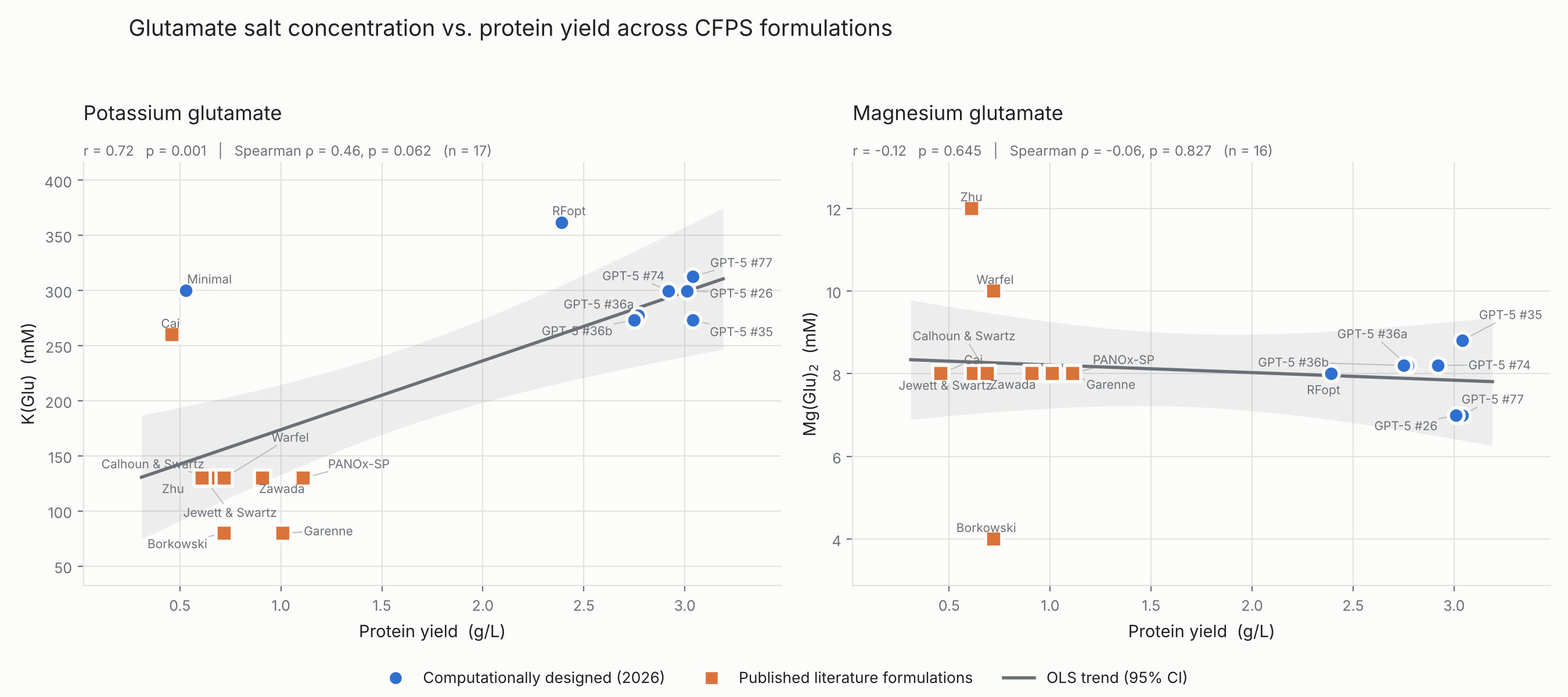
The graph shows that changes in Potassium ions correlates significantly with protein yield in the various CFPS formulations, whereas Magnesium ions concentration does not correlate with CFPS yield This shows that only potassium correlates with yield, which invalidated my hypothesis. This could be because
Explain how a PEP+NTP reaction formulation is different from a Ribose+NMP reaction formulation.
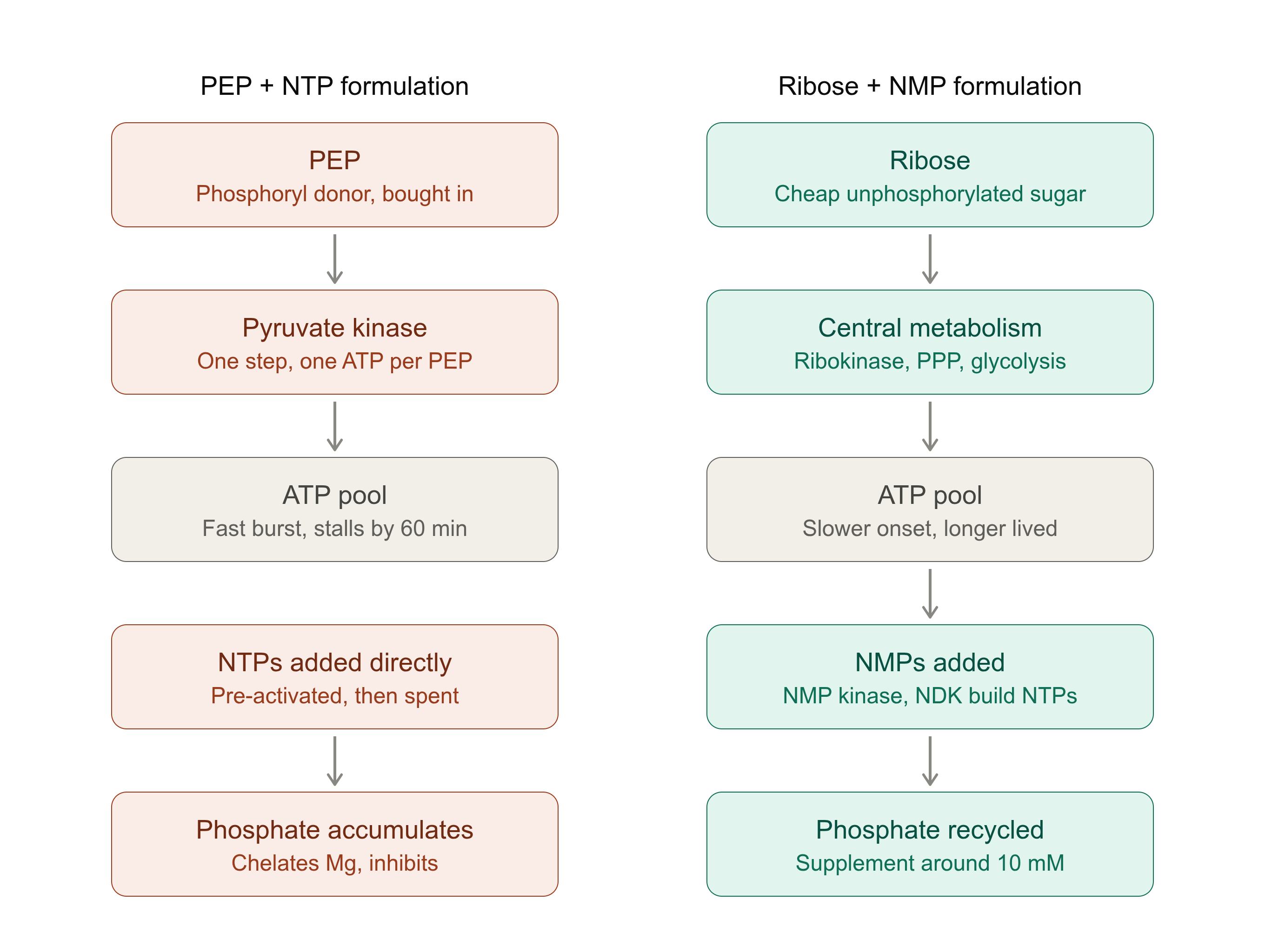
These two mainly differs in how the system regenerates its NTPs for mRNA synthesis and energy. PEP uses phospoenolpyruvate that is then broken down into pyruvate which then yield high levels of ATP quickly, since only one reaction step is needed to create pyruvate. However, PEP system leads to phospate accumulation and AMP as a byproduct which could potentially result in CFS yield inhibition. Ribose+NMP on the other hand, generates energy much more slowly, but more sustainably with ribose acting as a non phosporylated backbone for energy generation and NTP production. Here’s a diagram comparing the two systems.
Choose two cell-free reaction compositions from the literature, compare and contrast the choice of reagents and the concentration of reagents.
I will compare the earlier PANOx-SP and the optimized Rfopt formulation as described in the article by Olsen et al. 2026 as follows:
Table 1 (extract) — PANOx-SP vs RF_opt
Cell-free reagent formulations, from Olsen et al., Nat Commun 17, 3478 (2026). doi:10.1038/s41467-026-69605-8
| Parameter | PANOx-SP (Jewett & Swartz) | RF_opt (this work) |
|---|---|---|
| CFE cost ($reagent/g protein) | $4083 | $60 |
| Reagent cost ($/L_CFE) | $4535 | $143 |
| Yield determined in this work (g/L) | 1.11 ± 0.13 | 2.39 ± 0.28 |
| Reported yield (g/L) | 0.7 | — |
| Component | PANOx-SP | RF_opt |
|---|---|---|
| Mg(Glu)₂ | 8 | 8 |
| NH₄(Glu) | 10 | — |
| K(Glu) | 130 | 362 |
| Amino acids | 2 | 5 |
| Phosphate | — | 15 |
| Ribose | — | 50 |
| HEPES | 57 | 75 |
| Putrescine | 1 | — |
| Spermidine | 1.5 | 0.13 |
| Folinic acid | 0.03 | 2.05 |
| tRNA | 0.17 | — |
| CoA | 0.27 | — |
| NAD | 0.4 | — |
| PEP | 30 | — |
| Oxalic acid | 4 | — |
| ATP | 1.2 | — |
| CTP | 0.85 | — |
| GTP | 0.85 | — |
| UTP | 0.85 | — |
| AMP | — | 3 |
| CMP | — | 2.15 |
| GMP | — | 2.15 |
| UMP | — | 2.15 |
Units: all concentrations in mM, except folinic acid and tRNA (mg/mL). — indicates the component is absent from that formulation.
The starkest difference between the two formulation is of course the energy generation system used in both. The PANOx system uses a PEP-NTP system while the Rfopt uses a Ribose-NMP system. Furthermore, both differs in electrolytes used, PANOx uses ammonium glutamate, which RFopt has none of, and RFopt uses 3 times the amount of potassium glutamate compared to PANOx. Cofactors and coenzymes are also different between the two, as PANOx has more tRNA, CoA, and NAD, also putrescine; all of which are not present in RFopt. Spermidine on the otherhand is 10x more concentrated on PANOx compared to RFopt, while twice the amount of folinic acid is in RFopt compared to PANOXsp.
B. DESIGN ONE REACTION COMPOSITION FOR EACH OF THE THREE PROTEINS (40 minutes)
Sign in to coopetition.htgaa.org and publish your first unique 20 µL CFPS reaction composition for each of the following (don’t worry, you can resubmit later): For each composition, specify the reagents you would adjust from the relevant categories, including salts, energy sources, building blocks, cofactors, and redox components.
CFPS compositions — GPT-5 designs vs RF_opt
Exported from the HTGAA Cell-Free Reaction Designer (coopetition.htgaa.org/cfps). Blank = component absent from that formulation.
| Reagent | Unit | GPT-5 #77 | GPT-5 #26 | GPT-5 #35 | GPT-5 #74 | RF_opt (2026) |
|---|---|---|---|---|---|---|
| K(Glu) | mM | 200 | 200 | 200 | 200 | 200 |
| Mg(Glu)₂ | mM | 8.85 | 8.85 | 8.85 | 8.85 | 8.85 |
| Amino acids | mM | 4.1 | 3.2 | 4.8 | 4.8 | 5 |
| Tyrosine | mM | 4.1 | 3.2 | 1.2 | 1.2 | 5 |
| Cysteine | mM | 4 | 3.2 | 5 | 4 | 5 |
| HEPES pH 7.5 | mM | 45 | 50 | 67.5 | 75 | 75 |
| Phosphate (di:mono) | mM | 5.6 | 7.5 | 7.5 | 15 | 15 |
| Phosphate (mono:di) | mM | 5.6 | 7.5 | 7.5 | ||
| Glucose | mM | 6.9 | 8.3 | 8.3 | 10 | |
| Sodium pyruvate | mM | 9.1 | ||||
| Ribose | mM | 77.4 | 69.9 | 40 | 40 | 50 |
| Nicotinamide | mM | 3.1 | 4 | 4 | 4 | 4 |
| Spermidine | mM | 1.2 | 1.2 | |||
| Oxaloacetic acid | mM | 5 | ||||
| Adenosine | mM | 0.4 | ||||
| Guanine | mM | 0.2 | 0.6 | |||
| Catalase | U/mL | 187.5 | ||||
| AMP | mM | 0.6 | 0.8 | 0.5 | 1.5 | 3 |
| CMP | mM | 0.4 | 0.5 | 1 | 1 | 2.15 |
| GMP | mM | 0.5 | 1 | 2.15 | ||
| UMP | mM | 0.4 | 0.5 | 1 | 1 | 2.15 |
Rows absent from all five formulations (NH₄(Glu), PEP, 3-PGA, NTPs, tRNA, CoA, NAD, folinic acid, oxalate, putrescine, GSSG/GSH, DsbC, maltodextrin, and others) are omitted.
Each target protein’s .json file is as follows
sfGFP
{
  "sample_id": "farrel_alfaza_marsetyo_2026-10-06_0ztteo",
  "sample_type": "experimental",
  "reagent_list": {
    "amino_acid_mix_17": 1200,
    "amp": 100,
    "base_buffer": 2000,
    "cmp": 200,
    "coa": 100,
    "cysteine": 300,
    "folinic_acid": 50,
    "glucose": 150,
    "gmp": 200,
    "hepes_koh": 550,
    "kpo_dibasic_mix": 300,
    "lysate": 5000,
    "magnesium_glutamate": 250,
    "nad": 75,
    "nuclease_free_water": 4100,
    "ribose": 2250,
    "spermidine": 125,
    "template_sfgfp": 2000,
    "tyrosine": 825,
    "ump": 225
  },
  "metadata": {
    "ai_model": "",
    "protein_target": "sfGFP",
    "acknowledgements": "",
    "comments": ""
  }
}
For sfGFP I opted on using one of the GPT formulation as a basis, especially GPT #77 and #35 which has the highest yield. Compared to human-design RFopt, I noticed that the GPT designs often has a higher level of ribose and glucose and thus I incorporated that feature into this formulation. The GPT designs are also quite modest in terms of NMP, and thus I use that as a basis, while maximizing its amount, following the logic that higher concentrations means higher chance that a reaction will occur and higher yield.
PETase
{
  "sample_id": "farrel_alfaza_marsetyo_2026-10-06_psso1s",
  "sample_type": "experimental",
  "reagent_list": {
    "adenosine": 325,
    "amino_acid_mix_17": 1525,
    "amp": 100,
    "base_buffer": 2000,
    "catalase": 75,
    "cmp": 200,
    "cysteine": 400,
    "glucose": 150,
    "gmp": 200,
    "hepes_koh": 750,
    "kpo_dibasic_mix": 300,
    "kpo_monobasic_mix": 300,
    "lysate": 5000,
    "magnesium_glutamate": 250,
    "nicotinamide": 800,
    "nuclease_free_water": 3850,
    "ribose": 1200,
    "sodium_pyruvate": 200,
    "spermidine": 100,
    "template_petase": 2000,
    "tyrosine": 75,
    "ump": 200
  },
  "metadata": {
    "ai_model": "",
    "protein_target": "PETase",
    "acknowledgements": "",
    "comments": ""
  }
}
The PETase formulation was built on the same GPT #35 basis but optimised for PETase salt optima. As PETase only have a single sulfide bridge, I thought that not much adjustment is needed for the oxidizing part of the reagents.
Reteplase
{
  "sample_id": "farrel_alfaza_marsetyo_2026-10-06_81ag4u",
  "sample_type": "experimental",
  "reagent_list": {
    "adenosine": 325,
    "amino_acid_mix_17": 1525,
    "amp": 100,
    "base_buffer": 2000,
    "catalase": 75,
    "cmp": 200,
    "cysteine": 400,
    "dsbc_ecoli": 1000,
    "glucose": 150,
    "gmp": 200,
    "hepes_koh": 750,
    "kpo_dibasic_mix": 300,
    "kpo_monobasic_mix": 300,
    "lysate": 5000,
    "magnesium_glutamate": 225,
    "nicotinamide": 800,
    "nuclease_free_water": 2175,
    "oxidized_glutathione": 500,
    "reduced_glutathione": 200,
    "ribose": 1200,
    "sodium_pyruvate": 200,
    "spermidine": 100,
    "template_reteplase": 2000,
    "tyrosine": 75,
    "ump": 200
  },
  "metadata": {
    "ai_model": "",
    "protein_target": "Reteplase",
    "acknowledgements": "",
    "comments": ""
  }
}
The reteplase part is about adjusting the redox-related components. This includes the gluthationes and the catalases, which I matched to the reteplase ribose formulation. The rest of the formulation is identical to the GPT#35.