Week 2 HW: DNA Design
Part 0: Set up in Kernel
Repository: HTBAA26_Genspace
Folder: Flavoris Belue/Orange_Petunia
Part 1: Define your expression target
What molecule are you expressing?
I would like to express the enzyme dihydroflavonol-4-reductase (DFR), from the plant Gerbera hybrida (gdfr) to create an orange pigment in Petunia flowers. This enzyme uses NADPH to convert dihydrokaempferol into leucopelargonidin, an intermediate in the production of pelargonidin derived anthocyanins. I would rely on the petunia’s existing enzymes for the subsequent pigment producing steps. (Johnson et al., 2001)
What is the sequence?
I was able to find the DFR protein from Gerbera hybrida, originally described by Helariutta et al. (1993) under the following NCBI number:
- NCBI nucleotide accession: Z17221.1
What host or chassis?
I would use Petunia hybrida, specifically the W080 line, also called W80, from the University of Amsterdam germplasm collection. This line carries mutations affecting competing pigment pathways and its native floral DFR activity. Introducing gerbera gdfr would provide a DFR enzyme capable of using dihydrokaempferol. (Johnson et al., 2001)
Where does the product need to go?
The resulting anthocyanin pigments would ultimately need to accumulate in the vacuole to contribute to flower coloration. I would initially rely on the petunia’s existing pigment transport machinery for this step. The enzyme’s intended location and the pigments’ final storage location are therefore different. (Mueller et al., 2000)
Part 2: Design your genetic parts
| Part Type/Short Name | Sequence | Justification |
|---|---|---|
| Promoter + 5′ UTR — GB0030 | CaMV 35S regulatory module from GoldenBraid GB0030. | I chose this plant promoter and its included 5′ UTR as a constitutive starting point for expressing gdfr in petunia. |
| CDS — gerbera gdfr | Reference: NCBI Z17221.1. | This gene encodes the DFR enzyme that would help direct dihydrokaempferol toward pelargonidin-derived pigments. |
| 3′ UTR + terminator — GB0037 | NOS downstream regulatory module from GoldenBraid GB0037. | I chose this part to provide signals for transcript 3′ end processing, polyadenylation, and transcription termination. |
Part 3: Assemble your construct
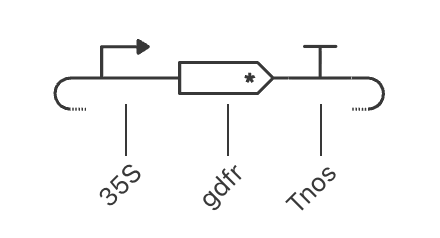
This design uses a CaMV 35S promoter to drive expression of the gerbera gdfr gene in Petunia hybrida, followed by a NOS terminator. The introduced DFR enzyme would work with the petunia’s existing pigment pathway to promote the production of pelargonidin-derived anthocyanins, with the goal of producing orange flowers.
Part 4: Optimize and quality-check
Codon-optimize your CDS for your chosen host.
For this homework, I selected brewer’s yeast (Saccharomyces cerevisiae) for codon optimization because Kernel did not offer a plant host. The optimization changed the DNA sequence to favor codons used by yeast while preserving the DFR amino acid sequence. Codon usage matters because different organisms use synonymous codons at different frequencies, which can affect translation efficiency and protein expression.
This was a demonstration of the optimization tool, not an optimization for petunia. For my actual experiment, I would retain the original gerbera gdfr coding sequence rather than use the yeast optimized version. I did not apply any additional constraints during optimization.
Search your sequence (BLAST / sequence search) against known sequences.
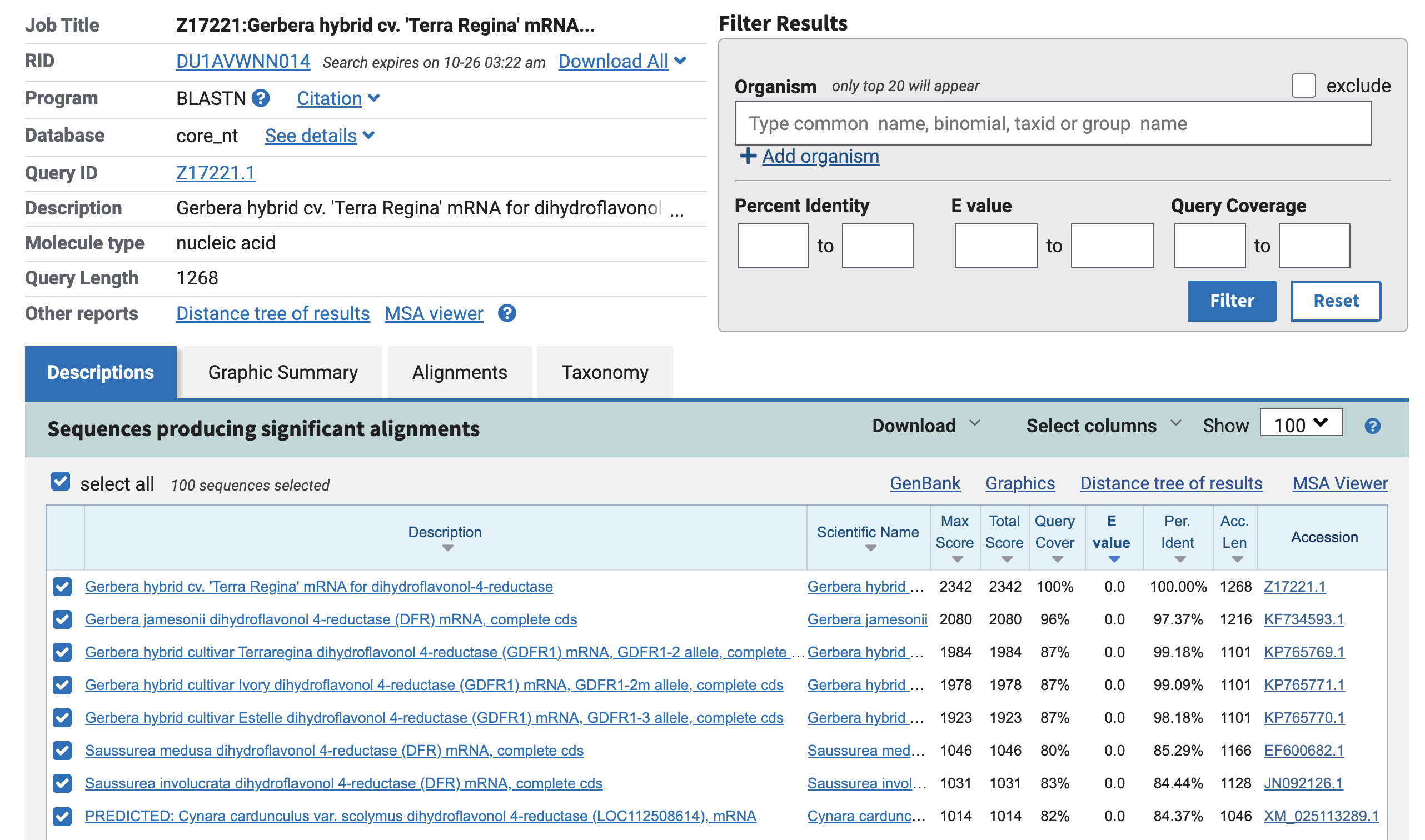
I used BLAST to search the native gerbera gdfr nucleotide sequence. The top match was the Gerbera hybrid cultivar ‘Terra Regina’ DFR mRNA, accession Z17221.1, with 100% query coverage and 100% nucleotide identity. Other leading matches were also gerbera DFR sequences, including a Gerbera jamesonii DFR mRNA.
These results are consistent with the gerbera DFR gene I intended to use. The exact match is expected because I used the original reference sequence.
Run the safety screen on your construct.
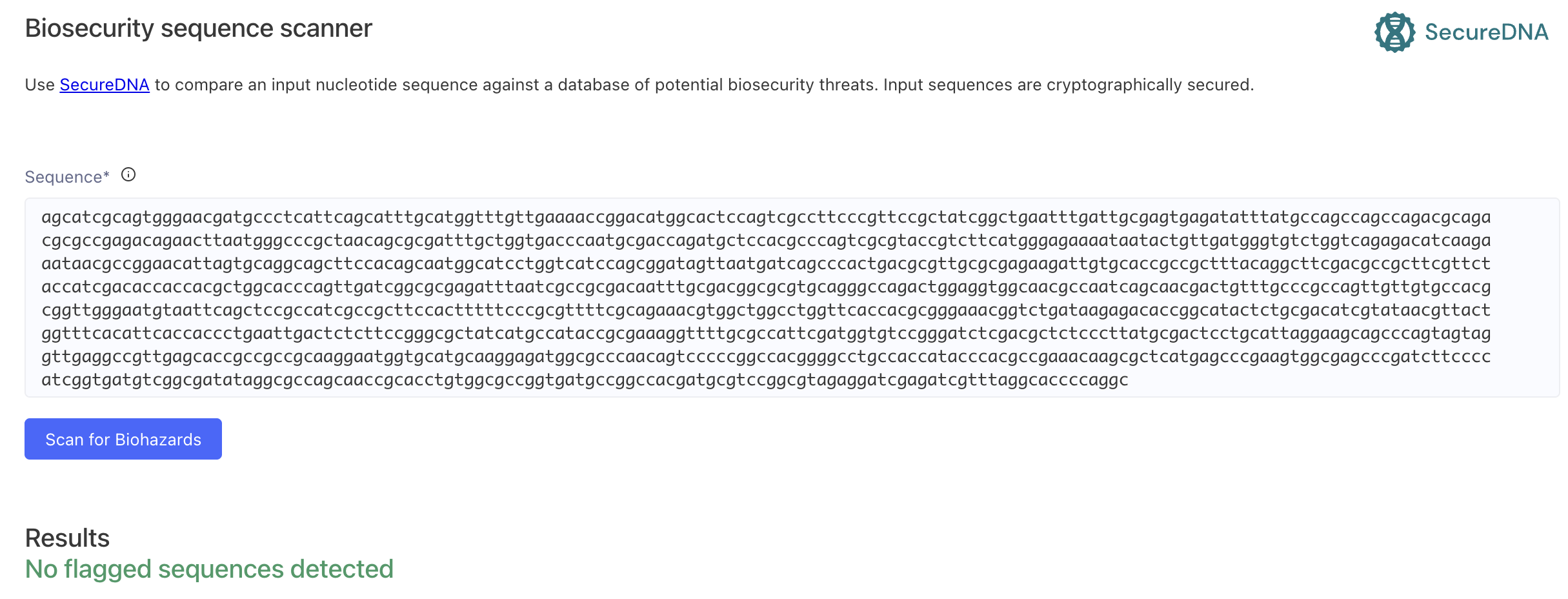
The safety screen compares the genetic construct against a database of sequences associated with potential biosecurity concerns. I ran the screen on my complete genetic construct, and the Biosecurity Sequence Scanner reported that no flagged sequences were detected.
Part 5: From design to build
How would you build it?
I would order the gerbera gdfr coding sequence, as a synthesized DNA fragment and prepare it as a GoldenBraid compatible part in the entry vector pUPD. Before ordering, I would check for internal restriction sites that could interfere with assembly and remove them through synonymous substitutions if necessary, without changing the DFR protein.
I would then use GoldenBraid to assemble the gdfr part with the existing GB0030 promoter + 5′ UTR and GB0037 3′ UTR + terminator directly into pDGB1_α1. GoldenBraid uses Type IIS restriction enzymes and DNA ligase to join standardized parts in a defined order. (Sarrion-Perdigones et al., 2013)
This approach fits my relatively simple, single gene construct because I only need to synthesize the coding sequence and can reuse existing regulatory parts and a destination plasmid. I would verify the assembled construct by sequencing before using it for plant transformation.
What does synthesis constrain?
I would only synthesize the gdfr coding sequence, rather than the entire plasmid, and reuse the existing GoldenBraid regulatory parts and backbone.
Synthesis could still introduce substitutions, insertions, or deletions that affect DFR function. If the supplier identified difficult regions, I could order smaller fragments and assemble the complete gene in pUPD before combining it with the promoter and terminator. Error correction methods can reduce synthesis errors, but they would not replace sequence verification. I would sequence the assembled coding region and its junctions before proceeding with plant transformation. (Carr et al., 2004)
Prototype vs. scale.
For the initial prototype, I would synthesize the gdfr coding sequence, assemble it with the regulatory parts using GoldenBraid, and sequence verify the construct. I would then use Agrobacterium mediated transformation to introduce it into petunia cells, regenerate plants, and check their flower pigmentation.
For larger scale production, I would propagate a successful, stable engineered line using cuttings rather than synthesize new DNA and transform each plant individually. The main scale up would therefore involve growing more orange flowering plants, not manufacturing more DNA. If additional transformation experiments were needed, I could amplify the verified plasmid in bacteria rather than order it again.
Part 6: What don’t you know yet?
One major unknown is whether the CaMV 35S promoter will produce enough gerbera DFR in petunia petals. I would measure gdfr RNA levels in several independently transformed lines and compare their flower pigmentation. If expression were consistently too low, I would test a different promoter, potentially one active specifically in petals.
Another unknown is whether the introduced DFR will function effectively with the W080 line’s existing pigment pathway. Gene expression alone would not guarantee orange flowers. I would measure DFR activity and analyze the flower pigments to determine whether pelargonidin-derived anthocyanins were being produced, using unmodified W080 plants as a control. If expression were present but pigment production remained low, I would investigate substrate availability and the remaining pathway steps.
A third concern is whether expression and flower coloration will remain stable. I would monitor pigmentation across flowering cycles and plants propagated from cuttings. If pigmentation declined, I would check whether the transgene was still present and whether its expression had decreased. This would help me select a stable line for further propagation.
Sources:
Carr, P. A. et al. Protein-mediated error correction for de novo DNA synthesis. Nucleic Acids Research 32, e162 (2004). https://doi.org/10.1093/nar/gnh160
Helariutta, Y. et al. Cloning of cDNA coding for dihydroflavonol-4-reductase (DFR) and characterization of dfr expression in the corollas of Gerbera hybrida var. Regina (Compositae). Plant Molecular Biology 22, 183–193 (1993). https://doi.org/10.1007/BF00014927
Johnson, E. T. et al. Alteration of a single amino acid changes the substrate specificity of dihydroflavonol 4-reductase. The Plant Journal 25, 325–333 (2001). https://doi.org/10.1046/j.1365-313x.2001.00962.x
Mueller, L. A. et al. AN9, a petunia glutathione S-transferase required for anthocyanin sequestration, is a flavonoid-binding protein. Plant Physiology 123, 1561–1570 (2000). https://doi.org/10.1104/pp.123.4.1561
Sarrion-Perdigones, A. et al. GoldenBraid 2.0: A comprehensive DNA assembly framework for plant synthetic biology. Plant Physiology 162, 1618–1631 (2013). https://doi.org/10.1104/pp.113.217661