Week 2 HW: DNA Design
Part 0: Set up in Kernel
Repository: HTBAA26_Genspace
Folder: Flavoris Belue
Part 1: Define your expression target
What molecule are you expressing?
I am looking to express the terpene limonene. The following proteins are involved in the metabolic pathway needed for the production of limonene from acetyl-CoA:
- atoB — Acetyl-CoA acetyltransferase Converts acetyl-CoA into acetoacetyl-CoA
- HMGS — HMG-CoA synthase Converts acetoacetyl-CoA to HMG-CoA
- HMGR — HMG-CoA reductase Converts HMG-CoA to mevalonate. In this system, an N-terminally truncated HMGR is used
- MK — mevalonate kinase Phosphorylates mevalonate
- PMK — phosphomevalonate kinase Carries out the next phosphorylation step in the mevalonate pathway
- PMD — Diphosphomevalonate decarboxylase Produces the isoprenoid precursor IPP
- idi — isopentenyl diphosphate isomerase Interconverts IPP and DMAPP so both precursor pools are available
- trGPPS — truncated geranyl pyrophosphate synthase Combines IPP and DMAPP to produce GPP, the direct precursor to limonene. The construct uses a truncated, codon-optimized version
- LS — limonene synthase Converts GPP into (S)-limonene. The system uses a truncated, codon-optimized Mentha spicata enzyme lacking its plastid targeting sequence
What is the sequence?
Any mutations or truncated proteins differing from the wild-type are based on the pJBEI-6410 system that produced limonene in E. coli (Alonso-Gutierrez et al.). NCBI or UniProt Accession numbers are provided for the wild-type variants of the proteins listed, with any truncation or mutations mentioned with their associated protein.
- atoB - UniProt Accession #: P76461
- HMGS - NCBI Accession #: AAG02422.1
- HMGR - NCBI Accession #: AAG02423.1
- MK - NCBI Accession #: NP_013935.1 (protein used contains the R364S mutation)
- PMK - NCBI Accession #: NP_013947.1
- PMD - NCBI Accession #: NP_014441.1
- idi - NCBI Accession #: NP_417365.1
- trGPPS - NCBI Accession #: AAN01134.1 (truncated, removes the first 84 aa, the plastid-targeting N terminus.)
- LS - NCBI Accession #: AAC37366.1 (truncated, without the plastidial targeting sequence (no plastids in E. coli), the first 57 amino acids at the N terminus are removed.)
What host or chassis?
Escherichia coli
Where does the product need to go?
Cytoplasm. Limonene synthase and the rest of the metabolic pathway can operate intracellularly.
Part 2: Design your genetic parts
| Part Type/Short Name | Sequence | Justification |
|---|---|---|
| Promoter - BBa_K3257005 (LacUV5)(iGem) | tttacactttatgcttccggctcgtataatg | This promoter contains LacI/lac-operator regulation, and allows IPTG control of precursor supply for limonene production. |
| RBS - atoB (Alonso-Gutierrez et al.) | aggaggaatataaa | This RBS supports translation initiation of atoB by E. coli ribosomes, enabling the first enzymatic step in the introduced pathway supplying limonene precursors. |
| CDS - atoB (Alonso-Gutierrez et al.) | MKNCVIVSAVRTAIGSFNGSLASTSAIDLGATVIKAAIERAKIDSQHVDEVIMGNVLQAGLGQNPARQALLKSGLAETVCGFTVNKVCGSGLKSVALAAQAIQAGQAQSIVAGGMENMSLAPYLLDAKARSGYRLGDGQVYDVILRDGLMCATHGYHMGITAENVAKEYGITREMQDELALHSQRKAAAAIESGAFTAEIVPVNVVTRKKTFVFSQDEFPKANSTAEALGALRPAFDKAGTVTAGNASGINDGAAALVIMEESAALAAGLTPLARIKSYASGGVPPALMGMGPVPATQKALQLAGLQLADIDLIEANEAFAAQFLAVGKNLGFDSEKVNVNGGAIALGHPIGASGARILVTLLHAMQARDKTLGLATLCIGGGQGIAMVIERLN* | This CDS initiates the introduced mevalonate pathway for limonene production. |
| RBS - HMGS (Alonso-Gutierrez et al.) | aggagaaacctt | This RBS supports translation initiation of HMGS in E. coli |
| CDS - HMGS (Alonso-Gutierrez et al.) | MTIGIDKINFYVPKYYVDMAKLAEARQVDPNKFLIGIGQTEMAVSPVNQDIVSMGANAAKDIITDEDKKKIGMVIVATESAVDAAKAAAVQIHNLLGIQPFARCFEMKEACYAATPAIQLAKDYLATRPNEKVLVIATDTARYGLNSGGEPTQGAGAVAMVIAHNPSILALNEDAVAYTEDVYDFWRPTGHKYPLVDGALSKDAYIRSFQQSWNEYAKRQGKSLADFASLCFHVPFTKMGKKALESIIDNADETTQERLRSGYEDAVDYNRYVGNIYTGSLYLSLISLLENRDLQAGETIGLFSYGSGSVGEFYSATLVEGYKDHLDQAAHKALLNNRTEVSVDAYETFFKRFDDVEFDEEQDAVHEDRHIFYLSNIENNVREYHRPE* | This CDS advances the mevalonate pathway that supplies limonene precursors. |
| RBS - HMGR (Alonso-Gutierrez et al.) | aggaaacagacc | This RBS supports translation initiation of HMGR in E. coli, allowing production of the enzyme that generates mevalonate for limonene biosynthesis. |
| CDS - HMGR (Alonso-Gutierrez et al.) | MSMQSLDKNFRHLSRKEKLQQLVDKQWLSEEQFDILLNHPLIDEEVANSLIENVIAQGALPVGLLPNIIVDDKAYVVPMMVEEPSVVAAASYGAKLVNQTGGFKTVSSERIMIGQIVFDGVDDTEKLSADIKALEKQIHKIADEAYPSIKARGGGYQRIAIDTFPEQQLLSLKVFVDTKDAMGANMLNTILEAITAFLKNEFPQSDILMSILSNHATASVVKVQGEIDVKDLARGERTGEEVAKRMERASVLAQVDIHRAATHNKGVMNGIHAVVLATGNDTRGAEASAHAYASRDGQYRGIATWRYDQDRQRLIGTIEVPMTLAIVGGGTKVLPIAKASLELLNVESAQELGHVVAAVGLAQNFAACRALVSEGIQQGHMSLQYKSLAIVVGAKGDEIAKVAEALKKEPRANTQAAEHILQEIRQQ* | This CDS supplies the substrate for downstream production of limonene precursors. |
| Terminator - BBa_K4291014 (iGem) | caaataaaacgaaaggctcagtcgaaagactgggcctttcgttttatctgttgtttgtcggtgaacgctctc | This terminator promotes termination of the transcript in E. coli. |
| Promoter - BBa_K4047032 (iGem) | ttgacaattaatcatccggctcgtataatg | The trc promoter drives expression of MK, PMK, PMD, and idi in E. coli, with LacI/lac operator regulation allowing IPTG control of limonene precursor production. |
| RBS - MK (Alonso-Gutierrez et al.) | aggaggaaataacc | This RBS supports translation of MK in E. coli, enabling the first phosphorylation step that converts mevalonate toward limonene precursors. |
| CDS - MK (Alonso-Gutierrez et al.) | MSLPFLTSAPGKVIIFGEHSAVYNKPAVAASVSALRTYLLISESSAPDTIELDFPDISFNHKWSINDFNAITEDQVNSQKLAKAQQATDGLSQELVSLLDPLLAQLSESFHYHAAFCFLYMFVCLCPHAKNIKFSLKSTLPIGAGLGSSASISVSLALAMAYLGGLIGSNDLEKLSENDKHIVNQWAFIGEKCIHGTPSGIDNAVATYGNALLFEKDSHNGTINTNNFKFLDDFPAIPMILTYTRIPRSTKDLVARVRVLVTEKFPEVMKPILDAMGECALQGLEIMTKLSKCKGTDDEAVETNNELYEQLLELIRINHGLLVSIGVSHPGLELIKNLSDDLRIGSTKLTGAGGGGCSLTLLRSDITQEQIDSFKKKLQDDFSYETFETDLGGTGCCLLSAKNLNKDLKIKSLVFQLFENKTTTKQQIDDLLLPGNTNLPWTS* | This CDS encodes an enzyme that phosphorylates mevalonate the mevalonate-5-phosphate in E. coli. |
| RBS - PMK (Alonso-Gutierrez et al.) | aggagggagatcat | This RBS supports translation initiation of PMK in E. coli, enabling the second phosphorylation step needed to produce limonene precursors. |
| CDS - PMK (Alonso-Gutierrez et al.) | MSELRAFSAPGKALLAGGYLVLDTKYEAFVVGLSARMHAVAHPYGSLQGSDKFEVRVKSKQFKDGEWLYHISPKSGFIPVSIGGSKNPFIEKVIANVFSYFKPNMDDYCNRNLFVIDIFSDDAYHSQEDSVTEHRGNRRLSFHSHRIEEVPKTGLGSSAGLVTVLTTALASFFVSDLENNVDKYREVIHNLAQVAHCQAQGKIGSGFDVAAAAYGSIRYRRFPPALISNLPDIGSATYGSKLAHLVDEEDWNITIKSNHLPSGLTLWMGDIKNGSETVKLVQKVKNWYDSHMPESLKIYTELDHANSRFMDGLSKLDRLHETHDDYSDQIFESLERNDCTCQKYPEITEVRDAVATIRRSFRKITKESGADIEPPVQTSLLDDCQTLKGVLTCLIPGAGGYDAIAVITKQDVDLRAQTANDKRFSKVQWLDVTQADWGVRKEKDPETYLDK* | This CDS enables E. coli to convert mevalonate-5-phosphate into mevalonate-5-diphosphate, supplying the substrate for IPP formation in the limonene pathway. |
| RBS - PMD (Alonso-Gutierrez et al.) | aggaggattatgag | This RBS supports translation initiation of PMD in E. coli, allowing production of the enzyme that generates IPP for limonene biosynthesis. |
| CDS - PMD (Alonso-Gutierrez et al.) | MTVYTASVTAPVNIATLKYWGKRDTKLNLPTNSSISVTLSQDDLRTLTSAATAPEFERDTLWLNGEPHSIDNERTQNCLRDLRQLRKEMESKDASLPTLSQWKLHIVSENNFPTAAGLASSAAGFAALVSAIAKLYQLPQSTSEISRIARKGSGSACRSLFGGYVAWEMGKAEDGHDSMAVQIADSSDWPQMKACVLVVSDIKKDVSSTQGMQLTVATSELFKERIEHVVPKRFEVMRKAIVEKDFATFAKETMMDSNSFHATCLDSFPPIFYMNDTSKRIISWCHTINQFYGETIVAYTFDAGPNAVLYYLAENESKLFAFIYKLFGSVPGWDKKFTTEQLEAFNHQFESSNFTARELDLELQKDVARVILTQVGSGPQETNESLIDAKTGLPKE* | This CDS encodes diphosphomevalonate decarboxylase, which converts mevalonate-5-diphosphate into IPP in E. coli to supply a building block for limonene. |
| RBS - idi (Alonso-Gutierrez et al.) | aggaggtaatgata | This RBS supports translation initiation of idi in E. coli, enabling production of the enzyme that interconverts the IPP and DMAPP precursors needed for limonene synthesis. |
| CDS - idi (Alonso-Gutierrez et al.) | MQTEHVILLNAQGVPTGTLEKYAAHTADTRLHLAFSSWLFNAKGQLLVTRRALSKKAWPGVWTNSVCGHPQLGESNEDAVIRRCRYELGVEITPPESIYPDFRYRATDPSGIVENEVCPVFAARTTSALQINDDEVMDYQWCDLADVLHGIDATPWAFSPWMVMQATNREARKRLSAFTQLK* | This CDS encodes an isomerase that interconverts IPP and DMAPP, helping provide both substrates required to make the GPP precursor of limonene. |
| Terminator - BBa_K3228006 (iGem) | cgcaaaaaaccccgcttcggcggggttttttcgc | This terminator promotes termination of the transcript in E. coli. |
| Promoter - BBa_K4047032 (iGem) | ttgacaattaatcatccggctcgtataatg | This trc promoter drives trGPPS and limonene synthase expression in E. coli, with LacI/lac operator regulation allowing IPTG control of the final steps in limonene biosynthesis. |
| RBS - BBa_M50062 (iGem) | aggagatatacat | This RBS supports translation initiation of trGPPS in E. coli, enabling production of the enzyme that supplies GPP directly to limonene synthase. |
| CDS - trGPPS (Alonso-Gutierrez et al.) | MEFDFNKYMDSKAMTVNEALNKAIPLRYPQKIYESMRYSLLAGGKRVRPVLCIAACELVGGTEELAIPTACAIEMIHTMSLMHDDLPCIDNDDLRRGKPTNHKIFGEDTAVTAGNALHSYAFEHIAVSTSKTVGADRILRMVSELGRATGSEGVMGGQMVDIASEGDPSIDLQTLEWIHIHKTAMLLECSVVCGAIIGGASEIVIERARRYARCVGLLFQVVDDILDVTKSSDELGKTAGKDLISDKATYPKLMGLEKAKEFSDELLNRAKGELSCFDPVKAAPLLGLADYVAFRQN* | This CDS lacks the plant targeting sequence and encodes the enzyme that converts GPP into the target product, limonene, in the E. coli cytoplasm. |
| RBS - BBa_K737020 (iGem) | aggagatatac | This RBS supports translation initiation of limonene synthase in E. coli, enabling production of the enzyme that converts GPP into the target product. |
| CDS - BBa_K3052001 (iGem) | MRRSGNYNPSRWDVNFIQSLLSDYKEDKHVIRASELVTLVKMELEKETDQIRQLELIDDLQRMGLSDHFQNEFKEILSSIYLDHHYYKNPFPKEERDLYSTSLAFRLLREHGFQVAQEVFDSFKNEEGEFKESLSDDTRGLLQLYEASFLLTEGETTLESAREFATKFLEEKVNEGGVDGDLLTRIAYSLDIPLHWRIKRPNAPVWIEWYRKRPDMNPVVLELAILDLNIVQAQFQEELKESFRWWRNTGFVEKLPFARDRLVECYFWNTGIIEPRQHASARIMMGKVNALITVIDDIYDVYGTLEELEQFTDLIRRWDINSIDQLPDYMQLCFLALNNFVDDTSYDVMKEKGVNVIPYLRQSWVDLADKYMVEARWFYGGHKPSLEEYLENSWQSISGPCMLTHIFFRVTDSFTKETVDSLYKYHDLVRWSSFVLRLADDLGTSVEEVSRGDVPKSLQCYMSDYNASEAEARKHVKWLIAEVWKKMNAERVSKDSPFGKDFIGCAVDLGRMAQLMYHNGDGHGTQHPIIHQQMTRTLFAPFA* | This CDS lacks the plant targeting sequence and encodes the enzyme that converts GPP into the target product, limonene, in the E. coli cytoplasm. |
| Terminator - pBbA5a double terminator (Alonso-Gutierrez et al.) | caaataaaacgaaaggctcagtcgaaagactgggcctttcgttttatctgttgtttgtcggtgaacgctctctactagagtcacactggctcaccttcgggtgggcctttctgcg | This double terminator combines rrnB T1 and T7Te to promote transcription termination after limonene synthase in E. coli. |
| Backbone - pBbA5a (Alonso-Gutierrez et al.) | Full backbone sequence available upon request | This backbone provides a p15A replication origin, ampicillin resistance, and LacI, supporting plasmid maintenance, selection, and regulated expression of the limonene pathway in E. coli. |
Part 3: Assemble your construct

This design contains the complete metabolic pathway required to produce limonene from acetyl-CoA in E. coli. The construct includes the mevalonate pathway enzymes to generate the isoprenoid precursors IPP and DMAPP, followed by GPPS to produce GPP and limonene synthase to convert GPP into limonene.
Part 4: Optimize and quality-check
Codon-optimize your CDS for your chosen host.
The nucleotide sequence of the gene changed after codon optimization, while the amino acid sequence remained the same. Codon usage matters for expression in E. coli because several of the genes used in the limonene production pathway are not native to E. coli. Different organisms preferentially use certain codons more frequently than others, so codon optimization can improve translation efficiency and protein expression in the chosen host. I did not apply any additional constraints during codon optimization.
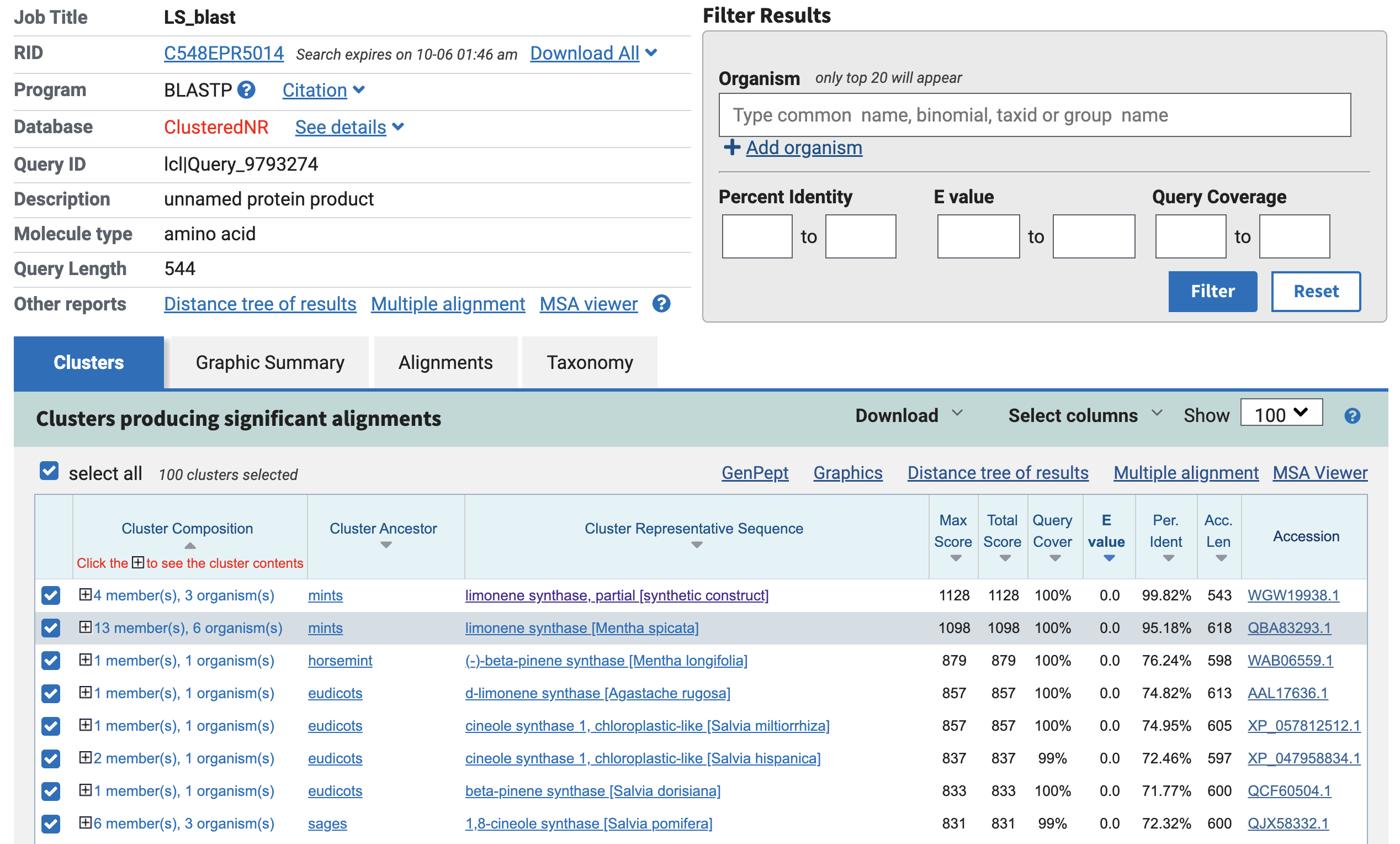
Search your sequence (BLAST / sequence search) against known sequences.
I chose to perform BLAST using the limonene synthase amino acid sequence because I did not obtain useful results when searching with the DNA sequence. This may be because the DNA sequence in my construct is both truncated and codon optimized for expression in E. coli, making it less similar at the nucleotide level to the native Mentha spicata gene. The amino acid sequence, however, is largely preserved despite the DNA sequence changes.
The top BLAST result was limonene synthase from a synthetic partial construct, which is consistent with the truncated limonene synthase used in my genetic construct. The next closest result was the wild-type limonene synthase from Mentha spicata, the organism from which the enzyme was originally derived. Based on these results, the sequence matches the protein I expected it to be.
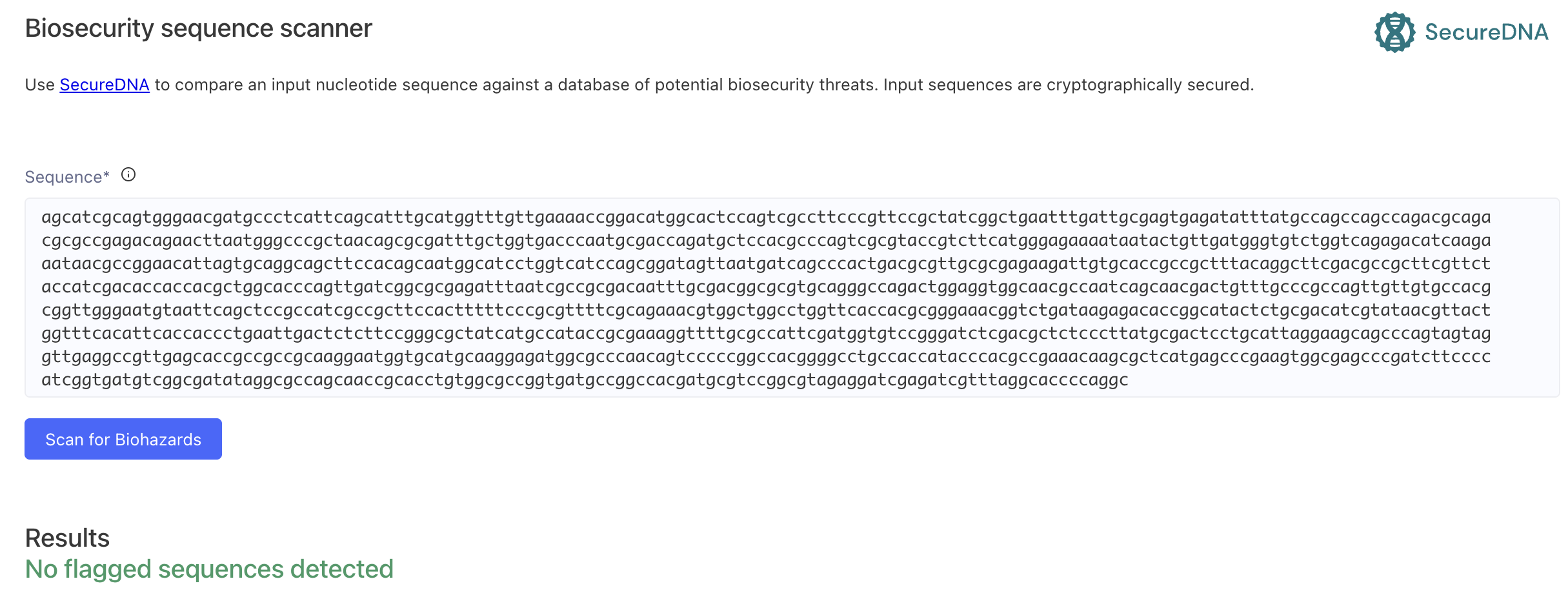
Run the safety screen on your construct.
The safety screen compares the genetic construct against a database of sequences associated with potential biosecurity concerns. I ran the screen on my complete genetic construct, and the Biosecurity Sequence Scanner reported that no flagged sequences were detected. Based on this result, none of the sequences in my construct were identified as potential biosecurity threats.
Part 5: From design to build
How would you build it?
Because the complete pJBEI-6410 plasmid already exists, I would most likely obtain the full plasmid directly rather than rebuild it from scratch. However, if I needed to build the construct myself, I would order the pathway as several synthetic DNA fragments and assemble them into the plasmid backbone using Gibson assembly. Synthetic DNA would allow me to specify the exact engineered sequences needed, including codon optimization for E. coli and the truncated versions of proteins such as GPPS and limonene synthase. Gibson assembly would be useful for this relatively large multigene construct because it allows several overlapping DNA fragments to be assembled seamlessly in a single reaction (Gibson et al., 2009).
What does synthesis constrain?
One concern with synthesizing a construct of this size is the possibility of errors being introduced during DNA synthesis. The construct also contains repeated regulatory elements, such as promoters and similar RBS sequences, which could make some regions more difficult to synthesize or assemble correctly. I would therefore order the construct as smaller fragments rather than attempting to synthesize the entire plasmid as one piece. Each fragment could be sequence verified before or after assembly, and error correction methods could also be used if necessary. Carr et al. demonstrated that error correction can substantially decrease the frequency of errors in de novo synthesized DNA, which becomes increasingly important as the length of the DNA being synthesized increases (Carr et al., 2004).
Prototype vs. scale.
For the initial prototype, I would either obtain the existing pJBEI-6410 plasmid or assemble one verified construct from synthetic DNA fragments and transform it into E. coli for testing. At manufacturing scale, I would not need to continuously synthesize new copies of the plasmid. Once a correct construct and production strain were established, the verified strain could be expanded for fermentation. If I were instead screening many different pathway variants during optimization, pooled or chip based DNA synthesis could be useful because it allows many different sequences to be produced and tested in parallel (Kosuri et al., 2010).
Part 6: What don’t you know yet?
One major unknown is whether all of the pathway enzymes will be expressed at the correct levels. Even though the promoters and RBSs come from a published construct, the pathway may still become unbalanced if one enzyme is expressed too strongly or too weakly. I would test this by measuring limonene production and pathway intermediates, then compare design variants with different promoter or RBS strengths if necessary.
Another unknown is whether all of the heterologous proteins, especially GPPS and limonene synthase, will fold correctly and remain active in E. coli. Codon optimization can improve expression, but it does not guarantee that the proteins will be soluble or functional. I would test this by measuring protein expression and solubility and by measuring limonene production as a functional readout of the pathway.
A third concern is whether carrying and expressing such a large multigene plasmid will create too much metabolic burden or become unstable in E. coli. I would monitor growth rate, plasmid retention, and limonene production over multiple generations. If stability or growth became a problem, I could reduce expression levels, divide the pathway between multiple plasmids, or consider integrating some of the genes into the chromosome.
Sources:
Alonso-Gutierrez, J. et al. Metabolic engineering of Escherichia coli for limonene and perillyl alcohol production. Metabolic Engineering 19, 33–41 (2013). https://doi.org/10.1016/j.ymben.2013.05.004
Carr, P. A. et al. Protein-mediated error correction for de novo DNA synthesis. Nucleic Acids Research 32, e162 (2004). https://doi.org/10.1093/nar/gnh160
Gibson, D. G. et al. Enzymatic assembly of DNA molecules up to several hundred kilobases. Nature Methods 6, 343–345 (2009). https://doi.org/10.1038/nmeth.1318