Week 4 LAB: Cell-Free Manufacturing
DESIGN A BATCH OF CELL-FREE REACTION COMPOSITIONS
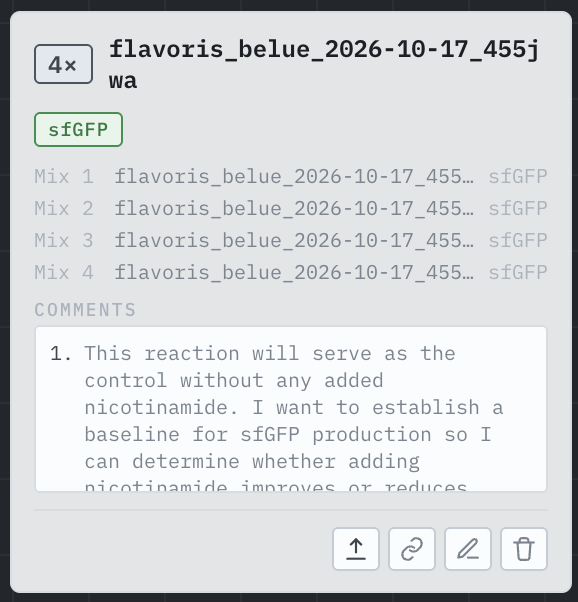
I hypothesize that changing the concentration of nicotinamide will affect sfGFP production in cell-free reactions. Since nicotinamide is involved in NAD metabolism, I want to investigate whether increasing its concentration can improve protein production by supporting energy regeneration and metabolic activity in the cell lysate. I will compare four different nicotinamide concentrations (0, 1.25, 3.125, and 5 mM) while keeping all other reagents constant to determine which concentration produces the highest sfGFP yield.
RESEARCH TEAM DISCUSSION, DATA ANALYSIS, METASCIENCE
1. Research Team Discussion:
Current Status of CFPS Optimization Ideas
For my CFPS optimization experiments, I have developed two different batches investigating ways to improve protein production and reduce reagent costs.
Batch 1:
My first batch focused on whether CFPS reaction costs could be reduced by adjusting the energy system, nucleotide sources, and folding supplements based on the requirements of different proteins. I designed three reactions targeting sfGFP, PETase, and Reteplase.
For sfGFP, I used a lower cost energy system containing ribose, glucose, and nucleotide monophosphates (NMPs) instead of PEP and added nucleotide triphosphates (NTPs). Since sfGFP does not require disulfide bonds, I also excluded unnecessary folding supplements. My goal was to determine whether this simpler formulation could maintain fluorescence while reducing reagent costs.
For PETase, I used the same low cost energy system but included a reduced concentration of DsbC (2.5 µM) to investigate whether I could lower folding related costs while maintaining enzyme activity.
For Reteplase, I took a different approach because the protein requires nine correctly paired disulfide bonds. I retained PEP, oxidizing lysate, glutathione, and the full concentration of DsbC to support proper folding. Instead, I partially replaced CTP, GTP, and UTP with their corresponding NMPs to investigate whether nucleotide costs could be reduced without significantly affecting enzyme activity.
The goal of this batch is to determine whether reagent cost savings outweigh any reduction in functional protein yield. These experiments test different cost saving strategies rather than isolating individual reagent effects.
Batch 2:
My second batch focuses on investigating how nicotinamide concentration affects sfGFP production. Since nicotinamide is involved in NAD metabolism, I wanted to explore whether supplementing CFPS reactions with different concentrations could improve protein production by supporting metabolic activity and energy regeneration.
I designed four reactions containing 0, 1.25, 3.125, and 5 mM nicotinamide. I also reduced PEP from 30 mM to 25 mM across all four reactions to allow enough volume for the higher nicotinamide concentrations. All other reagents remain constant.
Unlike my first batch, this experiment focuses on changing a single reagent concentration to better understand its effect on protein production.
Data Analysis:
The “sfGFP_control_20260722-39-L_96w_report.pdf” report shows that sfGFP production was significantly higher in the 96 well deep well plates compared to the 384 well plates. The deep well plates also showed better reproducibility. I think one possible explanation is better oxygen availability in the deep well plates, which could support energy regeneration and metabolic activity. Evaporation could also play a role by increasing reagent concentrations during incubation. Interestingly, the best performing formulations differed between the two formats, suggesting that reaction conditions can significantly influence CFPS performance. However, the experiments used different reaction volumes (20 µL versus 40 µL), so further testing would be needed to determine which factors caused these differences.
Metascience:
I think one important criteria should be how much useful information an experiment could provide, regardless of whether the hypothesis turns out to be correct. Since we have a limited number of experimental wells, I would prioritize experiments that help us better understand how different reagents affect CFPS performance and provide useful data for designing future experiments.
AGENTIC CONTRIBUTION
I used an AI agent to design and submit a small CFPS batch through the coopetition website. After reviewing the approved reagents and existing submissions, the agent prepared three sfGFP reactions with 0, 0.25, and 0.5 mM added ATP. AMP was reduced so that ATP plus AMP stayed at 3 mM, while all other reagent volumes remained the same. The agent wanted to see whether a small ATP supplement could improve protein production enough to justify its cost. The batch included my earlier formulation as a comparison and two new variants. All three passed dry run validation by the agent and were submitted after I approved them. I think this was a useful example of using AI to turn a scientific question into a validated experimental design, while I still guided the question and approved the submission.