Week 6 LAB: Microfluidic Manufacturing
Part 1- Explore non model organisms
Identify a non-model organism that naturally produces your target product.
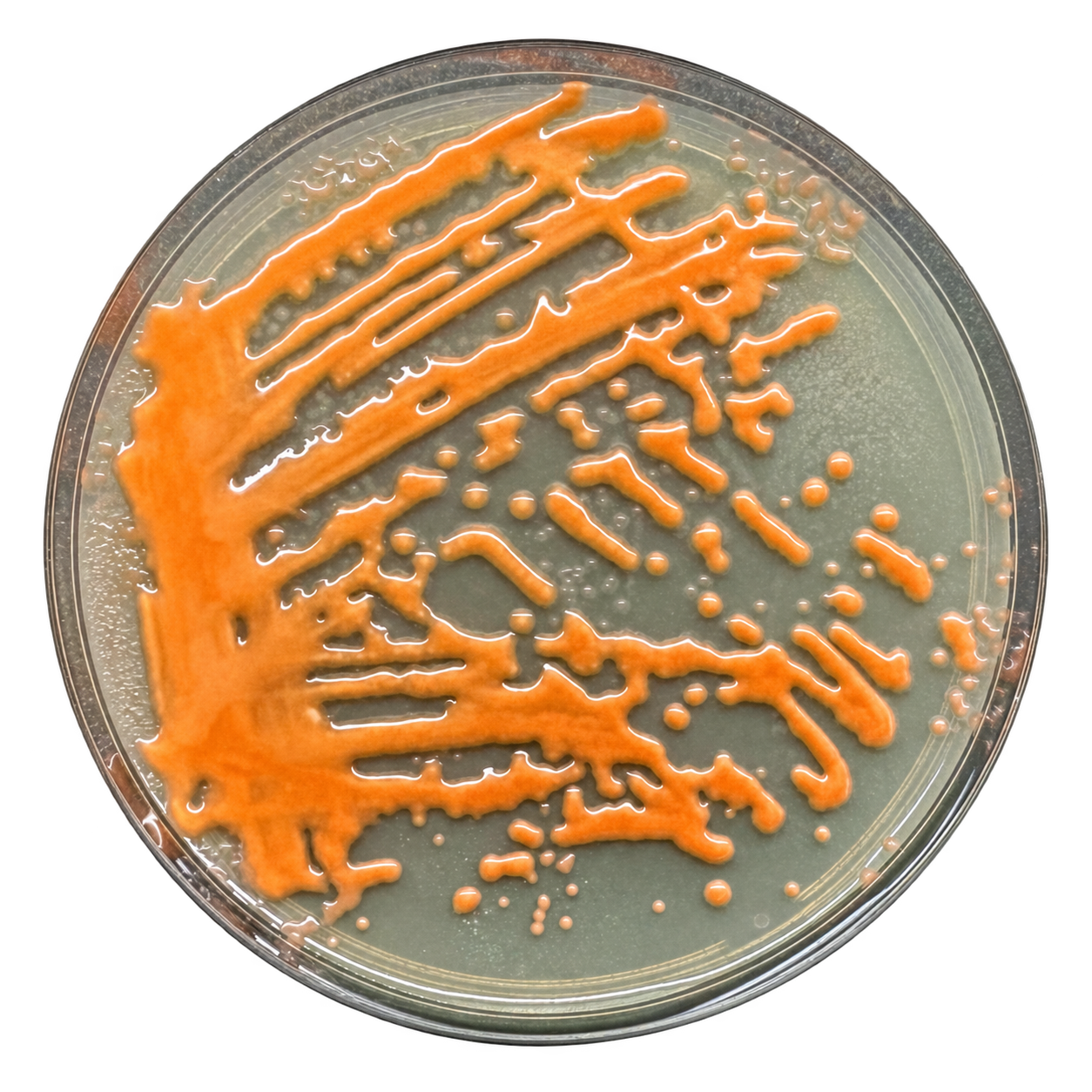
I chose Sporobolomyces salmonicolor, a non-model yeast that naturally produces orange and red carotenoid pigments, including β-carotene, torulene, and torularhodin. I identified this organism by searching for dihydroflavonol 4-reductase (DFR) using the Cultivarium MicroScopus search tool. One of the papers associated with this organism described an aldehyde reductase (ARII) that shares approximately 30–34% amino acid sequence identity with plant DFR enzymes (Kita et al., 1999). Although this enzyme has not been shown to have DFR activity, I thought this organism was interesting because of its connection to the DFR enzyme family and its ability to naturally produce colored pigments. While these pigments are different from the pelargonidin I want to produce in my petunias, I think this organism could be useful for exploring alternative pigment biosynthesis pathways and potentially identifying enzymes with related functions.
Examine what types of information are readily available for a specific strain.
| Category | Data |
|---|---|
| Species Name | Sporobolomyces salmonicolor (also listed as Sporidiobolus salmonicolor, Aessosporon salmonicolor, & Blastoderma salmonicolor) |
| Strain Name | Sporobolomyces salmonicolor CBS 490 |
| Link | https://portal.cultivarium.org/species/5005?strain_id=ATCC36400&view=strain |
| Growth Media and Temperature | |
| Susceptible antibiotics, and MIC90 | |
| Functional ORIs | |
| Genome size | |
| Number of publications listed |
The Reported Methods section lists the genetic methods found in literature for that species.
According to the Cultivarium Portal, there is one reported genetic method available for S. salmonicolor, which is classified as a transformation. The method comes from a single publication by Jing K. et al. (2005), making 2005 both the oldest and newest year of reported genetic research listed in the portal.

Part 2- Explore neighbor strains
For your species identified in Part 1, identify the nearest neighbor strain with available information to fill out the missing details.
| Neighbor Species | Related level (e.g., genus, family) | Category | Data |
|---|---|---|---|
| Moesziomyces aphidis | Phylum | Growth Media and Temperature | Potato Dextrose Broth (PDB), 30C |
| Yarrowia lipolytica | Domain | Genome size | 17,296,412 bp; estimated from a draft genome |
| Sporobolomyces salmonicolor CBS 5937 | Same species, different strain | Number of publications listed | 1 publication for this strain |
I couldn’t find results for antibiotic/MIC90 and ORI data in the fungal profiles checked.
Part 3: From Information to Delivery- What don’t you know yet?
What do you know about your target strain, and what information is still missing? How confident do you feel about your ability to design an experiment with this strain? Identify the 2-3 biggest unknowns or risks.
From the information I gathered, I know my target strain is Sporobolomyces salmonicolor CBS 490, and the portal lists a growth temperature of 26°C. The neighbor data gives me possible starting points, but it does not establish the same characteristics for CBS 490. I still lack strain specific genome information, antibiotic susceptibility data, functional plasmid ORIs, and a validated transformation method. I would feel comfortable designing initial growth experiments, but less confident about successfully engineering this strain.
My three biggest unknowns are:
Will the growth conditions from a neighbor work for CBS 490?
PDB at 30°C supported growth in Moesziomyces aphidis, but this organism is only related at the phylum level. I would compare candidate media, including PDB, at the portal listed 26°C and the neighbor’s 30°C. My readouts would be growth curves and colony formation, with uninoculated media as controls. These would tell me which conditions support reproducible growth and viable cells.Can I deliver DNA, select transformed cells, and maintain a plasmid?
I would first test candidate selection agents against unmodified CBS 490, using untreated cells as a growth control. Once I identified a useful selection condition, I would try a reporter construct with candidate yeast replication elements, alongside a no DNA control. Colony formation, reporter fluorescence, and PCR would help identify cells carrying and expressing the introduced DNA. I would then track reporter retention over repeated growth, with and without selection. DNA analysis would also be needed to distinguish a separate plasmid from genomic integration before concluding that an ORI works.Does CBS 490 contain an enzyme that could help with my pelargonidin project?
The ARII enzyme that interested me was characterized in strain AKU4429, so I cannot assume CBS 490 contains the same gene or that it performs the DFR reaction. I would look for a corresponding gene through sequencing, then test the candidate enzyme against a relevant DFR substrate, alongside a known DFR positive control and a no enzyme control. My readout would be formation of the expected reaction product, measured by chromatography or mass spectrometry. This would test its potential function rather than relying only on sequence similarity or the yeast’s natural color. (Kita et al., 1999)
Part 4: Final Project
Reflect on your final project proposal. How might the resources shared with you (Cultivarium Portal, Vault, PRISM) help with your living system design? Identify a specific tool and its relevance, and how you intend to use it for your project.
For my final project, I want to introduce the gerbera gdfr gene into petunias to promote orange pigment production and produce orange flowers. A specific resource I would use is PRISM, which turns narrated laboratory videos into timestamped, step-by-step protocols and flags missing details or inconsistencies.
Once I begin laboratory work, I would use PRISM to document my Agrobacterium mediated transformation and plant regeneration experiments. I would record and describe details such as how I handle the plant tissue, transfer it between media, and identify developing shoots and roots. These practical details could help me understand differences between successful and unsuccessful attempts.
I would review and correct the generated protocols, then save them alongside my experimental conditions, plant identifiers, and results. Connecting these records with my flower photographs and pigment analyses would help me compare different attempts and repeat the process if I obtain a stable orange flowering line. PRISM would be especially useful because transformation and regeneration in petunias remain major uncertainties in my project.
Sources:
Jing, K., Xu, Z., Liu, Y., Jiang, X., Peng, L., & Cen, P. (2005). Efficient production of recombinant aldehyde reductase and its application for asymmetric reduction of ethyl 4-chloro-3-oxobutanoate to ethyl (R)-4-chloro-3-hydroxybutanoate. Preparative Biochemistry & Biotechnology, 35(3), 203–215. https://doi.org/10.1081/PB-200065622
Kita, K., Fukura, T., Nakase, K.-I., Okamoto, K., Yanase, H., Kataoka, M., & Shimizu, S. (1999). Cloning, overexpression, and mutagenesis of the Sporobolomyces salmonicolor AKU4429 gene encoding a new aldehyde reductase, which catalyzes the stereoselective reduction of ethyl 4-chloro-3-oxobutanoate to ethyl (S)-4-chloro-3-hydroxybutanoate. Applied and Environmental Microbiology, 65(12), 5207–5211. https://doi.org/10.1128/AEM.65.12.5207-5211.1999