Week 1 HW: Final Project Ideas
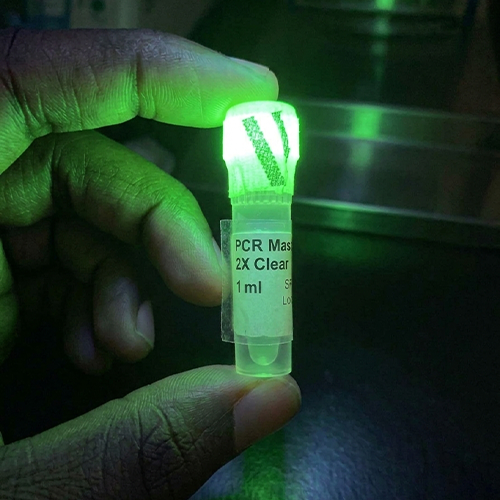
Biological −20°C Low-Cost Fluorescent Time–Temperature Indicator Sticker
What I would like to biomanufacture and why?
What is a Biological −20°C Low-Cost Fluorescent Time–Temperature Indicator Sticker?
This a sticker that can be attached to temperature-sensitive laboratory reagents and provide an early visual warning when they experience inappropriate warming. The indicator would ideally respond to both the temperature reached and the duration of exposure. Under appropriate storage conditions, it would remain in a low-fluorescence state. When the temperature rises above the −20°C storage threshold, it would begin producing a detectable fluorescent signal. A longer or more severe temperature excursion would produce a stronger signal, providing an indication of the severity of the exposure.
Why make this?
My motivation comes from a recent laboratory incident in which a number of reagents were lost after they were left outside their required refrigerated storage conditions. The problem was not only that the reagents were exposed to an inappropriate temperature, but that there was no simple way to know when the exposure had occurred or how long it had lasted. The proposed sticker is intended to provide an early warning so that laboratory personnel can identify reagents that have experienced an inappropriate temperature excursion and investigate or return them to proper storage before assuming that they are lost. The indicator would not determine whether a particular reagent has been damaged; rather, it would provide a record that its storage conditions were exceeded. The primary users would be laboratory scientists and technicians working with temperature-sensitive reagents such as enzymes and other biological materials. The same concept could potentially be adapted for other cold-chain applications.
What living system would you use?
Escherichia coli as microbial manufacturing chassis to produce an engineered AsLOV
I would initially use Escherichia coli as the microbial manufacturing chassis to produce an engineered AsLOV2-based temperature-sensing protein. AsLOV2 is a light-responsive protein domain from Avena sativa that undergoes a conformational change involving the Jα helix. Recent research has demonstrated that engineered AsLOV2-containing proteins can also exhibit tunable temperature-dependent switching in E. coli, providing a basis for investigating AsLOV2 as the sensing component of this project. However, the demonstrated temperature range is much warmer than −20°C, so shifting the response toward the desired storage temperature would remain a major engineering challenge. The engineered AsLOV2 would function as the temperature-sensing component, rather than the entire indicator. A separate fluorescent reporting system would convert the temperature-dependent molecular change into a visible signal. The final sticker would therefore contain a biological sensing material rather than living bacteria. This would allow the manufacturing organism and the final product to be physically separated. My initial assumption is that E. coli would be suitable because recombinant AsLOV2 production in E. coli has already been demonstrated.
At a high level, the proposed manufacturing process would be:
Engineered AsLOV2 design → E. coli produces the protein → sensing protein is recovered → protein is incorporated into an indicator material → indicator is assembled into a fluorescent sticker
How would I use automation?
The most important application of automation would be screening different AsLOV2 variants and temperature conditions. I would use an automated liquid-handling platform such as the Opentrons Flex to automate the design–build–test cycle for the sensor.
Variant Testing
The workflow would conceptually be:
AsLOV2 variants → automated preparation → parallel testing at different temperatures → fluorescence measurement → automated data analysis → identify the best-performing variant
The Opentrons Flex supports 1-, 8-, and 96-channel pipetting and can handle liquid volumes from 1–1,000 μL depending on the pipette configuration. It also supports modular temperature-control equipment and automated movement of labware. For this project, automation would allow many candidate sensor variants and exposure conditions to be tested in parallel rather than manually testing each one. For example, the system could compare candidate variants across a temperature range surrounding the desired −20°C threshold and measure their fluorescence. The resulting data could be used to identify variants with the clearest distinction between the normal-storage and excursion states. At a later manufacturing stage, the automation required would be different. Large-scale production would use larger fermentation and formulation/assembly systems, while the Opentrons-type system would mainly be valuable during research, development, optimization, and quality-control screening.
How much would I need to make, and how long would it take?
Production and Manufacturing
(a) How much?
For an initial meaningful prototype scale, I would aim to produce 10,000 indicator stickers, representing approximately the number that could be used across a laboratory or small laboratory network. I will assume that each sticker requires approximately 10 μg of the biological sensing material. Therefore:
10,000 stickers × 10 μg/sticker = 100,000 μg = 100 mg of sensing material
I would therefore target approximately 100 mg of recoverable sensing material for the initial 10,000-sticker production run. This is a planning assumption rather than an experimentally established requirement. The actual amount needed per sticker would need to be determined experimentally based on the sensitivity of the fluorescent system. For the production calculation, I can make a further engineering assumption of 10 mg of recoverable sensing protein per litre of production culture. Therefore:
100 mg ÷ 10 mg/L = 10 L of production culture
Under these assumptions, approximately 10 L of culture would be required to obtain enough sensing protein for 10,000 stickers. The actual yield could be substantially different, so this calculation would need to be revised after experimentally measuring protein production and recovery.
(b) How long?
I would divide the production timeline into:
- Sensor production
- Recovery/formulation of the sensing material
- Sticker assembly
- Quality-control testing For the prototype, I would estimate approximately one week per production cycle, allowing time for biological production, recovery/formulation, assembly, and quality-control testing. The exact production time would depend heavily on the final protein yield and the stability of the sensing material. At larger scale, production could be parallelized using multiple production vessels and automated downstream processing. The prototype automation system would therefore be used primarily to optimize the sensor, while larger-scale manufacturing would use dedicated bioprocessing and manufacturing equipment. The 10,000-sticker estimate is therefore not intended as a commercial manufacturing specification; it is a back-of-the-envelope scale that gives the project a measurable manufacturing target.
What don’t you know yet?
1. Can AsLOV2 be engineered to respond around −20°C?
This is the largest technical uncertainty. Existing work demonstrates temperature-responsive AsLOV2 systems, but the demonstrated switching range is approximately 37–41°C rather than −20°C. I would therefore need to determine whether modifications to the AsLOV2 system can shift its useful thermal response sufficiently toward the −20°C range.
2. Can the temperature response be converted into a useful fluorescent signal?
The sensing system needs to distinguish between normal −20°C storage and an excursion above that temperature. I would need to determine whether the molecular change can produce a sufficiently large and reproducible fluorescence difference. There is also an important design issue because AsLOV2 naturally responds to blue light. The final system would therefore need to distinguish the desired temperature response from unintended light activation. Existing AsLOV2 research has demonstrated that modifying the native photocycle can help reduce unwanted light activation, providing a possible direction for addressing this issue.
3. Can the indicator record both temperature and duration?
A useful sticker should not simply respond to the temperature at one instant. It should integrate temperature × exposure duration so that a brief minor excursion can be distinguished from a prolonged or severe excursion. I would therefore need to experimentally determine the relationship between temperature, exposure time, and fluorescence intensity, and determine whether the resulting signal remains detectable after the reagent returns to −20°C. Ultimately, the project would need to demonstrate that the biological sensor can be converted into a stable, inexpensive sticker that provides a sufficiently reliable warning to be useful in real laboratory cold-chain storage.