Week 9 HW: Genetic Circuit Design
Question 1) Design a neuromorphic genetic circuit that successfully classifies uveal melanoma from healthy cells. Your design should include TNSF10 and TRPM1 as inputs (e.g., X1 and X2 from the video example) , neuromorphic genetic circuitry that classifies cancer from healthy cells (e.g., an ERN and ERN target), and a molecular output that can treat/cure this cancer (think of strategies to either kill or reprogram the cancer, simulate the immune system, etc). The available neuromorphic genetic parts can be found in this spreadsheet (ignore both of the marker columns for now): HTBAA 2026 Genetic Circuit Part Names. If using the NeuromorphicWizard to complete the homework, use this template to create your genetic circuit so you can use the Predict tab to check your circuit’s input/output behavior: HTBAA 2026 Genetic Circuit Design Template - you will need to specify an arbitrary marker for each input. Wizard tutorial.mp4 [AI use discouraged]
Question 2) Pick a disease that you think could be treated or cured with a cell therapy. Then, research whether there are distinct biological markers (ideally 2 or 3 markers) that distinguish a diseased state from a non-diseased state. It’s important that the levels of these markers are characterized beyond just high/low levels: Look for data that measure the exact levels of the markers you choose. Make an input/output scatterplot or similar graph that incorporates your markers and classifies whether that point is considered diseased or not.
Rheumatoid arthritis
Rheumatoid arthritis (RA) is a chronic autoimmune disease in which the immune system attacks joint tissues, causing inflammation, pain and progressive joint damage. A potential cell therapy involves engineered regulatory T cells (Tregs) that suppress abnormal immune responses and reduce joint inflammation.
Three biological markers were selected to distinguish diseased from non-diseased states: anti-CCP antibodies, rheumatoid factor (RF) and C-reactive protein (CRP).
| Disease state | Anti-CCP (IU/mL) | RF (IU/mL) | CRP (mg/dL)* |
|---|---|---|---|
| Healthy | 2.67 | 5.78 | 0.31 |
| Mild RA | 153.62 | 136.38 | 24.20 |
| Moderate RA | 462.14 | 229.71 | 31.35 |
| Severe RA | 703.32 | 545.02 | 66.90 |
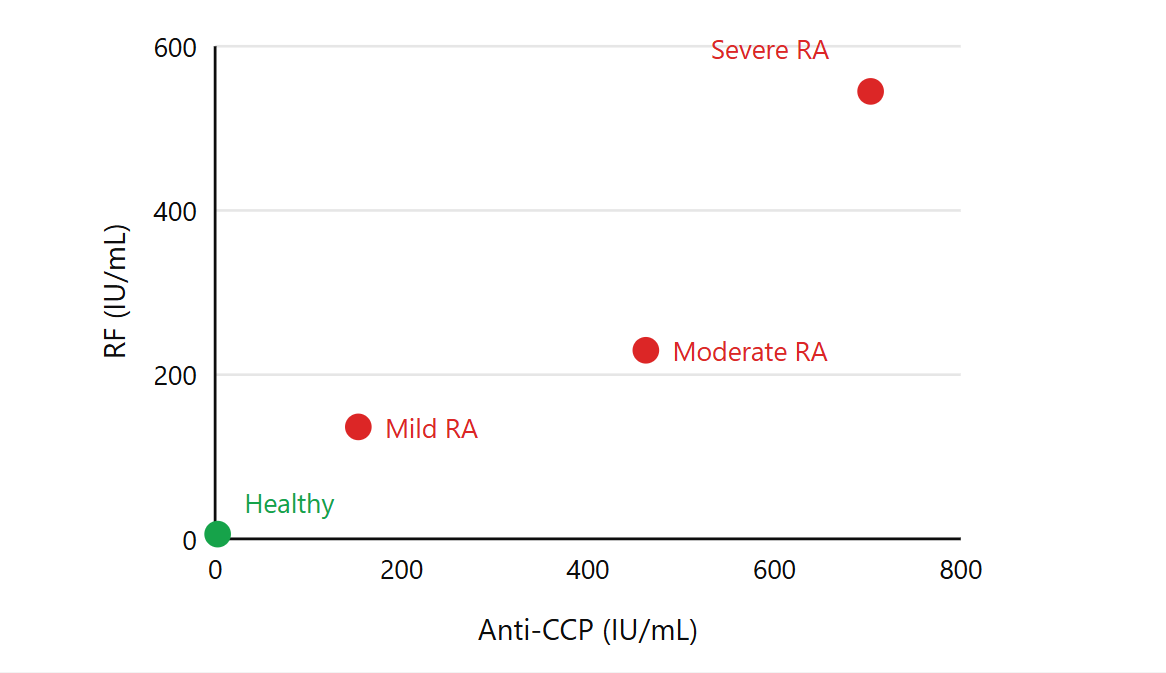
Finally, design a neuromorphic genetic circuit that incorporates sensing of your chosen markers, neuromorphic genetic circuitry that classifies disease vs. non-disease, and a molecular output that could treat/cure your disease of choice.
Question 3) So far we’ve only focused on how neuromorphic genetic circuits can be used in medicine. Choose a non-medical application that uses a neuromorphic genetic circuit of your own design. Like the previous questions, specify what your circuit design senses, the neuromorphic genetic circuitry, and the output of your circuit. [AI use discouraged]