Week 3 HW: Cell-Free Protocols
CFPS REACTION DESIGN FOR SFGFP, PETASE, RETEPLASE
GOAL: using the collective intelligence of the HTBAA community and accessible AI systems, design novel CFPS reaction compositions for each of the three target proteins: sfGFP, PETase, and Reteplase to reduce the cost per gram of functional protein. Each design should be compatible with the experimental framework described above and should reflect the distinct expression and folding requirements of that protein. You can learn more about the details of the coopetition.
COMPARE CELL-FREE REACTION COMPOSITIONS
1. Why does the concentration of potassium glutamate and magnesium glutamate differ between compositions? Which is more sensitive?
According to Jewett & Swartz (2004) and Olsen et al. (2026) , potassium glutamate and magnesium glutamate are used to mimic the cytoplasmic environment of E. coli and optimize protein expression in cell-free systems. Differences in concentration and variation among formulations: Potassium glutamate K(Glu) is required in high concentrations because it is the primary monovalent cation responsible for maintaining the total ionic strength and osmolarity of the medium. In contrast, the magnesium concentration varies substantially among formulations depending on the energy components used: traditional systems with charged phosphates (such as PEP and NTPs) chelate or “trap” a large amount of magnesium, requiring a greater external addition. Conversely, formulations optimized with sugars and NMPs release magnesium and allow the process to proceed with the minimal amount of residual Mg²⁺ present in the cell extract itself.
Sensitivity: Magnesium glutamate Mg(Glu)2 is significantly more sensitive. According to the literature, magnesium neutralizes the charges of nucleic acids and phosphorylated nucleotides and interacts directly with RNA polymerase and ribosomes. Therefore, it acts as a direct activator or destabilizer of protein synthesis. This is why even a slight magnesium deficiency disrupts the entire translation machinery and halts the reaction, while an excess could inhibit enzymes or cause reagents to precipitate. Consequently, the system tolerates only a very specific concentration range for magnesium, since this ion acts as a “switch” to turn protein synthesis on or off, unlike potassium, which regulates the overall ionic environment and allows for greater tolerance.
2. Explain how a PEP+NTP reaction formulation is different from a Ribose+NMP reaction formulation.
PEP+NTP system: uses high-energy phosphorylated substrates and directly activated nucleoside triphosphates (such as ATP, GTP, CTP, and UTP). According to Olsen et al. (2026), although these molecules generate a rapid initial energy surge, they accumulate a very high amount of free inorganic phosphate over the course of the reaction. This high concentration of phosphates chelates free magnesium ions, making it necessary to add high concentrations of external magnesium glutamate to stabilize the system’s machinery. Additionally, as noted in the study, NTP-based formulations require the addition of very expensive cofactors and additives, such as coenzyme A (CoA) and NAD, which significantly increases the total cost of protein production.
Ribose+NMP systems: represent a low-cost alternative that utilizes non-phosphorylated energy sources (such as ribose, glucose, or pyruvate) and nucleoside monophosphates (AMP, CMP, GMP, UMP) or their nucleobases. This formulation harnesses the native metabolic network of the cell extract itself to synthesize and regenerate NTPs in situ. As demonstrated by Olsen et al., this approach allows for the maintenance of stable ATP concentrations without accelerated depletion, while also keeping levels of residual inorganic phosphate low. Since toxic phosphate does not accumulate, the residual magnesium remains available to the ribosomes without forming precipitates that interfere with protein synthesis. Finally, this system drastically reduces costs by simplifying the formulation and eliminating the need for expensive reagents such as CoA, NAD, and the preactivated NTPs themselves.
3. Choose two cell-free reaction compositions from the literature, compare and contrast the choice of reagents and the concentration of reagents.
Comparison between Zawada et al. (2011) and Warfel et al. formulations:
Reagent Choice & Similarities:
- Both formulations share an identical ionic baseline of 130 mM Potassium Glutamate and equal concentrations of nucleoside monophosphates AMP 1.2 mM, CMP 0.86 mM, GMP 0.86 mM, UMP 0.86 mM.
- Both formulations eliminate expensive NTPs, PEP, and Coenzyme A (CoA).
Key Differences in Reagents & Buffering:
- Zawada et al.: Uses 35 mM Pyruvate as its primary energy driver, paired with redox agents 4 mM GSSG and 1 mM GSH to facilitate disulfide bonds. It does not include an added pH buffer like Bis-Tris.
- Warfel et al.: Replaces pyruvate with 60 mg/mL Maltodextrin to sustain long-term energy, incorporates higher phosphate levels 75 mM vs 15 mM, and adds 57 mM Bis-Tris as a buffer to stabilize pH. Additionally, it uses 0.4 mM NAD and 0.034 mg/mL Folinic acid.
Economic and Yield Comparison:
- Raw Reagent Cost per Liter: Warfel’s formulation is cheaper to prepare per liter of reaction $257/L compared to Zawada’s formulation $308/L, mainly because maltodextrin is a very economical polymer energy source compared to pyruvate and redox pairs.
- Cost per Gram of Protein Produced $/g_protein: Despite Warfel’s cheaper reagent mixture per liter, Zawada achieved a higher yield in this specific trial $0.91 g/L vs 0.72 g/L, making Zawada’s final cost per gram of protein slightly lower $339/g vs $356/g.
DESIGN ONE REACTION COMPOSITION FOR EACH OF THE THREE PROTEINS
Formulation
All the componets are reported in mM, and theo formulation are based on the NMP + ribose + Glucose system to reduce the cost of the formulation. There are some components that are in all formulations such as K(Glu), MG(Glu)2, HEPES KOH, Ribose, Glucose, Tyrosine, Cysteine, Amino Acid Mix, CMP, GMP, AMP, UMP. However, the non-common componets help to to decrease error to syntetize proteins with disulside bonds.
- NH4(Glu): this salt supports ribosome function and fine-tunes ionic environment.
- Putrescine and Spermidine: These molecules stibilize ribosome by neutralizing negative charge to increase the lifetime of the CFPS reaction.
- GSSG and GSH: this system sets the exact oxidizing potential to reshuffle incorrectly formed disulfide bonds toward the right pairings and allow DsbC to correct mis-paired disulfide bonds.
- Buffer Potassium Phosphate: This is a pH buffer that helps a cell-free ionic strength.
- DsbC: This enzyme corrects mis-paired disulfide bonds and it is essential for reteplase and help to improve yield of PETase.
| Components | sfGFP | PETase | Reteplase |
|---|---|---|---|
| K(Glu) | 362 | 200 | 200 |
| MG(Glu)2 | 8.22 | 8.22 | 8.22 |
| Tyrosine | 5 | 1 | 1 |
| HEPES KOH pH 7.5 | 46.25 | 30 | 30 |
| Ribose | 37.47 | 49.96 | 49.96 |
| Glucose | 12.49 | 9.71 | 9.71 |
| Cysteine | 5 | 2 | 2 |
| 17 Amino Acid Mix | 4.94 | 2 | 2 |
| CMP | 2.13 | 2.13 | 2.13 |
| GMP | 2.13 | 2.25 | 2.25 |
| UMP | 2 | 2.25 | 2.25 |
| AMP | 1.75 | 2.38 | 2.38 |
| NH4(Glu) | - | 6.25 | 6.25 |
| Putrescine Dihydrochloride | - | 1.25 | 1.25 |
| Spermidine | - | 0.9375 | 0.9375 |
| GSSG | - | 4.04 | 4.04 |
| GSH | - | 1 | 1 |
| Potassium phosphate 1.6:1 dibasic:monobasic | - | 15 | - |
| DsbC (E. coli, 25.5 kDa) | - | - | 0.001 |
ASIMOV KERNAL
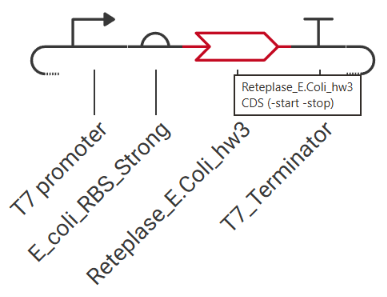
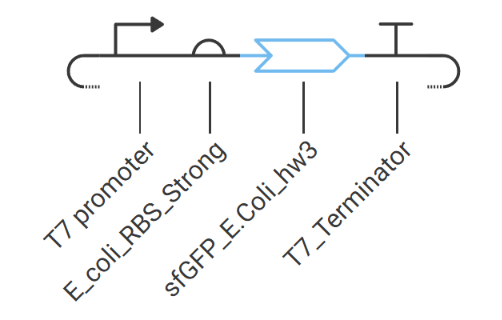
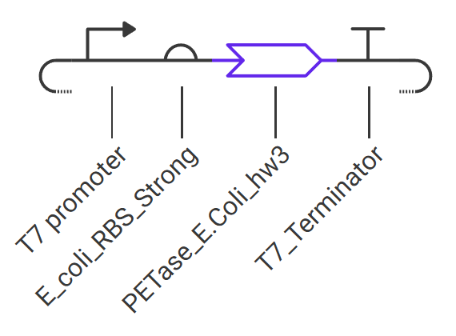
T7 compatible plasmids for cell-free expression using the amino acid coding sequences
sfGFP
MSKGEELFTGVVPILVELDGDVNGHKFSVRGEGEGDATIGKLTLKFICTTGKLPVPWPTLVTTLTYGVQCFSRYPDHMKRHDFFKSAMPEGYVQERTISFKDDGKYKTRAVVKFEGDTLVNRIELKGTDFKEDGNILGHKLEYNFNSHNVYITADKQKNGIKANFTVRHNVEDGSVQLADHYQQNTPIGDGPVLLPDNHYLSTQTVLSKDPNEKGTRDHMVLHEYVNAAGITWSHPQFEK
PETase
MEKKIWSHPQFEKGGSGENLYFQSGGASPAGGGANPYERGPNPTDALLEASSGPFSVSEENVSRLSASGFGGGTIYYPRENNTYGAVAISPGYTGTEASIAWLGERIASHGFVVITIDTITTLDQPDSRAEQLNAALNHMINRASSTVRSRIDSSRLAVMGHSMGGGGTLRLASQRPDLKAAIPLTPWHLNKNWSSVTVPTLIIGADLDTIAPVATHAKPFYNSLPSSISKAYLELDGATHFAPNIPNKIIGKYSVAWLKRFVDNDTRYTQFLCPGPRDGLFGEVEEYRSTCPFGGSGVSGWRLFKKIS
Reteplase
MEKKIWSHPQFEKGGSGENLYFQSGGASPAGGGNSDCYFGNGSAYRGTHSLTESGASCLPWNSMILIGKVYTAQNPSAQALGLGKHNYCRNPDGDAKPWCHVLKNRRLTWEYCDVPSCSTCGLRQYSQPQFRIKGGLFADIASHPWQAAIFAKHRRSPGERFLCGGILISSCWILSAAHCFQERFPPHHLTVILGRTYRVVPGEEEQKFEVEKYIVHKEFDDDTYDNDIALLQLKSDSSRCAQESSVVRTVCLPPADLQLPDWTECELSGYGKHEALSPFYSERLKEAHVRLYPSSRCTSQHLLNRTVTDNMLCAGDTRSGGPQANLHDACQGDSGGPLVCLNDGRMTLVGIISWGLGCGQKDVPGVYTKVTNYLDWIRDNMRPGGSGVSGWRLFKKIS