Week 3 HW: Cell-free design
HTBAA Homework #3 — Cell-Free Reaction Design
Coopetition profile: Gonzalo Povea · sfGFP, PETase and Reteplase compositions submitted to coopetition.htgaa.org
A. Compare cell-free reaction compositions
A1. Why do potassium glutamate and magnesium glutamate concentrations differ between compositions? Which is more sensitive?
The two salts sit an order of magnitude apart — potassium glutamate around 200 mM, magnesium glutamate around 8–10 mM — because they do fundamentally different jobs.
Potassium glutamate is a bulk ionic adjustment. Its role is to set ionic strength so that proteins and nucleic acids behave as they would inside the E. coli cytoplasm. Glutamate is the counter-ion rather than chloride because chloride inhibits cell-free translation. The yield-versus-concentration curve is broad, so a shift of 20–30 mM produces only modest changes.
Magnesium glutamate is a fine adjustment and is by far the more sensitive. Mg²⁺ is not a bulk contributor but a specific structural and catalytic cofactor, required at three distinct points:
- It holds the 30S and 50S ribosomal subunits associated. Below the optimum, ribosomes dissociate and translation collapses.
- It chelates the phosphate groups of every NTP. The true substrate for RNA polymerase and the ribosome is the Mg–NTP complex, so magnesium is part of the substrate itself.
- It is required by the polymerases and several accessory enzymes carried in the lysate. Above the optimum it becomes inhibitory, over-stabilising mRNA secondary structure and tightening ribosome association past the point where subunits can cycle. The result is a narrow optimum with a sharp peak, where a 2–3 mM shift can change yield severalfold.
The most important consequence for reaction design is that the optimal magnesium concentration is not a universal constant — it is coupled to the rest of the recipe. NTPs sequester Mg²⁺ stoichiometrically, so a formulation with more NTPs needs more magnesium. Energy systems that release inorganic phosphate chelate and precipitate Mg²⁺ as the reaction proceeds, lowering the effective free concentration over time. This is why magnesium must be re-tuned whenever the energy system or nucleotide source changes.
An empirical observation from the coopetition reagent set. Across all 25 reference formulations in the designer — PANOx-SP, Jewett & Swartz, Calhoun & Swartz, Zawada, Cai, Borkowski, Garenne, Warfel, Zhu, Minimal, RFopt and all six GPT-5 entries — potassium glutamate is 200 mM and magnesium glutamate is 8.85 mM without exception. Potassium glutamate shows 0 nL added in every case: all of it arrives in the fixed base buffer.
I tested this directly. My first sfGFP draft raised K(Glu) to 313 mM and lowered Mg(Glu)₂ to 6.97 mM. Raising potassium consumed 2,575 nL of the 11,000 nL variable budget — 23% of everything I had to spend — on a parameter that no published formulation varies, and potassium above roughly 200 mM is independently known to inhibit translation. I reverted both. The lesson is that these two salts are the wrong place to spend a constrained volume budget: the base buffer already places them at or near their plateau, and the variable budget is better spent on components that actually differentiate formulations.
A2. How does a PEP+NTP formulation differ from a Ribose+NMP formulation?
The difference is buy versus make. A PEP+NTP formulation purchases finished high-energy molecules; a Ribose+NMP formulation purchases cheap precursors and asks the lysate’s own metabolism to build them in situ.
PEP + NTP. The four nucleoside triphosphates are supplied directly and are immediately usable by RNA polymerase and the ribosome. Energy is regenerated from phosphoenolpyruvate: pyruvate kinase, already present in the lysate, transfers PEP’s phosphate to ADP to regenerate ATP. This is the classical approach used in PANOx-SP, which in this reagent set runs ATP at 1.25 mM, CTP/GTP/UTP at 0.875 mM each, and PEP at 30 mM.
Its advantages are speed and simplicity — no lag while the system builds a nucleotide pool, and high initial synthesis rates. Its disadvantages are cost and self-limitation:
- Nucleoside triphosphates are among the most expensive reagents available: CTP $27.94/mL, UTP $37.85/mL, GTP $39.34/mL, against $0.53–1.27/mL for the corresponding monophosphates. GTP alone is roughly 74× the price of GMP.
- PEP is consumed stoichiometrically, not catalytically: each molecule donates one phosphate and becomes pyruvate. Driving a reaction for hours therefore requires a large molar excess, and at 30 mM it occupies 6,000 nL — over half the entire variable budget.
- Every phosphate transfer releases inorganic phosphate, which accumulates, chelates and precipitates Mg²⁺, and progressively inhibits the reaction. This is a principal reason PEP-driven reactions have short productive lifetimes. Ribose + NMP. Nucleoside monophosphates are supplied instead, and the lysate’s retained kinases phosphorylate them in two steps, NMP → NDP → NTP. Energy comes from a non-phosphorylated catabolic substrate — ribose, maltodextrin or glucose — entering central metabolism and regenerating ATP by substrate-level phosphorylation.
This inverts the trade-offs. The reagents are dramatically cheaper, and because the energy substrate carries no phosphate there is no stoichiometric phosphate dump, so free magnesium stays closer to its optimum for longer. The costs are a slower start, since the system must first build its nucleotide pool, and greater dependence on the lysate retaining intact central metabolism — which makes performance more sensitive to lysate batch and preparation.
What the coopetition data actually show, and why it complicates the story. The reference plates pair each target with a PEP and a ribose version, and PEP wins all three:
| Target | PEP | Ribose |
|---|---|---|
| sfGFP | 0.61 g/L | 0.46 g/L |
| PETase | 314.6 µM | 274.8 µM |
| Reteplase | 10.9 µM | 0.81 µM |
Yet the best-performing formulation in the entire reference set, GPT-5 #77 at 3.04 g/L and $422/g, is ribose-based. Both facts are true, and the reconciliation is informative: the naive ribose reference plates appear to be PEP recipes with the energy system swapped and little else re-tuned, whereas #77 re-optimised around the substitution. It uses the highest ribose of any entry (77.4 mM), the lowest nucleotide supplementation (AMP 0.6, CMP 0.4, UMP 0.4 mM, and no GMP at all), and supplies guanine as a free base at 0.2 mM, leaning on the lysate’s salvage pathway rather than buying the nucleotide.
The conclusion I drew, and which shaped my own designs, is that substituting the energy system is not a drop-in change. It is only profitable when the nucleotide supply, magnesium and amino acid levels are re-optimised around it — and when it is not, as in the Reteplase Ribose plate, yield falls by 13-fold and no amount of reagent saving compensates.
A3. Comparing two published compositions
I compared PANOx-SP (Jewett & Swartz 2004), the long-standing reference formulation, with RFopt (Olsen et al. 2026), a deliberately cost-optimised formulation. All figures below are read directly from the coopetition designer rather than from the papers, so they are on a common basis. I include GPT-5 #77 (Smith et al. 2026) as a third point of comparison, since an AI-designed formulation turns out to beat both.
| PANOx-SP (2004) | RFopt (2026) | GPT-5 #77 (2026) | |
|---|---|---|---|
| Design goal | Maximise yield and reaction lifetime | Minimise cost per gram | AI-designed, cost-per-gram objective |
| Nucleotide source | ATP 1.25, CTP/GTP/UTP 0.875 mM | AMP 3, CMP/GMP/UMP 2.15 mM | AMP 0.6, CMP/UMP 0.4 mM, no GMP; guanine 0.2 mM |
| Energy substrate | PEP 30 mM | Ribose 50 mM, glucose 10 mM | Ribose 77.4 mM, glucose 6.9 mM |
| Amino acids | 2 mM (Tyr 2, Cys 2) | 5 mM (Tyr 5, Cys 5) | 4.1 mM (Tyr 4.1, Cys 4) |
| Cofactors | Folinic acid 0.03, NAD 0.4, CoA 0.27 mM, tRNA, cAMP | Nicotinamide 4 mM | Nicotinamide 3.1 mM |
| Buffer | HEPES 57.5 mM | HEPES 75 mM, phosphate 15 mM | HEPES 45 mM, phosphate 5.6 + 5.6 mM |
| sfGFP yield | 1.11 g/L | 2.39 g/L | 3.04 g/L |
| Cost per gram | $4,083 | $60 | $422 |
What the comparison shows. PANOx-SP supplies everything the reaction could need in ready-to-use form, including a generous excess of the most expensive species. It is robust and reproducible, which is why it remained the field reference for two decades, but almost its entire cost sits in two line items: PEP and the nucleoside triphosphates, together with CoA at $104/mL and NAD at $33/mL.
RFopt attacks exactly those line items and improves rather than sacrifices yield. The key insight is that the lysate is not merely a bag of ribosomes — it retains functional kinases and central metabolism, so it can be asked to manufacture its own NTPs from cheap monophosphates and to generate ATP from a sugar. The reagents removed were not providing irreplaceable function; they were providing convenience the lysate could supply itself. RFopt also replaces NAD with nicotinamide, its biosynthetic precursor, at a hundredth of the price, and drops CoA, folinic acid and tRNA entirely.
Three substitutions therefore account for almost the whole 68-fold cost reduction: NTPs → NMPs, PEP → ribose, and NAD/CoA → nicotinamide.
Why the AI formulation is interesting despite being more expensive per gram than RFopt. GPT-5 #77 produces the highest yield of any entry but costs $422/g against RFopt’s $60/g. The gap is not a design failure — it is an artifact of how the designer reports cost, discussed below, since #77’s figure includes the fixed lysate and DNA while RFopt’s appears not to. On the components the designer actually controls, #77 is the more aggressive of the two: it buys even fewer nucleotides than RFopt and pushes ribose 55% higher.
What I took from this for my own designs. First, the largest cost reductions come from substituting whole subsystems — energy source, nucleotide source, cofactor source — not from trimming individual components. Second, cheaper is not automatically worse: removing the phosphate burden improved cost and yield simultaneously, because phosphate accumulation was itself limiting. Third, once a formulation is already near the cost floor, further cost-cutting is pointless and yield becomes the only remaining lever — which is the principle behind all three of my submissions.
B. Design one reaction composition for each of the three proteins
B1. Published compositions
All three were built on a reference formulation rather than from scratch, so that each submission is a controlled test of a small number of changes rather than an untested recipe.
sfGFP
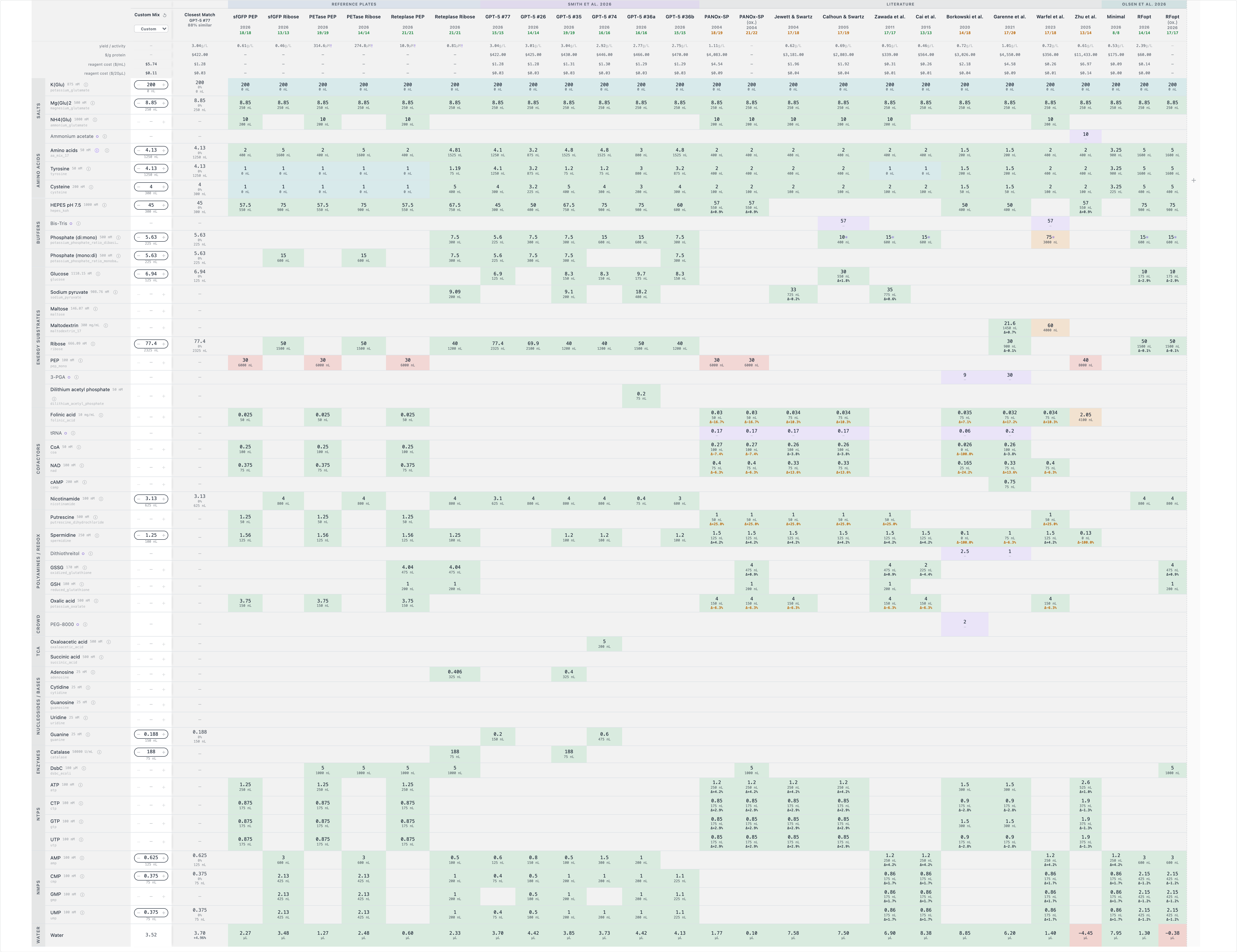
Click the image to open it full size — the composition table is wide and the inline view is not readable at full width.
Base: GPT-5 #77 (3.04 g/L, $422/g) — the best cost-per-gram entry in the reference set.
Reasoning. #77’s reagent cost is already near the floor. Working from the published price table, lysate, DNA template and base buffer together account for roughly $1.21/mL of its $1.28/mL, leaving about $0.04/mL for every variable component combined. There is essentially nothing left to cut, so yield is the only meaningful lever. I therefore kept the composition intact and added two components it omits.
| Change | Value | Rationale |
|---|---|---|
| Catalase | 188 U/mL | sfGFP chromophore maturation from Thr65-Tyr66-Gly67 is autocatalytic but strictly O₂-dependent, per the target’s own data sheet. Catalase liberates O₂ from hydrogen peroxide, and Olsen et al. (2026) report sfGFP rising from 2.4 to 3.7 g/L under oxygenation. GPT-5 #35 and the Reteplase Ribose plate both use exactly this level, so the dose is precedented; what is untested is catalase on the #77 background specifically. |
| Spermidine | 1.25 mM | Polyamines stabilise ribosomes and mRNA secondary structure. #77 omits it, but #35, #74 and #36b use 1.2 mM and every classical formulation in the set uses 1–1.56 mM. |
Deliberate omission: folinic acid. It has a clear mechanistic role in formyl-methionine initiation and appears in every PEP reference plate, but all six GPT-5 entries and all three ribose plates omit it. That pattern is consistent enough to suggest the lysate’s endogenous folate suffices under ribose-driven conditions, and I preferred to follow the data over the mechanism.
I also left amino acids and tyrosine at #77’s 4.1 mM rather than raising them to RFopt’s 5 mM, because #77 outperformed the entries that used higher amino acid levels (#35 and #74 both run 4.8 mM and score worse).
PETase (TfCut2)
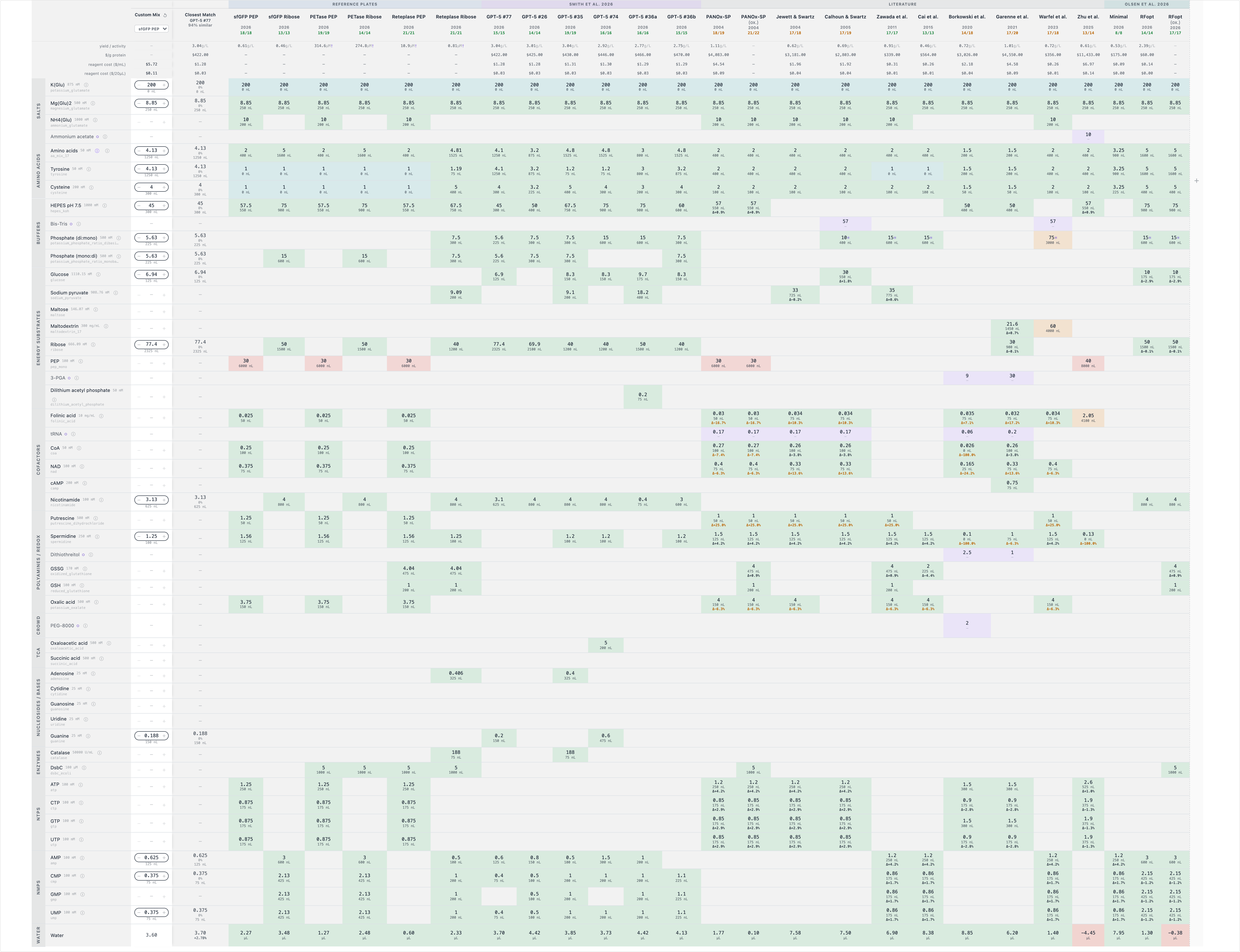
Click to open full size.
Base: GPT-5 #77, with spermidine added and catalase omitted — catalase was included for sfGFP only because of the O₂-dependent chromophore step, which a hydrolase has no analogue for.
The substantive decision is omitting DsbC. Both PETase reference plates carry it at 5 µM. At $5,632/mL that is 1,000 nL costing $5.63 per reaction, roughly 98% of total reagent cost. The target data sheet states that TfCut2 folds under standard CFPS conditions, and a single disulfide bond (Cys274–Cys292) should not require a dedicated isomerase. Critically, no DsbC-free control exists anywhere in the reference set, so the reagent’s contribution to this target has never been measured.
This makes the submission informative either way. If activity holds without DsbC, cost per unit activity falls by about two orders of magnitude. If it collapses, that is a clean demonstration that DsbC is doing real work even on a single-disulfide protein — which would itself be worth knowing.
I left cysteine at 4 mM rather than raising it. Excess free cysteine is reducing, and would work against formation of the one disulfide this protein needs.
Reteplase
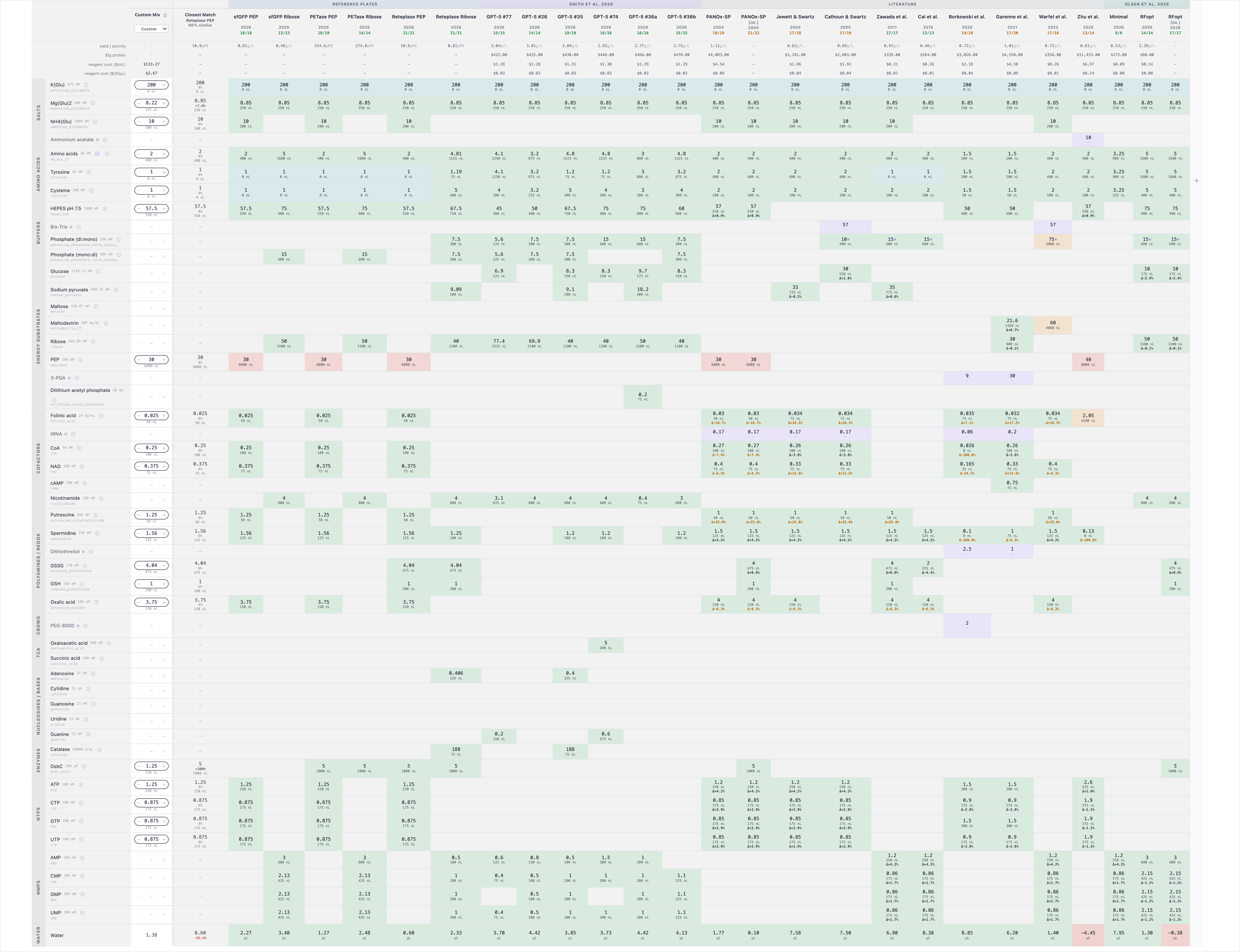
Click to open full size.
Base: Reteplase PEP (10.9 µM), not Reteplase Ribose (0.81 µM).
This is the one target where I abandoned the ribose strategy entirely. PEP outperforms ribose 13-fold here, and no reagent saving compensates for losing an order of magnitude of functional protein. The cost argument that drives the other two designs simply does not survive contact with the data on this target.
One change: DsbC from 5 µM to 1.25 µM.
The arithmetic is decisive. At $5,632/mL, DsbC is the most expensive reagent on the menu by roughly 50-fold and costs $5.63 of a ~$5.72 reaction. Converting the reference yield — 10.9 µM × 44,136 Da = 0.48 g/L — gives a specific cost near $585,000/g, against $422/g for sfGFP. Three orders of magnitude of that gap is attributable to a single reagent.
Cutting DsbC to a quarter reduces reaction cost to roughly a quarter. The bet is that if functional yield falls by less than 4-fold, cost per gram improves. Published effects of DsbC on disulfide-bonded proteins are typically in the 2–10× range, which places this test squarely in the informative band, and as with PETase no reduced-DsbC control exists in the reference set.
The structural answer, which this submission cannot test. The right long-term fix is not to buy less DsbC but to stop buying it: expressing DsbC in situ from a T7 helper plasmid would reduce its cost to approximately that of a second DNA template, about $2/mL rather than $5,632/mL. That is the subject of the optional Part C bonus question.
B2. Community Reagents

I upvoted FkpA (E. coli peptidyl-prolyl isomerase / chaperone), suggested by Xiangtao Shi, rather than proposing a new reagent.
How I decided. My own cost analysis pointed at the same target. Reteplase is where specific cost is decided in this study: DsbC at $5,632/mL is the most expensive reagent on the menu by roughly 50-fold, and at the reference 5 µM it accounts for about 98% of total reaction cost, putting that target near $585,000/g against $422/g for sfGFP. Any reagent that raises functional reteplase yield, or allows an equivalent result at a lower DsbC dose, moves the single biggest lever available in the entire reagent set.
I considered proposing DsbA instead, which is the missing half of the E. coli disulfide machinery: DsbC is an isomerase that reshuffles incorrectly paired cysteines after the fact, while DsbA is the oxidase that introduces the bonds in the first place. The menu currently offers only the correcting half.
I chose to back FkpA because it addresses a step that neither DsbC nor DsbA touches. FkpA carries peptidyl-prolyl isomerase activity, and cis–trans proline isomerisation is a classic rate-limiting step in protein folding that is entirely independent of disulfide chemistry. It also has general chaperone activity that suppresses aggregation of partially folded intermediates — a real risk for a 399-residue protein that must resolve 18 cysteines into 9 specific pairs.
The precedent is directly analogous. Groff et al. (2014) built a cell-free system for full-length immunoglobulins — multi-disulfide proteins with the same folding problem as reteplase — and found that purified FkpA reduced aggregation and acted together with DsbC to improve folding and assembly. That is a combination effect rather than a substitution, which is precisely why FkpA is worth testing on top of the existing DsbC rather than in place of it.
Reference: Groff D. et al. (2014). Engineering toward a bacterial “endoplasmic reticulum” for the rapid expression of immunoglobulin proteins. mAbs 6(3):671–678. https://www.tandfonline.com/doi/full/10.4161/mabs.28172
B3. Forum
I confirmed access to the cfps-coopetition forum channel and posted the following optimisation idea:
One observation from the reference plates: the sfGFP target sheet states chromophore maturation is autocatalytic but strictly O₂-dependent, and Olsen et al. (2026) report sfGFP rising from 2.4 to 3.7 g/L under oxygenation. Catalase is already on the menu and liberates O₂ from H₂O₂, but none of the six GPT-5 entries use it on their best-performing background (#77). I added it at 188 U/mL — the level used by GPT-5 #35 and the Reteplase Ribose plate — on top of #77. It costs under $0.001 per well, so the downside is negligible and it should separate cleanly if the effect is real.
A note on the designer’s cost display
While building these compositions I could not reconcile the reagent cost the designer reported for a custom mix with the cost it reports for the reference plate that custom mix was copied from.
Recomputing GPT-5 #77 from the published price table reproduces its listed figure closely: lysate at 25% of reaction volume contributes $1.00/mL, the sfGFP template $0.19/mL, base buffer $0.02/mL, and all variable components together $0.04/mL, totalling $1.26/mL against the $1.28/mL displayed. The cost basis for the reference plates therefore appears to include the fixed components.
However, when I loaded GPT-5 #77 as a custom mix and changed only catalase and spermidine — components worth well under $0.001 per 20 µL reaction, at 98% similarity to the source — the displayed cost was $5.71/mL rather than $1.28/mL. Loading PANOx-SP as a custom mix produced $8.64/mL against $4.54/mL for the reference entry. Both discrepancies are close to $4.1–4.4/mL, near the unscaled lysate price of $4.00/mL, which suggests the custom column may be counting the lysate at full price rather than at its 25% share of the reaction.
Separately, the literature entries are not all on the same basis as each other: RFopt is listed at $0.14/mL, which cannot include a lysate contribution of $1.00/mL, whereas PANOx-SP at $4.54/mL clearly does.
I flag this rather than work around it, because cost per gram is the scoring metric and these differences are large enough to reorder the rankings. For my own designs I relied on the published price table rather than the displayed figure.
C. Asimov Kernel (optional)
Not attempted within the time available. For the record, the construct design differs from Homework #2 in that this is a prokaryotic T7 system rather than a eukaryotic one: the cassette would be T7 promoter → RBS → CDS → T7 terminator, with codon optimisation for E. coli rather than H. sapiens, replacing the EF1α promoter, Kozak sequence and poly(A) signal used previously.
For the bonus question — a T7 helper plasmid to improve functional reteplase yield — the design that follows from my cost analysis is to co-express the folding machinery rather than purchase it: DsbC together with general chaperones (GroEL/GroES or DnaK/DnaJ/GrpE), and, following the reasoning behind my Community Reagents vote, FkpA. The economic argument is stark: purified DsbC costs $5,632/mL and dominates the reteplase reaction, whereas a second DNA template costs roughly $2/mL. Producing the isomerase inside the reaction rather than buying it is the only change that attacks the cost problem at its root instead of trading yield against it.
References
- Groff, D. et al. (2014). Engineering toward a bacterial “endoplasmic reticulum” for the rapid expression of immunoglobulin proteins. mAbs 6(3):671–678.
- Jewett, M. C. & Swartz, J. R. (2004). Mimicking the Escherichia coli cytoplasmic environment activates long-lived and efficient cell-free protein synthesis. Biotechnology and Bioengineering 86(1):19–26.
- Olsen, T. et al. (2026). Design-driven optimization of low-cost reagent formulations for reproducible and high-yielding cell-free gene expression. Nature Communications. https://www.nature.com/articles/s41467-026-69605-8
- Smith, M. et al. (2026). AI-designed cell-free reaction compositions (GPT-5 entries, coopetition reference set).
- Yin, G. & Swartz, J. R. (2004). Enhancing multiple disulfide bonded protein folding in a cell-free system. Biotechnology and Bioengineering.
- Reagent prices and reference formulations: CFPS coopetition overview and guidelines, and the designer at coopetition.htgaa.org.
AI
I used Claude (Anthropic, Claude Opus 5) via claude.ai throughout.
Claude was used to work through the underlying biochemistry from a standing start, since cell-free systems were outside my background; to retrieve and verify figures from Olsen et al. (2026) and the Groff et al. (2014) reference against the primary sources; to compute reagent costs per reaction from the published price table, including the reconciliation of the designer’s displayed costs described above; and to analyse the reference plate data for patterns, which is how the ribose-versus-PEP tension in A2 and the amino-acid signature of GPT-5 #77 were identified. Representative prompts:
Claude’s analysis changed three decisions I would otherwise have made differently. It identified that my first draft’s raised potassium glutamate consumed 23% of the variable budget on a parameter no published formulation varies; it caught that PEP outperforms ribose on all three targets in the reference data, which reversed my plan to use a ribose-based formulation for reteplase; and it worked out that DsbC accounts for roughly 98% of reteplase reaction cost, which became the central argument of two of my three submissions.