Week 1 HW: Final Project Ideas
What do you want to make?
My initial idea is to make a genetic circuit that could detect for amyloid biomarkers. Amyloid are aggregates (build ups) of misfolded proteins. They cause a lot of problems . . .
Non Transmissable
Amyloidosis is a build up of amyloid fibrils in the body’s tissue and organs. It can be extremely painful.
Misfolded proteins are also linked to such neurodegenerative diseases as Alzheimer’s, Parkinson’s, and Amyotrophic Lateral Sclerosis aka ALS, the latter of which Steven Hawking had. As of yet, there are no cures for these diseases. The root causes for such are still yet to be properly understood which is why prophylatic measures are difficult to prescribe. But with all of these diseases, scientists have found amyloids to play a significant role.
They are seen as non-transmissble diseases as you cannot simply “pass on” Alzheimer’s, Parkinson’s, or ALS. Have you ever met anyone with these diseases?
Transmissable
This keeps me up at night . . .
The presence of prions (“proteinaceous infectious particle”) which are harmful misfolded proteins (Kupfer at al. 2009). There are benign harmless prions in all body tissues, however the infectious ones are mainly concentrated in the brain and spinal chord where they wreak havoc. They are known to cause Creutzfeldt-Jakob disease (CJD) and Bovine Spongiform Encelopathy (BSE) aka Mad Cow Disease, Gerstmann–Sträussler–Scheinker syndrome, fatal familial insomnia, kuru, and variably protease-sensitive prionopathy.
Most neurons in the human brain are are not replaced. You have the same neurons from birth. Isn’t that crazy? Recent studies show that some regions of the brain can produce new neurons and theis process is known as adult neurogenesis.
However, the fact that neurons are long-lived cells mean that they are particularly vulnerable to the accummulation of misfolded proteins over a long period of time. What is scary about these diseases is that they are transmissible: eating a cow with BSE can cause vCJD in humans, or contaminated medical equipment coming into broken skin (like a cut) or mucous membranes could cause infection. Sterlising the contaminated equipment requires special protocols as standard sterilisation is insufficient. (Yikes.)
Focus
I think that I will focus on a genetic circuit which detects the known biomarkers for Alzheimer’s Disease.
Some of the core biomarkers for Alzheimer’s are:
Amyloid-beta (Aβ42 and Aβ42/Aβ40 ratio): Reflects the buildup of amyloid plaques in the brain, a hallmark pathology of Alzheimer’s.
Phosphorylated Tau (p-tau181, p-tau217, and p-tau231): Tracks abnormal tau tangles inside nerve cells. Plasma p-tau217 currently shows the highest diagnostic accuracy for detecting both amyloid and tau pathology.
Neurodegeneration (NfL): Neurofilament light chain measures general nerve cell damage and degeneration in the brain or spinal fluid.
Astrocytic Response (GFAP): Glial fibrillary acidic protein is an indicator of inflammation and astrocyte activation in the brain.
How Biomarkers Help Diagnose Dementia: NIH 2022
Researchers have been creating genetic circuits for the detection of Alzheimer’s biomarkers, but these disproportionately focus on Amyloid-beta and Tau. My genetic circuit can look at NfL or GFAP.
What living system could make it?
For a rapid prototype chassis I could make use of human embryonic cells. I read that these are good for circuit prototyping and have high transfection efficiency.
Otherwise, I could use human iPSCs.
Whilst E. coli is relatively cheap and ubiquitous compared to the cells of organisms, I am not sure if it may cause safety hazards in a human brain. E. coli would be better for a diagnostic blood test strip. But I am not sure fully how this would work in the case of Alzheimer’s.
How could automation help you make it?
If I were to design a new genetic circuit receptor that tests for Nfl OR GFAP, I would have to test lots of antibody fragments manually which would be slow and inconsistent. Making use of a liquid handling robot like Opentrons to perform multi-well transfections would massively speed up this process and keep things more consistent and hopefully reproducible.
What would it take to make it at a meaningful scale?
Making a genetic circuit that could test for biomarkers of Alzheimer’s Disease, namely NfL or GFAP, would necessitate automation, bio-scaling, and creating the necessary infrastructures for its creation.
The first step would be to even make the genetic circuit in the lab. Test if it works. And then test if results are reproducible.
Ultimately, a “meaningful scale” here would mean that this technology is trialled clinically and then used in diagnostics.
What don’t you know yet?
Readings
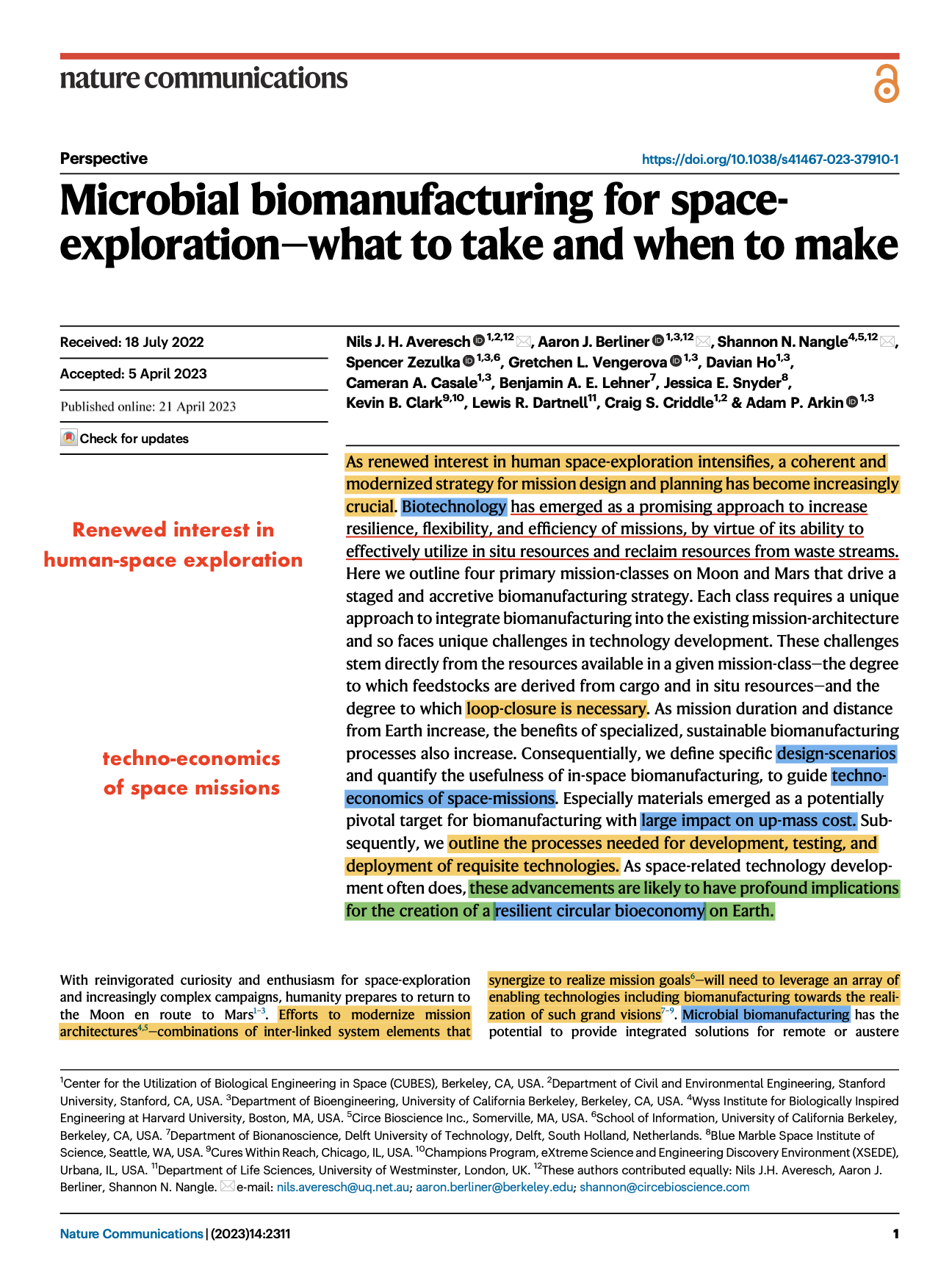
This paper, which was published in Nature, discusses the renewed interest in space exploration and how biomanufacturing may be used for such. It defines biomanufacturing as that which “corresponds to any deployable system that leverages biology as the primary driver in generating mission critical inventory items of increased complexity” (Averesch et al. 2023:2). As highlighted below, biomanufacturing has applications in food, thereapeutics, and materials. Advances in such are likely to have profound application for the creation of a resilient circular bio-economy on Earth! The researchers outline 4 primary mission classes on both the Moon and Mars which would necessitate a biomanufacturing strategy. These are as follows:
Class 1
- Short stay missions to the moon
- Stable logistics
- Small number of astronauts
- Narrow scope of scientific and technical exploration
- Testing through automating and scaling biomanufacturing technologies in space
- Require system TRL of 5 for testing, with automation past TRL 7 being metric for success
Class 2
- Advanced lunar operation capabilities
- Extensive infrastructure already deployed on the moon
- Disrupted logisitics
- Paucity of feedstock raw materials on the moon ∴ necessitates hyper-efficient use of stored supplies and waste streams via LC
- Ability to switch to biomanufacturing operations in extreme conditions
- Require system TRL of 7
- Engineered organisms for consumable materials, development of a basic waste processing system, flexible reconfigurable infrastructures
Class 3
- Mars
- Rudimentary logistics
- Many unknowns ∴ extensive planning for contingencies
- TRL 8 or 9
- Focus on advancements in food, thermoplastics: modular fermentations, and bioprocesses at scale, optimised genetically engineered microbial strains for the production of intermediates (e.g. crude polymers) and final products (meals, drugs, manufactured items)
Class 4
- Mars
- Developed logistics: fully-fledged integrated biomanufactory
- Logistic resupply enabled by interplanetary networks and deep-space outposts
- ISM of specialty reagents (e.g. phosphoramidites for DNA synthesis)
Key terms
- ISM = In situ [bio]manufacturing
- ISRU = In situ resource utilisation
- TRL = Technology readiness level
- LC = Loop closure