See the nav bar on the left to look through my work for How To
Biomanufacture Almost Anything (Fall 2026)!
Subsections of HEATHER QIAN — HTBAA Fall 2026
Week 1 HW: Final Project Ideas
(1) What you would like to biomanufacture and why?
Describe the target product or output you would like to make.
Why are you interested in making it? Your motivation might be utilitarian—for example, addressing a problem in health, sustainability, food, energy, or manufacturing—but it does not need to be. Your project might instead have a social, cultural, artistic, or personal motivation.
Clearly articulate what you want to make, who or what it is for, and why you think it is interesting or important.
I would like to make glow-in-the-dark ink using bioluminescent microbes. This is partially personally motivated, as I am an avid reader and would like to not have to find a good light source all the time, but it is also motivated by sustainability, as this could be used to make road signs or markings that glow at night and allow drivers, pedestrians, etc. to see better without using electricity.
(2) What living system would you use?
Propose at least one living-system manufacturing chassis that could produce your target—for example, a microbial, mammalian, or cell-free system.
At a high level, describe how the system would make your target product. What goes into the system? What biological process or processes occur? What comes out?
You do not need to design the complete biological system yet. Make reasonable assumptions where necessary and identify them.
I would use bacteria, perhaps a species that already has bioluminescent properties and engineer it to reliably glow at night/when there is a lack of light. This way, during the day, the microbes are also visible but not burdened by producing light. Bacteria are also helpful as they can form biofilms and persist better that way, which would be good for road markings since they are out in the elements.
(3) How would you use automation?
Identify at least one automation technology that you would combine with your living system.
This could include a large-scale Cloud Lab, a desktop liquid-handling robot such as an Opentrons, a programmable microfluidics platform such as Nuclera’s, or another automation technology.
Describe what part of the biomanufacturing workflow you would automate and why. For example, you might automate liquid handling, culturing, assembly, screening, sampling, measurement, optimization, or another step.
I would like to automate the assembly of the gene circuit I would be using to ensure the bacteria reliably glows below a certain light level and to encourage biofilm formation. Some papers have suggested that the Opentrons robot is capable of Golden Gate assembly (Bryant et al), so I could use that for this. It would also be helpful to automate culturing of the bacteria, as this would have to be made in large quantities if it is to be used widely. I would also use a Cloud Lab so that the circuit made by the Opentrons can automatically be fed into equipment that would electroporate the construct into the bacteria, screen for transformants, and grow it up.
(4) How much would you need to make, and how long would it take?
Perform a back-of-the-envelope calculation estimating what it would take to manufacture your target at a meaningful scale.
(a) How much?
Define a scale relevant to your project and calculate approximately how much of your target product you would need to manufacture.
For example, if you are producing a medicine, you might estimate the amount required to treat 1,000 people, everyone in Massachusetts, or everyone in the world. If you are producing a building material, you might calculate the amount required for one structure or an entire neighborhood. If you are producing an art or design artifact, define an appropriate scale yourself.
Clearly show your calculation, including units, assumptions, and sources for important numbers.
For Williamsburg, there are ~50 miles of road (Street Division).
Assuming a two-way road, there are four stripes (two white solid lines at the edges of the road, and the double yellow stripe down the middle)
Ignore other markings like crosswalks, lane arrows, etc. for simplicity.
Using your proposed living system and automation technology, estimate how long it would take to manufacture that amount.
Consider quantities such as production rate, yield, volume, number of parallel experiments or reactors, automation throughput, or whatever parameters are most appropriate for your system.
You may discover that the automation technology you would use to prototype your system is very different from what you would use to manufacture at scale. If so, describe both.
Again, we are looking for a reasonable engineering estimate. Show your assumptions and calculations.
To prototype my system, I would manually construct the circuit using a Thermal Cycler and a 100-250 mL culture in a shaking incubator.
For producing at scale, let’s assume I’m using Vibrio fischeri, the bioluminescent symbiont in Hawaiian bobtail squid that glows at night using quorum sensing (Nyholm et al).
Creation of electrocompetent cells following a protocol by Gonzales et al: including the step for growing up an overnight culture, 20 hours.
Assembly of construct: let’s assume I’m using Golden Gate assembly. According to NEB, the protocol is 30-60 5 minute cycles, but I want to make large quantities of construct, so we’ll choose 60 cycles. This ends up being a 5 hour reaction.
Electroporation does not take long, so we’ll say that’s one hour.
Then, plate the bacteria and allow them to form colonies on selective media to screen for transformants (the construct would have an antibiotic resistance gene, and the media would have the antibiotic). The plate would incubate for a day (24 hrs).
Then, select a colony to start a culture from, which takes 1-2 hours to grow to log phase (Christensen et al).
In total, this is 52 hours (a little over 2 days). However, the time to grow up the final culture would likely take longer, as I would be growing the bacteria in larger volumes but would want to inoculate still with a small volume to conserve energy/resources.
5. What don’t you know yet?
After completing your analysis, identify the 2–3 biggest technical unknowns, bottlenecks, or assumptions in your proposed biomanufacturing system.
What would you need to learn, measure, or experimentally determine to know whether your idea could actually work?
Whether it’s possible to engineer a system that responds to the lack of light. I’d experiment with light-sensitive proteins that change conformation in the presence of light to inactivate the bioluminescent protein.
Whether my chassis (whether its V. fischeri or not) would be able to survive on pavement/on paper. I would have to research types of bacteria that would grow in these conditions and their propensity for forming biofilms.
Week 2 HW: DNA Design
Part 0: Set up in Kernel
Repository and folder name are both “qian-project” until I think of a name for my project.
Part 1: Define your expression target
What molecule are you expressing? A protein, an RNA, or an enzyme (or small set of enzymes) for a pathway. If your HW1 product is a material, food, or chemical, identify the protein(s) that produce it and design for those.
Ultimately, I am expressing a bioluminescent protein, such as luciferase from V. fischeri, which is made of two subunits, LuxA and LuxB. I would also have to express regulatory proteins to ensure that this protein is only expressed/active at low light levels. I will also express LEVI, a fusion protein of blue-light-sensitive VIVID from N. crassa and DNA-binding domain of LexA repressor from E. coli, which will repress the expression of luciferase in low light. The fact that the LexA portion if from E. coli, because that way it binds a different sequence than the native B. subtilis LexA, so there is little chance of the E. coli LexA binding off target.
What is the sequence? Give the protein or RNA sequence, or the specific gene, you will encode, and say where it comes from (a database accession such as UniProt or NCBI, a known part, or de novo). Cite it.
From UniProt: Nucleotide sequeces obtained using Twist Biosciences’ reverse translator and codon optimizer. Optimized for B. subtilis.
What host or chassis? The living system from HW1, for example E. coli, S. cerevisiae, CHO or another mammalian line, or a cell-free system. Your host drives almost every part choice that follows.
I would choose a bacterium that does not already have bioluminescent properties, so I would not have to engineer that into it. Specifically, I would use Bacillus subtilis, as it is a soil bacterium that forms biofilms. This would mean that it would be relatively well adapted to be exposed to the elements, and forming a biofilm would further allow it to persist.
Where does the product need to go? Cytoplasm, secreted, membrane, or a compartment? This decides whether you need a signal peptide or targeting sequence.
Since Luciferase is a cytoplasmic protein in V. fischerii, I would leave it as that in B. subtilis.
Part 2: Design your genetic parts
For each part you use, record in Kernel (and note in your write-up):
The part type and a short name. Its sequence and where it came from (a Kernel part, a database, or designed). One sentence of justification, why this part, for this host, for this product.
You do not need to hand-design a backbone from scratch; you may reuse an existing one and say what it provides.
Name
Type
Description
Justification
Source
Nucleotide Sequence
BBa_K823022
Backbone
Integration vector for B. subtilis
Integrating this construct would help B. subtilis keep it permanently in the outdoors.
fusion protein of blue-light-sensitive VIVID from N. crassa and DNA-binding domain of LexA repressor from E. coli. Binds to LexA408 operator and inhibits transcription of downstream genes. Optimized for B. subtilis
Regulator for luciferase expression. Ensures that luciferase is only expressed when it’s dark
Want native RBS so that B. subtilis ribosomes will recognize it
iGEM Registry of Standard Biological Parts
aaaggtggtgaa
BBa_K3985015
Terminator
rrnB terminator B. subtilis. The rrnB terminator is a strong terminator in B. subtilis and can be universally applied to control transcription of any gene of choice. We used the rrnB terminator to terminate transcription of the reporter proteins in all genetic circuit designs for B. subtilis.
Now put the parts together into a single construct in Kernel.
Create a new construct in your folder and add your parts in the correct 5’→3’ order for your host (for a basic expression cassette: promoter → RBS or 5’ UTR/Kozak → CDS → terminator, plus any signal peptide or tag, in the vector backbone). Check the assembled sequence: the reading frame is intact, the start and stop codons are where you expect, and there are no accidental internal stops. Look at the construct map Kernel renders and confirm the parts sit in the order and orientation you intended.
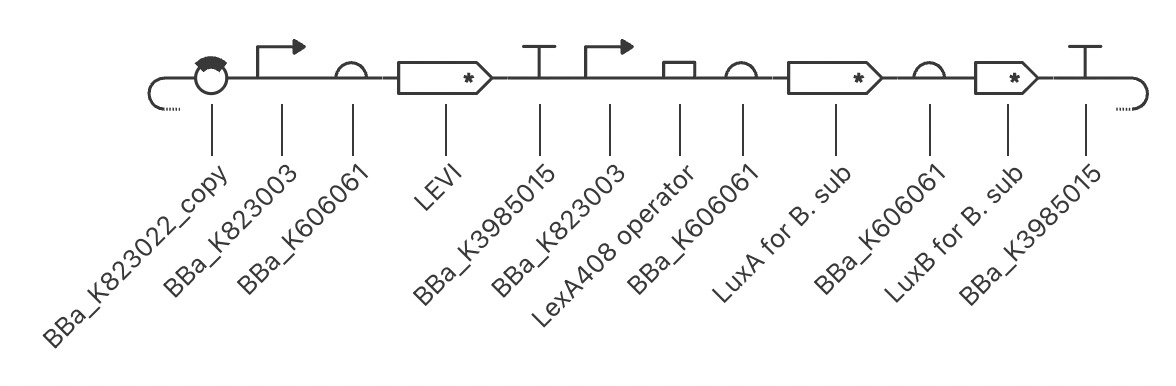
Deliverable for this part: your assembled construct in Kernel, plus an exported schematic of it in your write-up, with a brief description of the design.
This construct has two cassettes: one constitutively expressing LEVI, and one expressing Luciferase as long as LEVI does not bind to the LexA408 operator. LEVI is a light sensitive protein that binds to the LexA408 operator in the presence of blue light. All parts have been codon-optimized for B. subtilis or are native to B. subtilis.
Part 4: Optimize and quality-check
Use Kernel’s design tools on your coding sequence and construct, and interpret the results rather than just running them.
Codon-optimize your CDS for your chosen host. Compare before and after: what changed, and why does codon usage matter for expression in this organism? Note any constraints you applied (e.g. avoiding certain restriction sites, GC content).
Parts were already codon optimized for B. subtilis, because it was easier to find the amino acid sequence than the nucleotide sequence, so I codon optimized when reverse translating the sequences. Codon optimization changes the 3rd amino acid in codons to match the more prevalent tRNAs in the host species. I did not apply any constraints about cut sites, GC content, etc.
Search your sequence (BLAST / sequence search) against known sequences. Is your CDS what you think it is? Is it identical to a natural gene, or novel? What is the closest match?
LuxA: 78% identity with “Vibrio fischeri genes luxA and luxB for luciferase alpha and beta subunits.” Makes sense since codon optimization at most would change every 3rd base, and this is more than 67% identity.
LuxB: 77% identity with “Vibrio fischeri strain emors.9.1 alpha subunit luciferase (luxA) gene, partial cds; and beta subunit luciferase (luxB) gene, complete cds”. Makes sense for the same reason as above.
LEVI: 63% identity to synthetic constructs/other proteins containing the photosensitive VVD from N. crassa. Surprisingly, I’m not seeing anything about LexA in the results. This could be because this protein only contains the DNA binding domain of LexA, so the query coverage would be fairly small. Upon further investigation, LEVI does align to LexA in various species of bacteria if I click into the genome it aligns to and look at the specific region of alignment. This alignment has 79% identity.
Run the safety screen on your construct. Summarize what it checks for and what it reports. If it flags something, explain whether it is expected for your design and how you would respond.
No flags were detected, which is expected since B. subtilis is non-pathogenic, and none of the proteins in the construct are toxic.
Part 5: From design to build
How would you build it? Would you order it as synthetic DNA, assemble it from smaller fragments (e.g. Gibson assembly), or build it from a pool of oligos synthesized on a chip? Justify your choice given your construct’s length and complexity.
Given that the entire construct is ~8 kb, I would not be able to order it directly. I could order the backbone, then order the other parts in pieces, then Gibson assembly everything together (Gibson et al. 2009. I likely wouldn’t order each part separately, as some parts are fairly short, so depending on what Twist can synthesize, I might order the LEVI cassette as one fragment and the luciferase cassette as another.
What does synthesis constrain? Synthesis has error rates and struggles with certain sequences. Does your design contain anything hard to synthesize? How would error correction or fragment-based assembly change your approach?
Synthesis is constrained by error rates. Especially parts with repeats are difficult to synthesize. Checking with Twist, both fragments (the LEVI and Luciferase cassettes) are standard complexity. Twist is able to synthesize them, so I could use the above approach.
Although there are ways to minimize error rates to synthesize fragments longer than a few kb, such as 2.5 megabases by amplifying DNA from high fidelity microchips (Kosuri et al. 2010), this is unnecessary for my particular construct.
Prototype vs. scale. Mirroring HW1: the way you’d build one construct to test your idea may differ from how you’d produce DNA at the scale your product needs. Briefly describe both if they differ.
To test my idea, I’d carry out the assembly manually, while if I were scaling up, I would program the Opentrons to do it for me multiple times.
Part 6: What don’t you know yet?
As in Homework #1, close by naming the edges of your design. Identify the 2–3 biggest unknowns or risks in your construct. For example: Will the promoter give the right expression level? Will the protein fold and be active in this host? Will it be secreted? Is codon optimization enough, or do you need to tune it empirically?
For each, state how you would find out: the measurement, experiment, or design variant you would try next. A good answer here shows you know which decisions are still bets.
Speed of response to darkness: how quickly would Luciferase be expressed once the environment is dark?
Test this by taking measurements of luminescence at certain time points after darkness has been applied. To adjust this, I could adjust the strength of the promoter for luciferase or engineer LEVI to have a smaller binding affinity for the LexA operon so that it dissociates faster, although that risks leakiness when the environment is bright.
Light threshold for shutting off expression of Luciferase
Measure luminescence at different intensities of environmental light.
Why does the concentration of potassium glutamate and magnesium glutamate differ between compositions? Which is more sensitive?
Potassium and magnesium serve different roles in cells, and magnesium is prone to binding things like ATP, ADP, GDP, DNA, RNA, etc. This means that other components in the CFPS composition change the effective concentration of magnesium. Overall, magnesium is more sensitive, as it has a narrower optimal concentration.
Explain how a PEP+NTP reaction formulation is different from a Ribose+NMP reaction formulation.
A ribose+NMP formulation relies more on the metabolism of the lysate to regenerate ATP from ribose and to create NTPs from NMPs. A PEP+NTP formulation relies less on the lysate’s metabolism, providing “external” energy in the form of PEP.
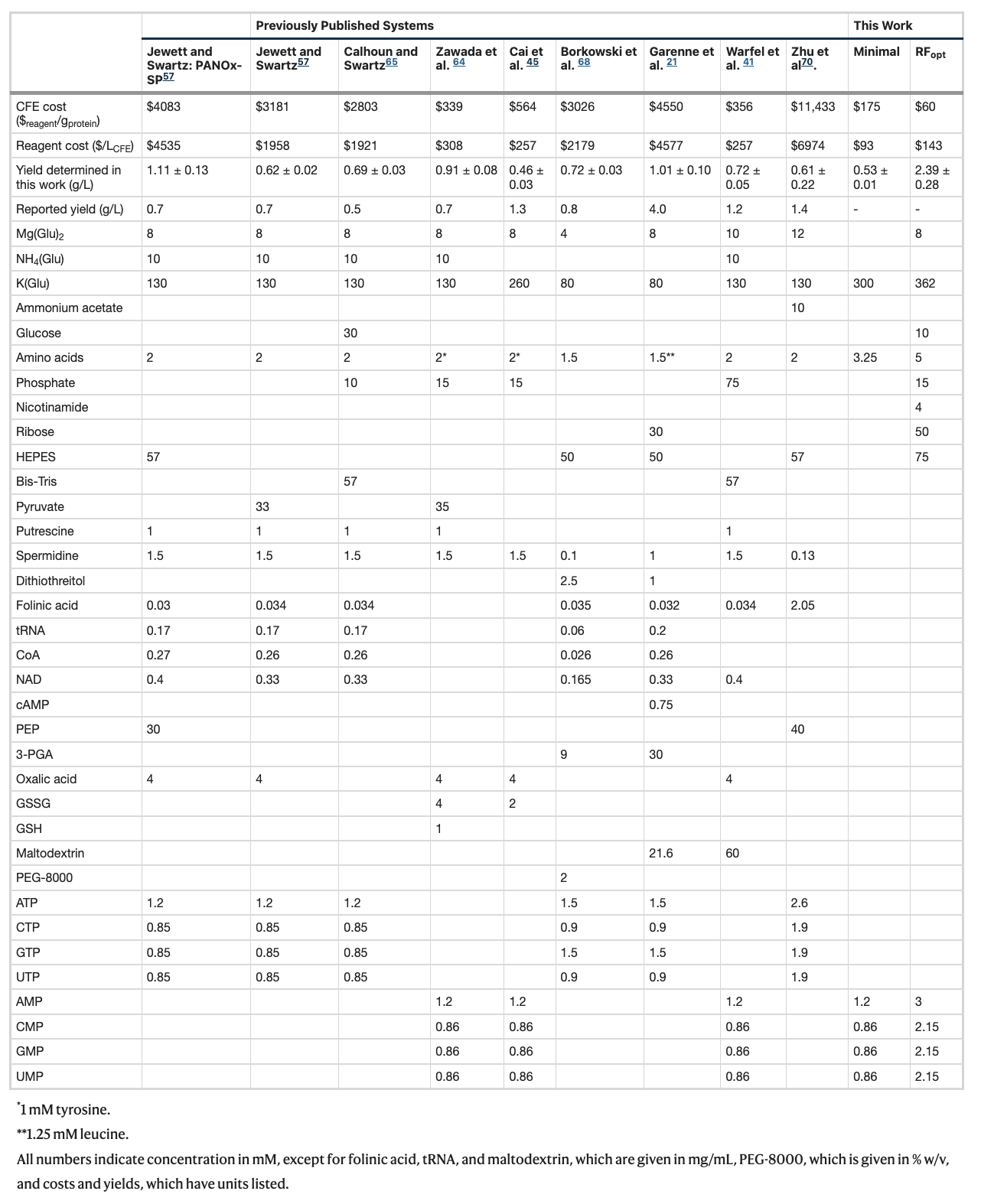
Choose two cell-free reaction compositions from the literature, compare and contrast the choice of reagents and the concentration of reagents. Note: A recommended starting point would be to review a least one published formulation, such as PANOx-SP (Jewett & Swartz 2004), a cost-optimized formulation from Olsen et al. (2026), and/or an AI-designed formulation from Smith et al. (2026).
Comparing CFPS for immunoglobin synthesis (Cai et al., 2015) vs AI-designed CFPS system (Zhu et al, 2025) because they have similar yields but are very different prices
Cai et al use glutamate as the sole energy source, having it feed into the TCA cycle while the AI-designed CFPS system uses PEP as an energy source
Cai et al use NMPs while the AI-designed system uses NTPs
Also, the AI-designed system uses double the concentration of nucleotides
Cai et al use a lot more spermidine than the AI-designed system
Cai et al use oxalic acid, while the AI-designed system does not
Oxalic acid helps prevent unnecessary ATP use
DESIGN ONE REACTION COMPOSITION FOR EACH OF THE THREE PROTEINS (40 minutes)
Sign in to coopetition.htgaa.org and publish your first unique 20 µL CFPS reaction composition for each of the following (don’t worry, you can resubmit later): sfGFP PETase Reteplase
For each composition, specify the reagents you would adjust from the relevant categories, including salts, energy sources, building blocks, cofactors, and redox components.
As a HTBAA research team, we will have the opportunity to suggest new reagents to add to the cell-free reagent inventory. Contribute (or upvote) at least one reagent to the “Community Reagents” section of the website and provide a short rationale. Include in your homework documentation how you decided on that specific reagent and provide links to any relevant research.
Visit the cfps-coopetition forum page to ensure you will be able to take part in the discussion. Bonus: send a note in the channel about a CFPS optimization idea that you have! If you would like clarification on aspects of the project, please message in this dedicated channel.
sfGFP: based composition off of Cai et al, but did not include GSSG since sfGFP doesn’t have disulfide bonds
PETase: added GSSG to the composition for sfGFP, since GSSG will allow for redox reactions to occur and for disulfide bonds to form
Reteplase: added a small amount of DsbC to help disulfide bonds form correctly